The US's Three Moves Against Iran: A Breakdown of the Trading Logic for Oil and Gold
2026-05-12 15:30:28
Currently, the situation between the US and Iran is at what appears to be an extremely dangerous "freezing point," and the figures on paper are indeed not optimistic.
President Trump, speaking directly in the Oval Office, dismissed Iran’s latest peace proposal as “a pile of garbage.”
Despite Iran's offer to lift the maritime blockade and ease sanctions in exchange for partial control of the Strait of Hormuz, Trump insisted it was a meaningless document that "could have been prepared in less than 10 minutes."
With Sunday's negotiations stalled, the prospect of a ceasefire between the US and Iran has become increasingly fragile, and the situation in the Middle East has officially shifted from a diplomatic tug-of-war to a "quasi-war" state.
However, my view remains clear: the ultimate goal is dialogue. Even if there is a turning point in the future, it won't be now. Currently, the US is still trying its best to find Iran's weaknesses. The recent blockade of Iranian oil tankers has given the US some benefits, so the US is repeating this logic.
After diplomacy reached a deadlock, Trump quickly assembled his "strongest hawk team," including Vice President Vance, Secretary of State Rubio, and Secretary of Defense Hergese.
The core agenda of Monday's national security meeting was very clear: to discuss the next steps in military action against Iran.
The US military has identified 25% of key targets within Iran and is preparing to launch supplementary strikes. Simultaneously, the US has deployed a series of measures in an attempt to undermine Iran's foundations by severing its "radiation chains":
Meanwhile, the U.S. State Department offered a $15 million reward to target the financial networks of the Iranian Revolutionary Guard in an attempt to uncover the chain of Iranian proxies: in places like Yemen, the U.S. is trying to cut off Iran's supply lines to proxies such as the Houthis, attempting to remove Iran's "tentacles" in the Middle East and force Tehran, which has lost its external shield, back to the negotiating table.
Even without directly dismantling these proxies, Iran would be pressured to complete peace talks by threatening to dismantle them.
In response to the near-shutdown of shipping in the Strait of Hormuz, the U.S. Navy is no longer deploying alone, but has begun to seek possible military assistance.
As US destroyers engaged in direct combat with Iran, the British Royal Navy's HMS Dragon and French naval forces also began to assemble in the area.
This international coalition posture is intended to send a signal to Iran: if diplomatic means fail, the US, UK, France, and Israel will not hesitate to use "physical clearing" to forcibly cut off this global energy lifeline.
Despite the United States’ overwhelming military superiority, the backlash from the energy market is putting immense pressure on the Trump administration.
Forced to "put out the fire": International oil prices have stabilized above $105 due to Iran's retaliatory blockade of the Strait.
In an effort to quell public discontent over high oil prices, the U.S. Department of Energy was forced to implement a plan to release 53.3 million barrels of strategic petroleum reserves (SPR), and in conjunction with the International Energy Agency, launched the largest joint release of reserves in history.
This is a typical "self-destructive" process.
The United States has released a total of 172 million barrels of crude oil, bringing its strategic reserves to their lowest level in more than 40 years.
Although it appears to be "lending" crude oil to giants like Trafigura and ExxonMobil at high prices, this "cutting losses to ease the pain" move makes the United States' energy security margin extremely fragile.
Once reserves are depleted and the strait remains unopened, the United States will lose its last economic buffer.
Currently, Trump is trying every means to end the war, and the use of force and deterrence is incessant. This can be seen from the fact that he brought half of the White House and the military command system with him during his visit to China. He is flexing his muscles in the Strait of Hormuz by remotely commanding naval deployments and allies, while trying to find a network of proxies in Iran, seize Iran's weaknesses to increase his bargaining chips, and release valuable strategic reserves to offset the impact of high inflation.
The probability of a final showdown, or even a full-scale war, remains low; otherwise, the United States might have already taken action. Therefore, the market is still inclined to bet on peace talks, with the United States gaining more leverage and ultimately forcing the US and Iran to sign an agreement.
Meanwhile, as mentioned in previous articles, the market is likely to treat this geopolitical negative as a case of "the worst is over," meaning that after oil prices break through, gold and equity assets will fall. At this point, bargain hunters will rush in to bet that the US and Iran will continue to negotiate, resulting in a phenomenon where oil prices rise and then fall, while risk assets fall and then rebound after optimistic funds intervene.
From a technical perspective, Brent crude oil prices are currently consolidating near the important 0.786 Fibonacci retracement level and the 5-day moving average support. If the situation deteriorates significantly, oil prices could break through the 106.43 level in an instant.
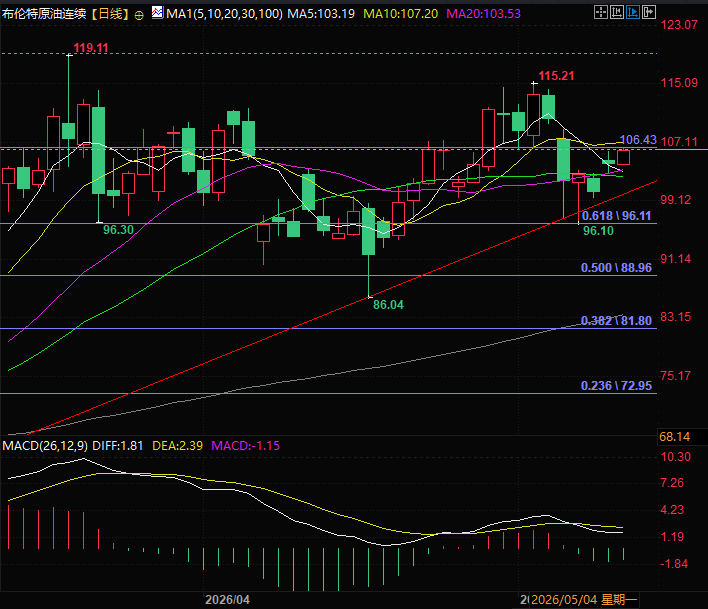
(Brent crude oil futures daily chart, source: EasyForex)
At 15:26 Beijing time, Brent crude oil futures contracts were trading at $106.22 per barrel.
President Trump, speaking directly in the Oval Office, dismissed Iran’s latest peace proposal as “a pile of garbage.”
Despite Iran's offer to lift the maritime blockade and ease sanctions in exchange for partial control of the Strait of Hormuz, Trump insisted it was a meaningless document that "could have been prepared in less than 10 minutes."
With Sunday's negotiations stalled, the prospect of a ceasefire between the US and Iran has become increasingly fragile, and the situation in the Middle East has officially shifted from a diplomatic tug-of-war to a "quasi-war" state.
However, my view remains clear: the ultimate goal is dialogue. Even if there is a turning point in the future, it won't be now. Currently, the US is still trying its best to find Iran's weaknesses. The recent blockade of Iranian oil tankers has given the US some benefits, so the US is repeating this logic.
Searching for the Achilles' heel: Military conferences and proxy strangulation
After diplomacy reached a deadlock, Trump quickly assembled his "strongest hawk team," including Vice President Vance, Secretary of State Rubio, and Secretary of Defense Hergese.
The core agenda of Monday's national security meeting was very clear: to discuss the next steps in military action against Iran.
The US military has identified 25% of key targets within Iran and is preparing to launch supplementary strikes. Simultaneously, the US has deployed a series of measures in an attempt to undermine Iran's foundations by severing its "radiation chains":
Meanwhile, the U.S. State Department offered a $15 million reward to target the financial networks of the Iranian Revolutionary Guard in an attempt to uncover the chain of Iranian proxies: in places like Yemen, the U.S. is trying to cut off Iran's supply lines to proxies such as the Houthis, attempting to remove Iran's "tentacles" in the Middle East and force Tehran, which has lost its external shield, back to the negotiating table.
Even without directly dismantling these proxies, Iran would be pressured to complete peace talks by threatening to dismantle them.
Coalition forces pressuring the border: the deterrent effect of forcibly "clearing the way with physical force"
In response to the near-shutdown of shipping in the Strait of Hormuz, the U.S. Navy is no longer deploying alone, but has begun to seek possible military assistance.
As US destroyers engaged in direct combat with Iran, the British Royal Navy's HMS Dragon and French naval forces also began to assemble in the area.
This international coalition posture is intended to send a signal to Iran: if diplomatic means fail, the US, UK, France, and Israel will not hesitate to use "physical clearing" to forcibly cut off this global energy lifeline.
Hurting the enemy by a thousand while suffering eight hundred of its own: The "bloody loss" dilemma of the US strategic reserves.
Despite the United States’ overwhelming military superiority, the backlash from the energy market is putting immense pressure on the Trump administration.
Forced to "put out the fire": International oil prices have stabilized above $105 due to Iran's retaliatory blockade of the Strait.
In an effort to quell public discontent over high oil prices, the U.S. Department of Energy was forced to implement a plan to release 53.3 million barrels of strategic petroleum reserves (SPR), and in conjunction with the International Energy Agency, launched the largest joint release of reserves in history.
This is a typical "self-destructive" process.
The United States has released a total of 172 million barrels of crude oil, bringing its strategic reserves to their lowest level in more than 40 years.
Although it appears to be "lending" crude oil to giants like Trafigura and ExxonMobil at high prices, this "cutting losses to ease the pain" move makes the United States' energy security margin extremely fragile.
Once reserves are depleted and the strait remains unopened, the United States will lose its last economic buffer.
Summary and Technical Analysis:
Currently, Trump is trying every means to end the war, and the use of force and deterrence is incessant. This can be seen from the fact that he brought half of the White House and the military command system with him during his visit to China. He is flexing his muscles in the Strait of Hormuz by remotely commanding naval deployments and allies, while trying to find a network of proxies in Iran, seize Iran's weaknesses to increase his bargaining chips, and release valuable strategic reserves to offset the impact of high inflation.
The probability of a final showdown, or even a full-scale war, remains low; otherwise, the United States might have already taken action. Therefore, the market is still inclined to bet on peace talks, with the United States gaining more leverage and ultimately forcing the US and Iran to sign an agreement.
Meanwhile, as mentioned in previous articles, the market is likely to treat this geopolitical negative as a case of "the worst is over," meaning that after oil prices break through, gold and equity assets will fall. At this point, bargain hunters will rush in to bet that the US and Iran will continue to negotiate, resulting in a phenomenon where oil prices rise and then fall, while risk assets fall and then rebound after optimistic funds intervene.
From a technical perspective, Brent crude oil prices are currently consolidating near the important 0.786 Fibonacci retracement level and the 5-day moving average support. If the situation deteriorates significantly, oil prices could break through the 106.43 level in an instant.
(Brent crude oil futures daily chart, source: EasyForex)
At 15:26 Beijing time, Brent crude oil futures contracts were trading at $106.22 per barrel.
- Risk Warning and Disclaimer
- The market involves risk, and trading may not be suitable for all investors. This article is for reference only and does not constitute personal investment advice, nor does it take into account certain users’ specific investment objectives, financial situation, or other needs. Any investment decisions made based on this information are at your own risk.