The pound fell back to the lower end of its trading range against the dollar, awaiting the release of UK GDP data.
2026-05-14 14:43:30
The British pound (GBP/USD) remained stable in Asian trading on Thursday, trading around 1.3520, temporarily halting its decline after three consecutive days of losses. The market is currently focused on the upcoming release of the UK's preliminary Q1 2026 GDP figures, as well as industrial and manufacturing output data, hoping to gain further insight into the UK's economic growth momentum and the Bank of England's subsequent policy path.
Despite a short-term stabilization in the pound, the US dollar remains generally strong. Amid rising risk aversion, the market awaits the release of US April retail sales data later in the day to assess US consumer demand and economic resilience. Meanwhile, geopolitical tensions remain a crucial variable that the market cannot ignore. The ongoing conflict with Iran has led the US to further intensify pressure on Tehran, imposing new sanctions on entities involved in exporting Iranian crude oil to major Asian countries and issuing warnings to financial institutions facilitating these transactions.
Market concerns that escalating tensions in the Middle East could further drive up global energy prices and intensify global inflationary pressures have kept the US dollar a safe-haven asset in the short term, while also significantly increasing volatility in the global foreign exchange market.
Meanwhile, the latest inflation data released in the United States further strengthened market expectations that the Federal Reserve will maintain high interest rates. Data released by the U.S. Bureau of Labor Statistics showed that the U.S. Producer Price Index (PPI) rose sharply to 6.0% year-on-year in April, not only higher than 4.3% in March, but also significantly exceeding market expectations of 4.9%, reaching the highest level since the end of 2022.
On a monthly basis, the US PPI rose 1.4% in April, far exceeding the previous value of 0.7% and significantly higher than the market forecast of 0.5%. US wholesale inflation hit a near three-year high, indicating renewed inflationary pressures in the US. Following the data release, US Treasury yields and the US dollar index rose in tandem, with the market significantly reducing its bets on a Federal Reserve rate cut this year.
Amid expectations of continued high interest rates, the US dollar received support from capital inflows, while the pound sterling was somewhat pressured. However, some investors remain cautiously optimistic about the UK economy. The market currently expects UK first-quarter GDP data to show moderate growth. If UK manufacturing and industrial production data perform better than expected, it could alleviate market concerns about a UK economic slowdown, thus providing some support for the pound sterling.
UK economic data will directly influence market expectations regarding the Bank of England's future interest rate policy. If the economy shows stronger resilience than the market anticipates, the Bank of England may extend the period of high interest rates, which would be beneficial for the stability of the pound.
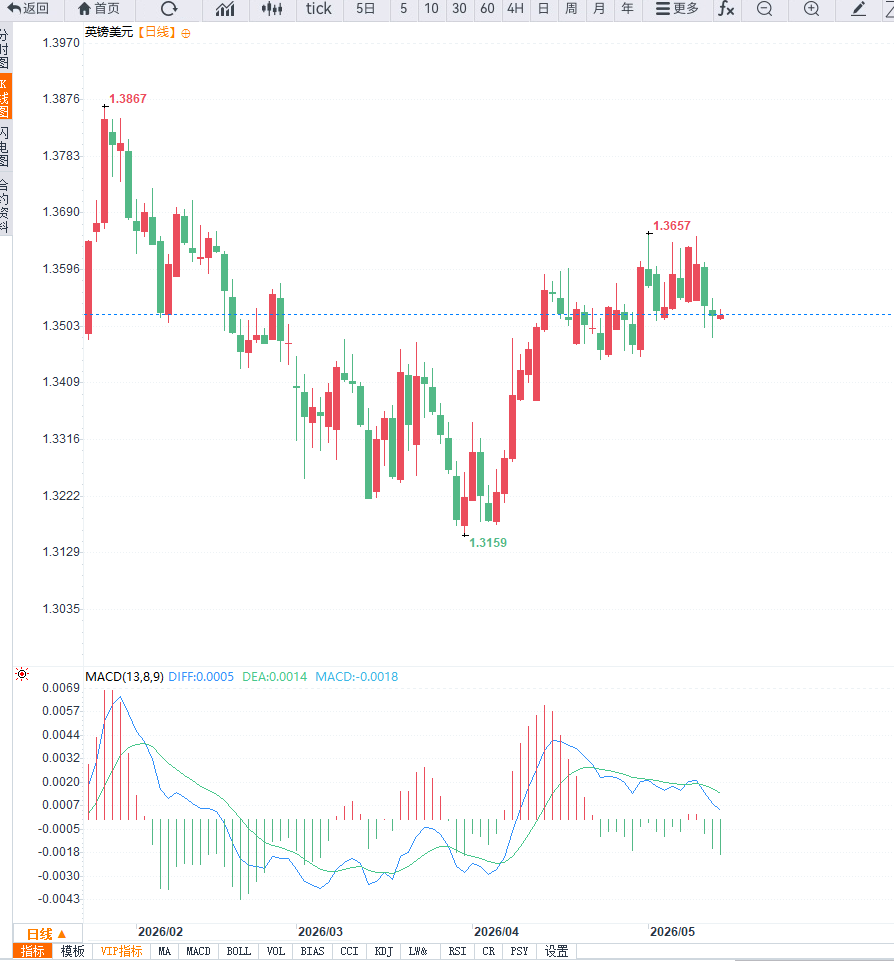
From a technical perspective, the GBP/USD pair remains in a high-level consolidation pattern on the daily chart, but the overall upward momentum has slowed. The exchange rate has repeatedly attempted to break through the key resistance area of 1.3600 without success, indicating that selling pressure remains significant. Currently, the area around 1.3480 forms important short-term support. A break below this area could lead to a further pullback to the 1.3420 area. The first key resistance level is at 1.3560, followed by the psychological level of 1.3600.
The 4-hour chart shows that GBP/USD is still trending sideways in the short term. The MACD indicator is hovering around the zero line, indicating that the market's short-term direction is still unclear; the RSI indicator is gradually falling back to around 50, suggesting that the previous overbought pressure is easing. The Bollinger Bands are starting to narrow, meaning that the market may be waiting for new direction from UK GDP and US retail sales data.
If UK GDP data is better than market expectations, while US consumption data shows signs of slowing, the pound/dollar pair may retest the area above 1.3600; conversely, if US economic data continues to be strong, the dollar may strengthen further, thus pushing GBP/USD back down to the support level near 1.3450.
Editor's Summary : The current GBP/USD exchange rate is influenced by three factors: Federal Reserve policy expectations, UK economic data, and global geopolitical risks. Resurgence in US inflation is causing the market to reassess the prospect of interest rate cuts, pushing the dollar strong. The resilience of the UK economy will be key to the pound's short-term performance. In the short term, GBP/USD may maintain a range-bound trading pattern, but its future direction will still depend on UK GDP data and whether US economic data continues to reinforce expectations of high interest rates. For the market, the divergence in policy paths between the Bank of England and the Federal Reserve in the coming weeks will be a crucial factor determining the pound's medium- to long-term trend.
Despite a short-term stabilization in the pound, the US dollar remains generally strong. Amid rising risk aversion, the market awaits the release of US April retail sales data later in the day to assess US consumer demand and economic resilience. Meanwhile, geopolitical tensions remain a crucial variable that the market cannot ignore. The ongoing conflict with Iran has led the US to further intensify pressure on Tehran, imposing new sanctions on entities involved in exporting Iranian crude oil to major Asian countries and issuing warnings to financial institutions facilitating these transactions.
Market concerns that escalating tensions in the Middle East could further drive up global energy prices and intensify global inflationary pressures have kept the US dollar a safe-haven asset in the short term, while also significantly increasing volatility in the global foreign exchange market.
Meanwhile, the latest inflation data released in the United States further strengthened market expectations that the Federal Reserve will maintain high interest rates. Data released by the U.S. Bureau of Labor Statistics showed that the U.S. Producer Price Index (PPI) rose sharply to 6.0% year-on-year in April, not only higher than 4.3% in March, but also significantly exceeding market expectations of 4.9%, reaching the highest level since the end of 2022.
On a monthly basis, the US PPI rose 1.4% in April, far exceeding the previous value of 0.7% and significantly higher than the market forecast of 0.5%. US wholesale inflation hit a near three-year high, indicating renewed inflationary pressures in the US. Following the data release, US Treasury yields and the US dollar index rose in tandem, with the market significantly reducing its bets on a Federal Reserve rate cut this year.
Amid expectations of continued high interest rates, the US dollar received support from capital inflows, while the pound sterling was somewhat pressured. However, some investors remain cautiously optimistic about the UK economy. The market currently expects UK first-quarter GDP data to show moderate growth. If UK manufacturing and industrial production data perform better than expected, it could alleviate market concerns about a UK economic slowdown, thus providing some support for the pound sterling.
UK economic data will directly influence market expectations regarding the Bank of England's future interest rate policy. If the economy shows stronger resilience than the market anticipates, the Bank of England may extend the period of high interest rates, which would be beneficial for the stability of the pound.
From a technical perspective, the GBP/USD pair remains in a high-level consolidation pattern on the daily chart, but the overall upward momentum has slowed. The exchange rate has repeatedly attempted to break through the key resistance area of 1.3600 without success, indicating that selling pressure remains significant. Currently, the area around 1.3480 forms important short-term support. A break below this area could lead to a further pullback to the 1.3420 area. The first key resistance level is at 1.3560, followed by the psychological level of 1.3600.
The 4-hour chart shows that GBP/USD is still trending sideways in the short term. The MACD indicator is hovering around the zero line, indicating that the market's short-term direction is still unclear; the RSI indicator is gradually falling back to around 50, suggesting that the previous overbought pressure is easing. The Bollinger Bands are starting to narrow, meaning that the market may be waiting for new direction from UK GDP and US retail sales data.
If UK GDP data is better than market expectations, while US consumption data shows signs of slowing, the pound/dollar pair may retest the area above 1.3600; conversely, if US economic data continues to be strong, the dollar may strengthen further, thus pushing GBP/USD back down to the support level near 1.3450.
Editor's Summary : The current GBP/USD exchange rate is influenced by three factors: Federal Reserve policy expectations, UK economic data, and global geopolitical risks. Resurgence in US inflation is causing the market to reassess the prospect of interest rate cuts, pushing the dollar strong. The resilience of the UK economy will be key to the pound's short-term performance. In the short term, GBP/USD may maintain a range-bound trading pattern, but its future direction will still depend on UK GDP data and whether US economic data continues to reinforce expectations of high interest rates. For the market, the divergence in policy paths between the Bank of England and the Federal Reserve in the coming weeks will be a crucial factor determining the pound's medium- to long-term trend.
- Risk Warning and Disclaimer
- The market involves risk, and trading may not be suitable for all investors. This article is for reference only and does not constitute personal investment advice, nor does it take into account certain users’ specific investment objectives, financial situation, or other needs. Any investment decisions made based on this information are at your own risk.