Silver prices ended a six-day winning streak and fell back to around $87. Is a correction about to begin?
2026-05-14 14:39:25
Spot silver (XAG/USD) retreated during Thursday's Asian trading session, falling to around $87.30 per ounce, ending a six-day winning streak. Market risk appetite cooled somewhat as investors awaited important talks between the US and major Asian powers, while also focusing on the release of US April retail sales data later in the day, hoping to find the latest clues about the US economy and consumer momentum.
Global geopolitical tensions remain high. The ongoing escalation of the conflict with Iran, coupled with recent intensified US pressure on Tehran, including new sanctions against entities involved in exporting Iranian crude oil to Asian countries and warnings to financial institutions facilitating such transactions, keeps the energy and precious metals markets highly sensitive.
One of the core issues currently of greatest concern to the market is whether the situation in the Middle East will further impact the stability of the global energy supply chain. If the situation continues to escalate, safe-haven funds may flow back into the gold and silver markets, thereby limiting the downside potential for silver prices.
Meanwhile, India announced an increase in import taxes on gold and silver, which also put short-term pressure on the silver market. The Indian government raised the import tax on gold and silver from 6% to 15%, including a 10% basic tariff and a 5% infrastructure surcharge. The policy aims to stabilize the Indian rupee exchange rate and control capital outflows.
As one of the world's largest consumers of precious metals, India's significant increase in import taxes may temporarily suppress physical silver demand. Market concerns suggest that high import costs could lead to a slowdown in jewelry, silver ornaments, and some investment demand, thus putting short-term downward pressure on silver prices.
However, in the medium to long term, industrial demand remains a key driver supporting the price of silver. With the continued expansion of the global new energy industry, demand for silver from solar panels, electronic products, and new energy vehicles continues to increase. Especially in the photovoltaic industry, silver remains one of the most important conductive materials.
Market estimates indicate that the global photovoltaic industry's demand for silver is steadily increasing, and the demand for new energy is gradually changing silver's traditional safe-haven properties. This means that silver is now simultaneously possessing the characteristics of both a precious metal and an industrial metal.
On the other hand, changes in expectations regarding the Federal Reserve's monetary policy are also a significant reason for the recent decline in silver prices. Previously released US Consumer Price Index (CPI) and Producer Price Index (PPI) both exceeded market expectations, indicating that US inflation remains resilient.
Against this backdrop, the market is gradually reducing its bets on a Federal Reserve rate cut this year. US Treasury yields remain high, supporting the dollar index, while non-yielding silver is under some pressure.
The market has significantly reduced its expectations for the number of interest rate cuts in 2026, and the high-interest-rate environment may persist for a longer period. This has led some silver bulls who had previously accumulated substantial gains to take profits.
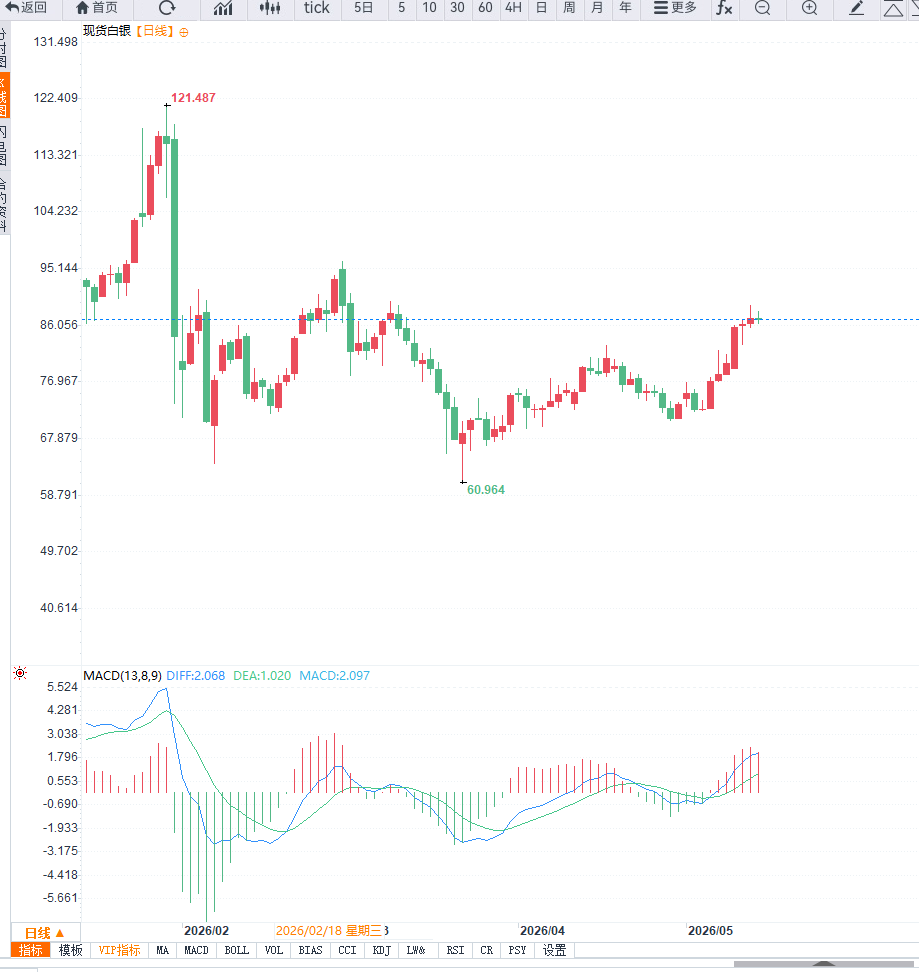
From a technical perspective, silver maintains its medium-to-long-term upward structure on the daily chart, but short-term upward momentum is weakening. After breaking through key resistance levels of $85 and $86, silver prices quickly approached the $88 area, but there are clear signs of profit-taking at current highs. If it fails to regain a foothold above $88, the market may further test the support area around $86, with a more crucial support level around $84.80. Resistance is concentrated at $88.50 and the psychological level of $90.
The 4-hour chart shows that short-term technical indicators for silver are beginning to cool. The MACD indicator shows increasing signs of a bearish crossover at high levels, and the RSI indicator has also fallen back from the overbought zone, indicating that short-term bullish momentum has weakened. However, the Bollinger Band's middle line is still trending upwards, suggesting that the overall trend has not completely turned bearish. If US retail sales data is weaker than expected, the market may re-bet on the Fed's easing expectations, thereby driving a rebound in silver prices.
Editor's Summary : The silver market is currently in a phase of intertwined factors. On the one hand, the resilience of US inflation is causing the market to reassess the prospect of Fed rate cuts, and the high-interest-rate environment is significantly suppressing silver prices. On the other hand, tensions in the Middle East and the expansion of demand from the new energy industry continue to support silver prices. In the short term, silver prices may maintain a high-level consolidation pattern, with the market focusing on US economic data, the Fed's policy path, and changes in the global geopolitical situation. In the medium to long term, the continued growth in demand for silver from the new energy industry is likely to remain a key driver of silver prices.
Global geopolitical tensions remain high. The ongoing escalation of the conflict with Iran, coupled with recent intensified US pressure on Tehran, including new sanctions against entities involved in exporting Iranian crude oil to Asian countries and warnings to financial institutions facilitating such transactions, keeps the energy and precious metals markets highly sensitive.
One of the core issues currently of greatest concern to the market is whether the situation in the Middle East will further impact the stability of the global energy supply chain. If the situation continues to escalate, safe-haven funds may flow back into the gold and silver markets, thereby limiting the downside potential for silver prices.
Meanwhile, India announced an increase in import taxes on gold and silver, which also put short-term pressure on the silver market. The Indian government raised the import tax on gold and silver from 6% to 15%, including a 10% basic tariff and a 5% infrastructure surcharge. The policy aims to stabilize the Indian rupee exchange rate and control capital outflows.
As one of the world's largest consumers of precious metals, India's significant increase in import taxes may temporarily suppress physical silver demand. Market concerns suggest that high import costs could lead to a slowdown in jewelry, silver ornaments, and some investment demand, thus putting short-term downward pressure on silver prices.
However, in the medium to long term, industrial demand remains a key driver supporting the price of silver. With the continued expansion of the global new energy industry, demand for silver from solar panels, electronic products, and new energy vehicles continues to increase. Especially in the photovoltaic industry, silver remains one of the most important conductive materials.
Market estimates indicate that the global photovoltaic industry's demand for silver is steadily increasing, and the demand for new energy is gradually changing silver's traditional safe-haven properties. This means that silver is now simultaneously possessing the characteristics of both a precious metal and an industrial metal.
On the other hand, changes in expectations regarding the Federal Reserve's monetary policy are also a significant reason for the recent decline in silver prices. Previously released US Consumer Price Index (CPI) and Producer Price Index (PPI) both exceeded market expectations, indicating that US inflation remains resilient.
Against this backdrop, the market is gradually reducing its bets on a Federal Reserve rate cut this year. US Treasury yields remain high, supporting the dollar index, while non-yielding silver is under some pressure.
The market has significantly reduced its expectations for the number of interest rate cuts in 2026, and the high-interest-rate environment may persist for a longer period. This has led some silver bulls who had previously accumulated substantial gains to take profits.
From a technical perspective, silver maintains its medium-to-long-term upward structure on the daily chart, but short-term upward momentum is weakening. After breaking through key resistance levels of $85 and $86, silver prices quickly approached the $88 area, but there are clear signs of profit-taking at current highs. If it fails to regain a foothold above $88, the market may further test the support area around $86, with a more crucial support level around $84.80. Resistance is concentrated at $88.50 and the psychological level of $90.
The 4-hour chart shows that short-term technical indicators for silver are beginning to cool. The MACD indicator shows increasing signs of a bearish crossover at high levels, and the RSI indicator has also fallen back from the overbought zone, indicating that short-term bullish momentum has weakened. However, the Bollinger Band's middle line is still trending upwards, suggesting that the overall trend has not completely turned bearish. If US retail sales data is weaker than expected, the market may re-bet on the Fed's easing expectations, thereby driving a rebound in silver prices.
Editor's Summary : The silver market is currently in a phase of intertwined factors. On the one hand, the resilience of US inflation is causing the market to reassess the prospect of Fed rate cuts, and the high-interest-rate environment is significantly suppressing silver prices. On the other hand, tensions in the Middle East and the expansion of demand from the new energy industry continue to support silver prices. In the short term, silver prices may maintain a high-level consolidation pattern, with the market focusing on US economic data, the Fed's policy path, and changes in the global geopolitical situation. In the medium to long term, the continued growth in demand for silver from the new energy industry is likely to remain a key driver of silver prices.
- Risk Warning and Disclaimer
- The market involves risk, and trading may not be suitable for all investors. This article is for reference only and does not constitute personal investment advice, nor does it take into account certain users’ specific investment objectives, financial situation, or other needs. Any investment decisions made based on this information are at your own risk.