Goldman Sachs says South Korean government bond interest rate hikes are overpriced; foreign investors have bought 21 trillion won worth of bonds this year.
2026-05-14 15:23:48
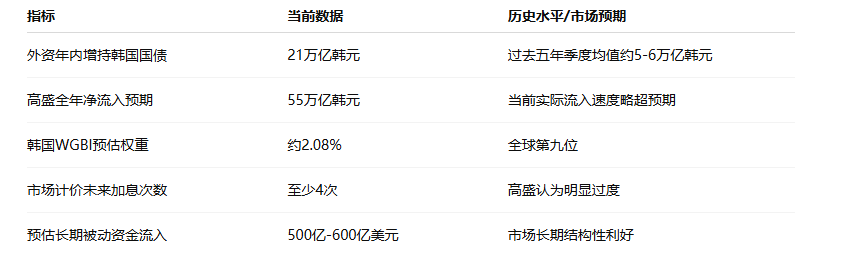
According to APP, Goldman Sachs' latest research indicates that with the temporary easing of global geopolitical tensions and the renewed flow of international capital into Asian fixed-income markets, South Korean government bond yields have room to gradually stabilize. Current market expectations regarding the future monetary policy path of the Bank of Korea are already significantly overly optimistic, with the interest rate market even pricing in the possibility of at least four rate hikes over the next 12 months. Goldman Sachs believes this expectation exceeds the capacity of the South Korean economy to withstand such a scenario.

Recently, the South Korean bond market has become an important window for observing Asian capital flows. Affected by the global high-interest-rate environment, volatile Middle East relations, and the US's long-term tight monetary policy, South Korean government bond yields had previously risen rapidly. However, as global risk aversion has cooled, international funds have begun to increase their holdings of South Korean bond assets again.
Goldman Sachs believes the most significant change in the South Korean government bond market is the inflow of foreign capital, which far exceeds previous market expectations. Data shows that as of April this year, foreign investors have cumulatively increased their holdings of South Korean government bonds by approximately 21 trillion won, equivalent to about US$14 billion. This figure is not only significantly higher than the average quarterly level of 5 trillion to 6 trillion won over the past five years, but also exceeds Goldman Sachs' previous forecast of approximately 55 trillion won in net inflows for the whole year.
Market research indicates that since South Korea was officially included in the FTSE World Government Bond Index (WGBI), international passive funds and long-term allocation funds have been continuously increasing their allocation to the South Korean bond market. South Korea's inclusion in the global government bond index is widely regarded as a long-term structural boon for the South Korean bond market over the next few years.
The FTSE World Government Bond Index is one of the world's leading fixed-income benchmarks, tracked by numerous pension funds, sovereign wealth funds, and ETFs. Market estimates suggest that the South Korean bond market may attract approximately $50 billion to $60 billion in passive inflows over the next few years.
The South Korean bond market is currently experiencing a coexistence of weak domestic demand and sustained foreign capital inflows. Domestic investors have relatively limited interest in long-term government bonds due to rising financing costs for South Korean financial institutions, a slowing real estate market, and declining credit demand. However, Goldman Sachs believes that foreign investment demand is sufficient to partially offset the pressure from weak domestic funding. Especially with the global central bank interest rate hike cycle nearing its end, international capital is reassessing the investment value of Asian high-yield bond markets.
From a macro perspective, the South Korean economy still faces the challenge of slowing export growth and an uneven recovery in consumption. While artificial intelligence is driving the semiconductor industry's prosperity, the global economic slowdown continues to put pressure on South Korea's external demand. Goldman Sachs recently raised its earnings forecast for the South Korean semiconductor industry and predicts that South Korean semiconductor exports will maintain strong growth momentum in the coming year.
However, Goldman Sachs also pointed out that the Bank of Korea may not need to continue taking aggressive interest rate hikes, as the current economic growth momentum in South Korea is not strong enough to support a long-term high-interest-rate environment.
The following is a comparison of some key data in the current South Korean bond market:
From a market perspective, the yield on South Korean 10-year government bonds has recently begun to show signs of fluctuating at high levels. Previously, due to market concerns about rising global energy prices and the risk of imported inflation, the yield on South Korean long-term bonds had surged rapidly.
However, the upward momentum of South Korean government bond yields has weakened significantly recently. It's worth noting that the South Korean bond market is currently influenced not only by interest rate expectations but also by changes in global risk appetite. Previously, escalating tensions in the Middle East triggered synchronized fluctuations in the South Korean stock and bond markets, but recently, with improved global market risk sentiment, foreign capital has flowed back into South Korean assets. Some international investment institutions believe that as a high-beta market in Asia, South Korean asset prices are extremely sensitive to changes in global liquidity and risk appetite.
The future trend of the South Korean government bond market will mainly depend on the global interest rate environment, the Korean won exchange rate, and changes in international capital flows.
Editor's Summary : The South Korean bond market is currently undergoing a critical transition from "high interest rate pressure" to "capital inflow support." Goldman Sachs believes that the market's pricing in South Korea's future interest rate hike path is already significantly hawkish, while South Korea's inclusion in the global government bond index will provide long-term international capital support for the bond market. Although domestic demand in South Korea remains weak, continued foreign investment is improving market liquidity and enhancing the attractiveness of South Korean bond assets. In the future, if major central banks around the world gradually end their tightening cycles, South Korean government bond yields may have room for further stabilization or even decline.
Recently, the South Korean bond market has become an important window for observing Asian capital flows. Affected by the global high-interest-rate environment, volatile Middle East relations, and the US's long-term tight monetary policy, South Korean government bond yields had previously risen rapidly. However, as global risk aversion has cooled, international funds have begun to increase their holdings of South Korean bond assets again.
Goldman Sachs believes the most significant change in the South Korean government bond market is the inflow of foreign capital, which far exceeds previous market expectations. Data shows that as of April this year, foreign investors have cumulatively increased their holdings of South Korean government bonds by approximately 21 trillion won, equivalent to about US$14 billion. This figure is not only significantly higher than the average quarterly level of 5 trillion to 6 trillion won over the past five years, but also exceeds Goldman Sachs' previous forecast of approximately 55 trillion won in net inflows for the whole year.
Market research indicates that since South Korea was officially included in the FTSE World Government Bond Index (WGBI), international passive funds and long-term allocation funds have been continuously increasing their allocation to the South Korean bond market. South Korea's inclusion in the global government bond index is widely regarded as a long-term structural boon for the South Korean bond market over the next few years.
The FTSE World Government Bond Index is one of the world's leading fixed-income benchmarks, tracked by numerous pension funds, sovereign wealth funds, and ETFs. Market estimates suggest that the South Korean bond market may attract approximately $50 billion to $60 billion in passive inflows over the next few years.
The South Korean bond market is currently experiencing a coexistence of weak domestic demand and sustained foreign capital inflows. Domestic investors have relatively limited interest in long-term government bonds due to rising financing costs for South Korean financial institutions, a slowing real estate market, and declining credit demand. However, Goldman Sachs believes that foreign investment demand is sufficient to partially offset the pressure from weak domestic funding. Especially with the global central bank interest rate hike cycle nearing its end, international capital is reassessing the investment value of Asian high-yield bond markets.
From a macro perspective, the South Korean economy still faces the challenge of slowing export growth and an uneven recovery in consumption. While artificial intelligence is driving the semiconductor industry's prosperity, the global economic slowdown continues to put pressure on South Korea's external demand. Goldman Sachs recently raised its earnings forecast for the South Korean semiconductor industry and predicts that South Korean semiconductor exports will maintain strong growth momentum in the coming year.
However, Goldman Sachs also pointed out that the Bank of Korea may not need to continue taking aggressive interest rate hikes, as the current economic growth momentum in South Korea is not strong enough to support a long-term high-interest-rate environment.
The following is a comparison of some key data in the current South Korean bond market:
From a market perspective, the yield on South Korean 10-year government bonds has recently begun to show signs of fluctuating at high levels. Previously, due to market concerns about rising global energy prices and the risk of imported inflation, the yield on South Korean long-term bonds had surged rapidly.
However, the upward momentum of South Korean government bond yields has weakened significantly recently. It's worth noting that the South Korean bond market is currently influenced not only by interest rate expectations but also by changes in global risk appetite. Previously, escalating tensions in the Middle East triggered synchronized fluctuations in the South Korean stock and bond markets, but recently, with improved global market risk sentiment, foreign capital has flowed back into South Korean assets. Some international investment institutions believe that as a high-beta market in Asia, South Korean asset prices are extremely sensitive to changes in global liquidity and risk appetite.
The future trend of the South Korean government bond market will mainly depend on the global interest rate environment, the Korean won exchange rate, and changes in international capital flows.
Editor's Summary : The South Korean bond market is currently undergoing a critical transition from "high interest rate pressure" to "capital inflow support." Goldman Sachs believes that the market's pricing in South Korea's future interest rate hike path is already significantly hawkish, while South Korea's inclusion in the global government bond index will provide long-term international capital support for the bond market. Although domestic demand in South Korea remains weak, continued foreign investment is improving market liquidity and enhancing the attractiveness of South Korean bond assets. In the future, if major central banks around the world gradually end their tightening cycles, South Korean government bond yields may have room for further stabilization or even decline.
- Risk Warning and Disclaimer
- The market involves risk, and trading may not be suitable for all investors. This article is for reference only and does not constitute personal investment advice, nor does it take into account certain users’ specific investment objectives, financial situation, or other needs. Any investment decisions made based on this information are at your own risk.