The surge in US PPI to 6% has raised expectations of an interest rate hike, causing the euro to fall to around 1.17 against the dollar.
2026-05-14 16:38:03
According to APP, the euro/dollar pair remained weak in early Asian and European trading on Thursday, hovering around the 1.1700 level, with a cumulative weekly decline of approximately 0.65%. The market is currently awaiting the outcome of two days of talks between the US and major Asian powers, while also focusing on ECB President Christine Lagarde's speech later in Aachen, Germany, hoping to glean more signals regarding the ECB's future interest rate policy.

The US dollar has recently outperformed non-US currencies. With the ongoing stalemate in the Middle East, global risk aversion has resurfaced, leading to a continued inflow of international funds into the US dollar and US Treasury markets. The core logic behind the dollar's strength this week is gradually shifting from a "rate cut trade" to "expectations of renewed rate hikes."
The latest inflation data released in the United States has further reinforced market concerns about the duration of the high-interest-rate environment. Data shows that the U.S. Producer Price Index (PPI) rose 1.4% month-on-month in April, not only higher than March's 0.7% but also far exceeding market expectations; the year-on-year growth rate rose to 6%, the highest level since December 2023.
Previously, the US Consumer Price Index (CPI) also showed strong performance, indicating that US inflationary pressures had not eased as significantly as the market had previously expected. Rising energy prices and continued resilience in US consumption are prompting the market to reassess the Federal Reserve's future monetary policy path. Particularly against the backdrop of the Middle East situation pushing up international oil prices, the market is concerned that imported inflation may intensify again. The market has begun betting that the Federal Reserve may restart its rate hike cycle by the end of 2026 or even the beginning of 2027.
Data from the CME Group's Fed Watch tool shows that the interest rate futures market now projects a 31% probability of a December rate hike, up from just 22% a week ago. This change has directly driven a broad-based rise in US Treasury yields. The yield on the 10-year US Treasury bond continued to climb this week, attracting further global inflows into dollar assets, thereby further suppressing the euro's performance.
Meanwhile, European markets are also facing renewed inflation. Spain's latest EU Highest Consumer Price Index (HICP) for April rose 3.5% year-on-year, higher than March's 3.4%. The market believes that rising energy prices in the Middle East are gradually transmitting to the European inflation system. This resurgence of inflation in Europe presents the European Central Bank with a more complex policy balancing act.
On the one hand, the Eurozone economy remains weak, with a slow recovery in manufacturing; on the other hand, rising energy prices have significantly slowed the decline in inflation. Therefore, the market is currently paying close attention to Lagarde's speech, hoping to determine whether the ECB will further postpone interest rate cuts or even reconsider the possibility of raising rates. The market currently expects the ECB to take further tightening measures as early as June or July. Some ECB officials have also recently expressed concern that rising energy prices could push up inflation.
The following is a comparison of key data in the current European and American markets:
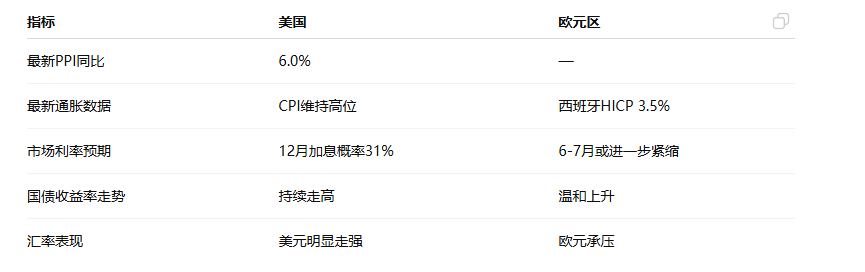
From a market sentiment perspective, the global foreign exchange market has clearly re-entered a "dollar-dominated phase." Previously, the market had bet on the Federal Reserve gradually cutting interest rates, but with US inflation consistently exceeding expectations, the dollar has regained strong support. Safe-haven inflows and expectations of high interest rates are creating a dual bullish structure for the dollar.
From a technical perspective, the EUR/USD pair remains in a range-bound trading pattern on the daily chart, but short-term bearish momentum is clearly dominant. The pair continues to be pressured below the 1.1800 level, indicating significant selling pressure in the market. 1.1700 is currently a key short-term support area for the EUR/USD. A break below the 1.1645-1.1675 support zone could open up further downside potential, potentially retesting the April low near 1.1510. On the upside, the 1.1740 area forms the first short-term resistance level, followed by the top of the three-week trading range at 1.1795, while the April high of 1.1851 represents a significant medium-term resistance. The 4-hour chart shows that the EUR/USD remains bearish in the short term. The MACD indicator continues to trade below the zero line; although bearish momentum has weakened slightly recently, the overall trend has not yet reversed significantly. The RSI indicator remains below the 50 midline, indicating that the market is still dominated by bears.
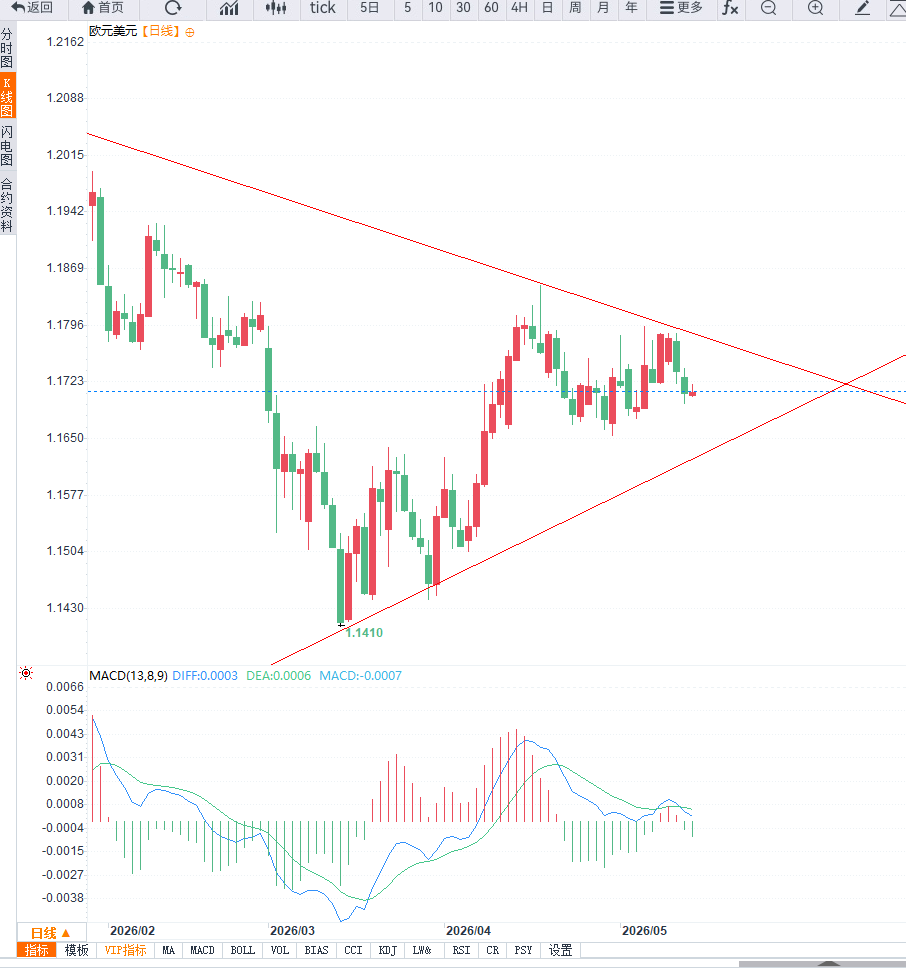
If Lagarde's speech is hawkish, the euro may receive some support; however, if the dollar continues to be driven by safe-haven demand and high interest rates, EUR/USD may remain weak and volatile.
Editor's Summary : The current EUR/USD exchange rate is fundamentally returning to two main drivers: the "interest rate expectation gap" and "global safe-haven capital flows." Continued higher-than-expected US inflation is pushing the market to bet on a possible resumption of interest rate hikes by the Federal Reserve, while escalating tensions in the Middle East are further strengthening the dollar's safe-haven appeal. In Europe, although inflation is rising again, weak economic growth limits the European Central Bank's policy space. In the short term, EUR/USD is likely to continue its high-volatility fluctuations around 1.1700, with its future direction depending on Lagarde's speech, changes in Fed policy expectations, and the performance of the global energy market.
The US dollar has recently outperformed non-US currencies. With the ongoing stalemate in the Middle East, global risk aversion has resurfaced, leading to a continued inflow of international funds into the US dollar and US Treasury markets. The core logic behind the dollar's strength this week is gradually shifting from a "rate cut trade" to "expectations of renewed rate hikes."
The latest inflation data released in the United States has further reinforced market concerns about the duration of the high-interest-rate environment. Data shows that the U.S. Producer Price Index (PPI) rose 1.4% month-on-month in April, not only higher than March's 0.7% but also far exceeding market expectations; the year-on-year growth rate rose to 6%, the highest level since December 2023.
Previously, the US Consumer Price Index (CPI) also showed strong performance, indicating that US inflationary pressures had not eased as significantly as the market had previously expected. Rising energy prices and continued resilience in US consumption are prompting the market to reassess the Federal Reserve's future monetary policy path. Particularly against the backdrop of the Middle East situation pushing up international oil prices, the market is concerned that imported inflation may intensify again. The market has begun betting that the Federal Reserve may restart its rate hike cycle by the end of 2026 or even the beginning of 2027.
Data from the CME Group's Fed Watch tool shows that the interest rate futures market now projects a 31% probability of a December rate hike, up from just 22% a week ago. This change has directly driven a broad-based rise in US Treasury yields. The yield on the 10-year US Treasury bond continued to climb this week, attracting further global inflows into dollar assets, thereby further suppressing the euro's performance.
Meanwhile, European markets are also facing renewed inflation. Spain's latest EU Highest Consumer Price Index (HICP) for April rose 3.5% year-on-year, higher than March's 3.4%. The market believes that rising energy prices in the Middle East are gradually transmitting to the European inflation system. This resurgence of inflation in Europe presents the European Central Bank with a more complex policy balancing act.
On the one hand, the Eurozone economy remains weak, with a slow recovery in manufacturing; on the other hand, rising energy prices have significantly slowed the decline in inflation. Therefore, the market is currently paying close attention to Lagarde's speech, hoping to determine whether the ECB will further postpone interest rate cuts or even reconsider the possibility of raising rates. The market currently expects the ECB to take further tightening measures as early as June or July. Some ECB officials have also recently expressed concern that rising energy prices could push up inflation.
The following is a comparison of key data in the current European and American markets:
From a market sentiment perspective, the global foreign exchange market has clearly re-entered a "dollar-dominated phase." Previously, the market had bet on the Federal Reserve gradually cutting interest rates, but with US inflation consistently exceeding expectations, the dollar has regained strong support. Safe-haven inflows and expectations of high interest rates are creating a dual bullish structure for the dollar.
From a technical perspective, the EUR/USD pair remains in a range-bound trading pattern on the daily chart, but short-term bearish momentum is clearly dominant. The pair continues to be pressured below the 1.1800 level, indicating significant selling pressure in the market. 1.1700 is currently a key short-term support area for the EUR/USD. A break below the 1.1645-1.1675 support zone could open up further downside potential, potentially retesting the April low near 1.1510. On the upside, the 1.1740 area forms the first short-term resistance level, followed by the top of the three-week trading range at 1.1795, while the April high of 1.1851 represents a significant medium-term resistance. The 4-hour chart shows that the EUR/USD remains bearish in the short term. The MACD indicator continues to trade below the zero line; although bearish momentum has weakened slightly recently, the overall trend has not yet reversed significantly. The RSI indicator remains below the 50 midline, indicating that the market is still dominated by bears.
If Lagarde's speech is hawkish, the euro may receive some support; however, if the dollar continues to be driven by safe-haven demand and high interest rates, EUR/USD may remain weak and volatile.
Editor's Summary : The current EUR/USD exchange rate is fundamentally returning to two main drivers: the "interest rate expectation gap" and "global safe-haven capital flows." Continued higher-than-expected US inflation is pushing the market to bet on a possible resumption of interest rate hikes by the Federal Reserve, while escalating tensions in the Middle East are further strengthening the dollar's safe-haven appeal. In Europe, although inflation is rising again, weak economic growth limits the European Central Bank's policy space. In the short term, EUR/USD is likely to continue its high-volatility fluctuations around 1.1700, with its future direction depending on Lagarde's speech, changes in Fed policy expectations, and the performance of the global energy market.
- Risk Warning and Disclaimer
- The market involves risk, and trading may not be suitable for all investors. This article is for reference only and does not constitute personal investment advice, nor does it take into account certain users’ specific investment objectives, financial situation, or other needs. Any investment decisions made based on this information are at your own risk.