Interest rate hikes forced upon them: The underlying truth behind the Bank of Japan's reluctance to raise interest rates
2026-05-14 18:20:00
The Bank of Japan recently underwent a key policy shift, with board member Kazuo Masui reversing his previous stance and officially joining the hawkish camp, publicly calling for an early interest rate hike. As a result, the market significantly increased the probability of a June rate hike.
This policy easing was not a proactive choice by the Bank of Japan; it was essentially a passive compromise, forced upon them.
Previously, U.S. Treasury Secretary Bessenter visited Japan and made it clear that he did not approve of Japan's direct intervention in the exchange rate to support the yen by selling dollars, and emphasized that exchange rate stability should rely on monetary policy adjustments rather than administrative intervention.
Under pressure from the United States, hawkish voices within the Bank of Japan have risen rapidly, and expectations for interest rate hikes have suddenly increased, which is actually a concession that they have no choice but to make.
In fact, even with continued high imported inflation, rising oil prices due to geopolitical conflicts in the Middle East, and increased inflationary pressures due to the depreciation of the yen, the Bank of Japan has been delaying interest rate hikes for a long time.
They would rather spend huge amounts of foreign exchange reserves to repeatedly intervene in the foreign exchange market than tighten monetary policy.
From a first-principles perspective, the Bank of Japan is not ignoring the risk of inflation, but rather actively tolerating the spread of inflation and deliberately delaying interest rate hikes.
In the central bank's weighing of its options, the negative impact of raising interest rates far outweighs the cost of continued inflation, so it has consistently maintained an accommodative environment.
This choice is fundamentally constrained by the Mundell-Fleming trilemma: a country cannot simultaneously achieve three goals: independent monetary policy, exchange rate stability, and free capital flow; it can only achieve two at most.
As a completely open economy, Japan adheres to the bottom line of free capital flow, and therefore can only choose between stabilizing the exchange rate and loosening monetary policy.
Japan ultimately chose to stick to its independent loose monetary policy, voluntarily abandoning exchange rate stability. Even with the yen continuing to depreciate and inflation remaining high, it resolutely refused to raise interest rates aggressively.
Japan's insistence on low interest rates and tolerance of inflation is primarily aimed at preserving its precarious fiscal system.
Japan's government debt exceeds 260% of GDP. A sharp interest rate hike would cause a surge in interest payments on national debt, directly triggering a debt crisis. Moderate inflation, on the other hand, can dilute the massive debt. Furthermore, low interest rates coupled with a depreciating yen would benefit the export-oriented economy.
Export giants like Toyota and Sony saw their profits surge after converting overseas revenues into yen, with the exchange rate advantage offsetting energy cost pressures. Meanwhile, foreign capital poured in to buy up Japanese stocks at low interest rates, leading to a strong performance in the Japanese stock market against the trend. Both corporate profits and the capital market benefited.
Ultimately, the cost of this model is borne entirely by ordinary people. The continuous rise in energy, food, and daily necessities prices leads to a reduction in people's real income and an increase in the cost of living. Essentially, this means making ordinary people suffer in order to protect government finances, revive export companies, and stabilize the capital market.
China's trade restrictions on Japan in relevant sectors, coupled with the Middle East energy crisis, have further exacerbated Japan's predicament.
Japan is highly dependent on imports of energy and raw materials from overseas. Trade restrictions have exacerbated imported inflationary pressures, putting continued pressure on domestic demand and further amplifying the inflationary impact on the public.
The Bank of Japan's hawkish rhetoric and brewing interest rate hikes are not a sudden realization, but rather a response to inflation exceeding manageable limits. Persistently high prices have fueled widespread inflation expectations, and the disorderly depreciation of the yen has triggered capital outflows. If left unchecked, this will ultimately undermine the foundation of the debt system and economic stability.
This long-awaited interest rate hike is merely a passive measure taken by Japan after external pressure and uncontrolled internal risks. Ordinary people have already become the first and most persistent victims in this macroeconomic game between major powers.
For the Japanese yen, even if interest rates are raised, the market may not react favorably. Although the central bank has intervened twice recently, the yen is still depreciating. If the Japanese interest rate hike is implemented in June, it will indeed put downward pressure on the USD/JPY exchange rate in the short term. However, for the yen to break free from its depreciation, it will either experience a period of accelerated depreciation, or there will be a significant improvement in the domestic fundamentals or a sharp correction in energy prices.
From a technical perspective, the USD/JPY pair initially fell below the middle band of its upward trend line due to the Bank of Japan's open market intervention, but is currently rebounding based on 156.9 and the middle band of the upward trend line.
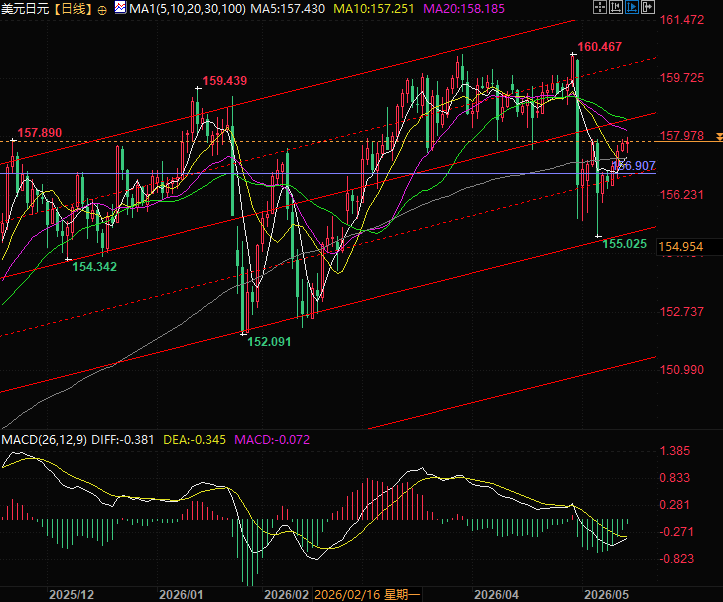
(USD/JPY daily chart, source: EasyForex)
At 18:09 Beijing time, the USD/JPY exchange rate is currently at 157.90/91.
This policy easing was not a proactive choice by the Bank of Japan; it was essentially a passive compromise, forced upon them.
Previously, U.S. Treasury Secretary Bessenter visited Japan and made it clear that he did not approve of Japan's direct intervention in the exchange rate to support the yen by selling dollars, and emphasized that exchange rate stability should rely on monetary policy adjustments rather than administrative intervention.
Under pressure from the United States, hawkish voices within the Bank of Japan have risen rapidly, and expectations for interest rate hikes have suddenly increased, which is actually a concession that they have no choice but to make.
Preferring intervention to interest rate hikes: A deeper choice to actively condone inflation.
In fact, even with continued high imported inflation, rising oil prices due to geopolitical conflicts in the Middle East, and increased inflationary pressures due to the depreciation of the yen, the Bank of Japan has been delaying interest rate hikes for a long time.
They would rather spend huge amounts of foreign exchange reserves to repeatedly intervene in the foreign exchange market than tighten monetary policy.
From a first-principles perspective, the Bank of Japan is not ignoring the risk of inflation, but rather actively tolerating the spread of inflation and deliberately delaying interest rate hikes.
In the central bank's weighing of its options, the negative impact of raising interest rates far outweighs the cost of continued inflation, so it has consistently maintained an accommodative environment.
The Mundell-Fleming Trilemma: Underlying Policy Shackles in Japan
This choice is fundamentally constrained by the Mundell-Fleming trilemma: a country cannot simultaneously achieve three goals: independent monetary policy, exchange rate stability, and free capital flow; it can only achieve two at most.
As a completely open economy, Japan adheres to the bottom line of free capital flow, and therefore can only choose between stabilizing the exchange rate and loosening monetary policy.
Japan ultimately chose to stick to its independent loose monetary policy, voluntarily abandoning exchange rate stability. Even with the yen continuing to depreciate and inflation remaining high, it resolutely refused to raise interest rates aggressively.
Overall stability at the cost of the entire population: the government, businesses, and the stock market all benefit.
Japan's insistence on low interest rates and tolerance of inflation is primarily aimed at preserving its precarious fiscal system.
Japan's government debt exceeds 260% of GDP. A sharp interest rate hike would cause a surge in interest payments on national debt, directly triggering a debt crisis. Moderate inflation, on the other hand, can dilute the massive debt. Furthermore, low interest rates coupled with a depreciating yen would benefit the export-oriented economy.
Export giants like Toyota and Sony saw their profits surge after converting overseas revenues into yen, with the exchange rate advantage offsetting energy cost pressures. Meanwhile, foreign capital poured in to buy up Japanese stocks at low interest rates, leading to a strong performance in the Japanese stock market against the trend. Both corporate profits and the capital market benefited.
Ultimately, the cost of this model is borne entirely by ordinary people. The continuous rise in energy, food, and daily necessities prices leads to a reduction in people's real income and an increase in the cost of living. Essentially, this means making ordinary people suffer in order to protect government finances, revive export companies, and stabilize the capital market.
External sanctions exacerbated the situation, further amplifying inflationary pressures.
China's trade restrictions on Japan in relevant sectors, coupled with the Middle East energy crisis, have further exacerbated Japan's predicament.
Japan is highly dependent on imports of energy and raw materials from overseas. Trade restrictions have exacerbated imported inflationary pressures, putting continued pressure on domestic demand and further amplifying the inflationary impact on the public.
Forced interest rate hikes: merely a passive stop-loss measure after risks spiral out of control.
The Bank of Japan's hawkish rhetoric and brewing interest rate hikes are not a sudden realization, but rather a response to inflation exceeding manageable limits. Persistently high prices have fueled widespread inflation expectations, and the disorderly depreciation of the yen has triggered capital outflows. If left unchecked, this will ultimately undermine the foundation of the debt system and economic stability.
This long-awaited interest rate hike is merely a passive measure taken by Japan after external pressure and uncontrolled internal risks. Ordinary people have already become the first and most persistent victims in this macroeconomic game between major powers.
For the Japanese yen, even if interest rates are raised, the market may not react favorably. Although the central bank has intervened twice recently, the yen is still depreciating. If the Japanese interest rate hike is implemented in June, it will indeed put downward pressure on the USD/JPY exchange rate in the short term. However, for the yen to break free from its depreciation, it will either experience a period of accelerated depreciation, or there will be a significant improvement in the domestic fundamentals or a sharp correction in energy prices.
From a technical perspective, the USD/JPY pair initially fell below the middle band of its upward trend line due to the Bank of Japan's open market intervention, but is currently rebounding based on 156.9 and the middle band of the upward trend line.
(USD/JPY daily chart, source: EasyForex)
At 18:09 Beijing time, the USD/JPY exchange rate is currently at 157.90/91.
- Risk Warning and Disclaimer
- The market involves risk, and trading may not be suitable for all investors. This article is for reference only and does not constitute personal investment advice, nor does it take into account certain users’ specific investment objectives, financial situation, or other needs. Any investment decisions made based on this information are at your own risk.