Gold stagnates while silver soars? What are the reasons for this price divergence?
2026-05-14 18:23:01
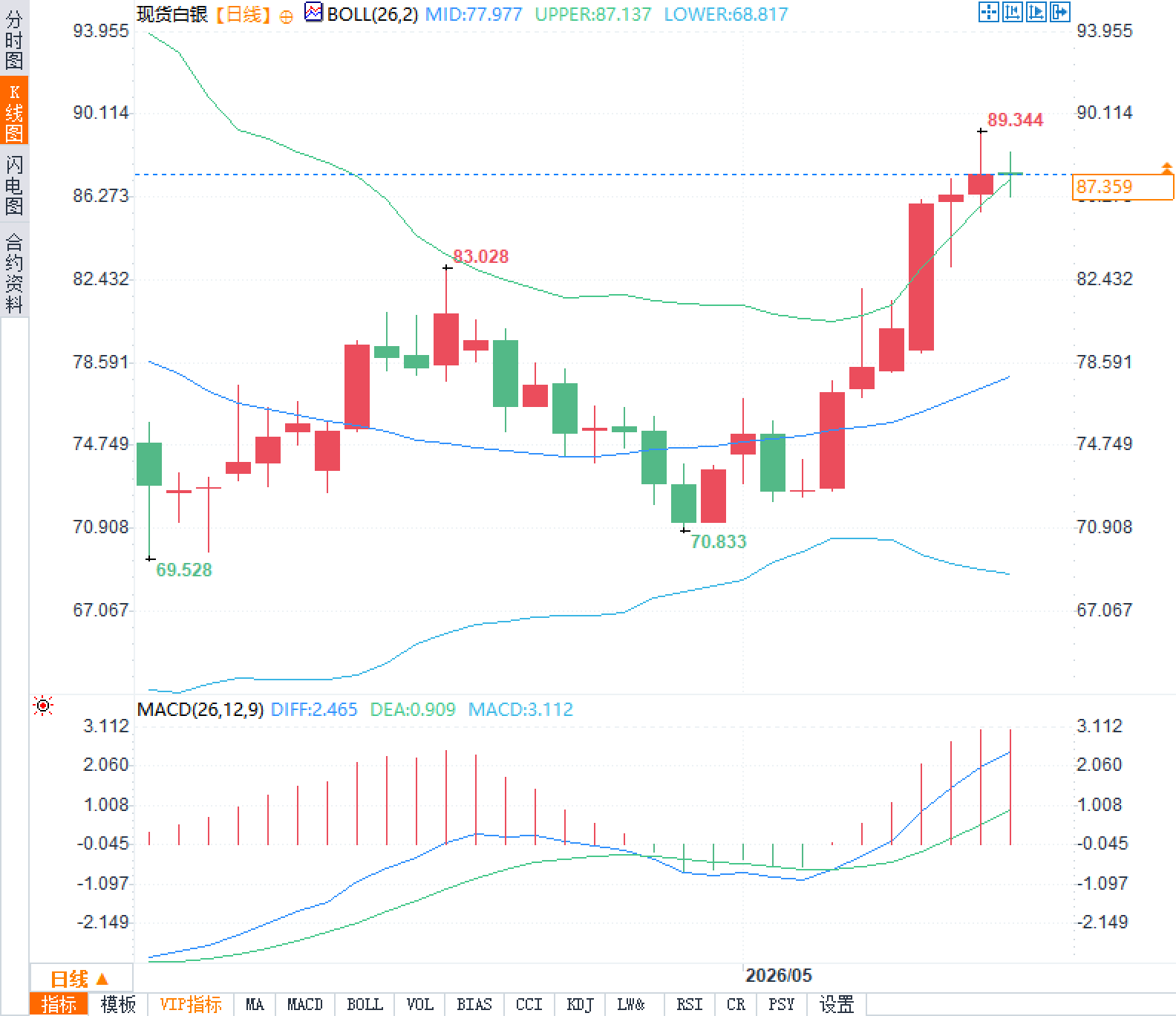
On Thursday, May 14th, spot silver prices traded around $87 per ounce, remaining at a high level, while gold prices remained relatively stable during the same period. Silver's combined industrial and precious metal attributes make its price more sensitive to macroeconomic variables than gold's.
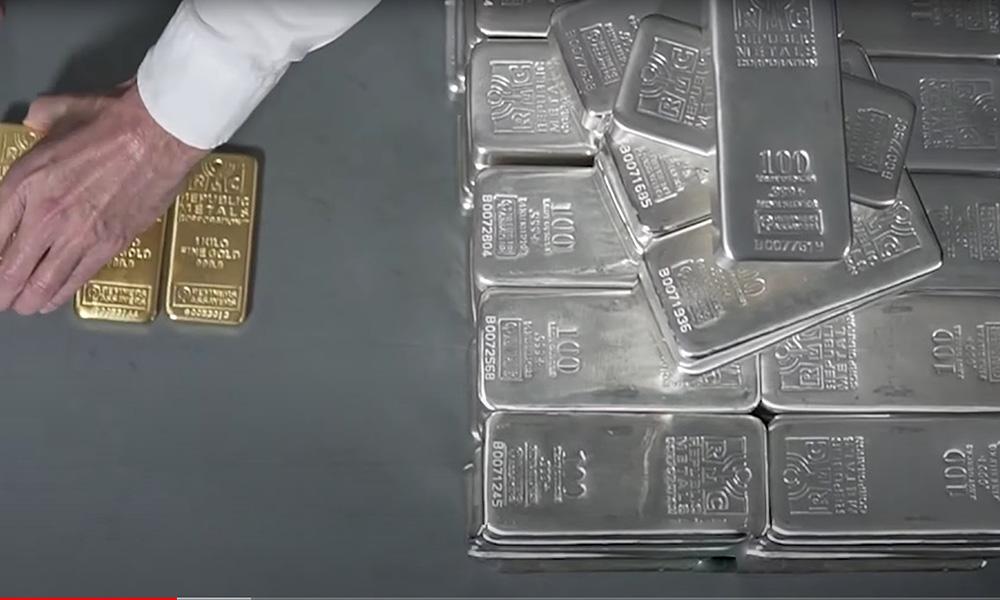
Silver prices have been steadily rising recently, with a temporary weakening of their correlation with gold. This divergence is not uncommon, but silver's higher volatility amplifies its gains in an environment of declining real yields. Traders have observed that silver's cumulative gains over the past week significantly outpaced gold, primarily driven by a combination of industrial demand and safe-haven demand.
Currently, spot silver prices are fluctuating between $85 and $87 per ounce, while gold is trading around $4,700 per ounce. The gold-silver ratio has narrowed, reflecting the market's relative preference for silver. The decline in real yields reduces the opportunity cost of holding non-yielding assets, providing a more significant boost to dual-attribute metals like silver.
Geopolitical tensions remain a key market focus. The standoff between the US and Iran over crucial waterways and persistently high oil prices are pushing up overall inflationary pressures. Resilient US economic data, coupled with high inflation indicators, creates uncertainty regarding the Federal Reserve's policy path. Traders are closely watching the Fed's actions, as the lack of a clear easing stance makes it difficult for precious metals, especially silver, to sustain new highs.
With the Federal Reserve's June meeting approaching, if inflation continues to rise and economic data remains strong, the probability of a hawkish policy shift increases, which could trigger selling pressure on silver and even test lower support levels. Conversely, if tensions along the waterways ease and oil prices fall, inflation concerns will be reduced, boosting expectations of interest rate cuts and thus benefiting silver.
The following is a comparison of key recent data (unit: USD/ounce or %):
High oil prices continue to support inflation, while the Federal Reserve's reliance on data means that any hawkish signals will be quickly reflected in silver prices.
Market expectations for the Fed's June meeting currently lean towards maintaining current interest rates. Economic data and persistent inflation have reduced the probability of easing. If the Fed releases a more hawkish signal before or during the meeting, silver may face downward pressure, as the lack of easing expectations will limit its upside potential.
In the long term, the supply and demand fundamentals of silver remain structurally supported: a persistent supply shortage coupled with growing industrial demand (solar energy, electronics, etc.). However, in the short term, the dominant factors remain monetary policy and geopolitical risk premiums. Any further decline in real yields could reignite silver's volatility, provided the Federal Reserve does not shift to a more hawkish stance.
Question 1: Why has silver been able to rise independently of gold recently?
A: Silver is more volatile than gold, and its price reacts more sharply when real yields fall. Industrial demand provides additional support, amplifying its gains in the current environment, and this divergence may persist until new changes occur in macroeconomic variables.
Question 2: What are the core impacts of the Federal Reserve's policies on silver prices?
A: Without a clear easing bias, silver is unlikely to challenge its historical highs. If the Federal Reserve maintains or hints at a hawkish stance around the June meeting due to inflation and economic resilience, silver is likely to experience selling pressure and even new lows. Conversely, if a decline in oil prices leads to easing inflation, it will increase expectations of interest rate cuts, supporting a silver rebound.
Question 3: What are the short-term and medium-term effects of geopolitical tensions on silver?
A: In the short term, if the waterway issue continues to push up oil prices, it will exacerbate inflation and may reinforce the Fed's hawkish stance, increasing the downside risk for silver. If the situation eases, leading to a decline in oil prices and reduced inflation concerns, it will be beneficial for silver. The fundamentals remain unchanged, with supply and demand shortages providing medium-term support, but monetary policy remains the dominant variable.
Short-term divergence between silver and gold
Silver prices have been steadily rising recently, with a temporary weakening of their correlation with gold. This divergence is not uncommon, but silver's higher volatility amplifies its gains in an environment of declining real yields. Traders have observed that silver's cumulative gains over the past week significantly outpaced gold, primarily driven by a combination of industrial demand and safe-haven demand.
Currently, spot silver prices are fluctuating between $85 and $87 per ounce, while gold is trading around $4,700 per ounce. The gold-silver ratio has narrowed, reflecting the market's relative preference for silver. The decline in real yields reduces the opportunity cost of holding non-yielding assets, providing a more significant boost to dual-attribute metals like silver.
The fundamental environment has not changed.
Geopolitical tensions remain a key market focus. The standoff between the US and Iran over crucial waterways and persistently high oil prices are pushing up overall inflationary pressures. Resilient US economic data, coupled with high inflation indicators, creates uncertainty regarding the Federal Reserve's policy path. Traders are closely watching the Fed's actions, as the lack of a clear easing stance makes it difficult for precious metals, especially silver, to sustain new highs.
With the Federal Reserve's June meeting approaching, if inflation continues to rise and economic data remains strong, the probability of a hawkish policy shift increases, which could trigger selling pressure on silver and even test lower support levels. Conversely, if tensions along the waterways ease and oil prices fall, inflation concerns will be reduced, boosting expectations of interest rate cuts and thus benefiting silver.
The following is a comparison of key recent data (unit: USD/ounce or %):
| variety | Current level | Recent Changes |
|---|---|---|
| spot silver | 85-87 | Significant rebound during the week |
| spot gold | Approximately 4700 | Relatively stable |
| US 30-year Treasury yield | Approximately 5.0 | near the high level |
The influence of Federal Reserve policy expectations on silver
Market expectations for the Fed's June meeting currently lean towards maintaining current interest rates. Economic data and persistent inflation have reduced the probability of easing. If the Fed releases a more hawkish signal before or during the meeting, silver may face downward pressure, as the lack of easing expectations will limit its upside potential.
In the long term, the supply and demand fundamentals of silver remain structurally supported: a persistent supply shortage coupled with growing industrial demand (solar energy, electronics, etc.). However, in the short term, the dominant factors remain monetary policy and geopolitical risk premiums. Any further decline in real yields could reignite silver's volatility, provided the Federal Reserve does not shift to a more hawkish stance.
Frequently Asked Questions
Question 1: Why has silver been able to rise independently of gold recently?
A: Silver is more volatile than gold, and its price reacts more sharply when real yields fall. Industrial demand provides additional support, amplifying its gains in the current environment, and this divergence may persist until new changes occur in macroeconomic variables.
Question 2: What are the core impacts of the Federal Reserve's policies on silver prices?
A: Without a clear easing bias, silver is unlikely to challenge its historical highs. If the Federal Reserve maintains or hints at a hawkish stance around the June meeting due to inflation and economic resilience, silver is likely to experience selling pressure and even new lows. Conversely, if a decline in oil prices leads to easing inflation, it will increase expectations of interest rate cuts, supporting a silver rebound.
Question 3: What are the short-term and medium-term effects of geopolitical tensions on silver?
A: In the short term, if the waterway issue continues to push up oil prices, it will exacerbate inflation and may reinforce the Fed's hawkish stance, increasing the downside risk for silver. If the situation eases, leading to a decline in oil prices and reduced inflation concerns, it will be beneficial for silver. The fundamentals remain unchanged, with supply and demand shortages providing medium-term support, but monetary policy remains the dominant variable.
- Risk Warning and Disclaimer
- The market involves risk, and trading may not be suitable for all investors. This article is for reference only and does not constitute personal investment advice, nor does it take into account certain users’ specific investment objectives, financial situation, or other needs. Any investment decisions made based on this information are at your own risk.