Iran allows 30 ships to pass, improving relations in the Strait of Hormuz; but there are details behind it.
2026-05-14 20:36:06
On Wednesday (May 14), during the Asian and European sessions, international oil prices saw a slight pullback, with Brent crude oil falling slightly by 1% to trade around 104.46. Traffic in the Strait of Hormuz has recently improved, and the market believes that the US visit to China will not bring negative news to the strait's passage.
At the same time, although the US and Iran regard each other as mortal enemies, in the real world, there is a more rational balance of interests.
The Iranian Revolutionary Guard disclosed that approximately 30 ships have successfully navigated the strait with Tehran's permission; the recent free passage of a second Japanese-related oil tanker through the strait is a typical signal of this.
The current confrontation between the US and Iran continues to escalate, and the market generally believes that the existing ceasefire agreement between the two sides is very fragile. The situation could break out into a full-scale war at any time, and the complete blockade of the Strait of Hormuz would directly trigger a global oil supply crisis.
However, judging from the actual geopolitical trends, the US and Iran are mortal enemies on the surface and both want to cripple each other, but neither dares to really start a full-scale war. Instead, they have entered a confrontational balance.
Under intense hostility, both sides have taken advantage of the Taiwan Strait crisis and the window of high oil prices to pursue their own interests, forming a special stable state of game dynamics.
Although Iran is openly confronting the United States and Israel, it has not indiscriminately blocked the Strait of Hormuz, while simultaneously extending goodwill to neighboring countries.
The Iranian Revolutionary Guard disclosed that approximately 30 ships have successfully navigated the strait with Tehran's permission, and recently a second Japanese-related oil tanker passed through the strait free of charge.
By selectively allowing passage and waiving tolls, Iran is proactively extending goodwill to major energy-importing countries like Japan, aiming to bolster diplomacy, secure future energy cooperation, and do them a favor.
Japanese energy giant Eneos will directly benefit, with its net profit expected to surge 1.6 times in fiscal year 2026; the fact that 39 Japanese ships are still stranded in the Persian Gulf has also forced Japan to shift its stance toward Iran towards direct negotiations with Iran.
The United States is also extremely hostile to Iran, but it has not gone all out to blockade or force a war.
Faced with Iran's release of neutral ships and seizure of US-affiliated oil tankers, the United States chose to exercise limited restraint and avoid escalating the situation completely.
The core logic of the United States is: tensions in the Middle East drive up oil prices, allowing them to take the opportunity to sign a large number of crude oil export contracts, seize a share of the global energy market, and turn geopolitical conflicts into export dividends for themselves.
Simply put: Iran uses the right of way through the Strait of Hormuz to win over allies, while the United States relies on high oil prices to secure energy contracts. The two sides are hostile to each other, but objectively, they have jointly driven up oil prices.
As long as neither the US nor Iran is completely crippled, this hostile but not all-out war, mutually restraining, and mutually beneficial situation will continue.
Iran will not fully open the Strait of Hormuz, and the United States is unwilling to initiate a full-scale war. The Strait of Hormuz remains tense, and the geopolitical risk premium for crude oil continues to exist.
The central level of oil prices is likely to continue to rise moderately in the future. The trend of crude oil trading will be closely tied to the intensity of the US-Iran confrontation, the status of navigation in the Taiwan Strait, the remaining capacity of Iranian oil tanks, and the pressure from the US midterm elections and public opinion. These will be the most critical trading variables going forward.
Meanwhile, as long as both sides are profitable and unwilling to take the risk of war, the short-term negative impact of oil price surges will continue to provide opportunities for bulls in other non-energy commodities, such as precious metals and equity assets.
From a technical perspective, Brent crude oil has failed to break through the key price level of 106.43 (0.786 Fibonacci retracement) for three consecutive days. It may now test the support level of the upward channel. In other words, without clear negative news, oil prices may continue to fluctuate and the price center may gradually move upward.
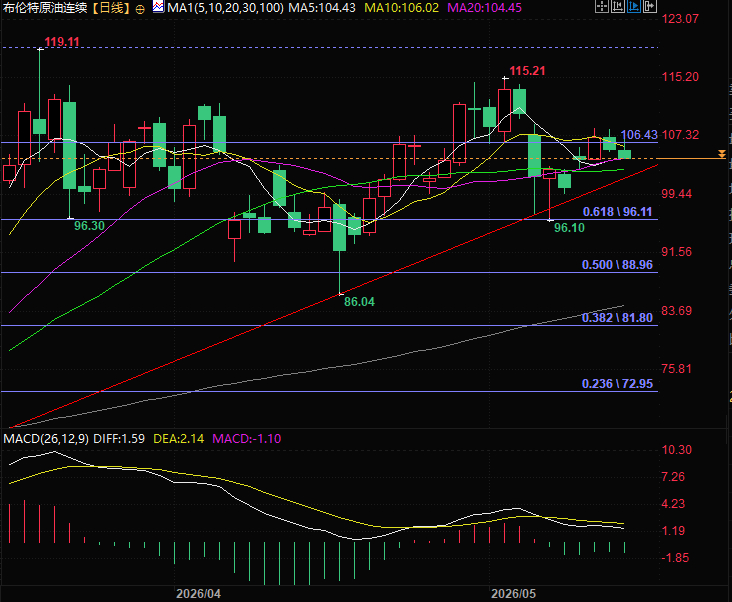
(Brent crude oil futures daily chart, source: EasyForex)
At 20:34 Beijing time, Brent crude oil futures were trading at $104.87 per barrel.
At the same time, although the US and Iran regard each other as mortal enemies, in the real world, there is a more rational balance of interests.
The Iranian Revolutionary Guard disclosed that approximately 30 ships have successfully navigated the strait with Tehran's permission; the recent free passage of a second Japanese-related oil tanker through the strait is a typical signal of this.
Market misjudgments could trigger conflict at any time: in reality, it's a balancing act of interests amidst confrontation.
The current confrontation between the US and Iran continues to escalate, and the market generally believes that the existing ceasefire agreement between the two sides is very fragile. The situation could break out into a full-scale war at any time, and the complete blockade of the Strait of Hormuz would directly trigger a global oil supply crisis.
However, judging from the actual geopolitical trends, the US and Iran are mortal enemies on the surface and both want to cripple each other, but neither dares to really start a full-scale war. Instead, they have entered a confrontational balance.
Under intense hostility, both sides have taken advantage of the Taiwan Strait crisis and the window of high oil prices to pursue their own interests, forming a special stable state of game dynamics.
Iran holds leverage in the Straits and uses it to curry favor with neighboring countries.
Although Iran is openly confronting the United States and Israel, it has not indiscriminately blocked the Strait of Hormuz, while simultaneously extending goodwill to neighboring countries.
The Iranian Revolutionary Guard disclosed that approximately 30 ships have successfully navigated the strait with Tehran's permission, and recently a second Japanese-related oil tanker passed through the strait free of charge.
By selectively allowing passage and waiving tolls, Iran is proactively extending goodwill to major energy-importing countries like Japan, aiming to bolster diplomacy, secure future energy cooperation, and do them a favor.
Japanese energy giant Eneos will directly benefit, with its net profit expected to surge 1.6 times in fiscal year 2026; the fact that 39 Japanese ships are still stranded in the Persian Gulf has also forced Japan to shift its stance toward Iran towards direct negotiations with Iran.
The US is not taking a full-blown confrontation, but is leveraging high oil prices to secure crude oil export orders.
The United States is also extremely hostile to Iran, but it has not gone all out to blockade or force a war.
Faced with Iran's release of neutral ships and seizure of US-affiliated oil tankers, the United States chose to exercise limited restraint and avoid escalating the situation completely.
The core logic of the United States is: tensions in the Middle East drive up oil prices, allowing them to take the opportunity to sign a large number of crude oil export contracts, seize a share of the global energy market, and turn geopolitical conflicts into export dividends for themselves.
Simply put: Iran uses the right of way through the Strait of Hormuz to win over allies, while the United States relies on high oil prices to secure energy contracts. The two sides are hostile to each other, but objectively, they have jointly driven up oil prices.
Summary and Technical Analysis:
As long as neither the US nor Iran is completely crippled, this hostile but not all-out war, mutually restraining, and mutually beneficial situation will continue.
Iran will not fully open the Strait of Hormuz, and the United States is unwilling to initiate a full-scale war. The Strait of Hormuz remains tense, and the geopolitical risk premium for crude oil continues to exist.
The central level of oil prices is likely to continue to rise moderately in the future. The trend of crude oil trading will be closely tied to the intensity of the US-Iran confrontation, the status of navigation in the Taiwan Strait, the remaining capacity of Iranian oil tanks, and the pressure from the US midterm elections and public opinion. These will be the most critical trading variables going forward.
Meanwhile, as long as both sides are profitable and unwilling to take the risk of war, the short-term negative impact of oil price surges will continue to provide opportunities for bulls in other non-energy commodities, such as precious metals and equity assets.
From a technical perspective, Brent crude oil has failed to break through the key price level of 106.43 (0.786 Fibonacci retracement) for three consecutive days. It may now test the support level of the upward channel. In other words, without clear negative news, oil prices may continue to fluctuate and the price center may gradually move upward.
(Brent crude oil futures daily chart, source: EasyForex)
At 20:34 Beijing time, Brent crude oil futures were trading at $104.87 per barrel.
- Risk Warning and Disclaimer
- The market involves risk, and trading may not be suitable for all investors. This article is for reference only and does not constitute personal investment advice, nor does it take into account certain users’ specific investment objectives, financial situation, or other needs. Any investment decisions made based on this information are at your own risk.