May 18th Financial Breakfast: Inflation concerns intensify, interest rate hike expectations rise; gold prices may test the $4500 mark; Iran issues strong warning of "offensive response"; oil prices continue their bullish trend.
2026-05-18 06:27:55
On Monday (May 18th, Beijing time) in early Asian trading, spot gold was trading around $4542 per ounce, and may test the $4500 per ounce level during the day. A stronger dollar dragged down gold prices, while US and Israeli military action against Iran exacerbated inflation concerns, further strengthening market expectations for interest rate hikes. US crude oil rose more than 1%, trading around $102.27 per barrel. Tensions between the US and Iran continued, and although Trump believes Iran is willing to reach an agreement, Iran warned that it would face an "offensive response" if the US launched another military operation.

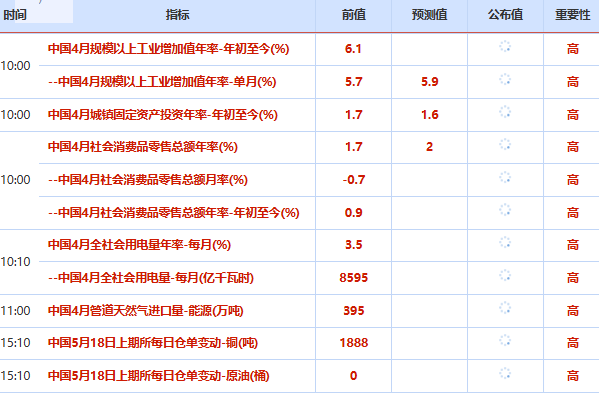
U.S. stocks retreated from record highs driven by artificial intelligence on Friday, with all three major indexes falling more than 1%, as soaring oil prices fueled global inflation concerns and rising benchmark bond yields made them more attractive than riskier stocks. Despite the sell-off, the S&P 500 recorded its seventh consecutive week of gains, its longest winning streak since December 2023, but the Nasdaq ended its six-week winning streak, and the Dow Jones also fell.
The Dow Jones Industrial Average fell 1.07% to 49,526.17 points on Friday, the S&P 500 fell 1.24% to 7,408.50 points, and the Nasdaq Composite fell 1.54% to 26,225.15 points.
Slatestone Wealth strategists say the market has significantly outpaced previous activity, having been caught up in the momentum-driven AI trading frenzy while neglecting bond market and economic data; oil prices surged after Trump and the Iranian foreign minister made tough statements, raising concerns about the resumption of shipping in the Strait of Hormuz.
The 10-year US Treasury yield hit its highest level since May 2025, and global government bond yields also rose as signs of the economic impact of the war on Iran increased. It was Powell's last day as Federal Reserve Chairman, and the new chairman Warsh faces potential pressure to raise interest rates. If the war on Iran continues and inflation remains high, policy tightening may be unavoidable. Market concerns that recent inflation data is not a temporary phenomenon have become prominent, and the probability of the Fed raising interest rates by 25 basis points in December has risen from 13.6% a week ago to nearly 40%.
Of the eleven sectors in the S&P 500, only energy stocks rose 2.3%, while materials and utilities saw the largest declines. The Philadelphia Semiconductor Index fell 4%, and Nvidia, AMD, and Intel fell 4.4%, 5.7%, and 6.2%, respectively. Microsoft rose 3.1% due to Pershing Square establishing a new position in the stock, while Ford fell 7.5%.
Gold prices fell to a more than one-week low on Friday, influenced by a stronger dollar and U.S. Treasury yields rising to near one-year highs. Meanwhile, U.S. and Israeli military action against Iran exacerbated inflation concerns and further strengthened market expectations for interest rate hikes.
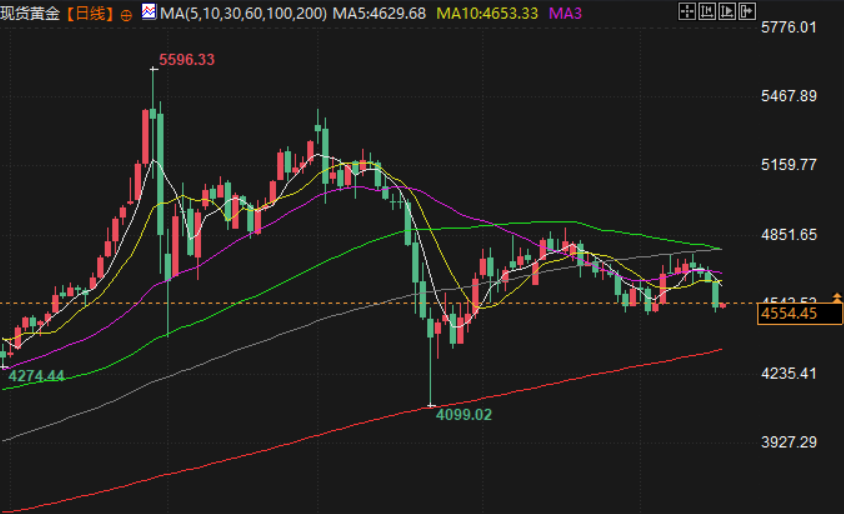
Spot gold fell 2.45% to $4,538.18 an ounce on Friday, hitting its lowest level since May 4, and fell 3.75% for the week. Analysts pointed out that a strong dollar and rising global yields jointly triggered the sell-off in the precious metals market. Silver, platinum, and palladium also recorded weekly declines.
Oil prices rose more than 3% on Friday as tough rhetoric from US President Trump and Iranian Foreign Minister Araqchi further dampened market hopes for an end to attacks and seizures of ships around the Strait of Hormuz. Brent crude settled at $106.57 a barrel, up 2.43%; WTI crude settled at $105.66 a barrel, up 3.57%. Driven by uncertainty surrounding the fragile ceasefire agreement in the Iranian conflict, Brent crude rose 8.57% and WTI crude rose 11.6% last week.
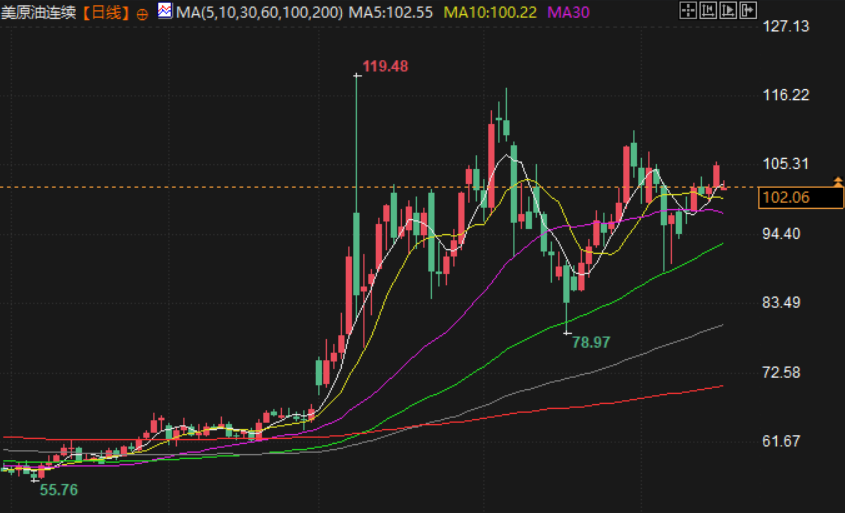
Analysts at Commerzbank pointed out that the rhetoric between the US and Iran is clearly at odds, and although the ceasefire is still in place, hopes for a swift reopening of the Strait of Hormuz have been dashed.
Iranian Foreign Minister Araqchi stated that Iran has no trust in the United States and will only be willing to negotiate if Washington shows sincerity. He added that Iran is prepared to return to the battlefield but is also seeking a diplomatic solution.
Trump stated that he had lost patience with Iran, would never allow Iran to possess nuclear weapons, and that the Strait of Hormuz—through which approximately one-fifth of the world's oil and liquefied natural gas are typically transported—must be reopened.
The Iranian Revolutionary Guard stated that 30 ships passed through the strait between Wednesday evening and Thursday. While this is still far below the pre-war level of 140 ships per day, it represents a significant increase if the report is accurate.
The dollar rose for the fifth consecutive trading day on Friday, posting its biggest weekly gain in two months, as U.S. Treasury yields continued to climb, with the benchmark 10-year Treasury yield rising to 4.599%, a one-year high, coupled with growing market expectations that the Federal Reserve might raise interest rates.
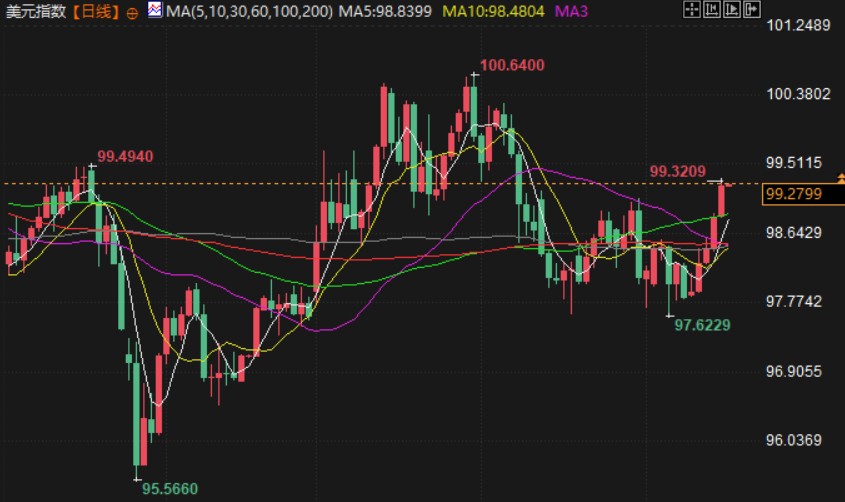
The dollar index rose 0.32% to 99.27, hitting a five-week high of 99.302 during the session; the euro fell 0.39% to $1.1623, the pound fell 0.57% to $1.3323, and the dollar rose 0.25% against the yen to 158.74.
Last week, the US dollar index rose by about 1.5%, the euro fell by about 1.4%, marking its biggest drop in two months, and the pound sterling fell by more than 2%, its biggest weekly decline since November 2024. Analysts pointed out that rising inflationary pressures are driving a repricing in the bond market due to energy supply disruptions in the Strait of Hormuz caused by the conflict with Iran.
Federal Reserve officials signaled concern about inflation this week, with New York Fed President Williams stating that there was no need to adjust interest rate policy at present. However, the market has clearly shifted its expectations towards a rate hike—CME FedWatch data shows that the market expects the probability of a rate hike of at least 25 basis points at the Fed's December meeting to rise from 14.3% a week ago to 49.5%. Japan's wholesale inflation rate in April saw its fastest pace in three years, also providing a basis for the Bank of Japan to raise interest rates as early as June.
The probability of the Federal Reserve keeping interest rates unchanged in June is 99.2%.
According to CME's "FedWatch": the probability of the Federal Reserve keeping interest rates unchanged by June is 99.2%, and the probability of a cumulative rate cut of 25 basis points is 0.8%. The probability of the Federal Reserve keeping interest rates unchanged by July is 95.0%, the probability of a cumulative rate cut of 25 basis points is 0.7%, and the probability of a cumulative rate hike of 25 basis points is 4.2%.
Iranian military: If the US launches another military operation, it will face an "offensive response".
Iranian media reported on the 17th that a senior spokesperson for the Iranian Armed Forces responded to recent remarks by US President Trump regarding Iran, warning the US against launching new military action against Iran. The spokesperson stated that any attempt to "save face" by taking further action against Iran would result in a "more severe and heavier blow" to the US. The spokesperson also stated that if the US again threatens or takes military action against Iran, its military assets and troops in the region will face a "completely new, offensive, unexpected, and storm-like response." (Xinhua)
Iran says the US has presented five key conditions to it.
Iran's Fars News Agency reported on May 17, citing sources, that the US, in responding to Iran's proposal, outlined five key conditions: the US would not pay any reparations or war damages; Iran would export and transfer 400 kilograms of enriched uranium to the US; only one Iranian nuclear facility would be allowed to remain operational; the US would refuse to unfreeze Iranian assets; and a ceasefire on all fronts would be contingent on negotiations. The report emphasized that even if Iran met these conditions, the threat of an attack on Iran by the US and Israel would persist. The report quoted analysts as saying that the US proposal was not aimed at resolving the issue, but rather at achieving political and military objectives that it had failed to achieve during the war through negotiation. (CCTV International News)
Trump says he still believes Iran is willing to reach an agreement.
On the evening of May 17 local time, US President Trump stated in an interview that he still believes Iran is willing to reach an agreement and expects Iran to submit an updated proposal in the coming days. It is understood that Trump declined to reveal a deadline for the negotiations but indicated that if Iran does not meet US demands regarding its nuclear program, the US will take more severe military action. (CCTV News)
US Energy Secretary: Strait of Hormuz to reopen no later than this summer; trade agreements prioritized over military action.
According to The Hill, U.S. Energy Secretary Frank Wright stated on Friday that the Strait of Hormuz will reopen "at the latest sometime this summer." Wright pointed out that although the strait's closure results in a loss of 10 billion cubic feet of natural gas transport capacity per day, the U.S. still gains an additional 2.5 billion cubic feet of natural gas export capacity daily; an agreement could be reached as early as "the next few days." Wright stated that if Iran "continues to hold the global economy hostage," the U.S. military will "force the reopening of the strait," but this will not be easy; preliminary steps have been taken, but "a better approach is to reach an agreement rather than resorting to military force."
Streatine confirms her candidacy for Labour leader and calls on Starmer to develop a timetable for the transition.
Wes Streatine, the resigned UK Health and Social Care Secretary, stated on May 16 that he would run for Labour leadership if an election were held. In an interview, he emphasized that Labour needs a "proper election" with the most competitive candidates. Streatine said he would not immediately launch a leadership challenge, as he needed to wait for Manchester Mayor Andy Burnham to return to Parliament; otherwise, a hastily elected new leader might lack sufficient legitimacy, thus prolonging instability. He reiterated his call for Prime Minister Starmer to establish a "proper timetable for leadership transition" and to allow cabinet ministers the freedom to nominate new party leaders and prime ministers. Starmer recently faced internal pressure following Labour's crushing defeat in local elections, with dozens of MPs calling for his resignation. However, Starmer stated he would not resign and would "fight" the leadership election. Burnham has confirmed he will run in a by-election for a seat in the House of Commons, seeking a return to Parliament.
British media: Starmer plans an orderly resignation, allies urge him to postpone the announcement.
According to the British newspaper *Daily Mail*, British Prime Minister Keir Starmer has confided to close friends that he intends to resign and has developed an orderly timetable for his departure. A cabinet member stated that Starmer understands the political realities and recognizes that the current chaotic situation cannot continue. He hopes to leave in a dignified and autonomous manner and will develop a concrete timetable. Another cabinet source said it is unclear when an announcement will be made; some of Starmer's senior allies are urging him to postpone any announcements until the first polls and vote counts from the Mekfield by-election are released.
Iranian officials: The traffic management mechanism for the Strait of Hormuz, formulated by Iran, will be announced soon.
On May 16 local time, Aziz, chairman of the Iranian Parliament's National Security Committee, stated on social media that, within the framework of safeguarding national sovereignty and ensuring international trade security, Iran has formulated a professional traffic management mechanism for the Strait of Hormuz, which will be officially announced soon. This mechanism will only be open to merchant ships and related parties cooperating with Iran. Iran will charge necessary fees in exchange for the professional services it provides through this mechanism. The route will remain closed to participants in the US "Freedom Project." (CCTV News)
The UK is on the verge of reaching a free trade agreement with the Gulf Cooperation Council.
According to sources, after years of negotiations, the UK and the Gulf Cooperation Council (GCC) member states are close to finalizing a long-awaited free trade agreement. The UK has been negotiating the free trade agreement with GCC member states (Saudi Arabia, the UAE, Qatar, Kuwait, Bahrain, and Oman) since 2022. Sources indicate that an agreement in principle is expected to be reached within days, and GCC Secretary-General Jassim Boudaiwi is expected to travel to London this week. A British official stated that negotiations have entered a deep-seated phase, and a British government spokesperson also confirmed that negotiations are ongoing and a priority. The British government estimates that the free trade agreement could increase the UK's annual GDP by £1.6 billion to £3.1 billion by 2036, equivalent to a long-term GDP increase of 0.06% to 0.11%. Currently, bilateral trade between the Gulf states and the UK exceeds $53 billion. (Xinhua)
The first batch of high-octane racing gasoline of No. 103 in China has been officially put into use.
Today (May 16), my country's domestically developed and produced 103-octane racing-grade gasoline officially went into use in Xinjiang. This is the first batch of 103-octane high-strength racing-grade gasoline to be industrially produced in China, filling the gap in high-performance racing fuel in the country and ending my country's long-term reliance on imports for top-level racing fuel. (CCTV News)
Key Focus Today
stock market
U.S. stocks retreated from record highs driven by artificial intelligence on Friday, with all three major indexes falling more than 1%, as soaring oil prices fueled global inflation concerns and rising benchmark bond yields made them more attractive than riskier stocks. Despite the sell-off, the S&P 500 recorded its seventh consecutive week of gains, its longest winning streak since December 2023, but the Nasdaq ended its six-week winning streak, and the Dow Jones also fell.
The Dow Jones Industrial Average fell 1.07% to 49,526.17 points on Friday, the S&P 500 fell 1.24% to 7,408.50 points, and the Nasdaq Composite fell 1.54% to 26,225.15 points.
Slatestone Wealth strategists say the market has significantly outpaced previous activity, having been caught up in the momentum-driven AI trading frenzy while neglecting bond market and economic data; oil prices surged after Trump and the Iranian foreign minister made tough statements, raising concerns about the resumption of shipping in the Strait of Hormuz.
The 10-year US Treasury yield hit its highest level since May 2025, and global government bond yields also rose as signs of the economic impact of the war on Iran increased. It was Powell's last day as Federal Reserve Chairman, and the new chairman Warsh faces potential pressure to raise interest rates. If the war on Iran continues and inflation remains high, policy tightening may be unavoidable. Market concerns that recent inflation data is not a temporary phenomenon have become prominent, and the probability of the Fed raising interest rates by 25 basis points in December has risen from 13.6% a week ago to nearly 40%.
Of the eleven sectors in the S&P 500, only energy stocks rose 2.3%, while materials and utilities saw the largest declines. The Philadelphia Semiconductor Index fell 4%, and Nvidia, AMD, and Intel fell 4.4%, 5.7%, and 6.2%, respectively. Microsoft rose 3.1% due to Pershing Square establishing a new position in the stock, while Ford fell 7.5%.
Gold Market
Gold prices fell to a more than one-week low on Friday, influenced by a stronger dollar and U.S. Treasury yields rising to near one-year highs. Meanwhile, U.S. and Israeli military action against Iran exacerbated inflation concerns and further strengthened market expectations for interest rate hikes.
Spot gold fell 2.45% to $4,538.18 an ounce on Friday, hitting its lowest level since May 4, and fell 3.75% for the week. Analysts pointed out that a strong dollar and rising global yields jointly triggered the sell-off in the precious metals market. Silver, platinum, and palladium also recorded weekly declines.
oil market
Oil prices rose more than 3% on Friday as tough rhetoric from US President Trump and Iranian Foreign Minister Araqchi further dampened market hopes for an end to attacks and seizures of ships around the Strait of Hormuz. Brent crude settled at $106.57 a barrel, up 2.43%; WTI crude settled at $105.66 a barrel, up 3.57%. Driven by uncertainty surrounding the fragile ceasefire agreement in the Iranian conflict, Brent crude rose 8.57% and WTI crude rose 11.6% last week.
Analysts at Commerzbank pointed out that the rhetoric between the US and Iran is clearly at odds, and although the ceasefire is still in place, hopes for a swift reopening of the Strait of Hormuz have been dashed.
Iranian Foreign Minister Araqchi stated that Iran has no trust in the United States and will only be willing to negotiate if Washington shows sincerity. He added that Iran is prepared to return to the battlefield but is also seeking a diplomatic solution.
Trump stated that he had lost patience with Iran, would never allow Iran to possess nuclear weapons, and that the Strait of Hormuz—through which approximately one-fifth of the world's oil and liquefied natural gas are typically transported—must be reopened.
The Iranian Revolutionary Guard stated that 30 ships passed through the strait between Wednesday evening and Thursday. While this is still far below the pre-war level of 140 ships per day, it represents a significant increase if the report is accurate.
Foreign exchange market
The dollar rose for the fifth consecutive trading day on Friday, posting its biggest weekly gain in two months, as U.S. Treasury yields continued to climb, with the benchmark 10-year Treasury yield rising to 4.599%, a one-year high, coupled with growing market expectations that the Federal Reserve might raise interest rates.
The dollar index rose 0.32% to 99.27, hitting a five-week high of 99.302 during the session; the euro fell 0.39% to $1.1623, the pound fell 0.57% to $1.3323, and the dollar rose 0.25% against the yen to 158.74.
Last week, the US dollar index rose by about 1.5%, the euro fell by about 1.4%, marking its biggest drop in two months, and the pound sterling fell by more than 2%, its biggest weekly decline since November 2024. Analysts pointed out that rising inflationary pressures are driving a repricing in the bond market due to energy supply disruptions in the Strait of Hormuz caused by the conflict with Iran.
Federal Reserve officials signaled concern about inflation this week, with New York Fed President Williams stating that there was no need to adjust interest rate policy at present. However, the market has clearly shifted its expectations towards a rate hike—CME FedWatch data shows that the market expects the probability of a rate hike of at least 25 basis points at the Fed's December meeting to rise from 14.3% a week ago to 49.5%. Japan's wholesale inflation rate in April saw its fastest pace in three years, also providing a basis for the Bank of Japan to raise interest rates as early as June.
International News
The probability of the Federal Reserve keeping interest rates unchanged in June is 99.2%.
According to CME's "FedWatch": the probability of the Federal Reserve keeping interest rates unchanged by June is 99.2%, and the probability of a cumulative rate cut of 25 basis points is 0.8%. The probability of the Federal Reserve keeping interest rates unchanged by July is 95.0%, the probability of a cumulative rate cut of 25 basis points is 0.7%, and the probability of a cumulative rate hike of 25 basis points is 4.2%.
Iranian military: If the US launches another military operation, it will face an "offensive response".
Iranian media reported on the 17th that a senior spokesperson for the Iranian Armed Forces responded to recent remarks by US President Trump regarding Iran, warning the US against launching new military action against Iran. The spokesperson stated that any attempt to "save face" by taking further action against Iran would result in a "more severe and heavier blow" to the US. The spokesperson also stated that if the US again threatens or takes military action against Iran, its military assets and troops in the region will face a "completely new, offensive, unexpected, and storm-like response." (Xinhua)
Iran says the US has presented five key conditions to it.
Iran's Fars News Agency reported on May 17, citing sources, that the US, in responding to Iran's proposal, outlined five key conditions: the US would not pay any reparations or war damages; Iran would export and transfer 400 kilograms of enriched uranium to the US; only one Iranian nuclear facility would be allowed to remain operational; the US would refuse to unfreeze Iranian assets; and a ceasefire on all fronts would be contingent on negotiations. The report emphasized that even if Iran met these conditions, the threat of an attack on Iran by the US and Israel would persist. The report quoted analysts as saying that the US proposal was not aimed at resolving the issue, but rather at achieving political and military objectives that it had failed to achieve during the war through negotiation. (CCTV International News)
Trump says he still believes Iran is willing to reach an agreement.
On the evening of May 17 local time, US President Trump stated in an interview that he still believes Iran is willing to reach an agreement and expects Iran to submit an updated proposal in the coming days. It is understood that Trump declined to reveal a deadline for the negotiations but indicated that if Iran does not meet US demands regarding its nuclear program, the US will take more severe military action. (CCTV News)
US Energy Secretary: Strait of Hormuz to reopen no later than this summer; trade agreements prioritized over military action.
According to The Hill, U.S. Energy Secretary Frank Wright stated on Friday that the Strait of Hormuz will reopen "at the latest sometime this summer." Wright pointed out that although the strait's closure results in a loss of 10 billion cubic feet of natural gas transport capacity per day, the U.S. still gains an additional 2.5 billion cubic feet of natural gas export capacity daily; an agreement could be reached as early as "the next few days." Wright stated that if Iran "continues to hold the global economy hostage," the U.S. military will "force the reopening of the strait," but this will not be easy; preliminary steps have been taken, but "a better approach is to reach an agreement rather than resorting to military force."
Streatine confirms her candidacy for Labour leader and calls on Starmer to develop a timetable for the transition.
Wes Streatine, the resigned UK Health and Social Care Secretary, stated on May 16 that he would run for Labour leadership if an election were held. In an interview, he emphasized that Labour needs a "proper election" with the most competitive candidates. Streatine said he would not immediately launch a leadership challenge, as he needed to wait for Manchester Mayor Andy Burnham to return to Parliament; otherwise, a hastily elected new leader might lack sufficient legitimacy, thus prolonging instability. He reiterated his call for Prime Minister Starmer to establish a "proper timetable for leadership transition" and to allow cabinet ministers the freedom to nominate new party leaders and prime ministers. Starmer recently faced internal pressure following Labour's crushing defeat in local elections, with dozens of MPs calling for his resignation. However, Starmer stated he would not resign and would "fight" the leadership election. Burnham has confirmed he will run in a by-election for a seat in the House of Commons, seeking a return to Parliament.
British media: Starmer plans an orderly resignation, allies urge him to postpone the announcement.
According to the British newspaper *Daily Mail*, British Prime Minister Keir Starmer has confided to close friends that he intends to resign and has developed an orderly timetable for his departure. A cabinet member stated that Starmer understands the political realities and recognizes that the current chaotic situation cannot continue. He hopes to leave in a dignified and autonomous manner and will develop a concrete timetable. Another cabinet source said it is unclear when an announcement will be made; some of Starmer's senior allies are urging him to postpone any announcements until the first polls and vote counts from the Mekfield by-election are released.
Iranian officials: The traffic management mechanism for the Strait of Hormuz, formulated by Iran, will be announced soon.
On May 16 local time, Aziz, chairman of the Iranian Parliament's National Security Committee, stated on social media that, within the framework of safeguarding national sovereignty and ensuring international trade security, Iran has formulated a professional traffic management mechanism for the Strait of Hormuz, which will be officially announced soon. This mechanism will only be open to merchant ships and related parties cooperating with Iran. Iran will charge necessary fees in exchange for the professional services it provides through this mechanism. The route will remain closed to participants in the US "Freedom Project." (CCTV News)
The UK is on the verge of reaching a free trade agreement with the Gulf Cooperation Council.
According to sources, after years of negotiations, the UK and the Gulf Cooperation Council (GCC) member states are close to finalizing a long-awaited free trade agreement. The UK has been negotiating the free trade agreement with GCC member states (Saudi Arabia, the UAE, Qatar, Kuwait, Bahrain, and Oman) since 2022. Sources indicate that an agreement in principle is expected to be reached within days, and GCC Secretary-General Jassim Boudaiwi is expected to travel to London this week. A British official stated that negotiations have entered a deep-seated phase, and a British government spokesperson also confirmed that negotiations are ongoing and a priority. The British government estimates that the free trade agreement could increase the UK's annual GDP by £1.6 billion to £3.1 billion by 2036, equivalent to a long-term GDP increase of 0.06% to 0.11%. Currently, bilateral trade between the Gulf states and the UK exceeds $53 billion. (Xinhua)
Domestic News
The first batch of high-octane racing gasoline of No. 103 in China has been officially put into use.
Today (May 16), my country's domestically developed and produced 103-octane racing-grade gasoline officially went into use in Xinjiang. This is the first batch of 103-octane high-strength racing-grade gasoline to be industrially produced in China, filling the gap in high-performance racing fuel in the country and ending my country's long-term reliance on imports for top-level racing fuel. (CCTV News)
- Risk Warning and Disclaimer
- The market involves risk, and trading may not be suitable for all investors. This article is for reference only and does not constitute personal investment advice, nor does it take into account certain users’ specific investment objectives, financial situation, or other needs. Any investment decisions made based on this information are at your own risk.