Hawkish comments from the European Central Bank boosted the euro, causing it to rebound against the yen to around 184.80, ending a four-day losing streak.
2026-05-18 13:44:44
The EUR/JPY pair rebounded in early European trading on Monday, rising to around 184.80 and ending a four-day losing streak. Market repricing of the European Central Bank's future policy direction was a key factor supporting the euro's recovery.

European Central Bank (ECB) Governing Council member Yannis Stournaras recently stated that moderately raising interest rates would help curb inflation without causing significant damage to the economy. This statement was interpreted by the market as a hawkish signal, strengthening investors' expectations for further tightening by the ECB. Meanwhile, ECB Governing Council member Boris Vujcic also indicated that whether to raise interest rates further in June would depend on future economic and inflation data. The renewed strengthening of hawkish voices within the ECB has supported a short-term rebound in the euro.
The Eurozone continues to face inflationary pressures from rising energy prices. With ongoing tensions in the Middle East and international crude oil prices remaining high, markets are concerned that imported inflation in Europe may resurface. Given Europe's high dependence on energy imports, rising energy costs could further increase operating costs for businesses and strain consumer spending. This is a key reason why some officials at the European Central Bank tend to maintain a relatively tight monetary policy.
Meanwhile, the yen received some support from improved expectations for Japanese economic data. The market is focused on the upcoming release of Japan's preliminary first-quarter GDP figures. Currently, the market expects Japan's first-quarter GDP to grow by approximately 0.4% quarter-on-quarter, higher than the previous reading of 0.3%. Stronger-than-expected data could boost market confidence in Japan's economic recovery and limit further yen weakness. Improved Japanese economic data could alleviate short-term depreciation pressure on the yen.
However, the US dollar and the euro are still supported by the global high-interest-rate environment, while the Bank of Japan's monetary policy remains relatively loose, so the yen is still relatively weak overall.
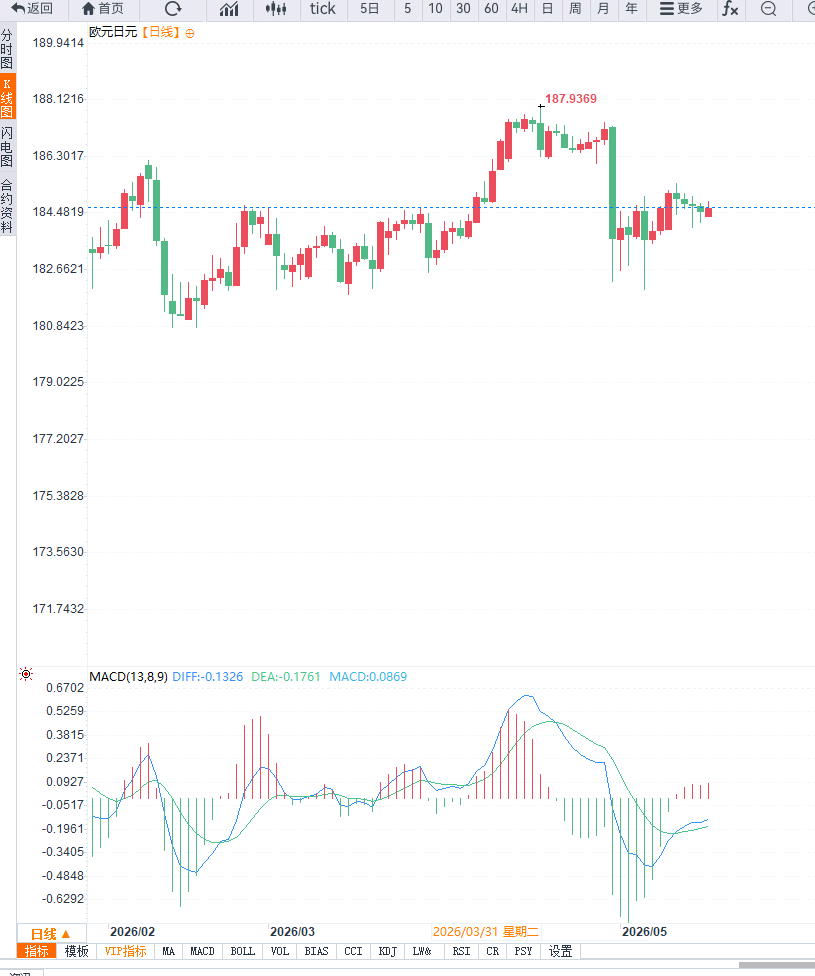
From a technical perspective, the EUR/JPY pair is currently maintaining a high-level consolidation pattern on the daily chart. The exchange rate is currently trading near the lower Bollinger Band, indicating a neutral short-term trend with insufficient market direction. The 14-day Relative Strength Index (RSI) is currently around 47.75, close to the midline, reflecting a temporary balance between bullish and bearish forces after the previous correction. The area around 184.30 has become a key technical support level.
If selling pressure intensifies again, the market may further test the support level around 183.50, which is also the low point of May 7th. A break below this level could lead to a further decline towards the lower Bollinger Band area around 182.85. On the upside, the middle Bollinger Band around 185.30 is currently a key short-term resistance level. A decisive break above this area could alleviate short-term downward pressure and open up further upside potential. If the bulls extend their gains, the market will focus on the recent high around 186.24, while stronger resistance lies in the upper Bollinger Band area around 187.78.
From the 4-hour chart, the EUR/JPY pair has shown some recovery momentum in its short-term rebound. The MACD indicator is gradually approaching the zero line, indicating weakening bearish pressure, while the RSI indicator has rebounded from its lows, suggesting improving market risk sentiment. However, in the absence of a clear breakout, the exchange rate may continue to trade within a range in the short term.
Editor's Summary:
The current euro/yen exchange rate is primarily influenced by the interplay between hawkish expectations from the European Central Bank (ECB) and expectations of a Japanese economic recovery. Hawkish signals from ECB officials have provided temporary support for the euro, but continued improvement in Japanese economic data could limit further yen weakness. In the short term, the euro/yen exchange rate is likely to maintain a high-level consolidation pattern, with the market focusing on Japanese GDP data, European inflation trends, and subsequent policy signals from the ECB.
European Central Bank (ECB) Governing Council member Yannis Stournaras recently stated that moderately raising interest rates would help curb inflation without causing significant damage to the economy. This statement was interpreted by the market as a hawkish signal, strengthening investors' expectations for further tightening by the ECB. Meanwhile, ECB Governing Council member Boris Vujcic also indicated that whether to raise interest rates further in June would depend on future economic and inflation data. The renewed strengthening of hawkish voices within the ECB has supported a short-term rebound in the euro.
The Eurozone continues to face inflationary pressures from rising energy prices. With ongoing tensions in the Middle East and international crude oil prices remaining high, markets are concerned that imported inflation in Europe may resurface. Given Europe's high dependence on energy imports, rising energy costs could further increase operating costs for businesses and strain consumer spending. This is a key reason why some officials at the European Central Bank tend to maintain a relatively tight monetary policy.
Meanwhile, the yen received some support from improved expectations for Japanese economic data. The market is focused on the upcoming release of Japan's preliminary first-quarter GDP figures. Currently, the market expects Japan's first-quarter GDP to grow by approximately 0.4% quarter-on-quarter, higher than the previous reading of 0.3%. Stronger-than-expected data could boost market confidence in Japan's economic recovery and limit further yen weakness. Improved Japanese economic data could alleviate short-term depreciation pressure on the yen.
However, the US dollar and the euro are still supported by the global high-interest-rate environment, while the Bank of Japan's monetary policy remains relatively loose, so the yen is still relatively weak overall.
From a technical perspective, the EUR/JPY pair is currently maintaining a high-level consolidation pattern on the daily chart. The exchange rate is currently trading near the lower Bollinger Band, indicating a neutral short-term trend with insufficient market direction. The 14-day Relative Strength Index (RSI) is currently around 47.75, close to the midline, reflecting a temporary balance between bullish and bearish forces after the previous correction. The area around 184.30 has become a key technical support level.
If selling pressure intensifies again, the market may further test the support level around 183.50, which is also the low point of May 7th. A break below this level could lead to a further decline towards the lower Bollinger Band area around 182.85. On the upside, the middle Bollinger Band around 185.30 is currently a key short-term resistance level. A decisive break above this area could alleviate short-term downward pressure and open up further upside potential. If the bulls extend their gains, the market will focus on the recent high around 186.24, while stronger resistance lies in the upper Bollinger Band area around 187.78.
From the 4-hour chart, the EUR/JPY pair has shown some recovery momentum in its short-term rebound. The MACD indicator is gradually approaching the zero line, indicating weakening bearish pressure, while the RSI indicator has rebounded from its lows, suggesting improving market risk sentiment. However, in the absence of a clear breakout, the exchange rate may continue to trade within a range in the short term.
Editor's Summary:
The current euro/yen exchange rate is primarily influenced by the interplay between hawkish expectations from the European Central Bank (ECB) and expectations of a Japanese economic recovery. Hawkish signals from ECB officials have provided temporary support for the euro, but continued improvement in Japanese economic data could limit further yen weakness. In the short term, the euro/yen exchange rate is likely to maintain a high-level consolidation pattern, with the market focusing on Japanese GDP data, European inflation trends, and subsequent policy signals from the ECB.
- Risk Warning and Disclaimer
- The market involves risk, and trading may not be suitable for all investors. This article is for reference only and does not constitute personal investment advice, nor does it take into account certain users’ specific investment objectives, financial situation, or other needs. Any investment decisions made based on this information are at your own risk.