Japan is issuing bonds on a large scale to stabilize people's livelihoods, with the yield on 10-year Japanese government bonds hitting a 30-year high.
2026-05-18 14:10:44
Affected by the situation in Iran pushing up international energy prices, Japan plans to introduce a special supplementary budget to alleviate domestic economic pressures, and has decided to raise funds by issuing additional government bonds.
This fiscal move directly triggered a market sell-off, causing the yield on Japanese 10-year government bonds to surge to its highest level since 1996. This move not only further exacerbates Japan's already heavy fiscal burden but will also disrupt the Bank of Japan's efforts to normalize its monetary policy. Given Japan's status as the world's largest holder of US Treasury bonds, subsequent fluctuations will also have a ripple effect on global bond markets and cross-border capital flows.

As geopolitical tensions continue to push up international oil prices, energy consumption expenditures by Japanese residents have increased significantly, leading to a continuous rise in the cost of living.
Japanese government sources revealed that the authorities will soon launch a supplementary fiscal budget specifically to offset the economic impact of rising energy prices and alleviate the financial burden on ordinary families . The relevant policy proposals will be officially announced by Japanese Prime Minister Sanae Takaichi.
Given limited available fiscal funds, Japan will rely on issuing new government bonds as the core source of funding for supplementing its budget. Prior to this, Japan's public finances were already operating under immense pressure; further increasing borrowing will undoubtedly make the overall fiscal situation increasingly fragile, fueling growing market concerns.
On Monday (May 18), the Japanese bond market saw a significant correction in early Tokyo trading, with the yield on 10-year government bonds briefly touching 2.797%, a near 30-year market record and the highest level since October 1996. The rapid rise in yields directly reflects the capital market's pessimistic expectations regarding Japan's continued balance sheet expansion and ever-growing debt.
The specific scale of this supplementary budget for relief of people's livelihoods has not yet been made public. However, the ratio of Japan's government debt to its total economy has long been among the highest of developed economies. Each round of new bond issuance will continue to increase the overall sovereign debt pressure, and long-term fiscal risks will continue to accumulate.
The Bank of Japan has long been committed to steadily normalizing its monetary policy and gradually moving away from a loose monetary environment. However, the recent sharp rise in government bond yields has added many obstacles to the central bank's policy adjustments, making it more difficult to control the pace and magnitude of interest rate adjustments, and exacerbating volatility in the domestic financial market. As a result, the yen exchange rate is also facing a new round of volatile pressure.
Amid persistently high energy prices and geopolitical conflicts that are unlikely to subside in the short term, a single supplementary budget is insufficient to completely alleviate the pressure on people's livelihoods and the economy. The market generally anticipates that Japan will introduce more fiscal support policies in the future, leading to a continued increase in the supply of government bonds, and the yields on medium- and long-term bonds will still have upward momentum.
As the world's largest holder of US Treasury bonds, Japan's domestic bond market has shown significant volatility, demonstrating a strong cross-border transmission capability. The continued rise in domestic yields in Japan will alter the asset allocation strategies of domestic funds, thereby influencing the performance of global fixed-income products.
At the same time, rising Japanese bond yields will also raise the transaction costs of various yen financing transactions, affecting cross-border capital deployments in multiple investment categories such as stocks and commodities, and potentially disrupting the overall stable operation of global financial markets. The future direction of Japan's fiscal and monetary policies will also become a key indicator for global investors.
Overall, the massive issuance of bonds to hedge against energy inflation has been the direct cause of rising long-term Japanese government bond yields, further straining Japan's already tight fiscal system. Domestically, the high debt level has disrupted the pace of monetary tightening and exacerbated domestic financial volatility; internationally, thanks to its large overseas asset holdings, fluctuations in the Japanese bond market will continue to have a ripple effect.
Before the geopolitical situation eases significantly, Japan's fiscal easing is unlikely to stop, the upward trend in bond market interest rates is unlikely to reverse in the short term, and global markets also need to be wary of a series of chain financial reactions that may be triggered by this.
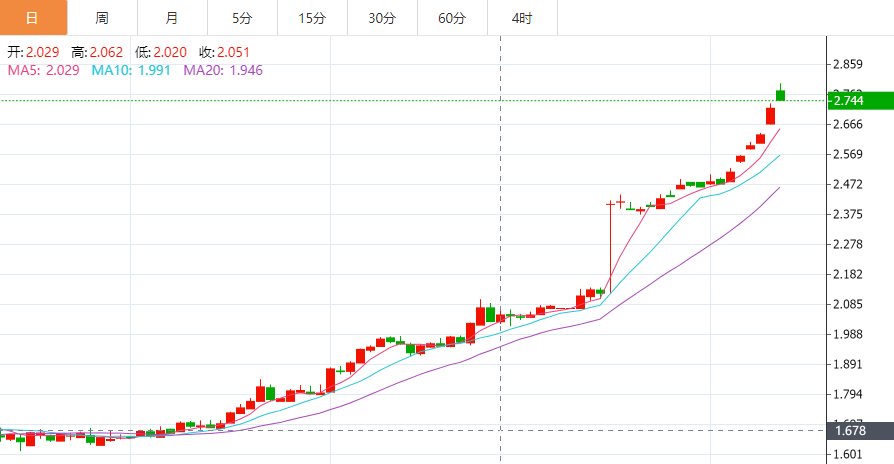
10-year Japanese government bond yield daily chart source:
At 14:05 Beijing time on May 18, the yield on 10-year Japanese government bonds was 2.738%.
This fiscal move directly triggered a market sell-off, causing the yield on Japanese 10-year government bonds to surge to its highest level since 1996. This move not only further exacerbates Japan's already heavy fiscal burden but will also disrupt the Bank of Japan's efforts to normalize its monetary policy. Given Japan's status as the world's largest holder of US Treasury bonds, subsequent fluctuations will also have a ripple effect on global bond markets and cross-border capital flows.
Japan confirms issuance of new bonds to further support people's livelihoods through fiscal stimulus.
As geopolitical tensions continue to push up international oil prices, energy consumption expenditures by Japanese residents have increased significantly, leading to a continuous rise in the cost of living.
Japanese government sources revealed that the authorities will soon launch a supplementary fiscal budget specifically to offset the economic impact of rising energy prices and alleviate the financial burden on ordinary families . The relevant policy proposals will be officially announced by Japanese Prime Minister Sanae Takaichi.
Given limited available fiscal funds, Japan will rely on issuing new government bonds as the core source of funding for supplementing its budget. Prior to this, Japan's public finances were already operating under immense pressure; further increasing borrowing will undoubtedly make the overall fiscal situation increasingly fragile, fueling growing market concerns.
The bond market experienced sharp fluctuations, with long-term interest rates surging.
On Monday (May 18), the Japanese bond market saw a significant correction in early Tokyo trading, with the yield on 10-year government bonds briefly touching 2.797%, a near 30-year market record and the highest level since October 1996. The rapid rise in yields directly reflects the capital market's pessimistic expectations regarding Japan's continued balance sheet expansion and ever-growing debt.
The specific scale of this supplementary budget for relief of people's livelihoods has not yet been made public. However, the ratio of Japan's government debt to its total economy has long been among the highest of developed economies. Each round of new bond issuance will continue to increase the overall sovereign debt pressure, and long-term fiscal risks will continue to accumulate.
Policy caught in a dilemma, central bank's adjustment pace disrupted
The Bank of Japan has long been committed to steadily normalizing its monetary policy and gradually moving away from a loose monetary environment. However, the recent sharp rise in government bond yields has added many obstacles to the central bank's policy adjustments, making it more difficult to control the pace and magnitude of interest rate adjustments, and exacerbating volatility in the domestic financial market. As a result, the yen exchange rate is also facing a new round of volatile pressure.
Amid persistently high energy prices and geopolitical conflicts that are unlikely to subside in the short term, a single supplementary budget is insufficient to completely alleviate the pressure on people's livelihoods and the economy. The market generally anticipates that Japan will introduce more fiscal support policies in the future, leading to a continued increase in the supply of government bonds, and the yields on medium- and long-term bonds will still have upward momentum.
Spillover effects become more pronounced, impacting global financial markets.
As the world's largest holder of US Treasury bonds, Japan's domestic bond market has shown significant volatility, demonstrating a strong cross-border transmission capability. The continued rise in domestic yields in Japan will alter the asset allocation strategies of domestic funds, thereby influencing the performance of global fixed-income products.
At the same time, rising Japanese bond yields will also raise the transaction costs of various yen financing transactions, affecting cross-border capital deployments in multiple investment categories such as stocks and commodities, and potentially disrupting the overall stable operation of global financial markets. The future direction of Japan's fiscal and monetary policies will also become a key indicator for global investors.
Summarize
Overall, the massive issuance of bonds to hedge against energy inflation has been the direct cause of rising long-term Japanese government bond yields, further straining Japan's already tight fiscal system. Domestically, the high debt level has disrupted the pace of monetary tightening and exacerbated domestic financial volatility; internationally, thanks to its large overseas asset holdings, fluctuations in the Japanese bond market will continue to have a ripple effect.
Before the geopolitical situation eases significantly, Japan's fiscal easing is unlikely to stop, the upward trend in bond market interest rates is unlikely to reverse in the short term, and global markets also need to be wary of a series of chain financial reactions that may be triggered by this.
10-year Japanese government bond yield daily chart source:
At 14:05 Beijing time on May 18, the yield on 10-year Japanese government bonds was 2.738%.
- Risk Warning and Disclaimer
- The market involves risk, and trading may not be suitable for all investors. This article is for reference only and does not constitute personal investment advice, nor does it take into account certain users’ specific investment objectives, financial situation, or other needs. Any investment decisions made based on this information are at your own risk.