The euro is nearing its sixth consecutive day of decline against the dollar, but hawkish sentiment from the European Central Bank is providing support.
2026-05-18 13:56:45
On Monday (May 18) during the Asian session, the euro continued its weakness against the US dollar, trading around 1.1620, and is on track for its sixth consecutive day of decline. The core reason for the euro's pressure is the broad-based strengthening of the US dollar – the Federal Reserve's shift to a more aggressive anti-inflationary policy stance, coupled with safe-haven demand stemming from ongoing geopolitical conflicts in the Middle East, has jointly pushed up the dollar's exchange rate.
Several Federal Reserve officials have recently emphasized that controlling inflation is the top priority, and even hinted that further interest rate hikes may be necessary if price pressures persist.
Boston Fed President Collins said she expects a prolonged period of stable interest rates, but also made it clear that "a scenario requiring policy tightening can be envisioned" to ensure inflation returns to 2%, noting that more than five years of inflation above target has reduced her patience.
Chicago Fed President Goolsby emphasized that in the current situation, "interest rate cuts cannot be seen as the only viable policy option." Both interest rate cuts and increases are options, and inflation "is performing poorly and has recently been heading in the wrong direction."
Kansas City Fed President Schmid believes that despite the resilience of the U.S. economy, persistent inflation remains the most pressing risk, and price levels remain too high. Overall, these officials' remarks indicate that concerns about inflation are rising within the Fed, and the option of raising interest rates has returned to the forefront.
Financial markets have quickly raised their expectations for a Federal Reserve rate hike – according to the CME FedWatch tool, the market now sees the probability of a December rate hike as rising sharply from just 14% a week ago to nearly 48%.
The Federal Reserve's hawkish shift has given the dollar a strong boost, while the continued deterioration of the situation in the Middle East has provided another layer of safe-haven buying support. The dollar benefits from its safe-haven asset status, and this advantage is being further amplified against the backdrop of the ongoing escalation of the Middle East situation. The US and Iran have yet to reach an agreement on ending the weeks-long conflict and reopening the crucial Strait of Hormuz, and the stalemate is evolving into a global energy crisis.
According to a May report by the International Energy Agency (IEA), the conflict has caused nearly 15% of global oil production to come offline, and the de facto closure of the Strait of Hormuz has resulted in a supply loss of over 14 million barrels per day, with cumulative supply losses exceeding 1 billion barrels. On May 17, US President Trump again issued a stern warning on social media, stating that Iran must act swiftly or it will "have nothing." According to US officials, Trump is expected to hold a meeting with his national security team in the White House Situation Room on May 19 to discuss options for renewed military action against Iran. Meanwhile, Israeli Prime Minister Netanyahu has spoken with Trump to discuss the possibility of resuming joint airstrikes. These developments indicate that the military conflict not only shows no signs of de-escalation but also faces the risk of further escalation.
With the Strait of Hormuz effectively still closed, global oil prices continue to climb, with Brent crude breaking through $110 per barrel, up more than 40% from pre-conflict levels. Morgan Stanley warns that if the blockade continues, oil prices could surge further to $150 per barrel.
High oil prices are forcing the European Central Bank (ECB) to intervene. The downside potential for the euro against the dollar may be limited, primarily due to market expectations of a hawkish ECB policy outlook. As geopolitical conflicts in the Middle East continue to escalate, soaring energy prices are fundamentally altering the ECB's decision-making logic, forcing the central bank to adopt a tough stance to curb inflation.
European Central Bank (ECB) policymakers have recently been sending a series of hawkish signals. Bundesbank President Nagel explicitly stated that the need for the ECB to raise borrowing costs is increasing due to the US-Iran conflict, warning that "we are no longer in the baseline scenario predicted by the Eurosystem, but are moving towards an adverse scenario." ECB Chief Economist Lane also pointed out that the energy shock may require a "sustained" monetary policy response to prevent high inflation from becoming entrenched. ECB official Kazak emphasized that if rising oil prices push up inflation expectations, the central bank must raise borrowing costs.
It is worth noting that the European Central Bank (ECB) explicitly adjusted its wording in its monetary policy statement on April 30. ECB President Christine Lagarde acknowledged that the US-Iran conflict had led to a sharp rise in energy prices, pushing up inflation and dampening economic confidence, and that upside risks to inflation had significantly increased. Although the ECB decided to keep interest rates unchanged at that time, the statement opened the door to action in June.
Market expectations are heating up rapidly. A survey shows that 85% of economists expect the European Central Bank to raise its deposit rate by 25 basis points to 2.25% in June, compared to just over half before the April meeting. More aggressive forecasts suggest two or even three rate hikes throughout 2026—one each in June and September, with a third possible before the end of the year. Standard Chartered Bank has also revised its outlook, shifting from expecting no change in interest rates for the year to betting on a 25 basis point rate hike in June.
However, the European Central Bank (ECB) faces the dilemma of "stagflation"—on the one hand, energy costs are pushing up inflation, and on the other hand, a weak economy makes interest rate decisions exceptionally difficult. Nagel has taken a tough stance on this: "Nobody likes raising interest rates when growth is under tremendous pressure, but our responsibility is to maintain price stability. We will fulfill our responsibilities—there are no excuses." Lagarde also emphasized in her April statement that although the economic outlook is highly uncertain, the ECB is "determined to ensure that inflation remains stable at the 2% target over the medium term."
The European Central Bank's hawkish shift is providing a floor for the euro. If a rate hike occurs as expected in June, and the Federal Reserve maintains high interest rates due to persistent inflation, the policy divergence between the US and Europe may converge, which will limit further downside for the euro.
The euro's sixth consecutive day of decline against the dollar was driven by two main factors: first, the Federal Reserve's hawkish shift fueled market expectations of a December rate hike; and second, escalating geopolitical conflicts in the Middle East increased the dollar's safe-haven appeal. However, the European Central Bank's own rate hike expectations may provide some buffer for the euro, limiting further declines. In the short term, the euro's movement against the dollar will depend on relative changes in the policy expectations of the US and European central banks, as well as the evolution of the geopolitical situation.
The current EUR/USD daily moving average system shows a weak, converging pattern: the 20-day moving average (MA20) (1.1709) and 100-day moving average (MA100) are above, the 200-day moving average (MA200) is in the middle, and the 50-day moving average (MA50) is at the bottom. The current price is around 1.1620, having broken below all major moving averages, indicating that bears are in control in the short term. The MA50 (1.1646) forms the first resistance level, and the 1.1680-1.1710 area, where the MA200/MA20/MA100 are located, forms a dense resistance zone. However, since the MA50 is below the MA20, a standard bearish alignment has not yet formed, and the medium-term direction remains unclear.
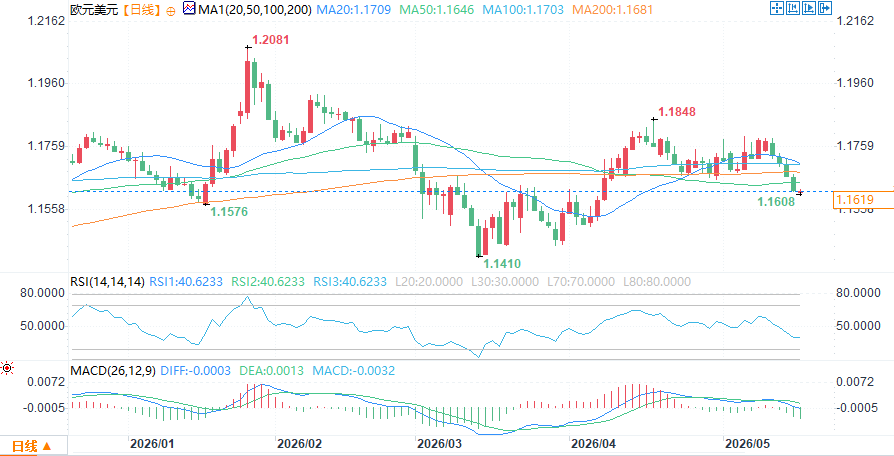
(Euro/USD daily chart, source: FX678)
In the short term, the euro/dollar exchange rate may fluctuate between 1.1576 and 1.1710. A break above 1.1650 is needed to alleviate downward pressure, and a firm hold above 1.1710 is required to confirm a strengthening trend.
At 13:56 Beijing time on May 18, the euro was trading at 1.1621/22 against the US dollar.
The Fed has shifted to a hawkish stance: Expectations for interest rate hikes have risen significantly.
Several Federal Reserve officials have recently emphasized that controlling inflation is the top priority, and even hinted that further interest rate hikes may be necessary if price pressures persist.
Boston Fed President Collins said she expects a prolonged period of stable interest rates, but also made it clear that "a scenario requiring policy tightening can be envisioned" to ensure inflation returns to 2%, noting that more than five years of inflation above target has reduced her patience.
Chicago Fed President Goolsby emphasized that in the current situation, "interest rate cuts cannot be seen as the only viable policy option." Both interest rate cuts and increases are options, and inflation "is performing poorly and has recently been heading in the wrong direction."
Kansas City Fed President Schmid believes that despite the resilience of the U.S. economy, persistent inflation remains the most pressing risk, and price levels remain too high. Overall, these officials' remarks indicate that concerns about inflation are rising within the Fed, and the option of raising interest rates has returned to the forefront.
Financial markets have quickly raised their expectations for a Federal Reserve rate hike – according to the CME FedWatch tool, the market now sees the probability of a December rate hike as rising sharply from just 14% a week ago to nearly 48%.
Geopolitical safe-haven demand: The US dollar receives additional support
The Federal Reserve's hawkish shift has given the dollar a strong boost, while the continued deterioration of the situation in the Middle East has provided another layer of safe-haven buying support. The dollar benefits from its safe-haven asset status, and this advantage is being further amplified against the backdrop of the ongoing escalation of the Middle East situation. The US and Iran have yet to reach an agreement on ending the weeks-long conflict and reopening the crucial Strait of Hormuz, and the stalemate is evolving into a global energy crisis.
According to a May report by the International Energy Agency (IEA), the conflict has caused nearly 15% of global oil production to come offline, and the de facto closure of the Strait of Hormuz has resulted in a supply loss of over 14 million barrels per day, with cumulative supply losses exceeding 1 billion barrels. On May 17, US President Trump again issued a stern warning on social media, stating that Iran must act swiftly or it will "have nothing." According to US officials, Trump is expected to hold a meeting with his national security team in the White House Situation Room on May 19 to discuss options for renewed military action against Iran. Meanwhile, Israeli Prime Minister Netanyahu has spoken with Trump to discuss the possibility of resuming joint airstrikes. These developments indicate that the military conflict not only shows no signs of de-escalation but also faces the risk of further escalation.
With the Strait of Hormuz effectively still closed, global oil prices continue to climb, with Brent crude breaking through $110 per barrel, up more than 40% from pre-conflict levels. Morgan Stanley warns that if the blockade continues, oil prices could surge further to $150 per barrel.
Euro's downside support: ECB hawkish expectations provide a buffer
High oil prices are forcing the European Central Bank (ECB) to intervene. The downside potential for the euro against the dollar may be limited, primarily due to market expectations of a hawkish ECB policy outlook. As geopolitical conflicts in the Middle East continue to escalate, soaring energy prices are fundamentally altering the ECB's decision-making logic, forcing the central bank to adopt a tough stance to curb inflation.
European Central Bank (ECB) policymakers have recently been sending a series of hawkish signals. Bundesbank President Nagel explicitly stated that the need for the ECB to raise borrowing costs is increasing due to the US-Iran conflict, warning that "we are no longer in the baseline scenario predicted by the Eurosystem, but are moving towards an adverse scenario." ECB Chief Economist Lane also pointed out that the energy shock may require a "sustained" monetary policy response to prevent high inflation from becoming entrenched. ECB official Kazak emphasized that if rising oil prices push up inflation expectations, the central bank must raise borrowing costs.
It is worth noting that the European Central Bank (ECB) explicitly adjusted its wording in its monetary policy statement on April 30. ECB President Christine Lagarde acknowledged that the US-Iran conflict had led to a sharp rise in energy prices, pushing up inflation and dampening economic confidence, and that upside risks to inflation had significantly increased. Although the ECB decided to keep interest rates unchanged at that time, the statement opened the door to action in June.
Market expectations are heating up rapidly. A survey shows that 85% of economists expect the European Central Bank to raise its deposit rate by 25 basis points to 2.25% in June, compared to just over half before the April meeting. More aggressive forecasts suggest two or even three rate hikes throughout 2026—one each in June and September, with a third possible before the end of the year. Standard Chartered Bank has also revised its outlook, shifting from expecting no change in interest rates for the year to betting on a 25 basis point rate hike in June.
However, the European Central Bank (ECB) faces the dilemma of "stagflation"—on the one hand, energy costs are pushing up inflation, and on the other hand, a weak economy makes interest rate decisions exceptionally difficult. Nagel has taken a tough stance on this: "Nobody likes raising interest rates when growth is under tremendous pressure, but our responsibility is to maintain price stability. We will fulfill our responsibilities—there are no excuses." Lagarde also emphasized in her April statement that although the economic outlook is highly uncertain, the ECB is "determined to ensure that inflation remains stable at the 2% target over the medium term."
The European Central Bank's hawkish shift is providing a floor for the euro. If a rate hike occurs as expected in June, and the Federal Reserve maintains high interest rates due to persistent inflation, the policy divergence between the US and Europe may converge, which will limit further downside for the euro.
The euro's sixth consecutive day of decline against the dollar was driven by two main factors: first, the Federal Reserve's hawkish shift fueled market expectations of a December rate hike; and second, escalating geopolitical conflicts in the Middle East increased the dollar's safe-haven appeal. However, the European Central Bank's own rate hike expectations may provide some buffer for the euro, limiting further declines. In the short term, the euro's movement against the dollar will depend on relative changes in the policy expectations of the US and European central banks, as well as the evolution of the geopolitical situation.
Prices have fallen below all moving averages, and the medium-term direction is unclear.
The current EUR/USD daily moving average system shows a weak, converging pattern: the 20-day moving average (MA20) (1.1709) and 100-day moving average (MA100) are above, the 200-day moving average (MA200) is in the middle, and the 50-day moving average (MA50) is at the bottom. The current price is around 1.1620, having broken below all major moving averages, indicating that bears are in control in the short term. The MA50 (1.1646) forms the first resistance level, and the 1.1680-1.1710 area, where the MA200/MA20/MA100 are located, forms a dense resistance zone. However, since the MA50 is below the MA20, a standard bearish alignment has not yet formed, and the medium-term direction remains unclear.
(Euro/USD daily chart, source: FX678)
In the short term, the euro/dollar exchange rate may fluctuate between 1.1576 and 1.1710. A break above 1.1650 is needed to alleviate downward pressure, and a firm hold above 1.1710 is required to confirm a strengthening trend.
At 13:56 Beijing time on May 18, the euro was trading at 1.1621/22 against the US dollar.
- Risk Warning and Disclaimer
- The market involves risk, and trading may not be suitable for all investors. This article is for reference only and does not constitute personal investment advice, nor does it take into account certain users’ specific investment objectives, financial situation, or other needs. Any investment decisions made based on this information are at your own risk.