WTI crude oil futures are poised for a third consecutive day of gains: driven by both geopolitical conflicts and tightening supply.
2026-05-18 15:38:34
On Monday (May 18) during Asian trading hours, WTI crude oil futures for July delivery continued their upward trend, rising for the third consecutive trading day, trading around $102. Drone attacks in the Middle East and escalating tensions between the US and Iran exacerbated market concerns about a global oil supply shortage, pushing oil prices higher.
The United Arab Emirates (UAE) is investigating the recent drone attack on the Barakah nuclear power plant, classifying it as a "terrorist attack" and emphasizing its full right to take responsive measures. Meanwhile, Saudi Arabia successfully intercepted three drones that entered its airspace from Iraq and warned it would take all necessary actions to defend its sovereignty and security.
Anwar Gargash, the UAE president's foreign policy advisor, issued a strong statement on social media, saying that the attack "whether carried out directly by the main perpetrators or through their proxies, signifies a dangerous escalation of the situation."
US President Donald Trump plans to meet with senior national security advisors to discuss military options against Iran, further increasing the risk of a wider conflict. According to two US officials, Trump is expected to meet with key members of his national security team in the White House Situation Room on May 19 to discuss options for renewed military action against Iran. Attendees are expected to include Vice President Vance, presidential envoy Witkov, Secretary of State Rubio, and CIA Director Ratcliffe, among other key officials.
Prior to this, Trump had spoken with Israeli Prime Minister Netanyahu on the evening of May 17, a call that lasted about half an hour, primarily discussing the possibility of resuming military strikes against Iran. According to a senior Israeli official, if the US resumes military action against Iran, a joint airstrike is expected.
Although Trump stated in an interview that he still believes Iran is willing to reach an agreement and expects Iran to submit an updated proposal in the coming days, his public statements have become increasingly hardline. On the 17th, Trump posted on social media, "Time is of the essence for Iran. They had better act quickly or they will have nothing. No time to lose!" He had previously stated in an interview that if Iran did not come up with a better solution, "our strikes against Iran will be far more powerful than ever before."
Meanwhile, Iran did not back down. A spokesperson for the Iranian Armed Forces warned the US against launching new military action against Iran, stating that any attempt to "save face" by taking further action against Iran would result in a "more severe and heavier blow" to the US. The spokesperson also stated that if the US again threatens or takes military action against Iran, US military assets and forces in the region will face a "completely new, offensive, unexpected, and storm-like response."
Adding to the already strained global oil supply, the Trump administration allowed a key exemption that allowed India to purchase seaborne oil from Russia to expire, despite the Indian government's direct request for an extension. This exemption officially expired on May 16, and the U.S. Treasury Department has not issued a renewal notice.
The United States had previously granted two exemptions. European countries have criticized the easing of sanctions as increasing Russia's energy revenue, while countries that rely on energy imports, such as India, have continued to lobby for an extension of the exemptions. India has made it clear that ensuring domestic energy stability is its top priority.
Analysts point out that pressure from Asian allies may still prompt the U.S. to issue new exemptions later.
In summary, WTI crude oil futures prices rose for the third consecutive day, primarily driven by the continued escalation of geopolitical conflicts in the Middle East—drone attacks on the UAE and Saudi Arabia, increased risks of military confrontation between the US and Iran, and the stalemate in negotiations to reopen the Strait of Hormuz. Meanwhile, the US refusal to extend the waiver for India to purchase Russian oil further tightened global supply. Under the combined pressure of multiple supply-side factors, oil prices are expected to remain strong in the short term; their future trajectory will depend on whether the situation in the Middle East deteriorates further and whether there are any signs of easing the blockade of the Strait of Hormuz.
The current technical outlook for the US crude oil July contract shows a strong bullish signal, with multiple indicators converging to confirm the sustainability of the medium-term upward trend.
In terms of the moving average system, a textbook bullish alignment is presented: MA20 (95.39) > MA50 (89.72) > MA100 (75.97) > MA200 (68.01), with short-term moving averages above long-term moving averages, a typical technical structure for a medium- to long-term bull market. The current price is trading in the $102-$104 range, significantly higher than all major moving averages, indicating that the bulls are in absolute control. The MA20 (95.39) serves as short-term dynamic support, and the price has effectively held above it, with the average holding cost over the past 20 trading days forming a solid bottom. The MA50 (89.72) is diverging upwards, forming a solid short-term support zone with the MA20. The widening gap between the MA100 and MA200 further confirms the sustainability of the medium- to long-term upward trend. No death cross or weakening signals have appeared in the moving average system, suggesting a high probability of trend continuation.
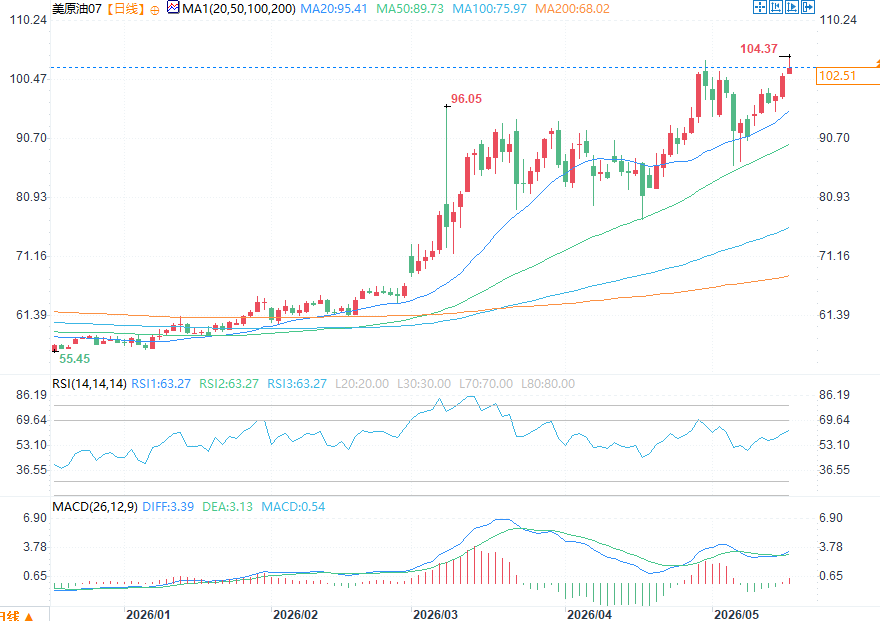
(Daily chart of US crude oil futures July contract, source: FX678)
The current price is trading in the $102-$104 range, significantly above all major moving averages, indicating that bulls are in absolute control. The 20-day moving average (MA20) (99.79) serves as short-term dynamic support, and the price has effectively held above it, with the average holding cost over the past 20 trading days forming a solid bottom. The 50-day moving average (MA50) (97.37) is trending upwards, forming a solid short-term support zone with the MA20. The widening gap between the 100-day and 200-day moving averages confirms the sustainability of the medium- to long-term upward trend. No death cross or weakening signals have appeared in the moving average system, suggesting a high probability of trend continuation. Technical targets are the previous highs of $107.90 and $119.48.
Escalating tensions in the Middle East: Drone attacks trigger supply panic
The United Arab Emirates (UAE) is investigating the recent drone attack on the Barakah nuclear power plant, classifying it as a "terrorist attack" and emphasizing its full right to take responsive measures. Meanwhile, Saudi Arabia successfully intercepted three drones that entered its airspace from Iraq and warned it would take all necessary actions to defend its sovereignty and security.
Anwar Gargash, the UAE president's foreign policy advisor, issued a strong statement on social media, saying that the attack "whether carried out directly by the main perpetrators or through their proxies, signifies a dangerous escalation of the situation."
The risk of conflict between the US and Iran is escalating.
US President Donald Trump plans to meet with senior national security advisors to discuss military options against Iran, further increasing the risk of a wider conflict. According to two US officials, Trump is expected to meet with key members of his national security team in the White House Situation Room on May 19 to discuss options for renewed military action against Iran. Attendees are expected to include Vice President Vance, presidential envoy Witkov, Secretary of State Rubio, and CIA Director Ratcliffe, among other key officials.
Prior to this, Trump had spoken with Israeli Prime Minister Netanyahu on the evening of May 17, a call that lasted about half an hour, primarily discussing the possibility of resuming military strikes against Iran. According to a senior Israeli official, if the US resumes military action against Iran, a joint airstrike is expected.
Although Trump stated in an interview that he still believes Iran is willing to reach an agreement and expects Iran to submit an updated proposal in the coming days, his public statements have become increasingly hardline. On the 17th, Trump posted on social media, "Time is of the essence for Iran. They had better act quickly or they will have nothing. No time to lose!" He had previously stated in an interview that if Iran did not come up with a better solution, "our strikes against Iran will be far more powerful than ever before."
Meanwhile, Iran did not back down. A spokesperson for the Iranian Armed Forces warned the US against launching new military action against Iran, stating that any attempt to "save face" by taking further action against Iran would result in a "more severe and heavier blow" to the US. The spokesperson also stated that if the US again threatens or takes military action against Iran, US military assets and forces in the region will face a "completely new, offensive, unexpected, and storm-like response."
Supply-side pressures continue to accumulate
Adding to the already strained global oil supply, the Trump administration allowed a key exemption that allowed India to purchase seaborne oil from Russia to expire, despite the Indian government's direct request for an extension. This exemption officially expired on May 16, and the U.S. Treasury Department has not issued a renewal notice.
The United States had previously granted two exemptions. European countries have criticized the easing of sanctions as increasing Russia's energy revenue, while countries that rely on energy imports, such as India, have continued to lobby for an extension of the exemptions. India has made it clear that ensuring domestic energy stability is its top priority.
Analysts point out that pressure from Asian allies may still prompt the U.S. to issue new exemptions later.
In summary, WTI crude oil futures prices rose for the third consecutive day, primarily driven by the continued escalation of geopolitical conflicts in the Middle East—drone attacks on the UAE and Saudi Arabia, increased risks of military confrontation between the US and Iran, and the stalemate in negotiations to reopen the Strait of Hormuz. Meanwhile, the US refusal to extend the waiver for India to purchase Russian oil further tightened global supply. Under the combined pressure of multiple supply-side factors, oil prices are expected to remain strong in the short term; their future trajectory will depend on whether the situation in the Middle East deteriorates further and whether there are any signs of easing the blockade of the Strait of Hormuz.
Moving average system: Standard bullish alignment
The current technical outlook for the US crude oil July contract shows a strong bullish signal, with multiple indicators converging to confirm the sustainability of the medium-term upward trend.
In terms of the moving average system, a textbook bullish alignment is presented: MA20 (95.39) > MA50 (89.72) > MA100 (75.97) > MA200 (68.01), with short-term moving averages above long-term moving averages, a typical technical structure for a medium- to long-term bull market. The current price is trading in the $102-$104 range, significantly higher than all major moving averages, indicating that the bulls are in absolute control. The MA20 (95.39) serves as short-term dynamic support, and the price has effectively held above it, with the average holding cost over the past 20 trading days forming a solid bottom. The MA50 (89.72) is diverging upwards, forming a solid short-term support zone with the MA20. The widening gap between the MA100 and MA200 further confirms the sustainability of the medium- to long-term upward trend. No death cross or weakening signals have appeared in the moving average system, suggesting a high probability of trend continuation.
(Daily chart of US crude oil futures July contract, source: FX678)
The current price is trading in the $102-$104 range, significantly above all major moving averages, indicating that bulls are in absolute control. The 20-day moving average (MA20) (99.79) serves as short-term dynamic support, and the price has effectively held above it, with the average holding cost over the past 20 trading days forming a solid bottom. The 50-day moving average (MA50) (97.37) is trending upwards, forming a solid short-term support zone with the MA20. The widening gap between the 100-day and 200-day moving averages confirms the sustainability of the medium- to long-term upward trend. No death cross or weakening signals have appeared in the moving average system, suggesting a high probability of trend continuation. Technical targets are the previous highs of $107.90 and $119.48.
- Risk Warning and Disclaimer
- The market involves risk, and trading may not be suitable for all investors. This article is for reference only and does not constitute personal investment advice, nor does it take into account certain users’ specific investment objectives, financial situation, or other needs. Any investment decisions made based on this information are at your own risk.