The US dollar index broke through the 99 mark, hitting a six-week high, with the situation in the Middle East and expectations of interest rate hikes dominating global market volatility.
2026-05-18 16:07:26
The US dollar index continued its strength during Monday's European trading session, rising above 99.25, its highest level since April 8. Increased risk aversion in the market, coupled with investors raising their bets on further interest rate hikes by the Federal Reserve, jointly propelled the dollar's continued strength. According to data from the CME Group's FedWatch tool, the market has now priced in a probability of another 25 basis point rate hike by the Fed in December at nearly 44.6%, a significant increase compared to the previous week.

The market has repriced in expectations of "prolonged high interest rates," pushing the dollar index to a new high for the period. Recently, several Federal Reserve officials have repeatedly emphasized that controlling inflation remains the top priority and hinted that further tightening of monetary policy cannot be ruled out if price pressures resurface. Meanwhile, the escalating situation in the Middle East has further strengthened the demand for the dollar as a safe haven.
US President Donald Trump warned Iran that "time is running out" and that the situation could worsen if negotiations remain stalled. Trump plans to convene a National Security Council meeting on Tuesday to discuss military options against Iran. The escalating tensions in the Middle East have driven safe-haven funds back into the US dollar market.
One of the biggest concerns in the market right now is the continued risk to shipping through the Strait of Hormuz. As one of the world's most important energy transport routes, the Strait of Hormuz handles approximately 20% of global seaborne crude oil shipments. If shipping continues to be disrupted, international oil prices could rise further, thereby reigniting global inflationary pressures.
Rising international energy prices are also altering market expectations regarding the policy path of global central banks. There is widespread concern that if oil prices remain high, the Federal Reserve, the European Central Bank, and the Bank of England may be forced to maintain high interest rates for an extended period.
Amid high energy prices and persistently high financing costs, the market is concerned that the global economy may face a complex situation of "slower growth and high inflation coexisting".
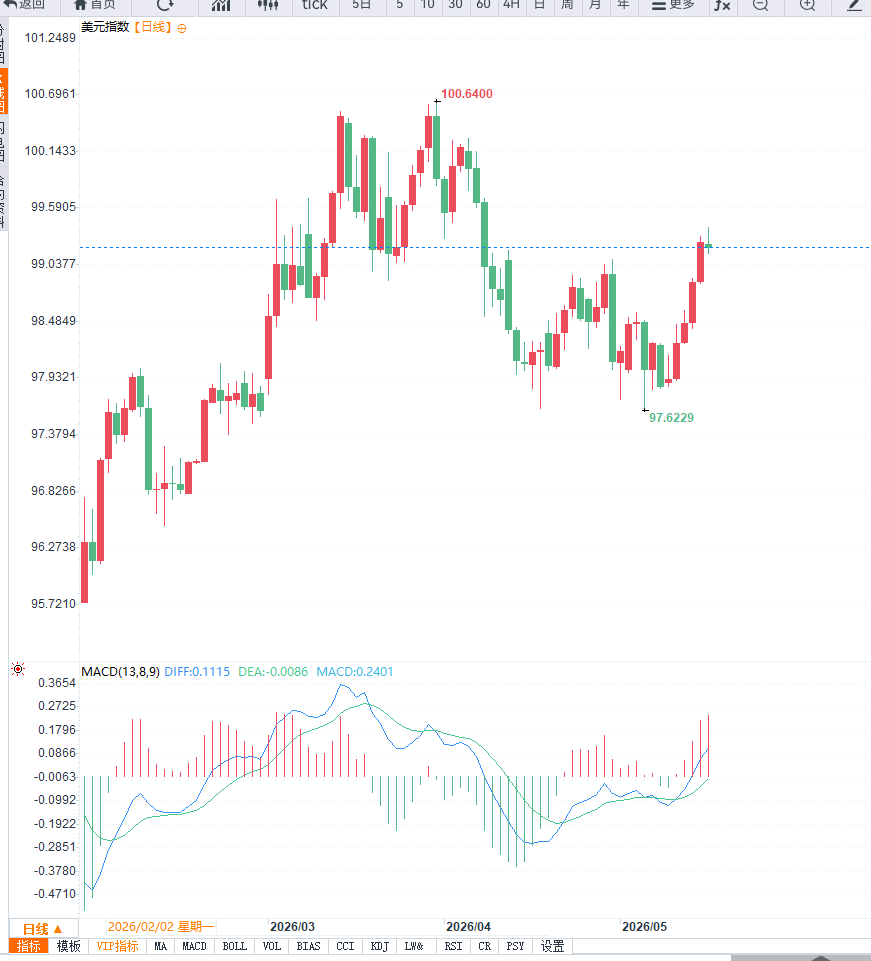
From a technical perspective, the US dollar index has formed a clear breakout pattern on the daily chart. The index has held above the 20-day and 50-day moving averages for several consecutive trading days and successfully broke through the key resistance area of 98.80, indicating a strengthening medium-term uptrend. The 14-day RSI is currently around 67, approaching overbought territory, suggesting a significant increase in bullish sentiment, but a short-term technical pullback is also possible. The MACD indicator remains above the zero line, with the red bars expanding further, indicating strong upward momentum. The current level around 99.50 is the first stage resistance level for the US dollar index. A successful break above this level could open up further upside potential, testing the 100.20 to 100.50 area. On the downside, 98.80 has transformed from resistance into a key short-term support level, with further key support located around the 50-day moving average near 97.90.
From the 4-hour chart, the US dollar index maintains a typical upward channel structure in the short term. While the MACD indicator remains in the strong zone, the red bars have begun to shorten, indicating a slight slowdown in short-term bullish momentum. Meanwhile, the RSI indicator, after entering the overbought zone, has begun to decline slightly, suggesting that the US dollar index may enter a period of high-level consolidation in the short term. However, the 4-hour moving average system still maintains a bullish alignment, indicating that the overall trend has not changed. If the US dollar index continues to hold above 99.00, the market may further test the 100 level; conversely, if it falls below 98.80, it may enter a short-term technical correction phase. The 99 level has become the current short-term dividing line between strength and weakness for the US dollar index.
Editor's Summary:
The global financial markets are currently being influenced by three factors: escalating tensions in the Middle East, energy-driven inflation, and hawkish expectations from the Federal Reserve. The US dollar index has reached a new high, driven by safe-haven demand and expectations of high interest rates, while non-US currencies and precious metals generally remain under pressure. Meanwhile, concerns about a global economic slowdown are also fueling market risk aversion. Going forward, market focus will be on developments in the Middle East, changes in expectations regarding Federal Reserve policy, and the trajectory of international oil prices.
The market has repriced in expectations of "prolonged high interest rates," pushing the dollar index to a new high for the period. Recently, several Federal Reserve officials have repeatedly emphasized that controlling inflation remains the top priority and hinted that further tightening of monetary policy cannot be ruled out if price pressures resurface. Meanwhile, the escalating situation in the Middle East has further strengthened the demand for the dollar as a safe haven.
US President Donald Trump warned Iran that "time is running out" and that the situation could worsen if negotiations remain stalled. Trump plans to convene a National Security Council meeting on Tuesday to discuss military options against Iran. The escalating tensions in the Middle East have driven safe-haven funds back into the US dollar market.
One of the biggest concerns in the market right now is the continued risk to shipping through the Strait of Hormuz. As one of the world's most important energy transport routes, the Strait of Hormuz handles approximately 20% of global seaborne crude oil shipments. If shipping continues to be disrupted, international oil prices could rise further, thereby reigniting global inflationary pressures.
Rising international energy prices are also altering market expectations regarding the policy path of global central banks. There is widespread concern that if oil prices remain high, the Federal Reserve, the European Central Bank, and the Bank of England may be forced to maintain high interest rates for an extended period.
Amid high energy prices and persistently high financing costs, the market is concerned that the global economy may face a complex situation of "slower growth and high inflation coexisting".
From a technical perspective, the US dollar index has formed a clear breakout pattern on the daily chart. The index has held above the 20-day and 50-day moving averages for several consecutive trading days and successfully broke through the key resistance area of 98.80, indicating a strengthening medium-term uptrend. The 14-day RSI is currently around 67, approaching overbought territory, suggesting a significant increase in bullish sentiment, but a short-term technical pullback is also possible. The MACD indicator remains above the zero line, with the red bars expanding further, indicating strong upward momentum. The current level around 99.50 is the first stage resistance level for the US dollar index. A successful break above this level could open up further upside potential, testing the 100.20 to 100.50 area. On the downside, 98.80 has transformed from resistance into a key short-term support level, with further key support located around the 50-day moving average near 97.90.
From the 4-hour chart, the US dollar index maintains a typical upward channel structure in the short term. While the MACD indicator remains in the strong zone, the red bars have begun to shorten, indicating a slight slowdown in short-term bullish momentum. Meanwhile, the RSI indicator, after entering the overbought zone, has begun to decline slightly, suggesting that the US dollar index may enter a period of high-level consolidation in the short term. However, the 4-hour moving average system still maintains a bullish alignment, indicating that the overall trend has not changed. If the US dollar index continues to hold above 99.00, the market may further test the 100 level; conversely, if it falls below 98.80, it may enter a short-term technical correction phase. The 99 level has become the current short-term dividing line between strength and weakness for the US dollar index.
Editor's Summary:
The global financial markets are currently being influenced by three factors: escalating tensions in the Middle East, energy-driven inflation, and hawkish expectations from the Federal Reserve. The US dollar index has reached a new high, driven by safe-haven demand and expectations of high interest rates, while non-US currencies and precious metals generally remain under pressure. Meanwhile, concerns about a global economic slowdown are also fueling market risk aversion. Going forward, market focus will be on developments in the Middle East, changes in expectations regarding Federal Reserve policy, and the trajectory of international oil prices.
- Risk Warning and Disclaimer
- The market involves risk, and trading may not be suitable for all investors. This article is for reference only and does not constitute personal investment advice, nor does it take into account certain users’ specific investment objectives, financial situation, or other needs. Any investment decisions made based on this information are at your own risk.