The European Central Bank is expected to raise interest rates in June, but one variable could reverse everything.
2026-05-18 16:08:46
The Societe Generale team pointed out that the European Central Bank emphasized in its latest Economic Bulletin that the oil shock triggered by the Middle East conflict will have a greater impact on inflation than on economic activity, but the impact on confidence may drag down economic growth in 2027.
The team added that if business surveys show only minor fluctuations in economic activity and renewed price pressures, expectations for a June rate hike by the European Central Bank will be largely solidified—unless there is a sharp and clear easing of tensions in the Middle East.
The European Central Bank published an analysis in its Economic Bulletin entitled "How the Middle East Wars Affect Household Savings and the Economy." The article confirms that the impact of oil price shocks on inflation will be greater than their impact on economic activity. However, it also points out that if household confidence overreacts, the blow to economic activity could be far greater than expected.
However, the drag on the economy from declining confidence will take longer to materialize: it will have a limited impact on GDP growth in 2026, but will have a significant negative effect on growth in 2027.
European Central Bank Executive Board member Panetta also warned that leading indicators, particularly declining household confidence, suggest the real economy may be slowing down.
European Central Bank Vice President Guindos stated more bluntly that even if a ceasefire agreement is reached soon, the conflict will leave "scars," with some infrastructure already destroyed and consumer confidence declining. "Key indicators are already declining," he said, adding that "the impact on confidence is sometimes underestimated."
Societe Generale warned that if price pressures resurface and extend to the service sector, this would clearly be seen as an ominous sign by central bank policymakers. The stickiness of inflation in the service sector is often a key indicator for central banks to determine whether inflation is deeply entrenched.
The European Central Bank (ECB) clearly stated in its March monetary policy statement that upside risks to inflation are intensifying, with particular attention needed to whether rising energy prices could spread to a wider price range through a "second-round effect." The second-round effect refers to the initial energy shock being reflected in a sustained rise in services and core inflation through cost transmission, wage negotiations, and inflation expectations. ECB President Christine Lagarde emphasized at a press conference on March 19th: "If it persists, higher energy prices could indirectly trigger a broader rise in inflation through a second-round effect—a situation that needs close monitoring."
The latest data has sent warning signals. The Eurozone's services PMI fell sharply to 50.1 in March, a new low since May last year, with new orders in the services sector declining for the first time in eight months. Meanwhile, services inflation stubbornly remains above 3.2%, showing no signs of decline for three consecutive months. The European Central Bank's April interest rate statement also acknowledged that while energy prices are currently the main driver of inflation, "if energy prices remain high for an extended period, their indirect impact on inflation could widen further."
Societe Generale concluded that, in either scenario, if the economic activity index fluctuates only slightly while the price index continues to point upward, it will help dispel any remaining market concerns about a June rate hike. The only scenario that could halt this process is a sudden and clear easing of tensions in the Middle East.
Societe Generale believes that a June rate hike by the European Central Bank is almost a "data confirmation" rather than a "directional game." The oil shock has transmitted inflation faster than it has dragged down growth, and the confidence effect will have a limited impact on growth in 2026, providing the central bank with policy space to act in the short term. The only variable currently hindering a rate hike is a sharp easing of tensions in the Middle East. Therefore, business survey data in the coming weeks—especially the services price sub-index—will be the core basis for the market to judge the probability of a June rate hike.
Market expectations for a June rate hike by the European Central Bank are already being priced into the euro exchange rate. As of the Asian session on May 18, the euro rebounded slightly against the US dollar after hitting a six-week low of 1.1608, and is currently trading around 1.1632, up 0.08% on the day, but still under pressure for the sixth consecutive trading day.
UOB analysts pointed out that although there has been a short-term technical rebound, strong downward momentum indicates that the euro still faces downside risks. If it breaks below the 1.1600 level, the next target will be 1.1570.
Looking at the daily chart for EUR/USD, the euro has broken below the key support level of 1.1700 and is currently trading below the 100-day and 200-day moving averages. Resistance lies in the 1.1650 and 1.1685 area. The current rebound from 1.1632 has been limited and insufficient to confirm a trend reversal. This means that even if the ECB raises interest rates as expected in June, it remains questionable whether the euro will receive a substantial boost—if the rate hike has already been fully priced in, the euro may experience a "buy the rumor, sell the fact" scenario.
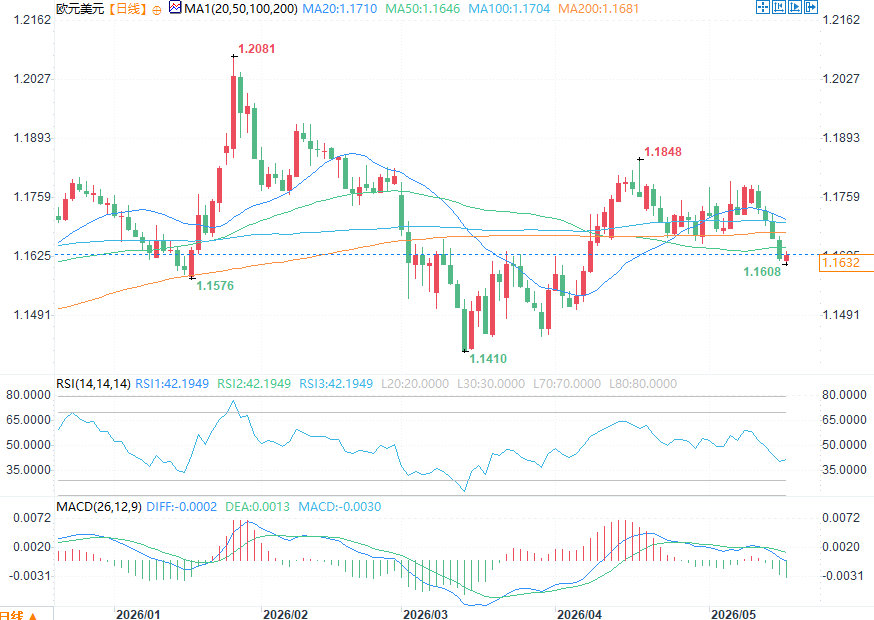
(Euro/USD daily chart, source: FX678)
It's worth noting that the core driver of the current euro weakness is not the interest rate differential between the US and Europe, but rather geopolitics. Analysts point out that if the euro's weakness were merely due to economic data or monetary policy disagreements, the decline would typically only last one or two days; however, the fact that it has fallen for several consecutive days indicates that the larger driving factor is geopolitical risks in the Middle East. Even if the European Central Bank raises interest rates, the euro may continue to be under pressure if tensions in the Middle East remain high. Whether the area around 1.1600 can become a short-term bottom will depend on whether there are signs of easing tensions in the Middle East and the tone of this week's Federal Reserve meeting minutes.
The team added that if business surveys show only minor fluctuations in economic activity and renewed price pressures, expectations for a June rate hike by the European Central Bank will be largely solidified—unless there is a sharp and clear easing of tensions in the Middle East.
The oil shock: its impact on inflation is greater than on growth, but the confidence effect is delayed.
The European Central Bank published an analysis in its Economic Bulletin entitled "How the Middle East Wars Affect Household Savings and the Economy." The article confirms that the impact of oil price shocks on inflation will be greater than their impact on economic activity. However, it also points out that if household confidence overreacts, the blow to economic activity could be far greater than expected.
However, the drag on the economy from declining confidence will take longer to materialize: it will have a limited impact on GDP growth in 2026, but will have a significant negative effect on growth in 2027.
European Central Bank Executive Board member Panetta also warned that leading indicators, particularly declining household confidence, suggest the real economy may be slowing down.
European Central Bank Vice President Guindos stated more bluntly that even if a ceasefire agreement is reached soon, the conflict will leave "scars," with some infrastructure already destroyed and consumer confidence declining. "Key indicators are already declining," he said, adding that "the impact on confidence is sometimes underestimated."
If price pressures spread to the service sector, it will serve as a warning signal for the central bank.
Societe Generale warned that if price pressures resurface and extend to the service sector, this would clearly be seen as an ominous sign by central bank policymakers. The stickiness of inflation in the service sector is often a key indicator for central banks to determine whether inflation is deeply entrenched.
The European Central Bank (ECB) clearly stated in its March monetary policy statement that upside risks to inflation are intensifying, with particular attention needed to whether rising energy prices could spread to a wider price range through a "second-round effect." The second-round effect refers to the initial energy shock being reflected in a sustained rise in services and core inflation through cost transmission, wage negotiations, and inflation expectations. ECB President Christine Lagarde emphasized at a press conference on March 19th: "If it persists, higher energy prices could indirectly trigger a broader rise in inflation through a second-round effect—a situation that needs close monitoring."
The latest data has sent warning signals. The Eurozone's services PMI fell sharply to 50.1 in March, a new low since May last year, with new orders in the services sector declining for the first time in eight months. Meanwhile, services inflation stubbornly remains above 3.2%, showing no signs of decline for three consecutive months. The European Central Bank's April interest rate statement also acknowledged that while energy prices are currently the main driver of inflation, "if energy prices remain high for an extended period, their indirect impact on inflation could widen further."
June rate hike expectations: Data will determine the outcome, geopolitical easing is the only variable.
Societe Generale concluded that, in either scenario, if the economic activity index fluctuates only slightly while the price index continues to point upward, it will help dispel any remaining market concerns about a June rate hike. The only scenario that could halt this process is a sudden and clear easing of tensions in the Middle East.
Societe Generale believes that a June rate hike by the European Central Bank is almost a "data confirmation" rather than a "directional game." The oil shock has transmitted inflation faster than it has dragged down growth, and the confidence effect will have a limited impact on growth in 2026, providing the central bank with policy space to act in the short term. The only variable currently hindering a rate hike is a sharp easing of tensions in the Middle East. Therefore, business survey data in the coming weeks—especially the services price sub-index—will be the core basis for the market to judge the probability of a June rate hike.
Has the euro exchange rate already priced in the expected June rate hike?
Market expectations for a June rate hike by the European Central Bank are already being priced into the euro exchange rate. As of the Asian session on May 18, the euro rebounded slightly against the US dollar after hitting a six-week low of 1.1608, and is currently trading around 1.1632, up 0.08% on the day, but still under pressure for the sixth consecutive trading day.
UOB analysts pointed out that although there has been a short-term technical rebound, strong downward momentum indicates that the euro still faces downside risks. If it breaks below the 1.1600 level, the next target will be 1.1570.
Looking at the daily chart for EUR/USD, the euro has broken below the key support level of 1.1700 and is currently trading below the 100-day and 200-day moving averages. Resistance lies in the 1.1650 and 1.1685 area. The current rebound from 1.1632 has been limited and insufficient to confirm a trend reversal. This means that even if the ECB raises interest rates as expected in June, it remains questionable whether the euro will receive a substantial boost—if the rate hike has already been fully priced in, the euro may experience a "buy the rumor, sell the fact" scenario.
(Euro/USD daily chart, source: FX678)
It's worth noting that the core driver of the current euro weakness is not the interest rate differential between the US and Europe, but rather geopolitics. Analysts point out that if the euro's weakness were merely due to economic data or monetary policy disagreements, the decline would typically only last one or two days; however, the fact that it has fallen for several consecutive days indicates that the larger driving factor is geopolitical risks in the Middle East. Even if the European Central Bank raises interest rates, the euro may continue to be under pressure if tensions in the Middle East remain high. Whether the area around 1.1600 can become a short-term bottom will depend on whether there are signs of easing tensions in the Middle East and the tone of this week's Federal Reserve meeting minutes.
- Risk Warning and Disclaimer
- The market involves risk, and trading may not be suitable for all investors. This article is for reference only and does not constitute personal investment advice, nor does it take into account certain users’ specific investment objectives, financial situation, or other needs. Any investment decisions made based on this information are at your own risk.