Has Asia's worst currency emerged? Bullish moving average alignment confirms a medium-term uptrend.
2026-05-18 16:35:38
Michael Wan, an analyst at MUFG Bank, pointed out that the Indian rupee is the worst-performing major Asian currency in 2026, having fallen to above 96 against the US dollar, a record low, and has depreciated by about 5.5% since the outbreak of the conflict with Iran at the end of February.
Wan emphasized that the Indian rupee is highly sensitive to rising oil prices and soaring US Treasury yields, and pointed out that Indian authorities have acted swiftly to support the currency exchange rate and foreign exchange reserves by tightening silver import rules.
In the report, Wan wrote: "The Indian rupee is the most prominent victim, falling below the historic 96 rupees to the US dollar for the first time last Friday. It has depreciated by about 5.5% since the outbreak of the conflict with Iran at the end of February, making it the worst-performing major currency in Asia in 2026."
It is worth noting that the rapid depletion of foreign exchange reserves has attracted market attention. Since the outbreak of the Middle East conflict, India's foreign exchange reserves have decreased by approximately $38 billion. As of the week ending May 8, they had slightly rebounded to $69.699 billion, but remained below the historical peak of $72.849 billion on February 27 before the conflict. Economists generally believe that despite the decline in reserve levels, India still has sufficient reserves to cope with shocks, with current import coverage days at approximately nine months, far exceeding the seven months during the 2013 "taper tantrum."
He further pointed out that this predicament is particularly severe for oil-importing countries. "Oil-importing currencies such as the Indian rupee and the Philippine peso are facing a double blow from rising oil prices and soaring US Treasury yields. In addition, currencies such as the Indonesian rupiah, which have their own domestic resistance and are sensitive to US Treasury yields, are also under pressure."
As the world's third-largest crude oil importer, India is over 60% dependent on Middle Eastern oil. The ongoing blockade of the Strait of Hormuz directly impacts its energy supply, causing a sharp rise in India's fuel import costs. The trade deficit widened to $28.38 billion in April, far exceeding March's $20.6 billion. According to industry forecasts, the Middle East conflict will significantly increase India's current account deficit as a percentage of GDP from 0.9% in the previous fiscal year to 2.5% in the next, making it difficult to alleviate the pressure on the rupee to depreciate in the short term.
In an effort to defend its currency, India acted swiftly over the weekend to further tighten its precious metal import policy. On May 16, the Indian government issued an order classifying silver bars with a purity of 99.9% or higher, as well as all other semi-finished forms of silver, into a "restricted" category, requiring prior government approval for their import. These two categories of silver accounted for over 90% of India's total silver imports in the previous fiscal year, meaning that virtually all forms of silver imports are now restricted.
This is the second precious metal import restriction measure introduced by India within a week. Previously, on May 13th, India significantly increased import tariffs on gold and silver from 6% to 15%, aiming to reduce the trade deficit and decrease foreign exchange consumption. India is the world's largest consumer of silver, relying on imports for over 80% of its demand. In the 2025/26 fiscal year ending in March, India's silver imports reached a record high of $12 billion, far exceeding the $4.8 billion of the previous fiscal year; in April, silver imports increased by 157% year-on-year to $411 million. Behind the surge in imports is strong investment demand for precious metals – with expectations of rupee depreciation, silver and gold have become hedging tools.
Market analysts point out that this move is expected to tighten the domestic silver supply in India, potentially pushing up local market premiums, while cooling demand from India may put pressure on international silver prices. A precious metals trader at a Mumbai private bank stated that the government may allow limited imports of industrial silver in the short term, but will suppress imports related to investment products. However, industry insiders also warn that tariffs as high as 15% and import restrictions could stimulate a resurgence of the gray market, such as silver smuggling, which could become a thorny issue for the Indian government's next regulatory steps.
In summary, the Indian rupee has fallen to a historic low, becoming the most vulnerable currency in Asia amid the Middle East conflict. The "double whammy" of soaring oil prices and rising US Treasury yields has put pressure on the currencies of oil-importing countries, with India being particularly hard hit due to its massive energy import needs and high dependence on external financing. In response, Indian authorities have taken policy measures such as tightening silver import rules to reduce unnecessary foreign exchange outflows and stabilize the rupee's exchange rate. However, with the ongoing stalemate in the Strait of Hormuz and persistently high oil prices, the downward pressure on the rupee is unlikely to ease significantly in the short term.
The USD/INR exchange rate has broken through the 96 mark, reaching a new historical high. The moving average system presents a textbook bullish alignment: MA20 (94.84) > MA50 (93.78) > MA100 (92.31) > MA200 (90.44). Short-term moving averages are above long-term moving averages, and the price is far above all major moving averages, which is a typical technical structure for a medium- to long-term bull market. The MA20 (94.84), serving as short-term dynamic support, and the MA200 (90.44), serving as a long-term bull-bear dividing line, have both been significantly lowered, confirming the sustainability of the medium- to long-term upward trend.
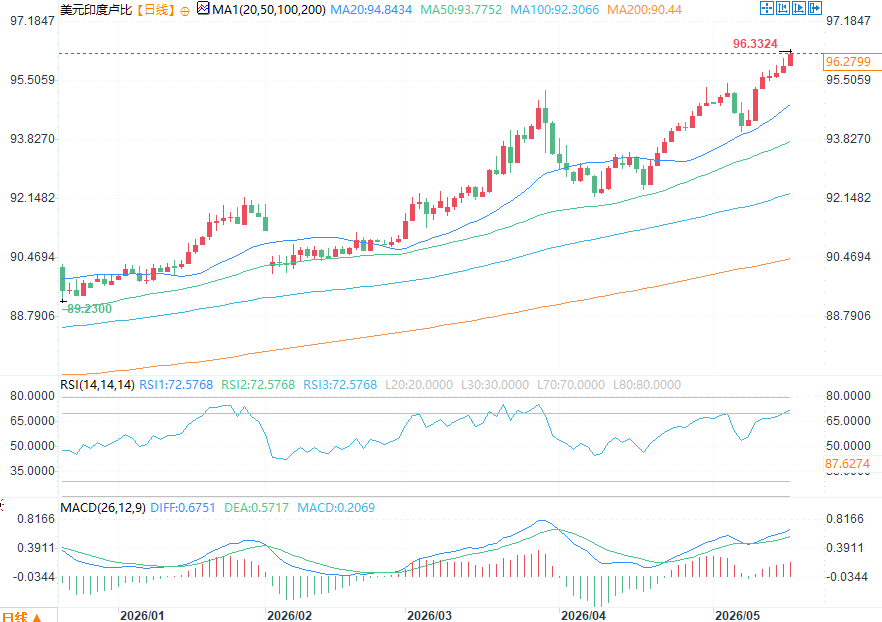
(USD/INR daily chart, source: FX678)
At 16:16 Beijing time on May 18, the US dollar was trading at 96.28/29 against the Indian rupee.
Wan emphasized that the Indian rupee is highly sensitive to rising oil prices and soaring US Treasury yields, and pointed out that Indian authorities have acted swiftly to support the currency exchange rate and foreign exchange reserves by tightening silver import rules.
The rupee fell to a record low, becoming the worst-performing currency in Asia.
In the report, Wan wrote: "The Indian rupee is the most prominent victim, falling below the historic 96 rupees to the US dollar for the first time last Friday. It has depreciated by about 5.5% since the outbreak of the conflict with Iran at the end of February, making it the worst-performing major currency in Asia in 2026."
It is worth noting that the rapid depletion of foreign exchange reserves has attracted market attention. Since the outbreak of the Middle East conflict, India's foreign exchange reserves have decreased by approximately $38 billion. As of the week ending May 8, they had slightly rebounded to $69.699 billion, but remained below the historical peak of $72.849 billion on February 27 before the conflict. Economists generally believe that despite the decline in reserve levels, India still has sufficient reserves to cope with shocks, with current import coverage days at approximately nine months, far exceeding the seven months during the 2013 "taper tantrum."
Oil-importing countries face a "double blow".
He further pointed out that this predicament is particularly severe for oil-importing countries. "Oil-importing currencies such as the Indian rupee and the Philippine peso are facing a double blow from rising oil prices and soaring US Treasury yields. In addition, currencies such as the Indonesian rupiah, which have their own domestic resistance and are sensitive to US Treasury yields, are also under pressure."
As the world's third-largest crude oil importer, India is over 60% dependent on Middle Eastern oil. The ongoing blockade of the Strait of Hormuz directly impacts its energy supply, causing a sharp rise in India's fuel import costs. The trade deficit widened to $28.38 billion in April, far exceeding March's $20.6 billion. According to industry forecasts, the Middle East conflict will significantly increase India's current account deficit as a percentage of GDP from 0.9% in the previous fiscal year to 2.5% in the next, making it difficult to alleviate the pressure on the rupee to depreciate in the short term.
India swiftly intervened, tightening rules on silver imports.
In an effort to defend its currency, India acted swiftly over the weekend to further tighten its precious metal import policy. On May 16, the Indian government issued an order classifying silver bars with a purity of 99.9% or higher, as well as all other semi-finished forms of silver, into a "restricted" category, requiring prior government approval for their import. These two categories of silver accounted for over 90% of India's total silver imports in the previous fiscal year, meaning that virtually all forms of silver imports are now restricted.
This is the second precious metal import restriction measure introduced by India within a week. Previously, on May 13th, India significantly increased import tariffs on gold and silver from 6% to 15%, aiming to reduce the trade deficit and decrease foreign exchange consumption. India is the world's largest consumer of silver, relying on imports for over 80% of its demand. In the 2025/26 fiscal year ending in March, India's silver imports reached a record high of $12 billion, far exceeding the $4.8 billion of the previous fiscal year; in April, silver imports increased by 157% year-on-year to $411 million. Behind the surge in imports is strong investment demand for precious metals – with expectations of rupee depreciation, silver and gold have become hedging tools.
Market analysts point out that this move is expected to tighten the domestic silver supply in India, potentially pushing up local market premiums, while cooling demand from India may put pressure on international silver prices. A precious metals trader at a Mumbai private bank stated that the government may allow limited imports of industrial silver in the short term, but will suppress imports related to investment products. However, industry insiders also warn that tariffs as high as 15% and import restrictions could stimulate a resurgence of the gray market, such as silver smuggling, which could become a thorny issue for the Indian government's next regulatory steps.
In summary, the Indian rupee has fallen to a historic low, becoming the most vulnerable currency in Asia amid the Middle East conflict. The "double whammy" of soaring oil prices and rising US Treasury yields has put pressure on the currencies of oil-importing countries, with India being particularly hard hit due to its massive energy import needs and high dependence on external financing. In response, Indian authorities have taken policy measures such as tightening silver import rules to reduce unnecessary foreign exchange outflows and stabilize the rupee's exchange rate. However, with the ongoing stalemate in the Strait of Hormuz and persistently high oil prices, the downward pressure on the rupee is unlikely to ease significantly in the short term.
Moving average system and price structure: Standard bullish alignment, clear medium-term uptrend.
The USD/INR exchange rate has broken through the 96 mark, reaching a new historical high. The moving average system presents a textbook bullish alignment: MA20 (94.84) > MA50 (93.78) > MA100 (92.31) > MA200 (90.44). Short-term moving averages are above long-term moving averages, and the price is far above all major moving averages, which is a typical technical structure for a medium- to long-term bull market. The MA20 (94.84), serving as short-term dynamic support, and the MA200 (90.44), serving as a long-term bull-bear dividing line, have both been significantly lowered, confirming the sustainability of the medium- to long-term upward trend.
(USD/INR daily chart, source: FX678)
At 16:16 Beijing time on May 18, the US dollar was trading at 96.28/29 against the Indian rupee.
- Risk Warning and Disclaimer
- The market involves risk, and trading may not be suitable for all investors. This article is for reference only and does not constitute personal investment advice, nor does it take into account certain users’ specific investment objectives, financial situation, or other needs. Any investment decisions made based on this information are at your own risk.