The US dollar index is facing multiple challenges around the 99 level; the FOMC minutes and PMI data will determine its direction.
2026-05-18 19:19:03
On Monday (May 18), the US dollar experienced a typical "high open, low close" pattern during the European session. In early Asian trading, the DXY strengthened steadily, reaching a five-week high of 99.41, with bullish momentum strong. However, entering the European trading session, with news of the Middle East peace talks, market risk sentiment quickly intensified, and the dollar's gains were completely reversed, hitting a low of around 99.09. It traded at 99.2214 during the session, a decrease of 0.05%.
In a cross-currency comparison, the US dollar saw the most significant decline against the British pound, while it was relatively more resilient against the Japanese yen. The British pound and the New Zealand dollar performed best that day, while the yen weakened, reflecting the overall risk appetite in the market.
It's worth noting that despite a significant waning of risk aversion, the dollar's decline remained restrained. There is considerable support around the 99 level, underpinned by a fundamental base built on high inflation and shifting interest rate expectations.
Geopolitics: Peace signals and the risk of war are rising simultaneously.
What overwhelmed the dollar bulls in European trading was a diplomatic announcement. An Iranian Foreign Ministry spokesperson officially confirmed that Washington and Tehran will assess the latest peace proposal put forward by Pakistani mediators. The same source also revealed that Iranian and Omani technical teams held specific consultations last week in Oman regarding safe passage through the Strait of Hormuz.
Following the news, market risk appetite quickly recovered. As a traditional safe-haven currency, the US dollar was the first to be affected by the shift in sentiment, with buying interest waning and the exchange rate subsequently falling. Meanwhile, WTI crude oil fell several dollars from its May high—the easing of expectations for peace talks reduced market concerns about energy supply disruptions.
However, the situation is far from optimistic. This weekend, a nuclear power plant in the UAE was attacked by drones, an attack widely attributed to Iran or its proxies. This incident has put further pressure on the already fragile ceasefire agreement. US President Trump immediately held an emergency meeting with his national security team and issued a strongly worded warning to Tehran on the X platform.
The parallel development of "diplomatic engagement" and "military escalation" on the same timeline—this highly uncertain situation means that geopolitical risk premiums will continue to disrupt the foreign exchange market for a considerable period. Any sudden news event could reverse market direction within minutes.
Energy Transmission: The Butterfly Effect in the Strait of Hormuz
In the logical chain of this round of dollar fluctuations, the Strait of Hormuz is a key intermediate node. This waterway, through which about 20% of the world's oil is transported, directly affects international oil prices when it opens or closes, thereby exporting inflationary pressures globally.
Over the past few weeks, persistent concerns about shipping disruptions have pushed oil prices to high levels. High oil prices have increased inflation expectations, which in turn have suppressed market expectations for a Federal Reserve rate cut, ultimately providing indirect support for the US dollar. This transmission chain of "strait disruption → higher oil prices → rising inflation → cooling rate cut expectations → stronger dollar" is one of the key sources of the dollar's recent resilience.
Once the peace talks make substantial progress and shipping routes return to normal, this chain will operate in complete reverse. The decline in crude oil prices that day was a leading signal that the market was beginning to price in this scenario, and it is worth continuing to monitor.
US Treasury yields directly impact the foreign exchange market.
If geopolitics is the trigger for short-term fluctuations in the US dollar, then the yield on US Treasury bonds is the "stabilizing force" determining its medium-term direction. In the current market trend, this variable carries particularly significant weight.
The starting point for this logic is the inflation data released last week: the US CPI rose to 3.8% year-on-year in April, the highest level in nearly three years. Following this figure, market expectations for the Federal Reserve's policy path underwent a fundamental shift—the widely circulated narrative of "two rate cuts this year" was almost completely overturned. According to the CME FedWatch tool, the market is currently pricing in a 54.5% probability of the Fed raising rates at least once this year, with rate cuts virtually disappearing from the options list.
This shift in expectations was directly transmitted to the foreign exchange market through US Treasury yields. When the market anticipates that US interest rates will remain high or even rise further, the attractiveness of holding dollar-denominated assets increases, strengthening the incentive for overseas funds to flow into dollar assets, thus building a support level at the fundamental level. This is precisely why the dollar's decline was limited that day—the easing of geopolitical tensions only dampened bullish enthusiasm but failed to break through the bottom built up by interest rate expectations.
This Wednesday, the minutes of the April FOMC meeting will be officially released. This document is one of the most important risk events in the foreign exchange market this week. If the wording of the minutes shows that the members' concerns about the persistence of inflation have deepened, or if they discussed specific thresholds for raising interest rates, US Treasury yields are expected to rise further, and the US dollar may resume its upward trend; conversely, if the minutes are dovish, the existing balance between bulls and bears will face repricing, and the support level of 99 will be directly tested.
Federal Reserve Policy Outlook: Shifting Expectations from Rate Cuts to Rate Hikes
Looking back at the beginning of this year, "two interest rate cuts within the year" was the mainstream narrative in the foreign exchange market, almost universally accepted. At that time, the US dollar was under pressure, and bulls lacked confidence. However, in just a few months, the situation underwent a historic reversal.
Rising energy prices have stubbornly kept inflation high, and the continued resilience of the job market gives the Federal Reserve no reason to rush into a shift. The framework of "maintaining high interest rates for a longer period" is being extended, reshaping market expectations. Today, the possibility of interest rate hikes has jumped from an off-the-beaten-path scenario to a mainstream prediction with a probability of over 50%.
This shift has two sides to the dollar. On the one hand, it provides solid fundamental support, giving the dollar a buffer when risk aversion subsides; on the other hand, high interest rates themselves are accumulating a suppressive effect on the economy. Once subsequent data shows a significant weakening, expectations of a policy shift will quickly resurface, at which point the dollar's current support logic will face its most severe test.
Key Agenda and Risk Warnings for This Week
Wednesday, April FOMC meeting minutes
The market will focus on interpreting the committee members' tolerance for sticky inflation and the actual progress of discussions regarding the threshold for interest rate hikes. Hawkish rhetoric will strengthen the bullish logic for the dollar, while dovish statements may trigger a defensive battle at the 99 level.
On Thursday, the preliminary S&P Global PMI for May was released.
For the first time, manufacturing and service sector data will quantitatively assess the extent to which the conflict in Iran and the energy crisis are impacting the U.S. real economy, serving as a key leading indicator for assessing the risk of an economic recession.
continued
Updates on US-Iran negotiations
Any substantial progress or signs of a breakdown in the peace talks will have a direct impact on the US dollar, crude oil, and safe-haven assets in the short term, requiring close monitoring.
Summarize
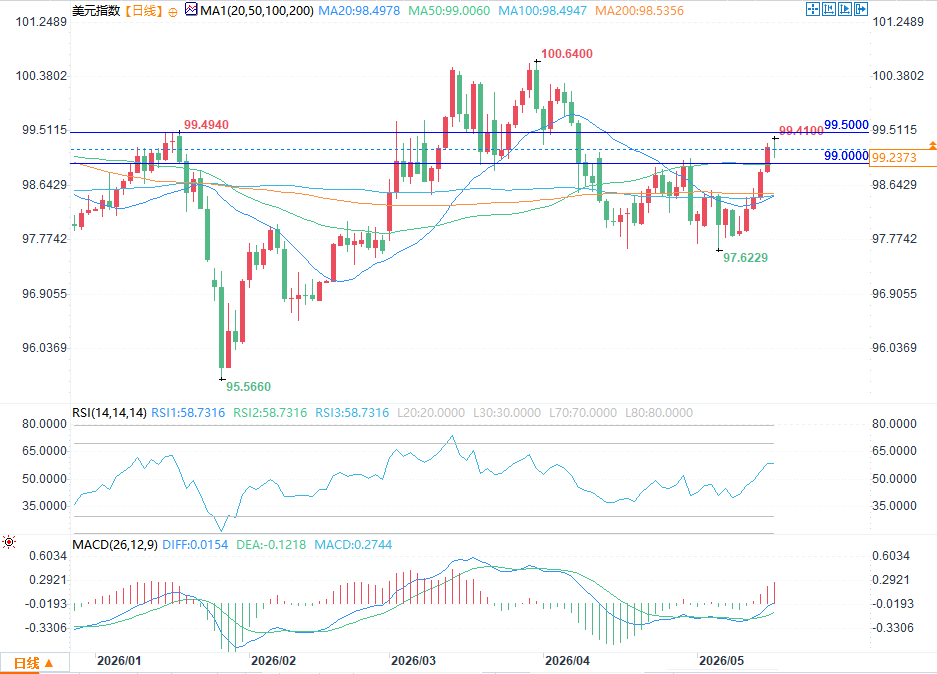
(US Dollar Index Daily Chart Source: FX678)
The US dollar index is currently hovering around 99, a result of a highly entrenched struggle between bullish and bearish forces. On the upside, it is supported by interest rate premiums provided by rising US Treasury yields and persistent inflation; on the downside, it faces pressure from waning safe-haven demand due to rising expectations of peace talks, as well as the economic downside risks accumulated by high interest rates.
Ahead of the release of the FOMC minutes and PMI data, the US dollar is likely to remain in a trading range of 99 to 99.50. If the minutes are hawkish and the PMI data is acceptable, the DXY may retest its five-week high; if both disappoint the market, coupled with positive breakthroughs in the Middle East peace talks, the psychological support level of 99 will be directly tested.
The biggest risk in the current market is not that a single data point exceeds expectations, but that geopolitical and monetary policy factors are simultaneously exerting their influence in the same direction—that would be the moment when a true trend-driven market rally begins.
In a cross-currency comparison, the US dollar saw the most significant decline against the British pound, while it was relatively more resilient against the Japanese yen. The British pound and the New Zealand dollar performed best that day, while the yen weakened, reflecting the overall risk appetite in the market.
It's worth noting that despite a significant waning of risk aversion, the dollar's decline remained restrained. There is considerable support around the 99 level, underpinned by a fundamental base built on high inflation and shifting interest rate expectations.
Geopolitics: Peace signals and the risk of war are rising simultaneously.
What overwhelmed the dollar bulls in European trading was a diplomatic announcement. An Iranian Foreign Ministry spokesperson officially confirmed that Washington and Tehran will assess the latest peace proposal put forward by Pakistani mediators. The same source also revealed that Iranian and Omani technical teams held specific consultations last week in Oman regarding safe passage through the Strait of Hormuz.
Following the news, market risk appetite quickly recovered. As a traditional safe-haven currency, the US dollar was the first to be affected by the shift in sentiment, with buying interest waning and the exchange rate subsequently falling. Meanwhile, WTI crude oil fell several dollars from its May high—the easing of expectations for peace talks reduced market concerns about energy supply disruptions.
However, the situation is far from optimistic. This weekend, a nuclear power plant in the UAE was attacked by drones, an attack widely attributed to Iran or its proxies. This incident has put further pressure on the already fragile ceasefire agreement. US President Trump immediately held an emergency meeting with his national security team and issued a strongly worded warning to Tehran on the X platform.
The parallel development of "diplomatic engagement" and "military escalation" on the same timeline—this highly uncertain situation means that geopolitical risk premiums will continue to disrupt the foreign exchange market for a considerable period. Any sudden news event could reverse market direction within minutes.
Energy Transmission: The Butterfly Effect in the Strait of Hormuz
In the logical chain of this round of dollar fluctuations, the Strait of Hormuz is a key intermediate node. This waterway, through which about 20% of the world's oil is transported, directly affects international oil prices when it opens or closes, thereby exporting inflationary pressures globally.
Over the past few weeks, persistent concerns about shipping disruptions have pushed oil prices to high levels. High oil prices have increased inflation expectations, which in turn have suppressed market expectations for a Federal Reserve rate cut, ultimately providing indirect support for the US dollar. This transmission chain of "strait disruption → higher oil prices → rising inflation → cooling rate cut expectations → stronger dollar" is one of the key sources of the dollar's recent resilience.
Once the peace talks make substantial progress and shipping routes return to normal, this chain will operate in complete reverse. The decline in crude oil prices that day was a leading signal that the market was beginning to price in this scenario, and it is worth continuing to monitor.
US Treasury yields directly impact the foreign exchange market.
If geopolitics is the trigger for short-term fluctuations in the US dollar, then the yield on US Treasury bonds is the "stabilizing force" determining its medium-term direction. In the current market trend, this variable carries particularly significant weight.
The starting point for this logic is the inflation data released last week: the US CPI rose to 3.8% year-on-year in April, the highest level in nearly three years. Following this figure, market expectations for the Federal Reserve's policy path underwent a fundamental shift—the widely circulated narrative of "two rate cuts this year" was almost completely overturned. According to the CME FedWatch tool, the market is currently pricing in a 54.5% probability of the Fed raising rates at least once this year, with rate cuts virtually disappearing from the options list.
This shift in expectations was directly transmitted to the foreign exchange market through US Treasury yields. When the market anticipates that US interest rates will remain high or even rise further, the attractiveness of holding dollar-denominated assets increases, strengthening the incentive for overseas funds to flow into dollar assets, thus building a support level at the fundamental level. This is precisely why the dollar's decline was limited that day—the easing of geopolitical tensions only dampened bullish enthusiasm but failed to break through the bottom built up by interest rate expectations.
This Wednesday, the minutes of the April FOMC meeting will be officially released. This document is one of the most important risk events in the foreign exchange market this week. If the wording of the minutes shows that the members' concerns about the persistence of inflation have deepened, or if they discussed specific thresholds for raising interest rates, US Treasury yields are expected to rise further, and the US dollar may resume its upward trend; conversely, if the minutes are dovish, the existing balance between bulls and bears will face repricing, and the support level of 99 will be directly tested.
Federal Reserve Policy Outlook: Shifting Expectations from Rate Cuts to Rate Hikes
Looking back at the beginning of this year, "two interest rate cuts within the year" was the mainstream narrative in the foreign exchange market, almost universally accepted. At that time, the US dollar was under pressure, and bulls lacked confidence. However, in just a few months, the situation underwent a historic reversal.
Rising energy prices have stubbornly kept inflation high, and the continued resilience of the job market gives the Federal Reserve no reason to rush into a shift. The framework of "maintaining high interest rates for a longer period" is being extended, reshaping market expectations. Today, the possibility of interest rate hikes has jumped from an off-the-beaten-path scenario to a mainstream prediction with a probability of over 50%.
This shift has two sides to the dollar. On the one hand, it provides solid fundamental support, giving the dollar a buffer when risk aversion subsides; on the other hand, high interest rates themselves are accumulating a suppressive effect on the economy. Once subsequent data shows a significant weakening, expectations of a policy shift will quickly resurface, at which point the dollar's current support logic will face its most severe test.
Key Agenda and Risk Warnings for This Week
Wednesday, April FOMC meeting minutes
The market will focus on interpreting the committee members' tolerance for sticky inflation and the actual progress of discussions regarding the threshold for interest rate hikes. Hawkish rhetoric will strengthen the bullish logic for the dollar, while dovish statements may trigger a defensive battle at the 99 level.
On Thursday, the preliminary S&P Global PMI for May was released.
For the first time, manufacturing and service sector data will quantitatively assess the extent to which the conflict in Iran and the energy crisis are impacting the U.S. real economy, serving as a key leading indicator for assessing the risk of an economic recession.
continued
Updates on US-Iran negotiations
Any substantial progress or signs of a breakdown in the peace talks will have a direct impact on the US dollar, crude oil, and safe-haven assets in the short term, requiring close monitoring.
Summarize
(US Dollar Index Daily Chart Source: FX678)
The US dollar index is currently hovering around 99, a result of a highly entrenched struggle between bullish and bearish forces. On the upside, it is supported by interest rate premiums provided by rising US Treasury yields and persistent inflation; on the downside, it faces pressure from waning safe-haven demand due to rising expectations of peace talks, as well as the economic downside risks accumulated by high interest rates.
Ahead of the release of the FOMC minutes and PMI data, the US dollar is likely to remain in a trading range of 99 to 99.50. If the minutes are hawkish and the PMI data is acceptable, the DXY may retest its five-week high; if both disappoint the market, coupled with positive breakthroughs in the Middle East peace talks, the psychological support level of 99 will be directly tested.
The biggest risk in the current market is not that a single data point exceeds expectations, but that geopolitical and monetary policy factors are simultaneously exerting their influence in the same direction—that would be the moment when a true trend-driven market rally begins.
- Risk Warning and Disclaimer
- The market involves risk, and trading may not be suitable for all investors. This article is for reference only and does not constitute personal investment advice, nor does it take into account certain users’ specific investment objectives, financial situation, or other needs. Any investment decisions made based on this information are at your own risk.