May 19th Financial Breakfast: The probability of a Fed rate hike this year has risen sharply; gold prices have bottomed out and rebounded, testing $4600; Trump postponed military strikes against Iran; oil prices fell by nearly 2%.
2026-05-19 07:31:08
On Tuesday (May 19, Beijing time) in early Asian trading, spot gold was trading around $4,597 per ounce. Gold prices rebounded on Monday after falling below the $4,500 per ounce level. The probability of a Fed rate hike this year rose to 52.5%, and Warsh will be sworn in as Fed Chairman on the 22nd. Iran's Supreme Leader reiterated that he would consider opening a new front. Affected by this, US crude oil rose above $105 per barrel on Monday, but Trump postponed military action against Iran, causing US crude oil to fall below $100 per barrel at one point. It is currently trading around $102.45 per barrel, down 1.84%.

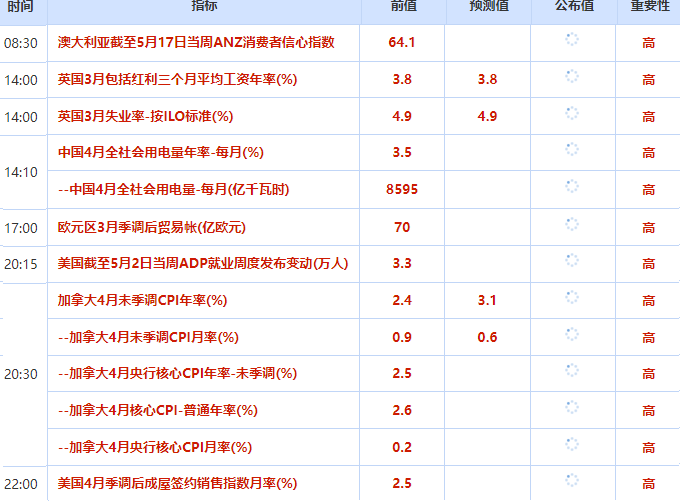
U.S. stocks traded mixed on Monday, with the Nasdaq leading the decline, mainly due to profit-taking in technology stocks, soaring bond yields, and high oil prices, amid market concerns that inflation and borrowing costs will remain high for an extended period.
The Dow Jones Industrial Average rose 0.32% to close at 49,686.12; the S&P 500 dipped 0.07% to 7,403.05; and the Nasdaq Composite fell 0.51% to 26,090.73. The 10-year U.S. Treasury yield rose to its highest level since February 2025, and U.S. crude oil futures closed up more than 3%, but subsequently gave back some gains after U.S. President Trump said Iran had submitted a new peace proposal and suspended military strikes, narrowing the stock market's losses.
Investors are focused on the impact of the Strait of Hormuz situation on inflation expectations, while high yields are putting pressure on technology and chip stocks. The S&P 500 has risen more than 18% since the end of March, and the Nasdaq has risen about 28% over the same period, leading to profit-taking in the market.
The energy sector performed best, rising 1.8%, while the information technology sector fell 0.97%, and the Philadelphia Semiconductor Index closed down 3.3%. The market estimates a 36.7% probability of the Federal Reserve raising interest rates by 25 basis points before the end of the year.
Nvidia will release its earnings report on Wednesday, and its stock price dragged down the S&P 500 the most on Monday; Walmart also releases its earnings report this week, and its stock price rose 1.4%.
In terms of individual stocks, Dominion Energy surged 9.4% after being acquired by NextEra Energy in an all-stock transaction for approximately $66.8 billion, while NextEra fell 4.6%; Regeneron plummeted 9.8% after its skin cancer combination drug failed to meet trial targets.
Gold prices rose slightly on Monday, boosted by a weaker dollar. Spot gold closed at $4,566.02 an ounce, up 0.61%, though it touched its lowest level since March 30 earlier in the session. The dollar index fell 0.3%, making dollar-denominated gold more affordable for buyers holding other currencies.
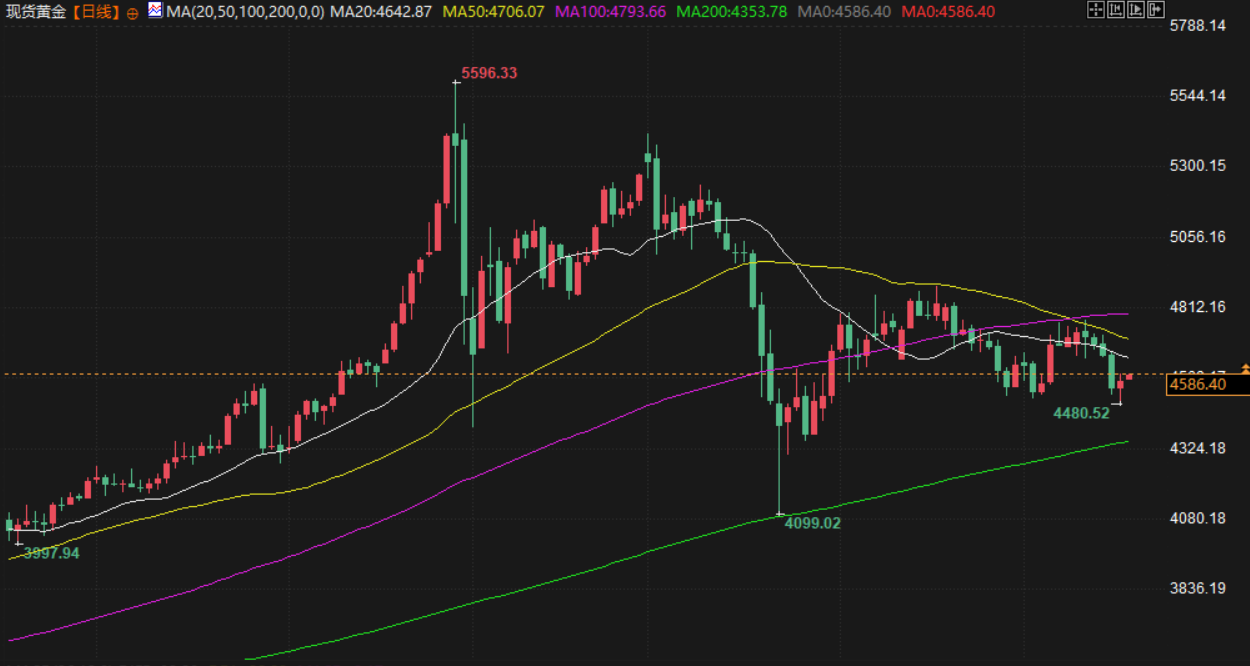
However, rising oil prices and climbing bond yields limited gold price gains. The benchmark 10-year US Treasury yield rose to its highest level since February 2025, as the situation in Iran pushed up energy prices, exacerbated inflation concerns, and reinforced expectations of central bank rate hikes. High yields and interest rates reduce the appeal of non-yielding gold.
As investor demand weakened, JPMorgan Chase became one of the first major banks to lower its 2026 average gold price forecast, reducing its expectation from $5,708 per ounce to $5,243. In other precious metals, spot silver rose 1.4% to $77.04, platinum dipped 0.1% to $1,972.10, and palladium fell 0.2% to $1,409.75.
Oil prices fluctuated more in volatile trading on Monday, hitting a two-week high, mainly driven by concerns that a war with Iran could disrupt supplies through the Strait of Hormuz, although news that the United States had agreed to waive sanctions on Iranian oil during negotiations had initially put pressure on prices.
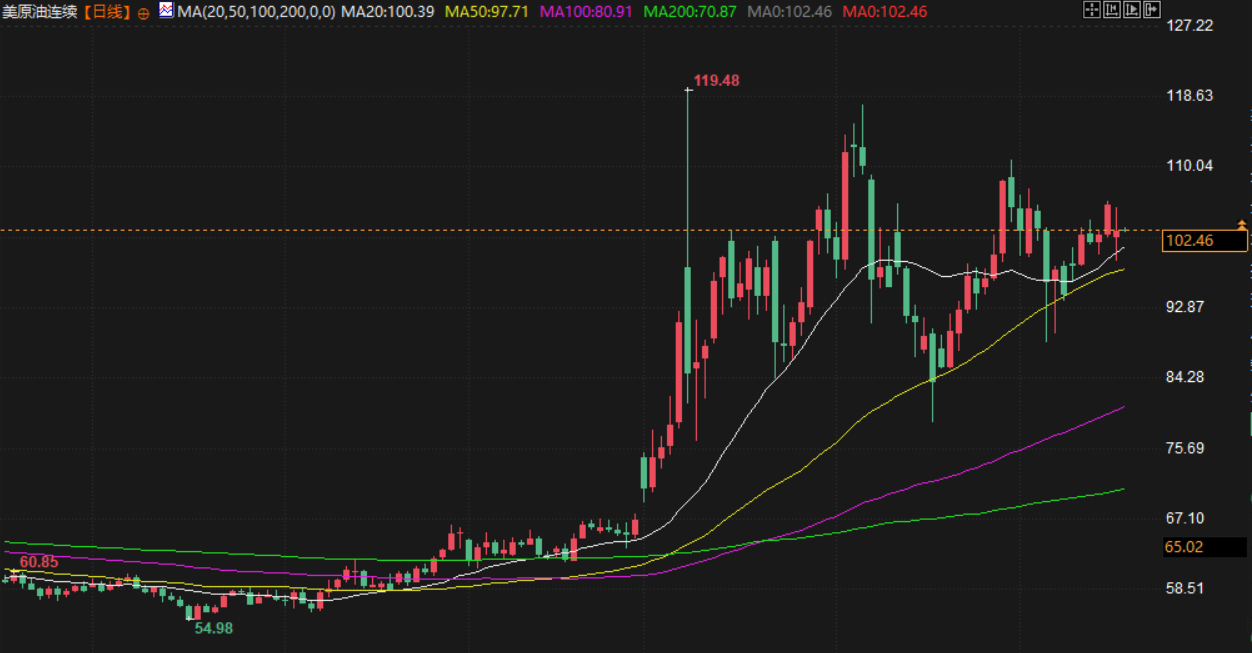
Brent crude rose 0.11% to settle at $109.28 a barrel; WTI crude touched $105.21 a barrel during the session before falling back to settle at $102.49 a barrel. The WTI near-month contract expires on Tuesday, with trading volume around 55,000 lots, far below the daily average of 359,000 lots since 2026. After the close, US President Trump announced a postponement of Tuesday's planned attack on Iran, following a week of gains exceeding 7% in both contracts as hopes for a peace agreement to end the Strait of Hormuz slump.
International Energy Agency Executive Director Fatih Birol warned that commercial crude oil inventories are rapidly declining, with only a few weeks' worth of supply remaining, and that while strategic reserves release 2.5 million barrels per day, they are not inexhaustible. Iran's semi-official news agency reported that the US agreed in a new text to waive oil sanctions during negotiations.
Analysis firm Capital Economics points out that unless negotiations break through and the Straits reopen, the global economy faces the risk of recession, with parts of Europe potentially experiencing a mild recession. Inflation rates in the UK and the Eurozone could peak at 5%-6%, forcing major central banks worldwide to raise interest rates.
In addition, the U.S. Treasury Department will extend the sanctions waiver period for purchasing Russian seaborne crude oil for another 30 days to help countries affected by disruptions to Gulf oil supplies cope with energy vulnerabilities.
The dollar fell on Monday as traders focused on developments in Iran and expectations that global central banks might further tighten monetary policy. The dollar index fell 0.14% to 99.13, after posting its strongest weekly performance in three months the previous week.
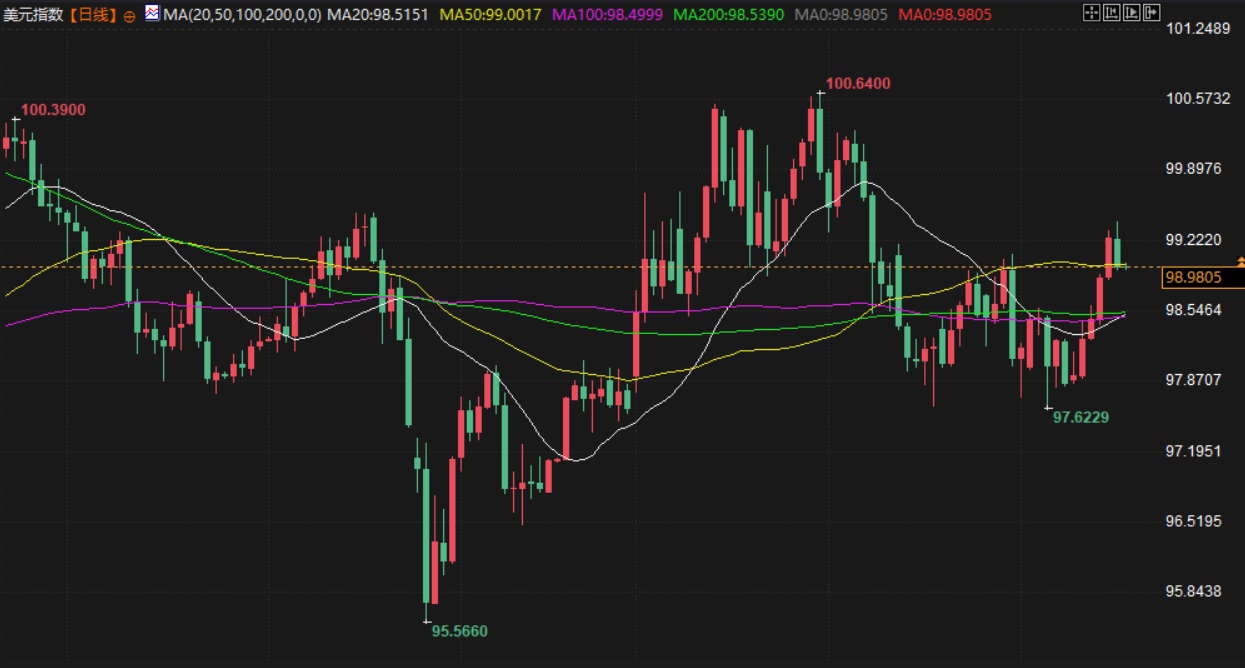
The euro rose 0.09% against the dollar to $1.1636, while the pound rose 0.66% against the dollar to $1.3409. The dollar rose 0.14% against the yen to 158.99 yen, a new high since April 30.
Market concerns about supply disruptions caused by a potential war with Iran offset the impact of a possible US waiver of sanctions on Iranian oil. US Treasury yields rose sharply last week as markets worried that energy costs would push up inflation and prompt the Federal Reserve to raise interest rates.
Commerzbank strategists say the most significant shift in expectations regarding Federal Reserve policy is seen among G10 currencies. DRW Trading strategists point out that the market is watching to see if new Fed Chairman Warsh will respond to higher inflation if necessary; Warsh has previously indicated there is still room for rate cuts, but persistent inflation could dash those hopes.
The market currently estimates a 51% probability of a Federal Reserve rate hike before December. Furthermore, a source revealed that the Japanese government may issue government bonds to finance additional budget spending in order to mitigate the economic impact of the Middle East wars.
Iran's Supreme Leader reiterated that he would consider opening a new front.
On March 18, Iran's Supreme Leader Mojtaba Khamenei reposted his first statement since taking office on his social media account, reiterating his intention to consider opening new fronts in areas where the enemy is not adept. The statement said that research on opening other fronts has been completed, and that "the enemy has very little experience and is extremely vulnerable in these areas." The statement indicated that if the "state of war" continues, Iran will open these new fronts. (Xinhua)
Iranian President: Dialogue Does Not Mean Surrender; We Will Defend National Dignity with All Our Might
On March 18 local time, Iranian President Manmohan Pezechzian posted on social media regarding the US-Iran situation, stating that dialogue does not mean surrender. Pezechzian emphasized that Iran participates in dialogue on the premise of upholding national dignity, authority, and the rights of its people, and will never compromise on the legitimate rights and interests of the country and its people. Pezechzian also stated that the government will use reason and all its strength to serve the people to the death and defend Iran's interests and dignity with all its might. (CCTV News)
Trump says he will postpone military strike against Iran
On May 18 local time, US President Trump posted on the social media platform "Real Social" that, at the request of the leaders of Qatar, Saudi Arabia, and the United Arab Emirates, he had ordered a military strike against Iran "tomorrow (May 19)" not as originally planned. Trump stated that, given the ongoing serious negotiations and the belief of these leaders and allies that an agreement would eventually be reached, and importantly, that this agreement would explicitly include the following core clause: Iran must not possess nuclear weapons. Trump stated that he had instructed Secretary of Defense Hergsays, Chairman of the Joint Chiefs of Staff Kaine, and the US military to deviate from the planned strike against Iran on May 19. However, he also issued further instructions: if a satisfactory agreement is not reached, the US military must remain on high alert and be ready to launch a full-scale military strike against Iran at any time. (CCTV News)
Trump stated that he is "not considering making any concessions to Tehran."
On May 18, local time, after receiving Iran's latest draft agreement aimed at ending the conflict, US President Trump stated that he was "not considering" making any concessions to Tehran. Trump also warned that Iran already knew "what was coming." Trump said he was not "frustrated" by Tehran's response. He also pointed out that Iran was fully aware of the US's ability to inflict even greater damage. Trump said, "I can tell you, they are more eager for a deal now than ever before because they know what's coming next." Earlier, US sources reported that Iran, through Pakistan, submitted a new draft agreement aimed at ending the conflict to the US on the evening of May 17, but it only made some "symbolic tweaks" compared to the previous version and did not make any substantial concessions on its nuclear program. A senior US official stated that the negotiations are currently in a "very tense" situation, and if Iran refuses to change its position, the US will have to "use bombs" to continue the negotiations. When asked about regional sources claiming that Iran was attempting to use delaying tactics against Washington on the nuclear issue and the issue of navigation in the Strait of Hormuz, Trump said he had "not heard of such a claim." It has been revealed that Trump is expected to hold a meeting with key members of his national security team in the White House Situation Room on the 19th to discuss options for further military action against Iran. (CCTV News)
Saudi media: Iran proposes conditional transfer of enriched uranium to Russia
According to a report by Saudi Arabia's Al Arabiya TV on the 18th, Iran's latest revised proposal aimed at ending the Middle East conflict includes a conditional transfer of enriched uranium to Russia, rather than the United States. The report stated that the proposal, obtained by the television station, shows that Iran has agreed to a long-term freeze on its nuclear program, but not a complete dismantling of its nuclear facilities. (Xinhua)
The International Monetary Fund raised its forecast for UK economic growth.
On March 18th local time, the International Monetary Fund (IMF) raised its forecast for UK economic growth this year from 0.8% to 1%, stating that the UK economy "remains resilient." The IMF also warned that the situation in the Middle East could lead to higher energy and food prices in the UK. Furthermore, domestic uncertainty in the UK could exacerbate existing volatility. (CCTV News)
Senior US official: Iran's latest proposal is insufficient to reach an agreement.
According to a report by Axios, a senior U.S. official and a source familiar with the matter stated that Iran has submitted an updated ceasefire proposal, but the White House believes the proposal lacks substantial improvements and is insufficient to reach an agreement. U.S. officials indicated that Trump wants to end the war with an agreement, but because Iran has rejected many of his demands and refused to make meaningful concessions on its nuclear program, Trump is considering resuming the war. U.S. officials stated that if Iran does not change its stance, the U.S. will have to continue negotiations “with bombs.” The senior U.S. official stated: “We haven’t actually made much progress. The Iranians need to show some sincerity. We need to have a real, solid, and detailed dialogue on the nuclear program. If dialogue fails, we will have to talk with bombs, which would be a regrettable thing.”
US officials: Iran is using the ceasefire window to adjust its deployment and upgrade its defense system.
A U.S. official revealed that Iran is using the current ceasefire window to reposition its missile launchers, repair damaged sites, and redesign its operational tactics. The official also noted that most of Iran's missile arsenal is stored in hardened underground facilities. Simultaneously, the official warned that Iran has studied patterns in U.S. military flight paths and has completed a comprehensive upgrade of its defense system.
The probability of a Federal Reserve rate hike this year has risen to 52.5%.
According to CME's "FedWatch": The probability of the Federal Reserve keeping interest rates unchanged by June is 99.6%, and the probability of a cumulative rate cut of 25 basis points is 0.6%. The probability of the Federal Reserve keeping interest rates unchanged by July is 93.0%, and the probability of a rate hike of at least 25 basis points is 7%. The probability of the Federal Reserve keeping interest rates unchanged by December is 47.5%, and the probability of a rate hike of at least 25 basis points is 52.5%.
Warsh will be sworn in as Chairman of the Federal Reserve on the 22nd.
Multiple US media outlets reported on March 18 that Kevin Warsh will be sworn in as Chairman of the Federal Reserve on May 22. A White House official stated that President Trump will hold an inauguration ceremony for Warsh at the White House. On March 13, the US Senate formally confirmed Warsh as the next Chairman of the Federal Reserve, succeeding Jerome Powell for a four-year term. Powell's term as Chairman of the Federal Reserve ended on March 15, and he has already begun serving as the interim Chairman. Trump announced his nomination of Warsh as the new Chairman of the Federal Reserve on January 30 via social media. The White House submitted Warsh's nomination to the Senate in early March for the positions of Federal Reserve Governor and the next Chairman of the Federal Reserve. Powell, nominated by Trump, succeeded Janet Yellen as Chairman of the Federal Reserve in February 2018. Nominated by then-President Biden, he will begin his second term as Chairman of the Federal Reserve in May 2022.
my country's first carbon dioxide geothermal energy project goes into operation
On the 19th, it was learned from China Huaneng that my country's first supercritical carbon dioxide geothermal energy heat extraction project officially went into operation in Zhengzhou, Henan Province, marking a new breakthrough in the efficient development and utilization of geothermal energy in my country. In Zhengzhou, Henan, with the opening of the wellhead valve, carbon dioxide entered the 2,500-meter-deep geothermal well through pipelines to absorb heat and raise its temperature, marking the official commissioning of the nation's first supercritical carbon dioxide geothermal energy heat extraction project. Unlike traditional geothermal energy heat extraction, this project uses supercritical carbon dioxide instead of water as the heat transfer medium. The supercritical carbon dioxide is transported to the bottom of the geothermal well, absorbs underground heat, and then returns to the surface to transfer it to heating water. (CCTV)
Ministry of Commerce: We will continue to focus on three aspects to further expand inbound consumption.
On May 18, the State Council Information Office held a press conference to introduce measures to strengthen and optimize tax refunds for departing tourists and expand inbound consumption, and answered questions from reporters. Yang Mu, Director-General of the Department of Market Operation and Consumption Promotion of the Ministry of Commerce, stated that the Ministry of Commerce will continue to focus on three aspects to further expand inbound consumption. (Xinhua News Agency)
Key Focus Today
stock market
U.S. stocks traded mixed on Monday, with the Nasdaq leading the decline, mainly due to profit-taking in technology stocks, soaring bond yields, and high oil prices, amid market concerns that inflation and borrowing costs will remain high for an extended period.
The Dow Jones Industrial Average rose 0.32% to close at 49,686.12; the S&P 500 dipped 0.07% to 7,403.05; and the Nasdaq Composite fell 0.51% to 26,090.73. The 10-year U.S. Treasury yield rose to its highest level since February 2025, and U.S. crude oil futures closed up more than 3%, but subsequently gave back some gains after U.S. President Trump said Iran had submitted a new peace proposal and suspended military strikes, narrowing the stock market's losses.
Investors are focused on the impact of the Strait of Hormuz situation on inflation expectations, while high yields are putting pressure on technology and chip stocks. The S&P 500 has risen more than 18% since the end of March, and the Nasdaq has risen about 28% over the same period, leading to profit-taking in the market.
The energy sector performed best, rising 1.8%, while the information technology sector fell 0.97%, and the Philadelphia Semiconductor Index closed down 3.3%. The market estimates a 36.7% probability of the Federal Reserve raising interest rates by 25 basis points before the end of the year.
Nvidia will release its earnings report on Wednesday, and its stock price dragged down the S&P 500 the most on Monday; Walmart also releases its earnings report this week, and its stock price rose 1.4%.
In terms of individual stocks, Dominion Energy surged 9.4% after being acquired by NextEra Energy in an all-stock transaction for approximately $66.8 billion, while NextEra fell 4.6%; Regeneron plummeted 9.8% after its skin cancer combination drug failed to meet trial targets.
Gold Market
Gold prices rose slightly on Monday, boosted by a weaker dollar. Spot gold closed at $4,566.02 an ounce, up 0.61%, though it touched its lowest level since March 30 earlier in the session. The dollar index fell 0.3%, making dollar-denominated gold more affordable for buyers holding other currencies.
However, rising oil prices and climbing bond yields limited gold price gains. The benchmark 10-year US Treasury yield rose to its highest level since February 2025, as the situation in Iran pushed up energy prices, exacerbated inflation concerns, and reinforced expectations of central bank rate hikes. High yields and interest rates reduce the appeal of non-yielding gold.
As investor demand weakened, JPMorgan Chase became one of the first major banks to lower its 2026 average gold price forecast, reducing its expectation from $5,708 per ounce to $5,243. In other precious metals, spot silver rose 1.4% to $77.04, platinum dipped 0.1% to $1,972.10, and palladium fell 0.2% to $1,409.75.
oil market
Oil prices fluctuated more in volatile trading on Monday, hitting a two-week high, mainly driven by concerns that a war with Iran could disrupt supplies through the Strait of Hormuz, although news that the United States had agreed to waive sanctions on Iranian oil during negotiations had initially put pressure on prices.
Brent crude rose 0.11% to settle at $109.28 a barrel; WTI crude touched $105.21 a barrel during the session before falling back to settle at $102.49 a barrel. The WTI near-month contract expires on Tuesday, with trading volume around 55,000 lots, far below the daily average of 359,000 lots since 2026. After the close, US President Trump announced a postponement of Tuesday's planned attack on Iran, following a week of gains exceeding 7% in both contracts as hopes for a peace agreement to end the Strait of Hormuz slump.
International Energy Agency Executive Director Fatih Birol warned that commercial crude oil inventories are rapidly declining, with only a few weeks' worth of supply remaining, and that while strategic reserves release 2.5 million barrels per day, they are not inexhaustible. Iran's semi-official news agency reported that the US agreed in a new text to waive oil sanctions during negotiations.
Analysis firm Capital Economics points out that unless negotiations break through and the Straits reopen, the global economy faces the risk of recession, with parts of Europe potentially experiencing a mild recession. Inflation rates in the UK and the Eurozone could peak at 5%-6%, forcing major central banks worldwide to raise interest rates.
In addition, the U.S. Treasury Department will extend the sanctions waiver period for purchasing Russian seaborne crude oil for another 30 days to help countries affected by disruptions to Gulf oil supplies cope with energy vulnerabilities.
Foreign exchange market
The dollar fell on Monday as traders focused on developments in Iran and expectations that global central banks might further tighten monetary policy. The dollar index fell 0.14% to 99.13, after posting its strongest weekly performance in three months the previous week.
The euro rose 0.09% against the dollar to $1.1636, while the pound rose 0.66% against the dollar to $1.3409. The dollar rose 0.14% against the yen to 158.99 yen, a new high since April 30.
Market concerns about supply disruptions caused by a potential war with Iran offset the impact of a possible US waiver of sanctions on Iranian oil. US Treasury yields rose sharply last week as markets worried that energy costs would push up inflation and prompt the Federal Reserve to raise interest rates.
Commerzbank strategists say the most significant shift in expectations regarding Federal Reserve policy is seen among G10 currencies. DRW Trading strategists point out that the market is watching to see if new Fed Chairman Warsh will respond to higher inflation if necessary; Warsh has previously indicated there is still room for rate cuts, but persistent inflation could dash those hopes.
The market currently estimates a 51% probability of a Federal Reserve rate hike before December. Furthermore, a source revealed that the Japanese government may issue government bonds to finance additional budget spending in order to mitigate the economic impact of the Middle East wars.
International News
Iran's Supreme Leader reiterated that he would consider opening a new front.
On March 18, Iran's Supreme Leader Mojtaba Khamenei reposted his first statement since taking office on his social media account, reiterating his intention to consider opening new fronts in areas where the enemy is not adept. The statement said that research on opening other fronts has been completed, and that "the enemy has very little experience and is extremely vulnerable in these areas." The statement indicated that if the "state of war" continues, Iran will open these new fronts. (Xinhua)
Iranian President: Dialogue Does Not Mean Surrender; We Will Defend National Dignity with All Our Might
On March 18 local time, Iranian President Manmohan Pezechzian posted on social media regarding the US-Iran situation, stating that dialogue does not mean surrender. Pezechzian emphasized that Iran participates in dialogue on the premise of upholding national dignity, authority, and the rights of its people, and will never compromise on the legitimate rights and interests of the country and its people. Pezechzian also stated that the government will use reason and all its strength to serve the people to the death and defend Iran's interests and dignity with all its might. (CCTV News)
Trump says he will postpone military strike against Iran
On May 18 local time, US President Trump posted on the social media platform "Real Social" that, at the request of the leaders of Qatar, Saudi Arabia, and the United Arab Emirates, he had ordered a military strike against Iran "tomorrow (May 19)" not as originally planned. Trump stated that, given the ongoing serious negotiations and the belief of these leaders and allies that an agreement would eventually be reached, and importantly, that this agreement would explicitly include the following core clause: Iran must not possess nuclear weapons. Trump stated that he had instructed Secretary of Defense Hergsays, Chairman of the Joint Chiefs of Staff Kaine, and the US military to deviate from the planned strike against Iran on May 19. However, he also issued further instructions: if a satisfactory agreement is not reached, the US military must remain on high alert and be ready to launch a full-scale military strike against Iran at any time. (CCTV News)
Trump stated that he is "not considering making any concessions to Tehran."
On May 18, local time, after receiving Iran's latest draft agreement aimed at ending the conflict, US President Trump stated that he was "not considering" making any concessions to Tehran. Trump also warned that Iran already knew "what was coming." Trump said he was not "frustrated" by Tehran's response. He also pointed out that Iran was fully aware of the US's ability to inflict even greater damage. Trump said, "I can tell you, they are more eager for a deal now than ever before because they know what's coming next." Earlier, US sources reported that Iran, through Pakistan, submitted a new draft agreement aimed at ending the conflict to the US on the evening of May 17, but it only made some "symbolic tweaks" compared to the previous version and did not make any substantial concessions on its nuclear program. A senior US official stated that the negotiations are currently in a "very tense" situation, and if Iran refuses to change its position, the US will have to "use bombs" to continue the negotiations. When asked about regional sources claiming that Iran was attempting to use delaying tactics against Washington on the nuclear issue and the issue of navigation in the Strait of Hormuz, Trump said he had "not heard of such a claim." It has been revealed that Trump is expected to hold a meeting with key members of his national security team in the White House Situation Room on the 19th to discuss options for further military action against Iran. (CCTV News)
Saudi media: Iran proposes conditional transfer of enriched uranium to Russia
According to a report by Saudi Arabia's Al Arabiya TV on the 18th, Iran's latest revised proposal aimed at ending the Middle East conflict includes a conditional transfer of enriched uranium to Russia, rather than the United States. The report stated that the proposal, obtained by the television station, shows that Iran has agreed to a long-term freeze on its nuclear program, but not a complete dismantling of its nuclear facilities. (Xinhua)
The International Monetary Fund raised its forecast for UK economic growth.
On March 18th local time, the International Monetary Fund (IMF) raised its forecast for UK economic growth this year from 0.8% to 1%, stating that the UK economy "remains resilient." The IMF also warned that the situation in the Middle East could lead to higher energy and food prices in the UK. Furthermore, domestic uncertainty in the UK could exacerbate existing volatility. (CCTV News)
Senior US official: Iran's latest proposal is insufficient to reach an agreement.
According to a report by Axios, a senior U.S. official and a source familiar with the matter stated that Iran has submitted an updated ceasefire proposal, but the White House believes the proposal lacks substantial improvements and is insufficient to reach an agreement. U.S. officials indicated that Trump wants to end the war with an agreement, but because Iran has rejected many of his demands and refused to make meaningful concessions on its nuclear program, Trump is considering resuming the war. U.S. officials stated that if Iran does not change its stance, the U.S. will have to continue negotiations “with bombs.” The senior U.S. official stated: “We haven’t actually made much progress. The Iranians need to show some sincerity. We need to have a real, solid, and detailed dialogue on the nuclear program. If dialogue fails, we will have to talk with bombs, which would be a regrettable thing.”
US officials: Iran is using the ceasefire window to adjust its deployment and upgrade its defense system.
A U.S. official revealed that Iran is using the current ceasefire window to reposition its missile launchers, repair damaged sites, and redesign its operational tactics. The official also noted that most of Iran's missile arsenal is stored in hardened underground facilities. Simultaneously, the official warned that Iran has studied patterns in U.S. military flight paths and has completed a comprehensive upgrade of its defense system.
The probability of a Federal Reserve rate hike this year has risen to 52.5%.
According to CME's "FedWatch": The probability of the Federal Reserve keeping interest rates unchanged by June is 99.6%, and the probability of a cumulative rate cut of 25 basis points is 0.6%. The probability of the Federal Reserve keeping interest rates unchanged by July is 93.0%, and the probability of a rate hike of at least 25 basis points is 7%. The probability of the Federal Reserve keeping interest rates unchanged by December is 47.5%, and the probability of a rate hike of at least 25 basis points is 52.5%.
Warsh will be sworn in as Chairman of the Federal Reserve on the 22nd.
Multiple US media outlets reported on March 18 that Kevin Warsh will be sworn in as Chairman of the Federal Reserve on May 22. A White House official stated that President Trump will hold an inauguration ceremony for Warsh at the White House. On March 13, the US Senate formally confirmed Warsh as the next Chairman of the Federal Reserve, succeeding Jerome Powell for a four-year term. Powell's term as Chairman of the Federal Reserve ended on March 15, and he has already begun serving as the interim Chairman. Trump announced his nomination of Warsh as the new Chairman of the Federal Reserve on January 30 via social media. The White House submitted Warsh's nomination to the Senate in early March for the positions of Federal Reserve Governor and the next Chairman of the Federal Reserve. Powell, nominated by Trump, succeeded Janet Yellen as Chairman of the Federal Reserve in February 2018. Nominated by then-President Biden, he will begin his second term as Chairman of the Federal Reserve in May 2022.
Domestic News
my country's first carbon dioxide geothermal energy project goes into operation
On the 19th, it was learned from China Huaneng that my country's first supercritical carbon dioxide geothermal energy heat extraction project officially went into operation in Zhengzhou, Henan Province, marking a new breakthrough in the efficient development and utilization of geothermal energy in my country. In Zhengzhou, Henan, with the opening of the wellhead valve, carbon dioxide entered the 2,500-meter-deep geothermal well through pipelines to absorb heat and raise its temperature, marking the official commissioning of the nation's first supercritical carbon dioxide geothermal energy heat extraction project. Unlike traditional geothermal energy heat extraction, this project uses supercritical carbon dioxide instead of water as the heat transfer medium. The supercritical carbon dioxide is transported to the bottom of the geothermal well, absorbs underground heat, and then returns to the surface to transfer it to heating water. (CCTV)
Ministry of Commerce: We will continue to focus on three aspects to further expand inbound consumption.
On May 18, the State Council Information Office held a press conference to introduce measures to strengthen and optimize tax refunds for departing tourists and expand inbound consumption, and answered questions from reporters. Yang Mu, Director-General of the Department of Market Operation and Consumption Promotion of the Ministry of Commerce, stated that the Ministry of Commerce will continue to focus on three aspects to further expand inbound consumption. (Xinhua News Agency)
- Risk Warning and Disclaimer
- The market involves risk, and trading may not be suitable for all investors. This article is for reference only and does not constitute personal investment advice, nor does it take into account certain users’ specific investment objectives, financial situation, or other needs. Any investment decisions made based on this information are at your own risk.