The Euro/Pound Sterling Seesaw: The Euro enjoys the backing of a hawkish central bank, while the Pound Sterling is mired in internal and external troubles.
2026-05-19 15:36:37
The euro found some buying support against the pound on Tuesday (May 19), temporarily halting the sharp decline from the 0.8730 area (the highest level since April 7) in the previous session. However, after the release of mixed UK employment data, the euro traded around 0.8680 against the pound, rising slightly during the day but remaining in a weak overall position.

Market participants are digesting conflicting signals from the UK job market while closely watching the evolution of the UK political crisis and subsequent statements from European Central Bank officials.
The latest employment report released by the UK Office for National Statistics became the focus of the foreign exchange market on Tuesday.
Data shows that in the three months to March, the ILO unemployment rate unexpectedly rose to 5% from 4.9%, exceeding market expectations of 4.9% and reaching a recent high. This rise in unemployment suggests that the UK labor market may be losing its previous resilience, which coincides with the backdrop of slowing economic growth and declining hiring activity among businesses.
Meanwhile, the number of people claiming unemployment benefits in April was 26,500, slightly lower than the market expectation of 27,300, which on the surface seems like a positive signal. However, what truly attracted market attention was the downward revision of the previous month's claim data—from 26,800 to 4,900, a revision of more than 20,000. This significant downward revision suggests that the actual situation in the UK labor market may not be as bad as the initial data indicated, thus providing marginal support for the pound and limiting the upside potential of the euro against the pound to some extent.
Overall, the employment report was mixed: the rising unemployment rate was worrying, but the significant revisions to the initial jobless claims data somewhat alleviated market pessimism. As a result, the pound did not experience a clear trend after the data release, with the euro/pound pair generally consolidating in a narrow range around 0.8680.
However, any meaningful appreciation of the pound seems unlikely, as the deepening political crisis in the UK is the core factor currently suppressing the pound's performance.
British Prime Minister Keir Starmer is reportedly facing increasing internal pressure, with growing speculation about a potential leadership challenge and strained relations within his party.
Since taking office, Starmer has been grappling with multiple challenges, including sluggish economic growth, immense pressure on public services, and the immigration issue. Recently, internal divisions within the Labour Party regarding policy direction have led some party members to question Starmer's leadership. In fact, the former UK Health Secretary publicly announced last week his intention to oust Starmer, a move widely interpreted as the formal beginning of a leadership challenge. Furthermore, polls show a recent decline in Labour's support, further eroding Starmer's political authority.
The direct impact of this political uncertainty is that traders are hesitant to establish aggressive long positions in the pound. Any attempt to push the pound higher before the political outlook becomes clearer carries significant risk. Therefore, even with some positive signals in UK employment data, market participants remain cautious. This cautious sentiment towards the pound, in turn, provides sustained support for the euro against the pound.
On the other hand, the euro continues to be supported by hawkish comments from European Central Bank officials, another important factor contributing to its strength against the pound. Janis Stornaras, a member of the European Central Bank's Governing Council and Governor of the Bank of Greece, delivered an important speech last weekend, stating that moderate interest rate hikes could effectively curb inflation without harming the economy.
Stornaras's remarks are noteworthy because he was previously considered one of the more dovish members within the European Central Bank (ECB). His current shift towards a hawkish stance reflects a subtle change in the ECB's assessment of inflation risks. While the Eurozone economy also faces pressure from slowing growth, ECB officials generally believe that inflation returning to the 2% target may take longer than expected, thus necessitating a continued tight policy stance.
This hawkish tone contrasts sharply with the Bank of England's predicament—it faces a dilemma between inflation and economic growth, while the political crisis further limits its policy maneuvering. Therefore, analysts believe that any pullback in the euro against the pound should be seen as a buying opportunity, and the downside potential for the exchange rate is expected to remain limited.
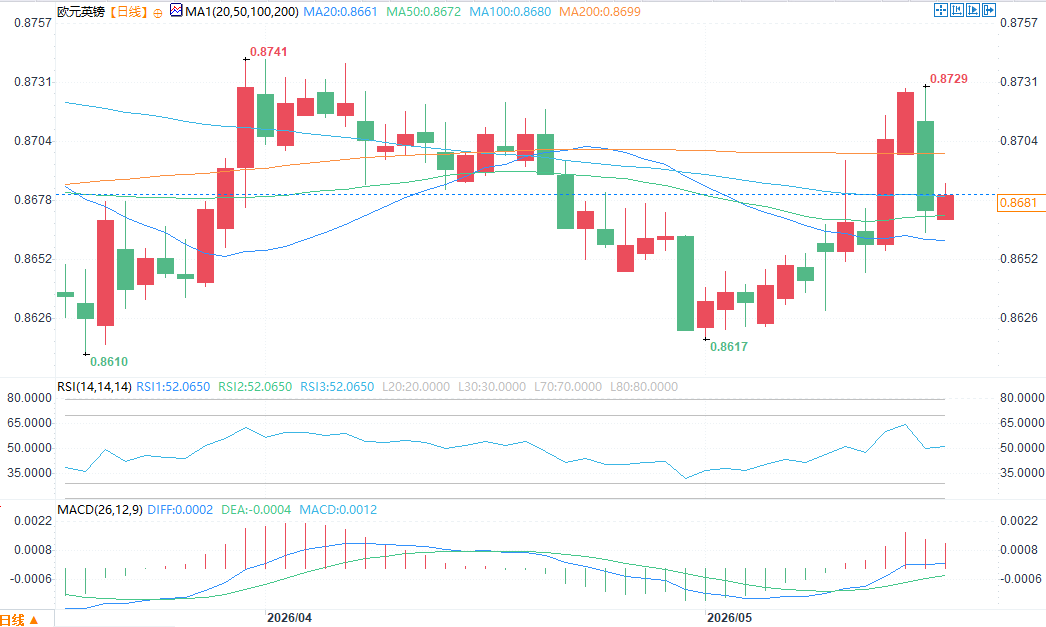
From the daily chart, the euro is currently trading around 0.8680 against the pound, precisely at the convergence of several key moving averages. Specifically, the 20-day moving average (MA20) is at 0.8661, the 50-day moving average (MA50) is at 0.8672, the 100-day moving average (MA100) is at 0.8680, and the 200-day moving average (MA200) is at 0.8699. The current price (0.8680) almost perfectly coincides with the MA100, while being slightly higher than the MA20 and MA50, but slightly lower than the MA200.
(Euro/Pound Sterling daily chart, source: FX678)
This moving average alignment pattern reflects that the market is at a critical juncture for directional choice. The four moving averages are highly convergent (less than 40 basis points apart), which is usually considered a "moving average convergence" state in technical analysis, indicating a potential breakout after a period of consolidation. It's worth noting that although the exchange rate has recently retreated from its high of 0.8729, it remains above the 20-day and 50-day moving averages (MA20 and MA50), indicating that the short-term bullish structure has not been broken. The 200-day moving average (MA200) (0.8699) forms the first resistance level; if it holds above this level, it is expected to further test the 0.8713-0.8741 area.
For traders, the current strategy may be to "buy on dips" rather than "chase highs," as political uncertainty in the UK could trigger short-term volatility in the pound at any time.
In conclusion, while the downward revision of UK jobless claims provided marginal support for the pound, the deepening political crisis in the UK is the core factor suppressing its performance. Meanwhile, the European Central Bank's hawkish tone injected upward momentum into the euro, contrasting with the Bank of England's policy dilemma. Against this backdrop, any pullback in the euro/pound exchange rate is likely to attract buying, and the overall trend is expected to remain bullish. The market's next focus will be on the evolution of the UK political situation and whether ECB officials will further reinforce their hawkish stance in subsequent speeches.
At 15:23 Beijing time on May 19, the euro was trading at 0.8682/83 against the pound.
Market participants are digesting conflicting signals from the UK job market while closely watching the evolution of the UK political crisis and subsequent statements from European Central Bank officials.
Mixed UK employment data failed to boost the pound.
The latest employment report released by the UK Office for National Statistics became the focus of the foreign exchange market on Tuesday.
Data shows that in the three months to March, the ILO unemployment rate unexpectedly rose to 5% from 4.9%, exceeding market expectations of 4.9% and reaching a recent high. This rise in unemployment suggests that the UK labor market may be losing its previous resilience, which coincides with the backdrop of slowing economic growth and declining hiring activity among businesses.
Meanwhile, the number of people claiming unemployment benefits in April was 26,500, slightly lower than the market expectation of 27,300, which on the surface seems like a positive signal. However, what truly attracted market attention was the downward revision of the previous month's claim data—from 26,800 to 4,900, a revision of more than 20,000. This significant downward revision suggests that the actual situation in the UK labor market may not be as bad as the initial data indicated, thus providing marginal support for the pound and limiting the upside potential of the euro against the pound to some extent.
Overall, the employment report was mixed: the rising unemployment rate was worrying, but the significant revisions to the initial jobless claims data somewhat alleviated market pessimism. As a result, the pound did not experience a clear trend after the data release, with the euro/pound pair generally consolidating in a narrow range around 0.8680.
The ongoing political crisis in the UK is putting pressure on the pound.
However, any meaningful appreciation of the pound seems unlikely, as the deepening political crisis in the UK is the core factor currently suppressing the pound's performance.
British Prime Minister Keir Starmer is reportedly facing increasing internal pressure, with growing speculation about a potential leadership challenge and strained relations within his party.
Since taking office, Starmer has been grappling with multiple challenges, including sluggish economic growth, immense pressure on public services, and the immigration issue. Recently, internal divisions within the Labour Party regarding policy direction have led some party members to question Starmer's leadership. In fact, the former UK Health Secretary publicly announced last week his intention to oust Starmer, a move widely interpreted as the formal beginning of a leadership challenge. Furthermore, polls show a recent decline in Labour's support, further eroding Starmer's political authority.
The direct impact of this political uncertainty is that traders are hesitant to establish aggressive long positions in the pound. Any attempt to push the pound higher before the political outlook becomes clearer carries significant risk. Therefore, even with some positive signals in UK employment data, market participants remain cautious. This cautious sentiment towards the pound, in turn, provides sustained support for the euro against the pound.
Hawkish comments from ECB officials provided support for the euro.
On the other hand, the euro continues to be supported by hawkish comments from European Central Bank officials, another important factor contributing to its strength against the pound. Janis Stornaras, a member of the European Central Bank's Governing Council and Governor of the Bank of Greece, delivered an important speech last weekend, stating that moderate interest rate hikes could effectively curb inflation without harming the economy.
Stornaras's remarks are noteworthy because he was previously considered one of the more dovish members within the European Central Bank (ECB). His current shift towards a hawkish stance reflects a subtle change in the ECB's assessment of inflation risks. While the Eurozone economy also faces pressure from slowing growth, ECB officials generally believe that inflation returning to the 2% target may take longer than expected, thus necessitating a continued tight policy stance.
This hawkish tone contrasts sharply with the Bank of England's predicament—it faces a dilemma between inflation and economic growth, while the political crisis further limits its policy maneuvering. Therefore, analysts believe that any pullback in the euro against the pound should be seen as a buying opportunity, and the downside potential for the exchange rate is expected to remain limited.
Technical Analysis and Trading Strategies
From the daily chart, the euro is currently trading around 0.8680 against the pound, precisely at the convergence of several key moving averages. Specifically, the 20-day moving average (MA20) is at 0.8661, the 50-day moving average (MA50) is at 0.8672, the 100-day moving average (MA100) is at 0.8680, and the 200-day moving average (MA200) is at 0.8699. The current price (0.8680) almost perfectly coincides with the MA100, while being slightly higher than the MA20 and MA50, but slightly lower than the MA200.
(Euro/Pound Sterling daily chart, source: FX678)
This moving average alignment pattern reflects that the market is at a critical juncture for directional choice. The four moving averages are highly convergent (less than 40 basis points apart), which is usually considered a "moving average convergence" state in technical analysis, indicating a potential breakout after a period of consolidation. It's worth noting that although the exchange rate has recently retreated from its high of 0.8729, it remains above the 20-day and 50-day moving averages (MA20 and MA50), indicating that the short-term bullish structure has not been broken. The 200-day moving average (MA200) (0.8699) forms the first resistance level; if it holds above this level, it is expected to further test the 0.8713-0.8741 area.
For traders, the current strategy may be to "buy on dips" rather than "chase highs," as political uncertainty in the UK could trigger short-term volatility in the pound at any time.
Political headwinds weighed on the pound, while the euro received support from hawkish voices.
In conclusion, while the downward revision of UK jobless claims provided marginal support for the pound, the deepening political crisis in the UK is the core factor suppressing its performance. Meanwhile, the European Central Bank's hawkish tone injected upward momentum into the euro, contrasting with the Bank of England's policy dilemma. Against this backdrop, any pullback in the euro/pound exchange rate is likely to attract buying, and the overall trend is expected to remain bullish. The market's next focus will be on the evolution of the UK political situation and whether ECB officials will further reinforce their hawkish stance in subsequent speeches.
At 15:23 Beijing time on May 19, the euro was trading at 0.8682/83 against the pound.
- Risk Warning and Disclaimer
- The market involves risk, and trading may not be suitable for all investors. This article is for reference only and does not constitute personal investment advice, nor does it take into account certain users’ specific investment objectives, financial situation, or other needs. Any investment decisions made based on this information are at your own risk.