Why does Trump keep crying wolf? The Defense Secretary's moves reveal key information.
2026-05-19 16:03:42
On Tuesday (May 19), during the Asian and European sessions, international crude oil rose slightly by 1%. On Monday, oil prices fluctuated widely throughout the day and then plunged at the end of the session as Trump repeatedly changed his rhetoric about war with Iran.
The United States continues to claim that it is delaying the strike on Iran, but adds that the U.S. military is prepared to launch a full-scale, large-scale strike on Iran if a mutually acceptable agreement cannot be reached.
Trump considers himself a top negotiator and has repeatedly played the "boy who cried wolf" card in the market, but ultimately he still finds himself in a stalemate on the Iran issue: his tough statements and military pressure have not shaken Tehran's core position, but have instead increased the market's consensus that extreme pressure is a buying opportunity.
With the US-Iran conflict now on the brink of war, US Defense Secretary Hagersey is not at the Pentagon but focused on campaigning for the Republican Party in the midterm elections. This suggests that beneath the US military's tough exterior lies a strong constraint imposed by the midterm elections.
Trump's policy toward Iran has been inconsistent: on the one hand, he claims that the Iran agreement is unacceptable and that military strikes will be restarted; on the other hand, he responds to requests from Gulf states to suspend attack plans, while still threatening to launch a "massive strike at any time."
Its repeated practice of setting negotiation deadlines and then backing down has led to a persistent "boy who cried wolf" scenario in the market. However, while the wolf will eventually come, the probability of the United States restarting military attacks on Iran is not high.
Despite facing domestic turmoil and economic difficulties, Iran has consistently rejected Trump's core demands, neither abandoning its nuclear program and ballistic missile development nor ceasing its support for regional proxy forces, leading to increasingly hardline stances on both sides.
The Strait of Hormuz is the core point of contention in the situation—Iran controls a strategic passage for more than a quarter of the world's seaborne oil trade.
While the US military blockaded Iranian ports, Iran's countermeasures triggered energy market volatility, pushing up US inflation and gasoline prices, causing Trump's economic approval rating to decline, and putting the Republican Party in a dilemma in the midterm elections.
As the U.S. Secretary of Defense and Trump's ideological vanguard, Hagerseth is no longer in the Pentagon and has abandoned the tradition of "military political neutrality," embarking on a deep involvement in the Republican midterm election mobilization.
Around May 17, he attended a large political and religious rally in Washington called “One Country Under God” with House Speaker Mike Johnson and other top Republican figures.
This event, rife with Christian nationalism, was essentially a political show by the Republican Party to consolidate its evangelical base, and was criticized for blurring the lines between church and state.
At a sensitive time of conflict, the Secretary of Defense's campaign appearance has turned the US policy toward Iraq into a tool for garnering votes, directly linking the risk of war with public opinion during the election. It also suggests that the US military's focus is shifting domestically, toward the midterm elections.
Experts have differing opinions on the situation: Ali Waez of the International Crisis Group pointed out that both the US and Iran believe that time is on their side, and Iran has not yet reached the painful threshold of "surrender-style concessions";
Former Assistant Secretary of State David Schenker defined the current situation as a "strategic stalemate," with Trump reluctant to restart a full-scale conflict due to factors such as energy volatility and concerns from allies.
Hawkish figure Rich Goldberg insists that the United States remains in a dominant position and that short-term oil price pressures will not affect its energy dominance.
U.S. officials said that Trump's postponement of military action against Iran may be a diversionary tactic, and that he may still launch a strike.
If the United States launches an attack on Iran, it would trigger a 60-day period under which military action by the president requires congressional approval. Meanwhile, high oil prices, high inflation, and high interest rates in the United States continue to weigh on the president's approval rating and the midterm elections. At present, the probability of continuing the war is still low. At the same time, the Strait of Hormuz remains blocked, and the marginal improvement in traffic volume is not obvious, which continues to push up oil prices.
Each instance of the US president applying maximum pressure creates a low point in public sentiment, which, when subsequently confirmed, presents a good opportunity for intervention.
From a technical perspective, international oil prices have shown a short-term bearish trend without falling, with resistance around 105.70, which is also the 0.786 Fibonacci retracement level of this round of oil price increases.
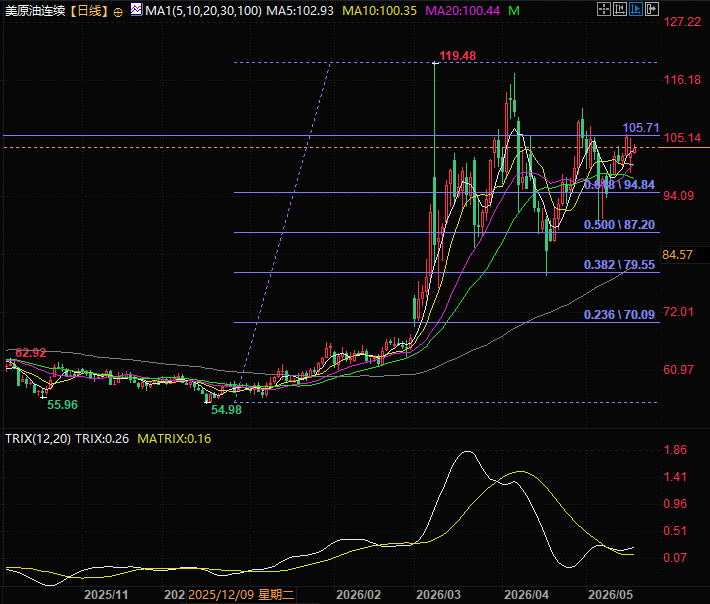
(WTI crude oil futures daily chart, source: EasyForex)
At 16:02 Beijing time, WTI futures were trading at $103.19 per barrel.
The United States continues to claim that it is delaying the strike on Iran, but adds that the U.S. military is prepared to launch a full-scale, large-scale strike on Iran if a mutually acceptable agreement cannot be reached.
Trump considers himself a top negotiator and has repeatedly played the "boy who cried wolf" card in the market, but ultimately he still finds himself in a stalemate on the Iran issue: his tough statements and military pressure have not shaken Tehran's core position, but have instead increased the market's consensus that extreme pressure is a buying opportunity.
With the US-Iran conflict now on the brink of war, US Defense Secretary Hagersey is not at the Pentagon but focused on campaigning for the Republican Party in the midterm elections. This suggests that beneath the US military's tough exterior lies a strong constraint imposed by the midterm elections.
Standoff between the two sides: policy shifts and hardline stances
Trump's policy toward Iran has been inconsistent: on the one hand, he claims that the Iran agreement is unacceptable and that military strikes will be restarted; on the other hand, he responds to requests from Gulf states to suspend attack plans, while still threatening to launch a "massive strike at any time."
Its repeated practice of setting negotiation deadlines and then backing down has led to a persistent "boy who cried wolf" scenario in the market. However, while the wolf will eventually come, the probability of the United States restarting military attacks on Iran is not high.
Despite facing domestic turmoil and economic difficulties, Iran has consistently rejected Trump's core demands, neither abandoning its nuclear program and ballistic missile development nor ceasing its support for regional proxy forces, leading to increasingly hardline stances on both sides.
Key bargaining chip: The energy game in the Strait of Hormuz
The Strait of Hormuz is the core point of contention in the situation—Iran controls a strategic passage for more than a quarter of the world's seaborne oil trade.
While the US military blockaded Iranian ports, Iran's countermeasures triggered energy market volatility, pushing up US inflation and gasoline prices, causing Trump's economic approval rating to decline, and putting the Republican Party in a dilemma in the midterm elections.
Defense Minister's unusual schedule: campaigning for the midterm elections
As the U.S. Secretary of Defense and Trump's ideological vanguard, Hagerseth is no longer in the Pentagon and has abandoned the tradition of "military political neutrality," embarking on a deep involvement in the Republican midterm election mobilization.
Around May 17, he attended a large political and religious rally in Washington called “One Country Under God” with House Speaker Mike Johnson and other top Republican figures.
This event, rife with Christian nationalism, was essentially a political show by the Republican Party to consolidate its evangelical base, and was criticized for blurring the lines between church and state.
At a sensitive time of conflict, the Secretary of Defense's campaign appearance has turned the US policy toward Iraq into a tool for garnering votes, directly linking the risk of war with public opinion during the election. It also suggests that the US military's focus is shifting domestically, toward the midterm elections.
Experts disagree: Stalemate, Advantages, and the Time Game
Experts have differing opinions on the situation: Ali Waez of the International Crisis Group pointed out that both the US and Iran believe that time is on their side, and Iran has not yet reached the painful threshold of "surrender-style concessions";
Former Assistant Secretary of State David Schenker defined the current situation as a "strategic stalemate," with Trump reluctant to restart a full-scale conflict due to factors such as energy volatility and concerns from allies.
Hawkish figure Rich Goldberg insists that the United States remains in a dominant position and that short-term oil price pressures will not affect its energy dominance.
U.S. officials said that Trump's postponement of military action against Iran may be a diversionary tactic, and that he may still launch a strike.
Summary and Technical Analysis:
If the United States launches an attack on Iran, it would trigger a 60-day period under which military action by the president requires congressional approval. Meanwhile, high oil prices, high inflation, and high interest rates in the United States continue to weigh on the president's approval rating and the midterm elections. At present, the probability of continuing the war is still low. At the same time, the Strait of Hormuz remains blocked, and the marginal improvement in traffic volume is not obvious, which continues to push up oil prices.
Each instance of the US president applying maximum pressure creates a low point in public sentiment, which, when subsequently confirmed, presents a good opportunity for intervention.
From a technical perspective, international oil prices have shown a short-term bearish trend without falling, with resistance around 105.70, which is also the 0.786 Fibonacci retracement level of this round of oil price increases.
(WTI crude oil futures daily chart, source: EasyForex)
At 16:02 Beijing time, WTI futures were trading at $103.19 per barrel.
- Risk Warning and Disclaimer
- The market involves risk, and trading may not be suitable for all investors. This article is for reference only and does not constitute personal investment advice, nor does it take into account certain users’ specific investment objectives, financial situation, or other needs. Any investment decisions made based on this information are at your own risk.