USD/JPY stuck at the 159 level: What is the market betting on?
2026-05-19 15:59:30
On Tuesday, May 19th, the USD/JPY pair traded around the 159 level in early European trading, with the exchange rate approaching the 160 mark again. The current driver is not solely the strength of the US dollar, but rather the result of pressure from oil prices, US interest rate expectations, the pace of the Bank of Japan's actions, and expectations of currency market intervention. Latest market pricing indicates that the US dollar remains supported by high interest rate expectations, with the Federal Reserve's policy rate remaining in the 3.5% to 3.75% range and the effective federal funds rate at 3.63%; the Bank of Japan's policy rate remains at 0.75%, and this interest rate differential remains the core background for the USD/JPY's high level of movement.

The USD/JPY pair has recently climbed back above 159, seemingly due to a stronger dollar, but in reality, it reflects a market reassessment of the speed at which the USD/JPY interest rate differential is narrowing. The Federal Reserve held rates steady at its April meeting, maintaining the policy rate range at 3.5% to 3.75%, while the latest effective interest rate remains at 3.63%. Amid high energy prices and fluctuating inflation expectations, the market is no longer solely betting on a rapid shift to easing by the Fed, and is even beginning to reconsider the risk of a further tightening policy.
This is particularly crucial for USD/JPY. The yen isn't without catalysts for appreciation; the problem is that these catalysts aren't enough to offset the yield disadvantage of holding yen. As long as short-term US interest rates remain significantly higher than Japanese rates, any pullback in USD/JPY can easily be absorbed by carry trades. In other words, the price around 159 isn't simply a result of risk appetite, but rather an equilibrium point resulting from the combined effects of short-term funding costs, carry trade demand, and uncertainty surrounding Japanese policy.
From a technical perspective, the daily chart shows the Bollinger Bands' middle band around 158.373, the upper band around 160.626, and the lower band around 156.120. The current price is above the middle band but has not yet broken through the upper band. While the MACD indicator remains in negative territory, the histogram has turned positive, indicating weakening downward momentum and a short-term correction is underway. This suggests that the exchange rate has not entered a one-sided acceleration phase but is instead testing resistance around 160.
The situation in the Middle East is currently the most direct source of volatility in the foreign exchange market. Latest reports indicate that the US has suspended planned military action and shifted its focus to negotiations, causing the dollar to stabilize during Asian trading hours. Meanwhile, the yield on 10-year US Treasury bonds fell slightly to approximately 4.5974%, and Brent crude oil dropped to around $109.84.
These changes indicate that the USD/JPY exchange rate is driven by two underlying logics. The first is the safe-haven logic: when geopolitical uncertainty escalates, the dollar's liquidity advantage makes it easier for the market to buy back in. The second is the inflation logic: if energy transportation disruptions persist and oil prices remain high, the market will reduce its expectations for Fed rate cuts and may even repric the tail risks of rate hikes. While these two logics are not entirely aligned, both are likely to suppress the yen at the current stage.
It's important to note that if the risks to shipping across the Taiwan Strait ease significantly, a drop in oil prices could lead to a short-term cooling of the US dollar, and the USD/JPY exchange rate might experience a technical pullback. However, this does not equate to a trend reversal, as the market will subsequently return to the Federal Reserve's interest rate path, US inflation data, and the Bank of Japan's policy pace. In other words, geopolitical risks affect the pace, while interest rate differentials are the primary driver.
The Bank of Japan kept its policy rate unchanged at 0.75% at its April meeting. Although three members advocated for a rate hike to 1.0%, the decision was ultimately made by a 6-3 vote to maintain the current rate. While the market was initially focused on the expansion of the camp advocating for a rate hike, the more important factor was the Bank of Japan's cautious stance on external uncertainties and potential inflation.
This is not favorable for the yen. Japan's inflation rate rose to 1.5% in March from 1.3% previously, but this is still insufficient to convince the market that the Bank of Japan will quickly catch up with US interest rates. Even though some surveys indicate that the market expects the Bank of Japan to raise interest rates to 1.0% in June and further to 1.25% in the fourth quarter, this is still a gradual path, not a rapid tightening.
Therefore, the problem with the yen is not the lack of policy shift, but rather the slow pace of that shift. As long as the Bank of Japan continues to emphasize monitoring external conditions, wage transmission, and underlying inflation, the market will perceive the yen's rebound as a correction rather than a trend reversal. Expectations of foreign exchange market intervention can amplify short-term volatility, but it's difficult to change the direction of capital flows without corresponding interest rate differentials.
160 is a psychologically important level for USD/JPY traders, but more noteworthy is the volatility shift as the price approaches this area. Currently, the price is trading around 159, not far from the previous high of 160.467 and the upper Bollinger Band of 160.626. If the market continues to revise upwards its expectations of a tighter stance from the Federal Reserve, USD/JPY may retest the area above 160.
However, 160 is not a safe zone for a one-sided trend. This level typically attracts three types of forces simultaneously: first, trend-following funds continue to bet on interest rate differentials; second, short-term funds take profits at previous highs and psychological levels; and third, the market becomes more sensitive to verbal or actual intervention by the Japanese government. Therefore, the closer to 160, the more important it is to control volatility than to determine the direction.
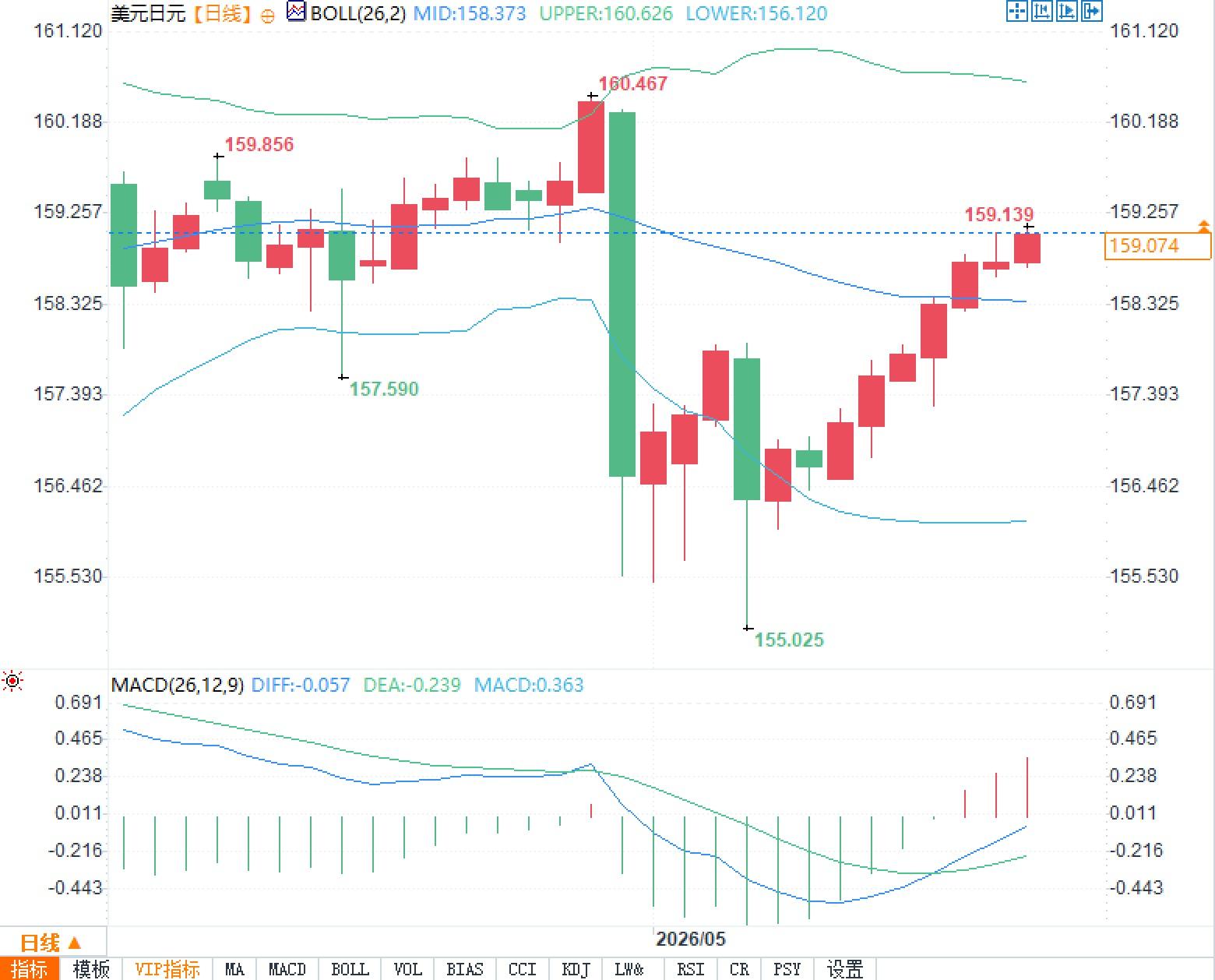
The current trading logic should be understood as "a policy-sensitive zone above and a profit-taking support zone below." If USD/JPY falls back to around 158.3, the Bollinger Middle Band and the recent cost zone may provide some insight; if it continues to rise to the 160.4-160.6 area, the market will reassess the probability of intervention and the sustainability of dollar interest rates. The real signal to change the structure is not a single-day breakout, but rather a continued rise in US yields, a significantly hawkish shift in the Bank of Japan's rhetoric, or a further increase in inflation expectations due to energy shocks.
Question 1: Why has the USD/JPY exchange rate not fallen significantly even though it is close to 160?
A: The core reason is the still large interest rate differential between the US and Japan. The Federal Reserve's interest rate remains at 3.5% to 3.75%, while the Bank of Japan's is only 0.75%. The yen's rebound lacks yield support, and any decline in the exchange rate is easily absorbed by interest rate carry trades.
Question 2: Is rising oil prices always a positive factor for the USD/JPY exchange rate?
A: Not necessarily, but the current environment leans towards supporting the US dollar. Rising oil prices will increase inflation concerns and weaken expectations of a Fed rate cut; meanwhile, Japan's reliance on energy imports makes the yen vulnerable to deteriorating terms of trade.
Question 3: Can the Bank of Japan's interest rate hike reverse the weakness of the yen?
A: A single rate hike may not be enough. The market is more concerned about whether the rate hike path is continuous, whether underlying inflation can stabilize back to near the target, and whether the Federal Reserve will simultaneously ease monetary policy. If the interest rate differential between the two ends narrows slowly, the yen's rebound will still be limited.
First, the 159 level is not simply a technical rebound, but rather a repricing of carry trades.
The USD/JPY pair has recently climbed back above 159, seemingly due to a stronger dollar, but in reality, it reflects a market reassessment of the speed at which the USD/JPY interest rate differential is narrowing. The Federal Reserve held rates steady at its April meeting, maintaining the policy rate range at 3.5% to 3.75%, while the latest effective interest rate remains at 3.63%. Amid high energy prices and fluctuating inflation expectations, the market is no longer solely betting on a rapid shift to easing by the Fed, and is even beginning to reconsider the risk of a further tightening policy.
This is particularly crucial for USD/JPY. The yen isn't without catalysts for appreciation; the problem is that these catalysts aren't enough to offset the yield disadvantage of holding yen. As long as short-term US interest rates remain significantly higher than Japanese rates, any pullback in USD/JPY can easily be absorbed by carry trades. In other words, the price around 159 isn't simply a result of risk appetite, but rather an equilibrium point resulting from the combined effects of short-term funding costs, carry trade demand, and uncertainty surrounding Japanese policy.
From a technical perspective, the daily chart shows the Bollinger Bands' middle band around 158.373, the upper band around 160.626, and the lower band around 156.120. The current price is above the middle band but has not yet broken through the upper band. While the MACD indicator remains in negative territory, the histogram has turned positive, indicating weakening downward momentum and a short-term correction is underway. This suggests that the exchange rate has not entered a one-sided acceleration phase but is instead testing resistance around 160.
II. Oil prices and cross-strait risks are altering the logic of the US dollar, with both safe-haven demand and inflation being priced in simultaneously.
The situation in the Middle East is currently the most direct source of volatility in the foreign exchange market. Latest reports indicate that the US has suspended planned military action and shifted its focus to negotiations, causing the dollar to stabilize during Asian trading hours. Meanwhile, the yield on 10-year US Treasury bonds fell slightly to approximately 4.5974%, and Brent crude oil dropped to around $109.84.
These changes indicate that the USD/JPY exchange rate is driven by two underlying logics. The first is the safe-haven logic: when geopolitical uncertainty escalates, the dollar's liquidity advantage makes it easier for the market to buy back in. The second is the inflation logic: if energy transportation disruptions persist and oil prices remain high, the market will reduce its expectations for Fed rate cuts and may even repric the tail risks of rate hikes. While these two logics are not entirely aligned, both are likely to suppress the yen at the current stage.
It's important to note that if the risks to shipping across the Taiwan Strait ease significantly, a drop in oil prices could lead to a short-term cooling of the US dollar, and the USD/JPY exchange rate might experience a technical pullback. However, this does not equate to a trend reversal, as the market will subsequently return to the Federal Reserve's interest rate path, US inflation data, and the Bank of Japan's policy pace. In other words, geopolitical risks affect the pace, while interest rate differentials are the primary driver.
Third, the Bank of Japan's cautious approach has limited the yen's potential for a sustained rebound.
The Bank of Japan kept its policy rate unchanged at 0.75% at its April meeting. Although three members advocated for a rate hike to 1.0%, the decision was ultimately made by a 6-3 vote to maintain the current rate. While the market was initially focused on the expansion of the camp advocating for a rate hike, the more important factor was the Bank of Japan's cautious stance on external uncertainties and potential inflation.
This is not favorable for the yen. Japan's inflation rate rose to 1.5% in March from 1.3% previously, but this is still insufficient to convince the market that the Bank of Japan will quickly catch up with US interest rates. Even though some surveys indicate that the market expects the Bank of Japan to raise interest rates to 1.0% in June and further to 1.25% in the fourth quarter, this is still a gradual path, not a rapid tightening.
Therefore, the problem with the yen is not the lack of policy shift, but rather the slow pace of that shift. As long as the Bank of Japan continues to emphasize monitoring external conditions, wage transmission, and underlying inflation, the market will perceive the yen's rebound as a correction rather than a trend reversal. Expectations of foreign exchange market intervention can amplify short-term volatility, but it's difficult to change the direction of capital flows without corresponding interest rate differentials.
IV. The real risk above 160: not the price level itself, but the expansion of volatility.
160 is a psychologically important level for USD/JPY traders, but more noteworthy is the volatility shift as the price approaches this area. Currently, the price is trading around 159, not far from the previous high of 160.467 and the upper Bollinger Band of 160.626. If the market continues to revise upwards its expectations of a tighter stance from the Federal Reserve, USD/JPY may retest the area above 160.
However, 160 is not a safe zone for a one-sided trend. This level typically attracts three types of forces simultaneously: first, trend-following funds continue to bet on interest rate differentials; second, short-term funds take profits at previous highs and psychological levels; and third, the market becomes more sensitive to verbal or actual intervention by the Japanese government. Therefore, the closer to 160, the more important it is to control volatility than to determine the direction.
The current trading logic should be understood as "a policy-sensitive zone above and a profit-taking support zone below." If USD/JPY falls back to around 158.3, the Bollinger Middle Band and the recent cost zone may provide some insight; if it continues to rise to the 160.4-160.6 area, the market will reassess the probability of intervention and the sustainability of dollar interest rates. The real signal to change the structure is not a single-day breakout, but rather a continued rise in US yields, a significantly hawkish shift in the Bank of Japan's rhetoric, or a further increase in inflation expectations due to energy shocks.
Frequently Asked Questions
Question 1: Why has the USD/JPY exchange rate not fallen significantly even though it is close to 160?
A: The core reason is the still large interest rate differential between the US and Japan. The Federal Reserve's interest rate remains at 3.5% to 3.75%, while the Bank of Japan's is only 0.75%. The yen's rebound lacks yield support, and any decline in the exchange rate is easily absorbed by interest rate carry trades.
Question 2: Is rising oil prices always a positive factor for the USD/JPY exchange rate?
A: Not necessarily, but the current environment leans towards supporting the US dollar. Rising oil prices will increase inflation concerns and weaken expectations of a Fed rate cut; meanwhile, Japan's reliance on energy imports makes the yen vulnerable to deteriorating terms of trade.
Question 3: Can the Bank of Japan's interest rate hike reverse the weakness of the yen?
A: A single rate hike may not be enough. The market is more concerned about whether the rate hike path is continuous, whether underlying inflation can stabilize back to near the target, and whether the Federal Reserve will simultaneously ease monetary policy. If the interest rate differential between the two ends narrows slowly, the yen's rebound will still be limited.
- Risk Warning and Disclaimer
- The market involves risk, and trading may not be suitable for all investors. This article is for reference only and does not constitute personal investment advice, nor does it take into account certain users’ specific investment objectives, financial situation, or other needs. Any investment decisions made based on this information are at your own risk.