May 20th Financial Breakfast: Inflation concerns drive up interest rate hike expectations; gold prices fall below $4,500; Trump hears about military action plans against Iran; US oil battles for the $104 mark.
2026-05-20 07:32:42
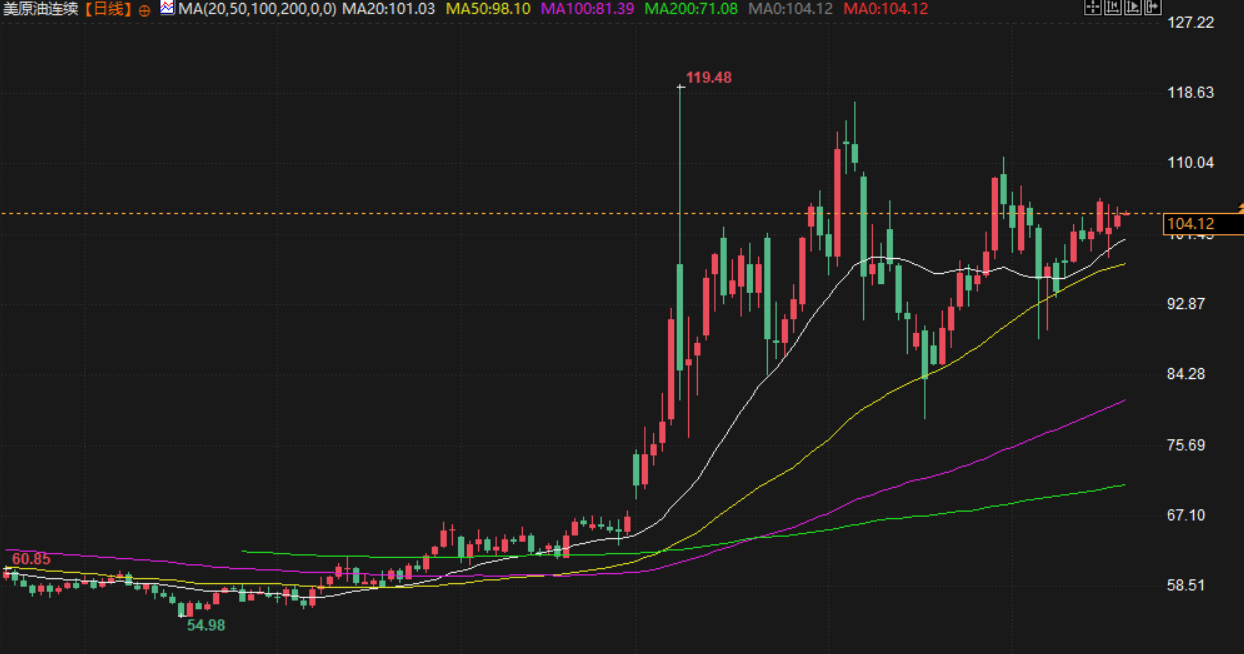
On Wednesday (May 20, Beijing time) in early Asian trading, spot gold was trading around $4486.80 per ounce. Gold prices fell nearly 2% on Tuesday, hitting a low of $4464.85 per ounce, the lowest since March 30. The price was influenced by a stronger dollar and persistent inflation concerns pushing up expectations of interest rate hikes and Treasury yields, with the probability of a Fed rate hike this year rising to 61.3%. US crude oil was trading around $104 per barrel. Although Vance stated that the US and Iran had made significant progress in negotiations and neither side wanted to resume military action, easing supply concerns, substantial disruptions to crude oil supply are still supporting oil prices.

U.S. stocks closed lower on Tuesday, with the Dow Jones Industrial Average falling 0.65% to 49,363.88, the S&P 500 down 0.67% to 7,353.61, and the Nasdaq Composite down 0.84% to 25,870.71.
The Nasdaq fell for the third consecutive day, mainly due to persistently high oil prices and investor concerns that the US and Iran failed to reach a substantial ceasefire agreement, rising inflation worries, and the benchmark 10-year US Treasury yield rising to its highest level in more than a year.
The S&P 500 and Nasdaq also fell for the third consecutive day as investors took profits after the rebound that began in late March and began to consider the possibility that the Federal Reserve might turn to raising interest rates if inflation remains high.
US President Trump stated that military action was delayed due to a new proposal from Iran, while Vice President Vance indicated that negotiations had progressed and neither side wanted to resume military operations. As inflation expectations rose, the 10-year US Treasury yield briefly climbed to 4.687%, a new high since January 2025.
Traders have begun pricing in a rising probability of a Federal Reserve rate hike. The CME FedWatch tool shows the market expects a 41.7% probability of a 25-basis-point rate hike in December and a 15.7% probability of a 50-basis-point hike, up from 4.7% a week ago. Investors are focused on the release of the minutes from the Fed's last policy meeting on Wednesday for clues as to whether policymakers support a shift from a dovish to a neutral stance.
Six of the 11 major sectors in the S&P 500 closed lower, with technology and communication services dragging down the index the most, followed by materials (down nearly 2.3%), while healthcare led the gains (1.1%). The S&P 500 software index closed down 1.2%, while the Philadelphia Semiconductor Index rose slightly by 0.03% after some fluctuation. Investors are awaiting quarterly results from AI chip leader Nvidia after the market closes on Wednesday, and its performance will be closely watched to determine whether AI demand supports the high valuations of the semiconductor sector.
Gold prices fell nearly 2% on Tuesday as a stronger dollar and persistent inflation concerns fueled expectations of interest rate hikes and higher Treasury yields: spot gold fell 1.84% to $4,481.83 per ounce, hitting its lowest level since March 30. The benchmark 10-year Treasury yield approached a more than one-year high, and the dollar strengthened in tandem, with markets anticipating a possible hawkish stance from the Federal Reserve to curb energy-driven inflation. Rising yields increased the opportunity cost of holding non-yielding gold, and a stronger dollar made dollar-denominated commodities more expensive for investors holding other currencies.
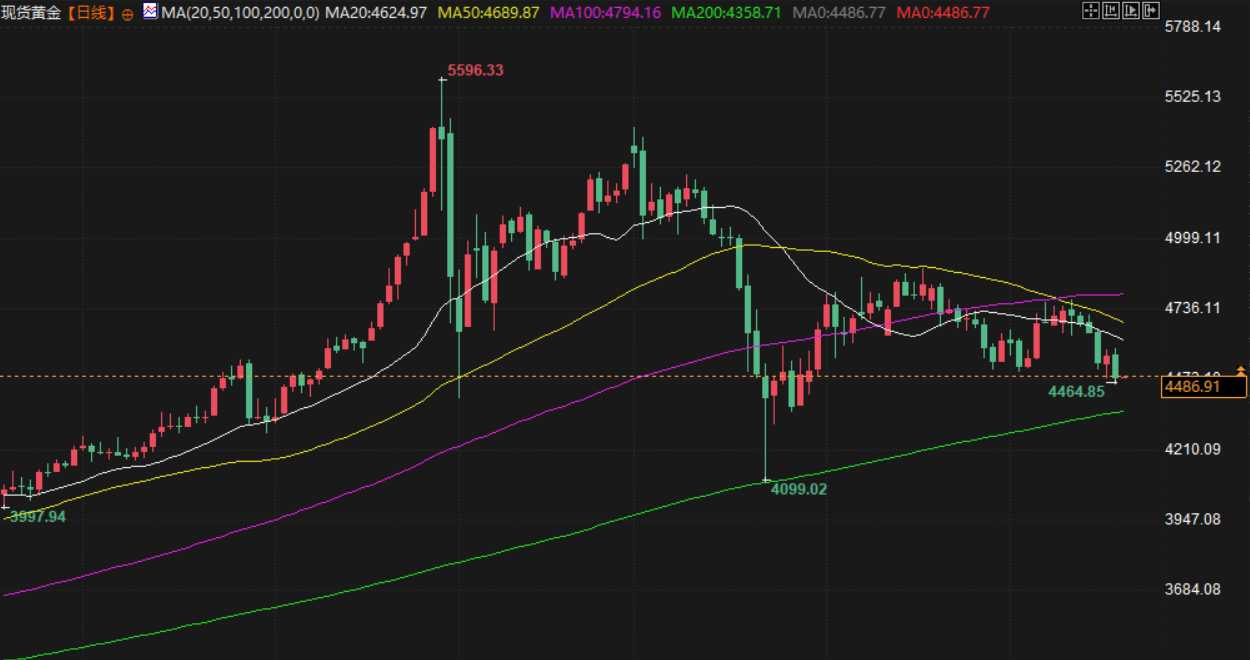
Global inflation concerns are intensifying, forcing central banks to maintain high interest rates. Although gold is an inflation hedge, it typically faces pressure in a high-interest-rate environment. The market believes there is limited room for interest rate cuts for most of 2026, and expectations are shifting towards maintaining interest rates unchanged this year or tightening policy later.
Investors await the release of the latest Federal Reserve policy meeting minutes on Wednesday. In other precious metals, spot silver fell 4.1% to $74.53, platinum dropped 2.2% to $1,936.10, and palladium declined 4.2% to $1,359.26. JPMorgan Chase predicts that platinum prices will reach $2,400 and palladium prices will reach $1,600 in the fourth quarter of 2026.
US crude oil rose 1.5% on Tuesday, despite US Vice President Vance saying that the US and Iran had made great progress in negotiations and that neither side wanted to resume military action, easing supply concerns; however, there are still significant disruptions to crude oil supply, Middle Eastern infrastructure is at risk of attack, and the International Energy Agency said the Strait of Hormuz has been effectively closed.
Furthermore, US President Trump had previously stated that he had postponed the military strike originally scheduled for Tuesday, but was prepared to resume the strike if no agreement was reached.
Iranian state media reported that Tehran's latest peace proposals include a cessation of hostilities on all fronts, the withdrawal of US troops from neighboring areas, and war reparations. Meanwhile, the United States imposed sanctions on an Iranian foreign exchange institution and several shell companies, and froze 19 ships suspected of transporting Iranian oil.
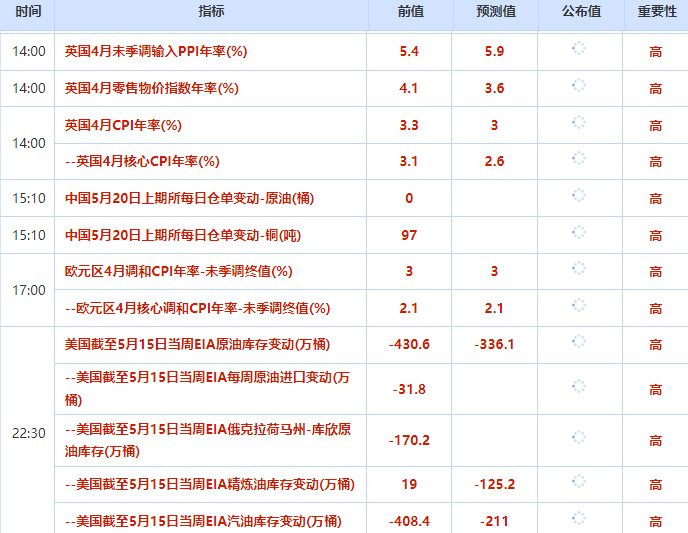
U.S. Treasury Secretary Bessenter extended sanctions waivers for 30 days, allowing "energy-vulnerable" countries to continue purchasing seaborne crude oil from Russia; Russia's Ryazan refinery has halted refining following a drone attack. Data from the U.S. Department of Energy showed a record 9.9 million barrels of crude oil released from the strategic petroleum reserve last week, bringing inventories to their lowest level since July 2024. The market expects U.S. crude oil inventories to decrease by approximately 3.4 million barrels in the week ending May 15. The EIA will release its weekly inventory data on Wednesday.
The dollar index rose 0.34% to 99.30 on Tuesday, while the 30-year Treasury yield climbed to its highest level since 2007. Federal funds rate futures indicate the market expects about a 50% probability of a Fed rate hike by December, but most analysts believe a rate hike is unlikely unless core inflation accelerates. The dollar was also supported by rising yields, with markets uncertain how new Fed Chairman Warsh will handle persistent price pressures.
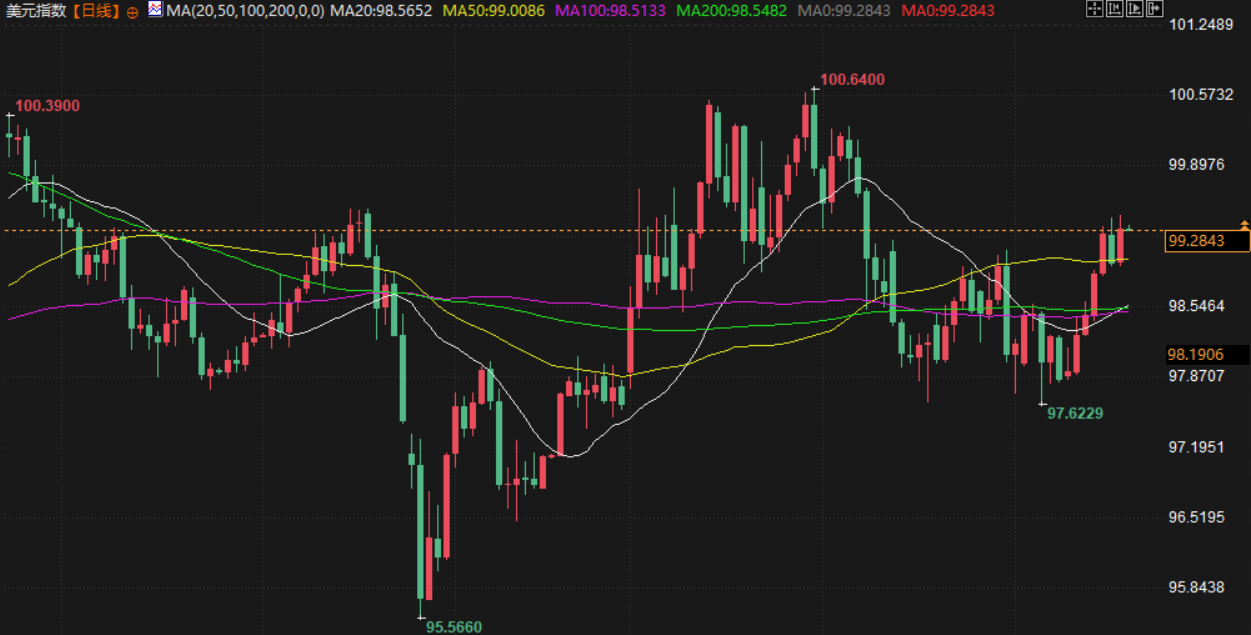
The dollar rose to a six-week high against the euro on Tuesday, supported mainly by expectations that the Federal Reserve might become more hawkish in an effort to curb energy-driven inflation, while uncertainty surrounding a potential Middle East peace deal also boosted safe-haven demand. US President Trump indicated that the US might need to strike Iran again, stating that he was just an hour away from ordering an attack, while Iran's near-complete blockade of the Strait of Hormuz in March had driven up oil prices and increased demand for the dollar as a safe haven.
The pound fell 0.25% to $1.3399. The dollar rose 0.13% against the yen to 159 yen, nearing the intervention range; stronger-than-expected first-quarter economic growth in Japan supported expectations of a June rate hike, but the market is also awaiting further budget details from the government, which could put pressure on the yen. Japan's finance minister stated that they are prepared to deal with excessive exchange rate volatility and will ensure that any intervention measures do not push up US Treasury yields.
Vance: Significant progress has been made in US-Iran negotiations, but the US has also prepared a "Plan B".
U.S. Vice President Vance stated at a White House press conference on the 19th that negotiations between the U.S. and Iran have made "significant progress," but the U.S. has also prepared a "Plan B" to restart military operations. Vance indicated that there are currently "only two options": either "a good agreement" or a return to military action. Clearly, President Trump wants an agreement, and Iran also leans towards one. Meanwhile, the U.S. has prepared a "Plan B" that allows for the resumption of military operations. Trump just told him, "We are ready." "We don't want to go that far, but if necessary, the president is willing and able to take that path," Vance emphasized. He stressed that Iran must not possess nuclear weapons; this is a U.S. "red line." The U.S. hopes Iran will cooperate to establish an effective mechanism to ensure Iran cannot rebuild its nuclear capabilities, "which is precisely what we are striving to achieve in the negotiations." He also stated that, from the U.S. perspective, Iran has not yet clearly defined its negotiating position, "and sometimes it's difficult to understand what the Iranians actually want to achieve through negotiations." When asked by a reporter whether the U.S.-Iran negotiations involved Russia taking over Iran's enriched uranium, Vance said, "This is not currently the U.S. government's plan. Iran has not raised this either." (Xinhua)
Israeli senior officials believe the US still favors resuming military action against Iraq.
According to Israeli sources on the evening of May 19th local time, despite US President Trump's announcement the previous day to cancel attacks on Iran, Israeli officials assessed that evening that Trump still favored resuming military action against Iran. Furthermore, Israeli sources also indicated that joint preparations between Israel and the US for resuming military action against Iran have been completed and are currently awaiting Trump's decision. (CCTV News)
Trump hears proposals for military action against Iran
According to a report by Axios on May 19, US President Trump convened a meeting with his national security team on the evening of May 18 to receive a briefing on military action plans against Iran. The report, citing two US officials, stated that the meeting focused on the next steps in the war against Iran, progress in diplomatic negotiations, and possible US military action. The briefing reportedly indicates that Trump is "seriously considering resuming military action against Iran." Attendees included Vice President Vance, Secretary of State Rubio, Presidential Envoy Witkov, Defense Secretary Hegseth, Chairman of the Joint Chiefs of Staff Kaine, and CIA Director Ratcliffe. The report, citing sources, stated that some advocates for a hardline stance against Iran believe Trump currently "has a desire to deliver a strong blow and force Iran to make concessions in negotiations." The report also noted that the US believes Iran's latest negotiating proposals "have not shown significant progress," and regional mediators are trying to persuade Iran to offer a more flexible solution in response to US demands on the nuclear issue. (CCTV International News)
The Israeli military has entered a state of high alert.
In light of the possibility of US military action against Iran in the coming days, the Israeli military has entered a state of high alert. Israel was surprised by US President Trump's announcement of a postponement of the planned strike against Iran, receiving notification of the decision only at the last minute. The Israeli Air Force is preparing for a scenario where Trump could order an attack on Iran as early as the next few days. It is understood that Israel and the US have completed a joint air force assessment of the latest possible conflict; both sides are taking measures to ensure that any future strikes would be highly lethal, including maintaining air superiority.
The European Parliament adopts new rules for screening foreign direct investment.
The European Parliament has adopted new rules for screening foreign direct investment. Once implemented, these new rules will require EU member states to review investments in sensitive sectors such as defense, dual-use goods, and critical technologies. Specific coverage includes entities in artificial intelligence, quantum technology and semiconductors; aerospace, energy, transportation, and digital infrastructure.
The United States announced a new round of sanctions against Iran.
The U.S. Treasury Department's Office of Foreign Assets Control (OFAC) announced a new round of sanctions against Iran on the 19th, aiming to further exert maximum pressure on the country. According to the OFAC announcement, 12 individuals from various countries and regions were added to the "Specially Designated Nationals List." The list also includes 19 oil, liquefied petroleum gas, and chemical transport vessels, as well as 29 trading and shipping companies. Among those sanctioned is the Amin Exchange, which engages in foreign exchange trading in Iran, and related individuals and companies. (Xinhua)
Republican lawmakers defect, Senate pushes forward bill to withdraw troops from Iran
The U.S. Senate on Tuesday advanced a bill aimed at forcing President Trump to withdraw troops from Iran, with Louisiana Republican Senator Bill Cassidy casting a crucial vote after his primary defeat. Democrats had been pushing for a vote since late February, demanding Trump either obtain congressional authorization to continue the war or withdraw troops. Republicans had previously successfully rejected the bill, but Cassidy's defection broke the deadlock. Cassidy lost the recent primary, and Trump endorsed his opponent. He had previously criticized Trump for using nearly $1.8 billion to compensate allies, and this vote was seen as a public retaliation against Trump.
The probability of a Federal Reserve rate hike this year has risen to 61.3%.
According to CME's "FedWatch": The probability of the Federal Reserve keeping interest rates unchanged by June is 99%, with a 1% probability of a cumulative rate cut of 25 basis points. The probability of the Federal Reserve keeping interest rates unchanged by July is 84.4%, with a 0.8% probability of a cumulative rate cut of 25 basis points and a 14.8% probability of a cumulative rate hike of 25 basis points. The probability of the Federal Reserve keeping interest rates unchanged by December is 38.3%, with a 0.4% probability of a cumulative rate cut of 25 basis points and a 61.3% probability of at least a 25 basis point rate hike.
China's fiber optic orders are booming, with domestic fiber optic orders booked until 2027.
As the construction of AI data centers accelerates globally, market focus is no longer solely on chips. Fiber optic cables, supporting high-speed connections for numerous servers, are becoming a new area of supply shortage. Reports indicate that global demand for fiber optics is surging, driven by the construction of AI data centers. Major Chinese fiber optic manufacturers have orders booked until early 2027. Data shows that in 2024, data centers accounted for less than 5% of global fiber optic demand. However, with the surge in demand, this proportion is expected to rise to 30% by 2027. Since the beginning of this year, several US tech giants have begun to invest in fiber optics, securing production capacity in advance through multi-year supply agreements. In January, Facebook's parent company, Meta, announced a multi-year supply agreement worth up to $6 billion with Corning Incorporated, securing fiber optic cables and connectivity products for AI data centers. In May, Nvidia also announced a partnership with Corning. (CCTV Finance)
Key Focus Today
stock market
U.S. stocks closed lower on Tuesday, with the Dow Jones Industrial Average falling 0.65% to 49,363.88, the S&P 500 down 0.67% to 7,353.61, and the Nasdaq Composite down 0.84% to 25,870.71.
The Nasdaq fell for the third consecutive day, mainly due to persistently high oil prices and investor concerns that the US and Iran failed to reach a substantial ceasefire agreement, rising inflation worries, and the benchmark 10-year US Treasury yield rising to its highest level in more than a year.
The S&P 500 and Nasdaq also fell for the third consecutive day as investors took profits after the rebound that began in late March and began to consider the possibility that the Federal Reserve might turn to raising interest rates if inflation remains high.
US President Trump stated that military action was delayed due to a new proposal from Iran, while Vice President Vance indicated that negotiations had progressed and neither side wanted to resume military operations. As inflation expectations rose, the 10-year US Treasury yield briefly climbed to 4.687%, a new high since January 2025.
Traders have begun pricing in a rising probability of a Federal Reserve rate hike. The CME FedWatch tool shows the market expects a 41.7% probability of a 25-basis-point rate hike in December and a 15.7% probability of a 50-basis-point hike, up from 4.7% a week ago. Investors are focused on the release of the minutes from the Fed's last policy meeting on Wednesday for clues as to whether policymakers support a shift from a dovish to a neutral stance.
Six of the 11 major sectors in the S&P 500 closed lower, with technology and communication services dragging down the index the most, followed by materials (down nearly 2.3%), while healthcare led the gains (1.1%). The S&P 500 software index closed down 1.2%, while the Philadelphia Semiconductor Index rose slightly by 0.03% after some fluctuation. Investors are awaiting quarterly results from AI chip leader Nvidia after the market closes on Wednesday, and its performance will be closely watched to determine whether AI demand supports the high valuations of the semiconductor sector.
Gold Market
Gold prices fell nearly 2% on Tuesday as a stronger dollar and persistent inflation concerns fueled expectations of interest rate hikes and higher Treasury yields: spot gold fell 1.84% to $4,481.83 per ounce, hitting its lowest level since March 30. The benchmark 10-year Treasury yield approached a more than one-year high, and the dollar strengthened in tandem, with markets anticipating a possible hawkish stance from the Federal Reserve to curb energy-driven inflation. Rising yields increased the opportunity cost of holding non-yielding gold, and a stronger dollar made dollar-denominated commodities more expensive for investors holding other currencies.
Global inflation concerns are intensifying, forcing central banks to maintain high interest rates. Although gold is an inflation hedge, it typically faces pressure in a high-interest-rate environment. The market believes there is limited room for interest rate cuts for most of 2026, and expectations are shifting towards maintaining interest rates unchanged this year or tightening policy later.
Investors await the release of the latest Federal Reserve policy meeting minutes on Wednesday. In other precious metals, spot silver fell 4.1% to $74.53, platinum dropped 2.2% to $1,936.10, and palladium declined 4.2% to $1,359.26. JPMorgan Chase predicts that platinum prices will reach $2,400 and palladium prices will reach $1,600 in the fourth quarter of 2026.
oil market
US crude oil rose 1.5% on Tuesday, despite US Vice President Vance saying that the US and Iran had made great progress in negotiations and that neither side wanted to resume military action, easing supply concerns; however, there are still significant disruptions to crude oil supply, Middle Eastern infrastructure is at risk of attack, and the International Energy Agency said the Strait of Hormuz has been effectively closed.
Furthermore, US President Trump had previously stated that he had postponed the military strike originally scheduled for Tuesday, but was prepared to resume the strike if no agreement was reached.
Iranian state media reported that Tehran's latest peace proposals include a cessation of hostilities on all fronts, the withdrawal of US troops from neighboring areas, and war reparations. Meanwhile, the United States imposed sanctions on an Iranian foreign exchange institution and several shell companies, and froze 19 ships suspected of transporting Iranian oil.
U.S. Treasury Secretary Bessenter extended sanctions waivers for 30 days, allowing "energy-vulnerable" countries to continue purchasing seaborne crude oil from Russia; Russia's Ryazan refinery has halted refining following a drone attack. Data from the U.S. Department of Energy showed a record 9.9 million barrels of crude oil released from the strategic petroleum reserve last week, bringing inventories to their lowest level since July 2024. The market expects U.S. crude oil inventories to decrease by approximately 3.4 million barrels in the week ending May 15. The EIA will release its weekly inventory data on Wednesday.
Foreign exchange market
The dollar index rose 0.34% to 99.30 on Tuesday, while the 30-year Treasury yield climbed to its highest level since 2007. Federal funds rate futures indicate the market expects about a 50% probability of a Fed rate hike by December, but most analysts believe a rate hike is unlikely unless core inflation accelerates. The dollar was also supported by rising yields, with markets uncertain how new Fed Chairman Warsh will handle persistent price pressures.
The dollar rose to a six-week high against the euro on Tuesday, supported mainly by expectations that the Federal Reserve might become more hawkish in an effort to curb energy-driven inflation, while uncertainty surrounding a potential Middle East peace deal also boosted safe-haven demand. US President Trump indicated that the US might need to strike Iran again, stating that he was just an hour away from ordering an attack, while Iran's near-complete blockade of the Strait of Hormuz in March had driven up oil prices and increased demand for the dollar as a safe haven.
The pound fell 0.25% to $1.3399. The dollar rose 0.13% against the yen to 159 yen, nearing the intervention range; stronger-than-expected first-quarter economic growth in Japan supported expectations of a June rate hike, but the market is also awaiting further budget details from the government, which could put pressure on the yen. Japan's finance minister stated that they are prepared to deal with excessive exchange rate volatility and will ensure that any intervention measures do not push up US Treasury yields.
International News
Vance: Significant progress has been made in US-Iran negotiations, but the US has also prepared a "Plan B".
U.S. Vice President Vance stated at a White House press conference on the 19th that negotiations between the U.S. and Iran have made "significant progress," but the U.S. has also prepared a "Plan B" to restart military operations. Vance indicated that there are currently "only two options": either "a good agreement" or a return to military action. Clearly, President Trump wants an agreement, and Iran also leans towards one. Meanwhile, the U.S. has prepared a "Plan B" that allows for the resumption of military operations. Trump just told him, "We are ready." "We don't want to go that far, but if necessary, the president is willing and able to take that path," Vance emphasized. He stressed that Iran must not possess nuclear weapons; this is a U.S. "red line." The U.S. hopes Iran will cooperate to establish an effective mechanism to ensure Iran cannot rebuild its nuclear capabilities, "which is precisely what we are striving to achieve in the negotiations." He also stated that, from the U.S. perspective, Iran has not yet clearly defined its negotiating position, "and sometimes it's difficult to understand what the Iranians actually want to achieve through negotiations." When asked by a reporter whether the U.S.-Iran negotiations involved Russia taking over Iran's enriched uranium, Vance said, "This is not currently the U.S. government's plan. Iran has not raised this either." (Xinhua)
Israeli senior officials believe the US still favors resuming military action against Iraq.
According to Israeli sources on the evening of May 19th local time, despite US President Trump's announcement the previous day to cancel attacks on Iran, Israeli officials assessed that evening that Trump still favored resuming military action against Iran. Furthermore, Israeli sources also indicated that joint preparations between Israel and the US for resuming military action against Iran have been completed and are currently awaiting Trump's decision. (CCTV News)
Trump hears proposals for military action against Iran
According to a report by Axios on May 19, US President Trump convened a meeting with his national security team on the evening of May 18 to receive a briefing on military action plans against Iran. The report, citing two US officials, stated that the meeting focused on the next steps in the war against Iran, progress in diplomatic negotiations, and possible US military action. The briefing reportedly indicates that Trump is "seriously considering resuming military action against Iran." Attendees included Vice President Vance, Secretary of State Rubio, Presidential Envoy Witkov, Defense Secretary Hegseth, Chairman of the Joint Chiefs of Staff Kaine, and CIA Director Ratcliffe. The report, citing sources, stated that some advocates for a hardline stance against Iran believe Trump currently "has a desire to deliver a strong blow and force Iran to make concessions in negotiations." The report also noted that the US believes Iran's latest negotiating proposals "have not shown significant progress," and regional mediators are trying to persuade Iran to offer a more flexible solution in response to US demands on the nuclear issue. (CCTV International News)
The Israeli military has entered a state of high alert.
In light of the possibility of US military action against Iran in the coming days, the Israeli military has entered a state of high alert. Israel was surprised by US President Trump's announcement of a postponement of the planned strike against Iran, receiving notification of the decision only at the last minute. The Israeli Air Force is preparing for a scenario where Trump could order an attack on Iran as early as the next few days. It is understood that Israel and the US have completed a joint air force assessment of the latest possible conflict; both sides are taking measures to ensure that any future strikes would be highly lethal, including maintaining air superiority.
The European Parliament adopts new rules for screening foreign direct investment.
The European Parliament has adopted new rules for screening foreign direct investment. Once implemented, these new rules will require EU member states to review investments in sensitive sectors such as defense, dual-use goods, and critical technologies. Specific coverage includes entities in artificial intelligence, quantum technology and semiconductors; aerospace, energy, transportation, and digital infrastructure.
The United States announced a new round of sanctions against Iran.
The U.S. Treasury Department's Office of Foreign Assets Control (OFAC) announced a new round of sanctions against Iran on the 19th, aiming to further exert maximum pressure on the country. According to the OFAC announcement, 12 individuals from various countries and regions were added to the "Specially Designated Nationals List." The list also includes 19 oil, liquefied petroleum gas, and chemical transport vessels, as well as 29 trading and shipping companies. Among those sanctioned is the Amin Exchange, which engages in foreign exchange trading in Iran, and related individuals and companies. (Xinhua)
Republican lawmakers defect, Senate pushes forward bill to withdraw troops from Iran
The U.S. Senate on Tuesday advanced a bill aimed at forcing President Trump to withdraw troops from Iran, with Louisiana Republican Senator Bill Cassidy casting a crucial vote after his primary defeat. Democrats had been pushing for a vote since late February, demanding Trump either obtain congressional authorization to continue the war or withdraw troops. Republicans had previously successfully rejected the bill, but Cassidy's defection broke the deadlock. Cassidy lost the recent primary, and Trump endorsed his opponent. He had previously criticized Trump for using nearly $1.8 billion to compensate allies, and this vote was seen as a public retaliation against Trump.
The probability of a Federal Reserve rate hike this year has risen to 61.3%.
According to CME's "FedWatch": The probability of the Federal Reserve keeping interest rates unchanged by June is 99%, with a 1% probability of a cumulative rate cut of 25 basis points. The probability of the Federal Reserve keeping interest rates unchanged by July is 84.4%, with a 0.8% probability of a cumulative rate cut of 25 basis points and a 14.8% probability of a cumulative rate hike of 25 basis points. The probability of the Federal Reserve keeping interest rates unchanged by December is 38.3%, with a 0.4% probability of a cumulative rate cut of 25 basis points and a 61.3% probability of at least a 25 basis point rate hike.
Domestic News
China's fiber optic orders are booming, with domestic fiber optic orders booked until 2027.
As the construction of AI data centers accelerates globally, market focus is no longer solely on chips. Fiber optic cables, supporting high-speed connections for numerous servers, are becoming a new area of supply shortage. Reports indicate that global demand for fiber optics is surging, driven by the construction of AI data centers. Major Chinese fiber optic manufacturers have orders booked until early 2027. Data shows that in 2024, data centers accounted for less than 5% of global fiber optic demand. However, with the surge in demand, this proportion is expected to rise to 30% by 2027. Since the beginning of this year, several US tech giants have begun to invest in fiber optics, securing production capacity in advance through multi-year supply agreements. In January, Facebook's parent company, Meta, announced a multi-year supply agreement worth up to $6 billion with Corning Incorporated, securing fiber optic cables and connectivity products for AI data centers. In May, Nvidia also announced a partnership with Corning. (CCTV Finance)
- Risk Warning and Disclaimer
- The market involves risk, and trading may not be suitable for all investors. This article is for reference only and does not constitute personal investment advice, nor does it take into account certain users’ specific investment objectives, financial situation, or other needs. Any investment decisions made based on this information are at your own risk.