Inflation concerns have resurfaced, causing long-term US Treasury yields to surge to a near 19-year high.
2026-05-20 10:52:40
On Tuesday (May 19), the global bond market experienced another sharp correction. Market participants, concerned about a resurgence of inflationary pressures, sold off US Treasury assets en masse, pushing yields across all maturities upward. The 30-year Treasury yield surged to a near 19-year high, and the simultaneous strengthening of both short- and long-term yields completely reversed expectations of an interest rate cut this year.
Market trading logic has shifted entirely to anticipating the start of a Federal Reserve interest rate hike cycle. Rising financing costs have not only suppressed household consumption and the vitality of the real economy, but have also had a significant impact on the highly valued equity market . Long-term bond yields in major global economies have also risen in tandem.
Driven by risk aversion selling, US Treasury bonds continued to weaken, with yields rising across the board. The yield on the 30-year Treasury bond rose to close at 5.182%, briefly touching 5.197% during the session, the highest level since July 2007. The yield on the 10-year Treasury bond, a core anchor for pricing various types of credit in the market, closed at 4.666%, having reached a high of 4.682%, a new high since January 2025.
The yield on the two-year U.S. Treasury note, which closely monitors short-term monetary policy moves, also rose slightly to 4.121%.
The general rule in the financial field is that one basis point equals 0.01 percent. Bond prices and yields always move in opposite directions, and a continuous rise in yields means that bond asset prices are under continuous pressure and fall.

Previously released economic data clearly showed that the upward trend in US inflation was becoming increasingly evident, and geopolitical tensions were driving a sustained rise in international oil prices, comprehensively increasing overall social operating costs from the production to the consumption side. This change completely altered the original judgment of the fixed income market. Investors were no longer convinced that the Federal Reserve would continue its rate-cutting strategy, but instead began to bet that the central bank was likely to introduce rate-hiking measures, resulting in a fundamental shift in market sentiment.
Jim Lacamp, Senior Vice President of Morgan Stanley Wealth Management, bluntly addressed the current market predicament. He stated that at the beginning of the year, the market was unanimously optimistic about declining interest rates, which was a key supporting factor for the strong performance of the capital market. However, the situation has now reversed, with the Federal Reserve initiating an interest rate hike process becoming the mainstream market assessment.
The continued rise in US Treasury yields has directly led to a simultaneous increase in interest rates for various private lending activities such as mortgages, car loans, and credit cards. The persistently high cost of living will gradually suppress residents' consumption capacity and drag down the vitality of the overall consumer market.
From a macro perspective, rising long-term interest rates will slow down the pace of overall economic expansion and exert strong downward pressure on the current high stock market valuations.
Ian Lyngen, head of U.S. interest rates at BMO, said that if the 30-year U.S. Treasury yield successfully reaches the 5.25% mark in the short term, the capital market will see a sustained round of valuation correction.
Dragged down by negative interest rate news, all three major U.S. stock indexes closed lower on the day, marking the third consecutive trading day of declines, with risk aversion and selling continuing to spread in the market.
The latest survey results released by Bank of America on the same day clearly reflect the pessimistic attitude of institutional investors. Among the global fund managers who participated in the survey, more than 60% of respondents believe that the yield on 30-year US Treasury bonds is likely to rise to 6%, a figure very close to the historical high range, and still has considerable upside potential from the current level. Only a few institutions are optimistic about a decline in interest rates.
This interest rate hike was not an isolated event in the US market; bond markets in developed economies around the world weakened in tandem. On the same day, yields on long-term German and British government bonds rose simultaneously, while the yield on Japan's 30-year government bonds hit a record high this week, establishing a global trend of rising interest rates.
Overall, the resurgence of inflation coupled with persistently high energy prices has completely shattered previous expectations of loose monetary policy. Long-term US Treasury yields have repeatedly broken through key levels, reshaping the market interest rate landscape. With expectations of a Federal Reserve policy shift intensifying, rising financing costs across society are now a major trend. This will not only profoundly impact the pace of the US economy but will also have a ripple effect on major global financial markets through financial linkages.
Before inflationary pressures are fully alleviated, long-term interest rates are more likely to rise than fall, and various assets will continue to seek a reasonable pricing range in a high-interest-rate environment.
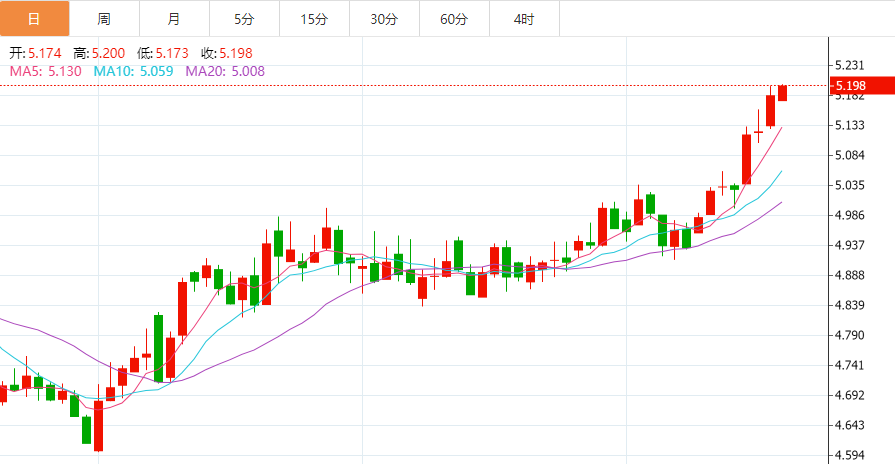
30-year US Treasury yield daily chart source:
At 10:52 AM Beijing time on May 20, the yield on the 30-year US Treasury bond was 5.189%.
Market trading logic has shifted entirely to anticipating the start of a Federal Reserve interest rate hike cycle. Rising financing costs have not only suppressed household consumption and the vitality of the real economy, but have also had a significant impact on the highly valued equity market . Long-term bond yields in major global economies have also risen in tandem.
US Treasuries weakened across the board, with long-term yields hitting multi-year highs.
Driven by risk aversion selling, US Treasury bonds continued to weaken, with yields rising across the board. The yield on the 30-year Treasury bond rose to close at 5.182%, briefly touching 5.197% during the session, the highest level since July 2007. The yield on the 10-year Treasury bond, a core anchor for pricing various types of credit in the market, closed at 4.666%, having reached a high of 4.682%, a new high since January 2025.
The yield on the two-year U.S. Treasury note, which closely monitors short-term monetary policy moves, also rose slightly to 4.121%.
The general rule in the financial field is that one basis point equals 0.01 percent. Bond prices and yields always move in opposite directions, and a continuous rise in yields means that bond asset prices are under continuous pressure and fall.
A strong rebound in inflation has completely reversed market expectations for interest rates.
Previously released economic data clearly showed that the upward trend in US inflation was becoming increasingly evident, and geopolitical tensions were driving a sustained rise in international oil prices, comprehensively increasing overall social operating costs from the production to the consumption side. This change completely altered the original judgment of the fixed income market. Investors were no longer convinced that the Federal Reserve would continue its rate-cutting strategy, but instead began to bet that the central bank was likely to introduce rate-hiking measures, resulting in a fundamental shift in market sentiment.
Jim Lacamp, Senior Vice President of Morgan Stanley Wealth Management, bluntly addressed the current market predicament. He stated that at the beginning of the year, the market was unanimously optimistic about declining interest rates, which was a key supporting factor for the strong performance of the capital market. However, the situation has now reversed, with the Federal Reserve initiating an interest rate hike process becoming the mainstream market assessment.
Rising financing costs are putting pressure on both the real economy and the stock market.
The continued rise in US Treasury yields has directly led to a simultaneous increase in interest rates for various private lending activities such as mortgages, car loans, and credit cards. The persistently high cost of living will gradually suppress residents' consumption capacity and drag down the vitality of the overall consumer market.
From a macro perspective, rising long-term interest rates will slow down the pace of overall economic expansion and exert strong downward pressure on the current high stock market valuations.
Ian Lyngen, head of U.S. interest rates at BMO, said that if the 30-year U.S. Treasury yield successfully reaches the 5.25% mark in the short term, the capital market will see a sustained round of valuation correction.
Dragged down by negative interest rate news, all three major U.S. stock indexes closed lower on the day, marking the third consecutive trading day of declines, with risk aversion and selling continuing to spread in the market.
Institutional expectations are extremely pessimistic, with global bond markets moving in tandem.
The latest survey results released by Bank of America on the same day clearly reflect the pessimistic attitude of institutional investors. Among the global fund managers who participated in the survey, more than 60% of respondents believe that the yield on 30-year US Treasury bonds is likely to rise to 6%, a figure very close to the historical high range, and still has considerable upside potential from the current level. Only a few institutions are optimistic about a decline in interest rates.
This interest rate hike was not an isolated event in the US market; bond markets in developed economies around the world weakened in tandem. On the same day, yields on long-term German and British government bonds rose simultaneously, while the yield on Japan's 30-year government bonds hit a record high this week, establishing a global trend of rising interest rates.
Summarize
Overall, the resurgence of inflation coupled with persistently high energy prices has completely shattered previous expectations of loose monetary policy. Long-term US Treasury yields have repeatedly broken through key levels, reshaping the market interest rate landscape. With expectations of a Federal Reserve policy shift intensifying, rising financing costs across society are now a major trend. This will not only profoundly impact the pace of the US economy but will also have a ripple effect on major global financial markets through financial linkages.
Before inflationary pressures are fully alleviated, long-term interest rates are more likely to rise than fall, and various assets will continue to seek a reasonable pricing range in a high-interest-rate environment.
30-year US Treasury yield daily chart source:
At 10:52 AM Beijing time on May 20, the yield on the 30-year US Treasury bond was 5.189%.
- Risk Warning and Disclaimer
- The market involves risk, and trading may not be suitable for all investors. This article is for reference only and does not constitute personal investment advice, nor does it take into account certain users’ specific investment objectives, financial situation, or other needs. Any investment decisions made based on this information are at your own risk.