Institutions: Central bank gold purchases this year exceeded expectations, further clarifying the potential for gold prices to rise towards the end of the year.
2026-05-20 11:16:19
The actual scale of gold purchases by central banks worldwide in 2026 has significantly exceeded previous market estimates. Goldman Sachs, after revising its calculation model and addressing statistical loopholes, has raised its forecast, believing that global official institution demand for gold will continue to expand in the second half of the year.
Amid a complex and volatile geopolitical landscape and the accelerated diversification of foreign exchange reserves by many countries, both official and private demand for gold has increased. Institutions are maintaining their year-end gold price targets while also rationally assessing potential market volatility risks, thus highlighting the overall value of commodity allocation.
Last Friday (May 15), Goldman Sachs' commodities research team announced that it had completed an optimization and adjustment of its central bank gold demand calculation model to fill statistical gaps in traditional official trade data. Back in March, the institution had already raised its short-term gold purchase calculation, increasing the monthly average central bank gold purchases based on the twelve-month moving average from 29 tons to 50 tons.
Based on a comprehensive assessment of the current market environment, Goldman Sachs has officially established a new forecast: central bank gold purchases will remain stable at around 60 tons per month throughout 2026. Researchers stated that since August 2025, UK trade statistics have been unable to fully capture gold outflows from London vaults, resulting in a significant amount of unrecorded implicit central bank gold purchases. This is the core reason why past industry forecasts have consistently been lower than expected.
Goldman Sachs stated that the underlying demand for gold in the current market is solid. Combined with internal central bank surveys and recent geopolitical developments, it is evident that the willingness of official institutions and ordinary investors to increase their gold holdings will continue to rise in the future.
The institution maintains its target price of $5,400 per ounce for international gold by the end of 2026, while also issuing a risk warning that if the financial markets experience significant volatility, investors may sell off liquid assets to replenish cash flow, putting downward pressure on gold prices in the short term.
When gold prices hit record highs at the end of January, Goldman Sachs set this high target price. A research team led by Daan Struyven and Lina Thomas stated that this optimistic forecast is primarily based on the stability of private safe-haven funds' holdings. Historically, gold safe-haven trading has often been geared towards short-term events, with investors quickly exiting once the trend ends. However, current long-term gold holdings used to hedge fiscal risks are less likely to be sold off within the year, demonstrating greater resilience.
Emerging market central banks continue to steadily optimize their foreign exchange reserve structures, increasing the proportion of gold assets and promoting a more diversified reserve asset portfolio. Meanwhile, the fiscal and monetary policies of major economies remain highly uncertain, and expectations of currency depreciation are rising. This is prompting high-net-worth individuals to increase their physical gold purchases, while also driving up trading activity in exchange-traded gold call options.
Analysts believe that the upward potential of gold prices in this round of price increases far outweighs the downward pressure. Numerous uncertainties at the global policy level will continue to drive private funds to increase their gold holdings. Only when market risk sentiment cools across the board and investors collectively reduce their holdings of macro-level safe-haven assets will gold prices face significant downward pressure.
In fact, in its annual commodity outlook released at the end of last year, Goldman Sachs clearly listed gold as the best investment option in the commodity sector, believing that private funds following the trend of central banks investing in gold would drive gold prices to break through benchmark expectations, while advocating that investors allocate a balanced portfolio of various commodities.
The research team stated that while gold is currently the most worthwhile long-term investment, diversifying across various commodities is also strategically significant. With global commodity supply now concentrated in a few areas, coupled with escalating geopolitical tensions and trade competition, the risk of supply chain disruptions is rising, making the overall asset protection value of commodities increasingly prominent.
Analysts warn that a shortage of commodity supply could easily lead to a slowdown in economic growth and a simultaneous rise in prices. An investment system built solely on a combination of stocks and bonds is unlikely to withstand such systemic risks. A reasonable allocation of commodity assets can further improve the asset risk control system.
Overall, after the statistical data revision, the true extent of global central banks' gold purchases has become fully apparent. Coupled with the continued influx of private safe-haven funds, the medium- to long-term upward trend in gold prices remains very solid. Institutions are sticking to their year-end high gold price targets, fully recognizing gold's value-preserving and hedging attributes. Short-term liquidity fluctuations will only cause temporary market volatility.
Against the backdrop of lingering global economic policy uncertainties, the central bank gold-buying spree is expected to continue, and the allocation value of gold and commodities as a whole will continue to be realized in the market.
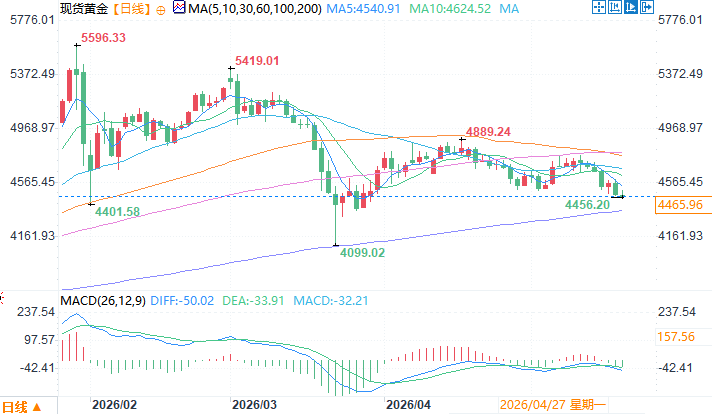
Spot gold daily chart source: EasyForex
At 11:16 AM Beijing time on May 20, spot gold was trading at $4460.22 per ounce.
Amid a complex and volatile geopolitical landscape and the accelerated diversification of foreign exchange reserves by many countries, both official and private demand for gold has increased. Institutions are maintaining their year-end gold price targets while also rationally assessing potential market volatility risks, thus highlighting the overall value of commodity allocation.
The revised statistical model has raised the central bank's gold purchase forecast for the whole year.
Last Friday (May 15), Goldman Sachs' commodities research team announced that it had completed an optimization and adjustment of its central bank gold demand calculation model to fill statistical gaps in traditional official trade data. Back in March, the institution had already raised its short-term gold purchase calculation, increasing the monthly average central bank gold purchases based on the twelve-month moving average from 29 tons to 50 tons.
Based on a comprehensive assessment of the current market environment, Goldman Sachs has officially established a new forecast: central bank gold purchases will remain stable at around 60 tons per month throughout 2026. Researchers stated that since August 2025, UK trade statistics have been unable to fully capture gold outflows from London vaults, resulting in a significant amount of unrecorded implicit central bank gold purchases. This is the core reason why past industry forecasts have consistently been lower than expected.
Multiple demands are driving the continued rise in popularity of gold investment.
Goldman Sachs stated that the underlying demand for gold in the current market is solid. Combined with internal central bank surveys and recent geopolitical developments, it is evident that the willingness of official institutions and ordinary investors to increase their gold holdings will continue to rise in the future.
The institution maintains its target price of $5,400 per ounce for international gold by the end of 2026, while also issuing a risk warning that if the financial markets experience significant volatility, investors may sell off liquid assets to replenish cash flow, putting downward pressure on gold prices in the short term.
When gold prices hit record highs at the end of January, Goldman Sachs set this high target price. A research team led by Daan Struyven and Lina Thomas stated that this optimistic forecast is primarily based on the stability of private safe-haven funds' holdings. Historically, gold safe-haven trading has often been geared towards short-term events, with investors quickly exiting once the trend ends. However, current long-term gold holdings used to hedge fiscal risks are less likely to be sold off within the year, demonstrating greater resilience.
Market funds are diversified and the demand for value preservation is spreading across the board.
Emerging market central banks continue to steadily optimize their foreign exchange reserve structures, increasing the proportion of gold assets and promoting a more diversified reserve asset portfolio. Meanwhile, the fiscal and monetary policies of major economies remain highly uncertain, and expectations of currency depreciation are rising. This is prompting high-net-worth individuals to increase their physical gold purchases, while also driving up trading activity in exchange-traded gold call options.
Analysts believe that the upward potential of gold prices in this round of price increases far outweighs the downward pressure. Numerous uncertainties at the global policy level will continue to drive private funds to increase their gold holdings. Only when market risk sentiment cools across the board and investors collectively reduce their holdings of macro-level safe-haven assets will gold prices face significant downward pressure.
The reshaping of asset class landscape highlights the safe-haven value of commodities.
In fact, in its annual commodity outlook released at the end of last year, Goldman Sachs clearly listed gold as the best investment option in the commodity sector, believing that private funds following the trend of central banks investing in gold would drive gold prices to break through benchmark expectations, while advocating that investors allocate a balanced portfolio of various commodities.
The research team stated that while gold is currently the most worthwhile long-term investment, diversifying across various commodities is also strategically significant. With global commodity supply now concentrated in a few areas, coupled with escalating geopolitical tensions and trade competition, the risk of supply chain disruptions is rising, making the overall asset protection value of commodities increasingly prominent.
Analysts warn that a shortage of commodity supply could easily lead to a slowdown in economic growth and a simultaneous rise in prices. An investment system built solely on a combination of stocks and bonds is unlikely to withstand such systemic risks. A reasonable allocation of commodity assets can further improve the asset risk control system.
Summarize
Overall, after the statistical data revision, the true extent of global central banks' gold purchases has become fully apparent. Coupled with the continued influx of private safe-haven funds, the medium- to long-term upward trend in gold prices remains very solid. Institutions are sticking to their year-end high gold price targets, fully recognizing gold's value-preserving and hedging attributes. Short-term liquidity fluctuations will only cause temporary market volatility.
Against the backdrop of lingering global economic policy uncertainties, the central bank gold-buying spree is expected to continue, and the allocation value of gold and commodities as a whole will continue to be realized in the market.
Spot gold daily chart source: EasyForex
At 11:16 AM Beijing time on May 20, spot gold was trading at $4460.22 per ounce.
- Risk Warning and Disclaimer
- The market involves risk, and trading may not be suitable for all investors. This article is for reference only and does not constitute personal investment advice, nor does it take into account certain users’ specific investment objectives, financial situation, or other needs. Any investment decisions made based on this information are at your own risk.