Risks in the Strait of Hormuz pushed up oil prices, while the Indian rupee fell to near record lows.
2026-05-20 15:12:41
The Indian rupee continued to be under pressure on Wednesday, with the USD/IRR exchange rate holding near 97.00, close to its all-time high. The core pressure currently stems from the continued rise in international oil prices and the overall strengthening of the US dollar amid heightened global risk aversion. Because India is highly dependent on crude oil imports, it typically faces more severe imported inflationary pressures when international oil prices rise sharply, and its current account deficit may also widen. Therefore, the rupee tends to underperform in high oil price environments.
While WTI crude oil prices have slightly retreated to around $103.00, international oil prices have still risen by more than 50% since the outbreak of the Middle East conflict. This increase significantly exceeded market expectations and has rapidly exacerbated concerns in the Indian market regarding energy costs and economic growth prospects. The shipping issues in the Strait of Hormuz remain largely unresolved. As one of the world's most critical energy transport routes, the region handles approximately 20% of global seaborne crude oil shipments. Continued disruptions to these routes will place enormous pressure on Asian energy-importing economies.
For India, high oil prices not only mean increased import costs but also potentially further push up domestic inflation and exacerbate fiscal and trade imbalances. Meanwhile, recent negotiations between the US and Iran have lacked a breakthrough. Iran demands the lifting of sanctions, the release of frozen assets, and an end to the US blockade of Iranian ports, while significant differences remain between the two sides on nuclear issues and regional security.
Meanwhile, US President Trump again sent a strong signal, stating that if Iran cannot reach an agreement soon, the US may launch another military strike in the coming days. Trump said he does not want a full-scale war, but the US "may have to launch another major strike," giving a "two to three-day" window. In response, Iran stated that it is prepared for any military action and warned that if the US resumes military operations, the Iranian military will "open a new front."
The escalating risk of this situation has further exacerbated market concerns about the stability of Middle Eastern supply chains, pushing international oil prices to remain high. Meanwhile, overseas funds' attitude towards the Indian market has also begun to weaken significantly. After three consecutive trading days of continuous buying of Indian stocks, foreign institutional investors (FIIs) turned to net selling on Tuesday.
Data shows that foreign institutional investors were net sellers of 245.749 billion rupees on Tuesday, compared with net purchases of approximately 433 billion rupees over the previous three trading days. The market believes that the high oil price environment may weaken India's economic growth expectations and increase cost pressures on businesses, leading some overseas funds to reduce their exposure to the Indian market. Furthermore, the continued rise in US Treasury yields has further pressured emerging market currencies, including the Indian rupee.
The yield on the 10-year US Treasury bond has risen to 4.69%, a new high for the year. Market bets on the Federal Reserve maintaining high interest rates or even raising them further have clearly intensified. According to the CME Group's FedWatch tool, the market now sees a probability of at least one more rate hike by the Fed this year at around 56.3%, while the remaining traders generally expect the Fed to keep rates unchanged.
The high-yield environment is driving global funds back into dollar assets, while simultaneously diminishing the attractiveness of emerging market currencies. This is particularly evident against the backdrop of deteriorating global risk sentiment, where the demand for safe-haven assets has significantly increased.
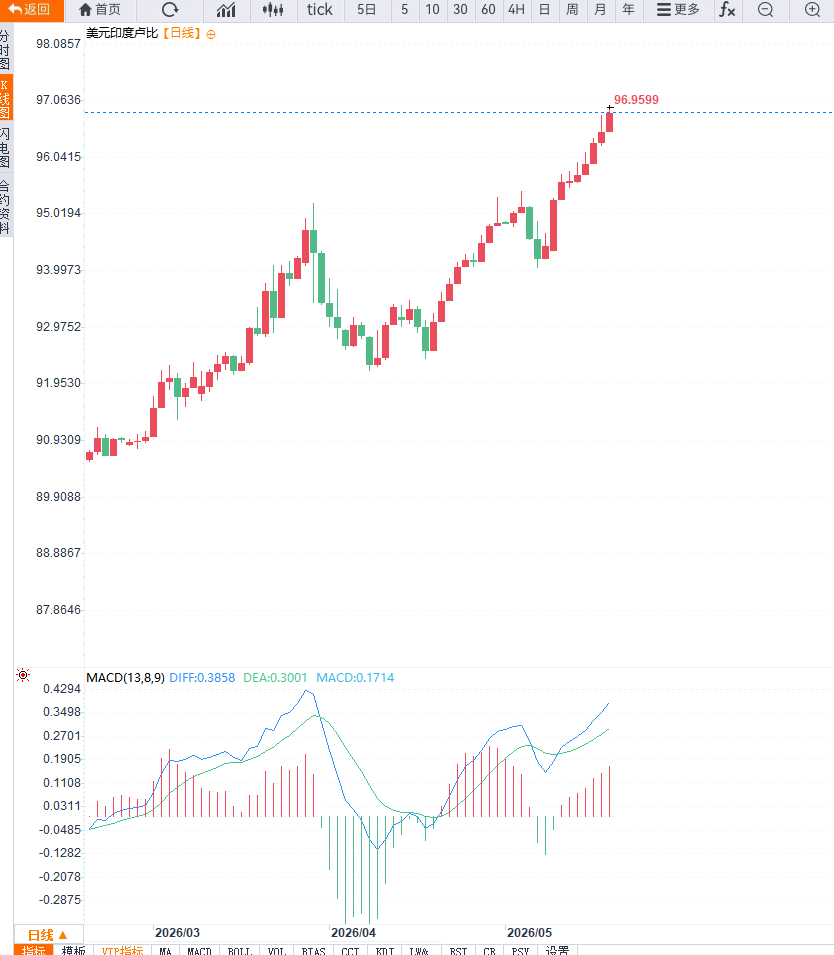
From a technical perspective, USD/INR has entered a clearly strong upward structure. The exchange rate is currently trading steadily above the 20-day exponential moving average (EMA) at 95.29, indicating that the short-term bullish trend remains intact. The daily chart shows that USD/INR has recently been hitting new all-time highs, with the upward slope accelerating significantly, indicating continued strong buying pressure. The 14-day Relative Strength Index (RSI) has risen to around 72.96, entering clearly overbought territory. This suggests very strong bullish momentum, but also hints at the possibility of a short-term technical correction at any time.
However, before the overall trend changes, the market tends to view pullbacks as new buying opportunities rather than trend reversals. On the downside, the 20-day EMA around 95.29 has become the most critical support area. As long as the exchange rate remains above this level, the overall upward trend is likely to continue. If USD/INR subsequently breaks below 95.29 on a daily chart basis, the market may enter a deeper technical correction. On the upside, 97.00 has become a significant psychological level. If the US dollar strengthens further and international oil prices continue to rise, USD/INR may push further towards the 98.00 area.
Overall, the Indian rupee is currently facing a triple pressure structure: high oil prices, a strong US dollar, and capital outflows. Its future exchange rate trend will primarily depend on changes in international oil prices, developments in the Middle East, and changes in expectations regarding the Federal Reserve's policies.
Editor's Summary : The Indian rupee is currently in a clearly weak phase. The sharp rise in international oil prices continues to impact India, an energy-importing economy, while the strong US dollar and rising US yields further amplify the pressure on the rupee to depreciate. From a market structure perspective, if the Strait of Hormuz shipping issues persist, the Indian economy will face greater risks of imported inflation and capital outflows. Meanwhile, the Federal Reserve's long-term expectation of maintaining high interest rates may also continue to push the US dollar stronger. Technically, USD/INR has broken through a key historical high area, and the overall trend remains upward. Going forward, the market will focus on the situation in the Middle East, international oil prices, and whether the Reserve Bank of India will take measures to stabilize the exchange rate.
While WTI crude oil prices have slightly retreated to around $103.00, international oil prices have still risen by more than 50% since the outbreak of the Middle East conflict. This increase significantly exceeded market expectations and has rapidly exacerbated concerns in the Indian market regarding energy costs and economic growth prospects. The shipping issues in the Strait of Hormuz remain largely unresolved. As one of the world's most critical energy transport routes, the region handles approximately 20% of global seaborne crude oil shipments. Continued disruptions to these routes will place enormous pressure on Asian energy-importing economies.
For India, high oil prices not only mean increased import costs but also potentially further push up domestic inflation and exacerbate fiscal and trade imbalances. Meanwhile, recent negotiations between the US and Iran have lacked a breakthrough. Iran demands the lifting of sanctions, the release of frozen assets, and an end to the US blockade of Iranian ports, while significant differences remain between the two sides on nuclear issues and regional security.
Meanwhile, US President Trump again sent a strong signal, stating that if Iran cannot reach an agreement soon, the US may launch another military strike in the coming days. Trump said he does not want a full-scale war, but the US "may have to launch another major strike," giving a "two to three-day" window. In response, Iran stated that it is prepared for any military action and warned that if the US resumes military operations, the Iranian military will "open a new front."
The escalating risk of this situation has further exacerbated market concerns about the stability of Middle Eastern supply chains, pushing international oil prices to remain high. Meanwhile, overseas funds' attitude towards the Indian market has also begun to weaken significantly. After three consecutive trading days of continuous buying of Indian stocks, foreign institutional investors (FIIs) turned to net selling on Tuesday.
Data shows that foreign institutional investors were net sellers of 245.749 billion rupees on Tuesday, compared with net purchases of approximately 433 billion rupees over the previous three trading days. The market believes that the high oil price environment may weaken India's economic growth expectations and increase cost pressures on businesses, leading some overseas funds to reduce their exposure to the Indian market. Furthermore, the continued rise in US Treasury yields has further pressured emerging market currencies, including the Indian rupee.
The yield on the 10-year US Treasury bond has risen to 4.69%, a new high for the year. Market bets on the Federal Reserve maintaining high interest rates or even raising them further have clearly intensified. According to the CME Group's FedWatch tool, the market now sees a probability of at least one more rate hike by the Fed this year at around 56.3%, while the remaining traders generally expect the Fed to keep rates unchanged.
The high-yield environment is driving global funds back into dollar assets, while simultaneously diminishing the attractiveness of emerging market currencies. This is particularly evident against the backdrop of deteriorating global risk sentiment, where the demand for safe-haven assets has significantly increased.
From a technical perspective, USD/INR has entered a clearly strong upward structure. The exchange rate is currently trading steadily above the 20-day exponential moving average (EMA) at 95.29, indicating that the short-term bullish trend remains intact. The daily chart shows that USD/INR has recently been hitting new all-time highs, with the upward slope accelerating significantly, indicating continued strong buying pressure. The 14-day Relative Strength Index (RSI) has risen to around 72.96, entering clearly overbought territory. This suggests very strong bullish momentum, but also hints at the possibility of a short-term technical correction at any time.
However, before the overall trend changes, the market tends to view pullbacks as new buying opportunities rather than trend reversals. On the downside, the 20-day EMA around 95.29 has become the most critical support area. As long as the exchange rate remains above this level, the overall upward trend is likely to continue. If USD/INR subsequently breaks below 95.29 on a daily chart basis, the market may enter a deeper technical correction. On the upside, 97.00 has become a significant psychological level. If the US dollar strengthens further and international oil prices continue to rise, USD/INR may push further towards the 98.00 area.
Overall, the Indian rupee is currently facing a triple pressure structure: high oil prices, a strong US dollar, and capital outflows. Its future exchange rate trend will primarily depend on changes in international oil prices, developments in the Middle East, and changes in expectations regarding the Federal Reserve's policies.
Editor's Summary : The Indian rupee is currently in a clearly weak phase. The sharp rise in international oil prices continues to impact India, an energy-importing economy, while the strong US dollar and rising US yields further amplify the pressure on the rupee to depreciate. From a market structure perspective, if the Strait of Hormuz shipping issues persist, the Indian economy will face greater risks of imported inflation and capital outflows. Meanwhile, the Federal Reserve's long-term expectation of maintaining high interest rates may also continue to push the US dollar stronger. Technically, USD/INR has broken through a key historical high area, and the overall trend remains upward. Going forward, the market will focus on the situation in the Middle East, international oil prices, and whether the Reserve Bank of India will take measures to stabilize the exchange rate.
- Risk Warning and Disclaimer
- The market involves risk, and trading may not be suitable for all investors. This article is for reference only and does not constitute personal investment advice, nor does it take into account certain users’ specific investment objectives, financial situation, or other needs. Any investment decisions made based on this information are at your own risk.