The Strait of Hormuz crisis boosted demand for the US dollar as a safe haven, causing the euro to fall to near a six-week low.
2026-05-20 15:55:01
The euro continued its weak and volatile trading against the dollar during Wednesday's European session, hovering around 1.1600, near a six-week low. The EUR/USD pair had previously retreated sharply from the 1.1660 area, with the overall bearish structure continuing to dominate. Current market focus remains on the escalating tensions in the Middle East and the shipping crisis in the Strait of Hormuz. US President Trump stated on Tuesday that the US might launch another military strike within the next "two to three days" if Iran refuses to sign a peace agreement.

Meanwhile, US Vice President Vance stated that the US military is "fully prepared" and could resume military operations at any time. In response, Iranian Foreign Minister Araqchi warned that if the US takes military action again, Iran will bring "more surprises." The escalating geopolitical risks have significantly increased risk aversion in global markets. Funds continue to flow into the US dollar and US Treasury markets, pushing the dollar index to a six-week high.
Meanwhile, the shipping problems in the Strait of Hormuz have persisted for nearly three months. As one of the world's most critical energy transport routes, the prolonged obstruction of this region is severely impacting the global supply of crude oil, natural gas, and other commodities. Currently, Brent crude oil prices have risen to around $108, while WTI crude oil remains above $100. This high oil price environment is having a significant impact on the Eurozone economy.
Because the Eurozone is highly dependent on energy imports, rising energy prices typically significantly increase business production costs and household consumption expenditures, thus weakening economic growth prospects. This is particularly true in economies with a high proportion of manufacturing, such as Germany, France, and Italy, where high energy costs have already begun to noticeably erode corporate profit margins.
The latest German Producer Price Index (PPI) data for April further reflects this issue. The data shows that Germany's PPI year-on-year growth rate rose to 1.7%, significantly higher than March's -0.2%, indicating that rising energy prices are once again pushing up industrial inflationary pressures. The market is also currently awaiting the Eurozone's April Highly Important Consumer Price Index (HICP) data. The market expects the Eurozone inflation rate to rise from 2.6% to 3%.
While rising inflation might theoretically encourage the European Central Bank to maintain a hawkish stance, the market is more concerned about the drag on Eurozone economic growth caused by high oil prices. In other words, the Eurozone currently faces a classic "stagflation risk"—the simultaneous occurrence of slowing economic growth and rising inflation. This environment is generally unfavorable for the euro's performance.
In contrast, the US economy remains relatively resilient. Meanwhile, the expectation that the Federal Reserve will maintain high interest rates continues to support the dollar. The market is awaiting the minutes of the Fed's April meeting, hoping to further observe the Fed's internal stance on future policy path.
Previously, the Federal Reserve kept interest rates unchanged at its meeting, but internal opinions were clearly divided. One member supported a rate cut, while three others advocated removing the phrase "accommodative bias," indicating that some officials were beginning to lean back towards a hawkish stance. With international oil prices continuing to rise, market bets on the Fed maintaining high interest rates for an extended period, or even further rate hikes, have clearly intensified.
U.S. Treasury yields remain high. The 10-year Treasury yield is close to 4.70%, while the 30-year yield remains around 5.20%. This high-yield environment further enhances the attractiveness of dollar assets while suppressing non-U.S. currencies, including the euro.
From a technical perspective, EUR/USD has formed a clear bearish structure. The exchange rate has fallen by nearly 1.6% over the past week, indicating continued strengthening of selling pressure. The daily chart shows that EUR/USD has recently broken through several key support levels, with the highs consistently moving lower, indicating a significant weakening of the overall trend. Currently, the exchange rate is trading below the short-term moving average system, suggesting that bearish funds still dominate the market.
Observing the 4-hour chart, although EUR/USD is approaching oversold territory, the market still lacks a clear reversal signal. The 4-hour Relative Strength Index (RSI) is currently around 27, which, although slightly higher than the previous extreme oversold area, still indicates a bearish market overall. Meanwhile, the MACD histogram is still hovering around the zero line, indicating that the market currently lacks strong upward momentum.
Looking at the upside, the 1.1610 area has become the first major resistance level, corresponding to the previously broken key support area. Further resistance lies in the 1.1650-1.1670 area, which was previously a key support zone but has now become a significant resistance zone. Only when EUR/USD regains a foothold above this area will the short-term bearish pressure in the market be significantly alleviated.
On the downside, 1.1590 is the current short-term low area. However, the market currently lacks strong support below, and the next key support area is around the April low of 1.1510 to 1.1525. If the US dollar continues to strengthen while oil prices remain high, EUR/USD risks further declines towards this area. From the 4-hour trend structure, the current EUR/USD lows and highs are moving lower in tandem, indicating that the downtrend remains intact.
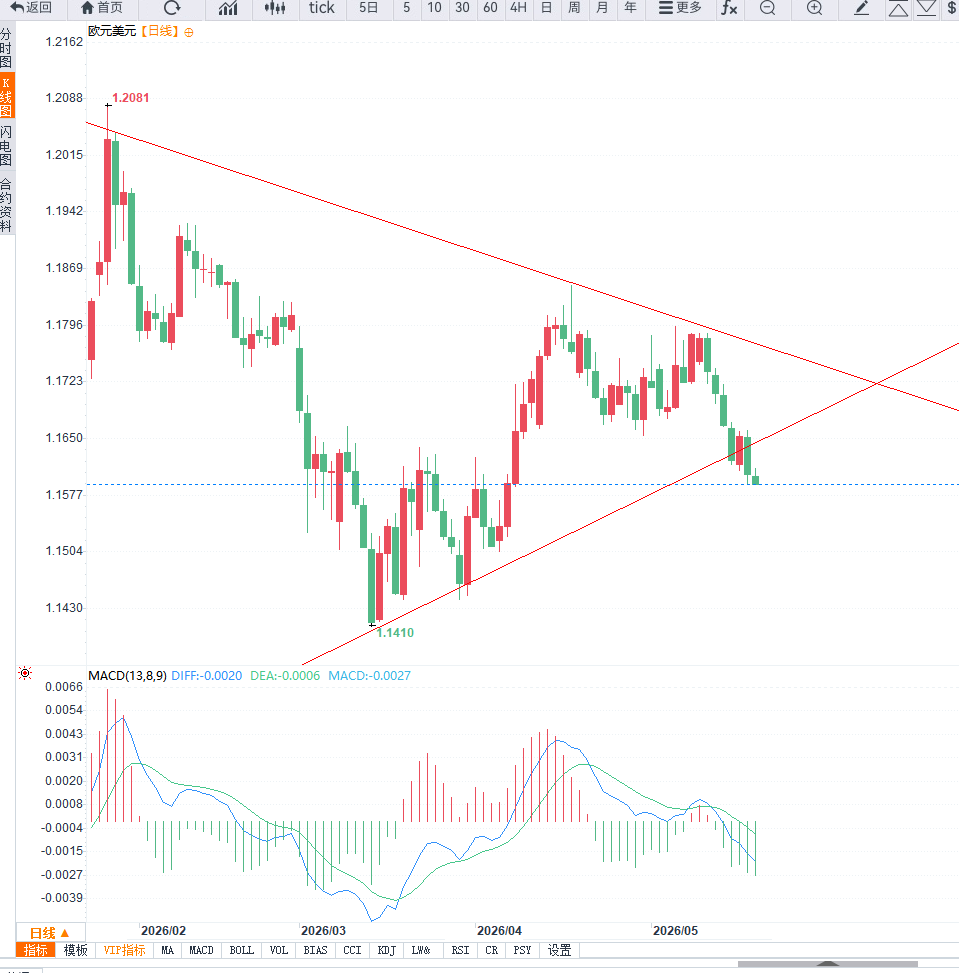
Overall, the EUR/USD exchange rate is currently facing a triple pressure structure: a strong US dollar as a safe haven, energy pressures in the Eurozone, and hawkish expectations from the Federal Reserve. The future direction of the exchange rate will primarily depend on the situation in the Middle East, international oil price trends, and the policy signals released in the Federal Reserve meeting minutes.
Editor's Summary : The Euro market has entered a clearly weak phase. Escalating tensions in the Middle East have driven international oil prices to remain high, while the Eurozone, as an energy-importing economy, is facing the dual pressures of imported inflation and economic slowdown. Meanwhile, the Federal Reserve's continued high interest rate expectations continue to support a strong US dollar, further widening the gap between monetary policy and economic expectations in the US and Europe. Technically, EUR/USD has fallen to near a six-week low, and the short-term downtrend remains unchanged. Going forward, the market will need to focus on the situation in the Strait of Hormuz, the Federal Reserve meeting minutes, and changes in Eurozone inflation data, as these factors will determine whether EUR/USD will further decline to its year-to-date lows.
Meanwhile, US Vice President Vance stated that the US military is "fully prepared" and could resume military operations at any time. In response, Iranian Foreign Minister Araqchi warned that if the US takes military action again, Iran will bring "more surprises." The escalating geopolitical risks have significantly increased risk aversion in global markets. Funds continue to flow into the US dollar and US Treasury markets, pushing the dollar index to a six-week high.
Meanwhile, the shipping problems in the Strait of Hormuz have persisted for nearly three months. As one of the world's most critical energy transport routes, the prolonged obstruction of this region is severely impacting the global supply of crude oil, natural gas, and other commodities. Currently, Brent crude oil prices have risen to around $108, while WTI crude oil remains above $100. This high oil price environment is having a significant impact on the Eurozone economy.
Because the Eurozone is highly dependent on energy imports, rising energy prices typically significantly increase business production costs and household consumption expenditures, thus weakening economic growth prospects. This is particularly true in economies with a high proportion of manufacturing, such as Germany, France, and Italy, where high energy costs have already begun to noticeably erode corporate profit margins.
The latest German Producer Price Index (PPI) data for April further reflects this issue. The data shows that Germany's PPI year-on-year growth rate rose to 1.7%, significantly higher than March's -0.2%, indicating that rising energy prices are once again pushing up industrial inflationary pressures. The market is also currently awaiting the Eurozone's April Highly Important Consumer Price Index (HICP) data. The market expects the Eurozone inflation rate to rise from 2.6% to 3%.
While rising inflation might theoretically encourage the European Central Bank to maintain a hawkish stance, the market is more concerned about the drag on Eurozone economic growth caused by high oil prices. In other words, the Eurozone currently faces a classic "stagflation risk"—the simultaneous occurrence of slowing economic growth and rising inflation. This environment is generally unfavorable for the euro's performance.
In contrast, the US economy remains relatively resilient. Meanwhile, the expectation that the Federal Reserve will maintain high interest rates continues to support the dollar. The market is awaiting the minutes of the Fed's April meeting, hoping to further observe the Fed's internal stance on future policy path.
Previously, the Federal Reserve kept interest rates unchanged at its meeting, but internal opinions were clearly divided. One member supported a rate cut, while three others advocated removing the phrase "accommodative bias," indicating that some officials were beginning to lean back towards a hawkish stance. With international oil prices continuing to rise, market bets on the Fed maintaining high interest rates for an extended period, or even further rate hikes, have clearly intensified.
U.S. Treasury yields remain high. The 10-year Treasury yield is close to 4.70%, while the 30-year yield remains around 5.20%. This high-yield environment further enhances the attractiveness of dollar assets while suppressing non-U.S. currencies, including the euro.
From a technical perspective, EUR/USD has formed a clear bearish structure. The exchange rate has fallen by nearly 1.6% over the past week, indicating continued strengthening of selling pressure. The daily chart shows that EUR/USD has recently broken through several key support levels, with the highs consistently moving lower, indicating a significant weakening of the overall trend. Currently, the exchange rate is trading below the short-term moving average system, suggesting that bearish funds still dominate the market.
Observing the 4-hour chart, although EUR/USD is approaching oversold territory, the market still lacks a clear reversal signal. The 4-hour Relative Strength Index (RSI) is currently around 27, which, although slightly higher than the previous extreme oversold area, still indicates a bearish market overall. Meanwhile, the MACD histogram is still hovering around the zero line, indicating that the market currently lacks strong upward momentum.
Looking at the upside, the 1.1610 area has become the first major resistance level, corresponding to the previously broken key support area. Further resistance lies in the 1.1650-1.1670 area, which was previously a key support zone but has now become a significant resistance zone. Only when EUR/USD regains a foothold above this area will the short-term bearish pressure in the market be significantly alleviated.
On the downside, 1.1590 is the current short-term low area. However, the market currently lacks strong support below, and the next key support area is around the April low of 1.1510 to 1.1525. If the US dollar continues to strengthen while oil prices remain high, EUR/USD risks further declines towards this area. From the 4-hour trend structure, the current EUR/USD lows and highs are moving lower in tandem, indicating that the downtrend remains intact.
Overall, the EUR/USD exchange rate is currently facing a triple pressure structure: a strong US dollar as a safe haven, energy pressures in the Eurozone, and hawkish expectations from the Federal Reserve. The future direction of the exchange rate will primarily depend on the situation in the Middle East, international oil price trends, and the policy signals released in the Federal Reserve meeting minutes.
Editor's Summary : The Euro market has entered a clearly weak phase. Escalating tensions in the Middle East have driven international oil prices to remain high, while the Eurozone, as an energy-importing economy, is facing the dual pressures of imported inflation and economic slowdown. Meanwhile, the Federal Reserve's continued high interest rate expectations continue to support a strong US dollar, further widening the gap between monetary policy and economic expectations in the US and Europe. Technically, EUR/USD has fallen to near a six-week low, and the short-term downtrend remains unchanged. Going forward, the market will need to focus on the situation in the Strait of Hormuz, the Federal Reserve meeting minutes, and changes in Eurozone inflation data, as these factors will determine whether EUR/USD will further decline to its year-to-date lows.
- Risk Warning and Disclaimer
- The market involves risk, and trading may not be suitable for all investors. This article is for reference only and does not constitute personal investment advice, nor does it take into account certain users’ specific investment objectives, financial situation, or other needs. Any investment decisions made based on this information are at your own risk.