Gold Analysis: Safe-haven Failure or Interest Rate Squeeze? Unveiling the Mysterious Divergence of "Risk Present, Price Falling"
2026-05-20 16:36:01
On Wednesday, May 20th, spot gold continued its pullback, fluctuating between $4450 and $4500 per ounce, remaining under pressure from the previous trading day. Market data shows that gold prices have hit a roughly one-and-a-half-month low, with an intraday low approaching $4454 per ounce; meanwhile, the 10-year US Treasury yield hovered around 4.65%, Brent crude oil was around $110 per barrel, and WTI crude oil was around $103 per barrel. High interest rate expectations, energy price fluctuations, and the situation in the Persian Gulf remain the core variables for current gold pricing.
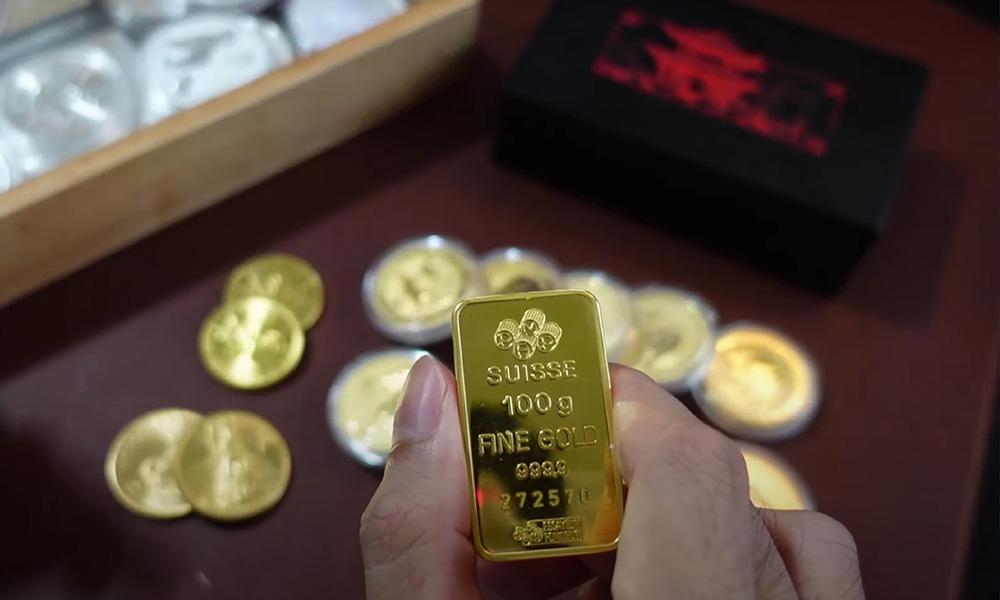
The key to this round of gold price declines lies not in the complete disappearance of safe-haven demand, but in the fact that the market has re-introduced the cost of holding gold after interest rates rose again. The 10-year US Treasury yield rose to around 4.65%, an increase of about 0.36 percentage points from the past month, meaning that non-interest-bearing assets face a higher opportunity cost. For traders, this is more important than a simple change in risk appetite, because gold pricing is simultaneously driven by three factors: real interest rates, dollar liquidity, and safe-haven premiums.
The current market paradox lies in the fact that geopolitical risks persist, but the resulting safe-haven buying has failed to offset the yield shock. If the bond sell-off continues to spread, gold is prone to a divergence where "risk events persist, but prices don't rise." This type of divergence typically indicates that funds are more focused on the Federal Reserve's course of action than on individual event risks. In other words, gold hasn't lost its safe-haven attributes; rather, these attributes have been temporarily weakened by a higher discount rate.
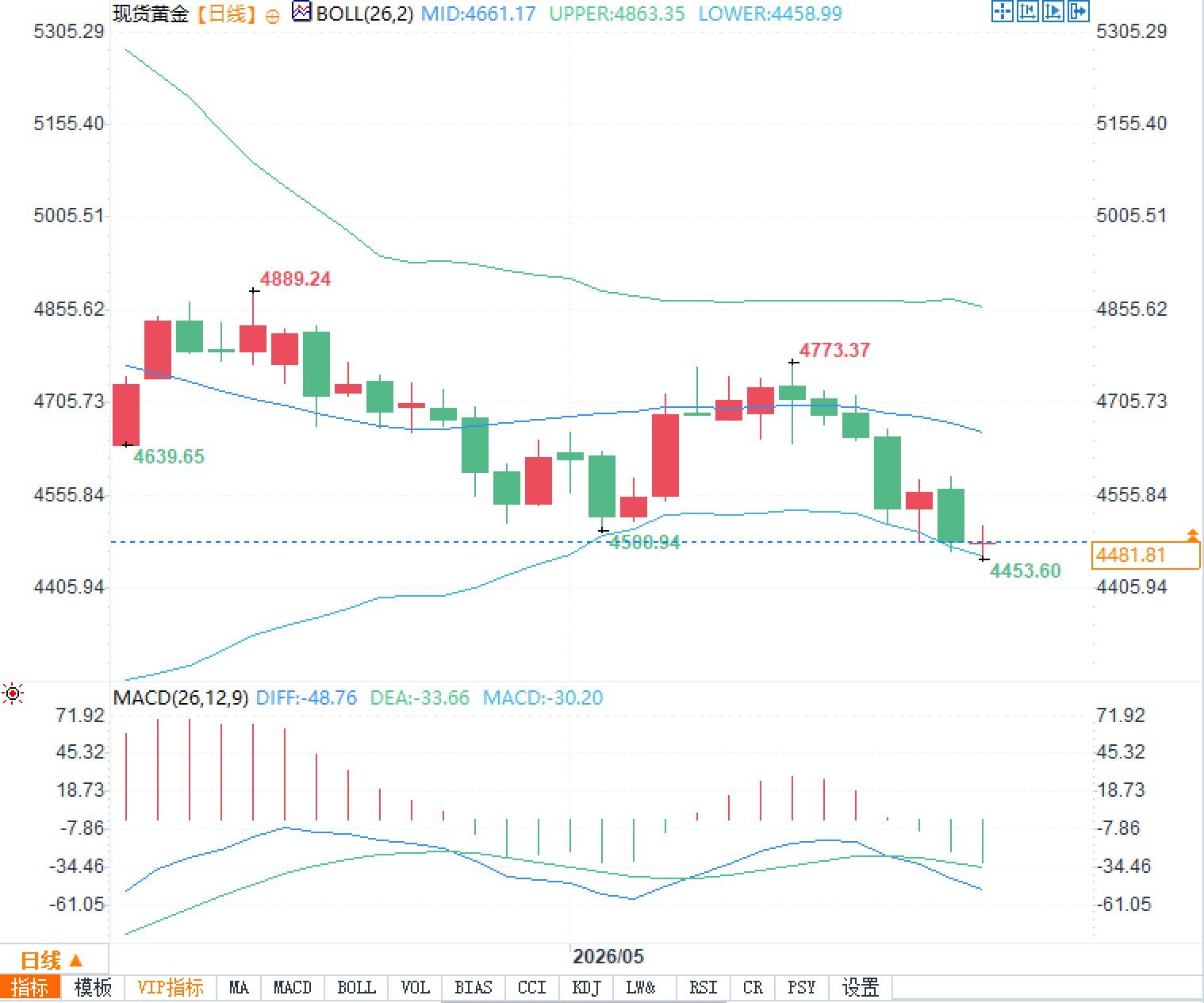
From a price structure perspective, after spot gold broke below the lower edge of its short-term trading range, the lower Bollinger Band on the daily chart has become the focus of market attention. The daily chart shows the Bollinger Band middle line around $4661, the upper line around $4863, and the lower line around $4459; the current price is trading close to the lower band. In the MACD indicator, the DIFF is approximately -48.76, the DEA is approximately -33.66, and the histogram remains in negative territory. The technical chart reflects that the trend momentum has not been restored, rather than a single day's emotional fluctuation.
The slight pullback in oil prices has not significantly alleviated inflation concerns. WTI crude oil remains around $103 per barrel, and Brent crude oil hovers around $110 per barrel, indicating that the energy market remains in a high-level consolidation phase. If transportation restrictions persist, energy prices may continue to transmit to inflation expectations; if the situation eases, a drop in oil prices could weaken safe-haven buying of gold. This puts gold in an uncomfortable position: high oil prices increase the risk of inflation and interest rate hikes, while a drop in oil prices could depress the risk premium.
This is also the main reason why gold has not strengthened in tandem with recent geopolitical tensions. The market is not only looking at the conflict itself, but also how it affects energy, inflation, and the Federal Reserve's response function. If energy prices remain high, even if the Fed remains cautious, it will be difficult to quickly shift to an easing stance. Interest rate futures pricing indicates that traders have begun to assess the possibility of another rate hike this year, with the probability once approaching 50%, which puts significant valuation pressure on gold.
Therefore, the short-term logic for gold is not the traditional "tension equals rising gold prices," but rather "whether tensions will force interest rates to be revised upwards again." This difference determines that traders will not simply chase the safe-haven narrative, but will first observe whether oil prices, yields, and the US dollar form a concerted downward pressure.
The US dollar index remains strong, putting pressure on dollar-denominated gold. Currently, the foreign exchange market does not show a clear one-sided risk appetite; the euro is consolidating around 1.1600 against the dollar, and the dollar is near 159.00 against the yen, indicating that major currencies are not providing additional support for gold. High yields provide a basis for interest rate differentials for the dollar, also limiting the upside potential for gold.
For gold, the US dollar is not the only variable, but its impact is amplified when US Treasury yields rise in tandem. A strong dollar, high yields, and upward revisions to real interest rate expectations typically compress gold's valuation multiples. Unless there is a rapid decline in yields or a repricing of easing expectations in the market, it is difficult for gold to resume its upward trend solely based on the safe-haven narrative.
It's important to note that the current price is near the lower technical level, indicating that some bearish momentum has already been priced in. However, approaching the lower level does not necessarily mean the trend has ended. Traders should focus on whether gold prices can regain above $4,500 and repair the daily chart's body structure; if the rebound fails to be accompanied by a decline in yields, the price action may still be merely a technical correction.
The core pressure on gold currently stems from expectations surrounding the Federal Reserve. Although there hasn't been a formal shift towards a more aggressive policy stance, the market has already begun pricing in higher inflation, higher oil prices, and higher yields. If subsequent inflation data continues to be strong, and employment and consumption data remain resilient, the probability of the Fed maintaining high interest rates for an extended period will continue to rise.
This means that the medium-term pricing of gold may shift from a "rate cut trade" to a "high interest rate tolerance test." Previously, during the gold price rally, the market was willing to price in both safe-haven demand and expectations of rate cuts; now, with rate cut expectations compressed and the safe-haven premium offset by the logic of energy inflation, gold prices will naturally enter a more sensitive and volatile phase.
From a technical perspective, the previous high near $4889 and the rebound high near $4773 have formed a descending resistance sequence, while the struggle around $4500 is more like a trend confirmation level than a typical psychological level. As long as the price remains below the Bollinger Middle Band near $4660, the market structure leans towards a weak correction. If yields continue to rise, gold may continue to experience valuation compression; only if yields fall and oil prices cool down can gold regain a more balanced pricing environment.
Yield repricing suppresses gold's safe-haven premium due to interest rate costs.
The key to this round of gold price declines lies not in the complete disappearance of safe-haven demand, but in the fact that the market has re-introduced the cost of holding gold after interest rates rose again. The 10-year US Treasury yield rose to around 4.65%, an increase of about 0.36 percentage points from the past month, meaning that non-interest-bearing assets face a higher opportunity cost. For traders, this is more important than a simple change in risk appetite, because gold pricing is simultaneously driven by three factors: real interest rates, dollar liquidity, and safe-haven premiums.
The current market paradox lies in the fact that geopolitical risks persist, but the resulting safe-haven buying has failed to offset the yield shock. If the bond sell-off continues to spread, gold is prone to a divergence where "risk events persist, but prices don't rise." This type of divergence typically indicates that funds are more focused on the Federal Reserve's course of action than on individual event risks. In other words, gold hasn't lost its safe-haven attributes; rather, these attributes have been temporarily weakened by a higher discount rate.
From a price structure perspective, after spot gold broke below the lower edge of its short-term trading range, the lower Bollinger Band on the daily chart has become the focus of market attention. The daily chart shows the Bollinger Band middle line around $4661, the upper line around $4863, and the lower line around $4459; the current price is trading close to the lower band. In the MACD indicator, the DIFF is approximately -48.76, the DEA is approximately -33.66, and the histogram remains in negative territory. The technical chart reflects that the trend momentum has not been restored, rather than a single day's emotional fluctuation.
Oil prices are tied to inflation expectations, putting gold under double pressure.
The slight pullback in oil prices has not significantly alleviated inflation concerns. WTI crude oil remains around $103 per barrel, and Brent crude oil hovers around $110 per barrel, indicating that the energy market remains in a high-level consolidation phase. If transportation restrictions persist, energy prices may continue to transmit to inflation expectations; if the situation eases, a drop in oil prices could weaken safe-haven buying of gold. This puts gold in an uncomfortable position: high oil prices increase the risk of inflation and interest rate hikes, while a drop in oil prices could depress the risk premium.
This is also the main reason why gold has not strengthened in tandem with recent geopolitical tensions. The market is not only looking at the conflict itself, but also how it affects energy, inflation, and the Federal Reserve's response function. If energy prices remain high, even if the Fed remains cautious, it will be difficult to quickly shift to an easing stance. Interest rate futures pricing indicates that traders have begun to assess the possibility of another rate hike this year, with the probability once approaching 50%, which puts significant valuation pressure on gold.
Therefore, the short-term logic for gold is not the traditional "tension equals rising gold prices," but rather "whether tensions will force interest rates to be revised upwards again." This difference determines that traders will not simply chase the safe-haven narrative, but will first observe whether oil prices, yields, and the US dollar form a concerted downward pressure.
The US dollar remains stable with a slight upward bias, and gold bulls lack a trigger for repricing.
The US dollar index remains strong, putting pressure on dollar-denominated gold. Currently, the foreign exchange market does not show a clear one-sided risk appetite; the euro is consolidating around 1.1600 against the dollar, and the dollar is near 159.00 against the yen, indicating that major currencies are not providing additional support for gold. High yields provide a basis for interest rate differentials for the dollar, also limiting the upside potential for gold.
For gold, the US dollar is not the only variable, but its impact is amplified when US Treasury yields rise in tandem. A strong dollar, high yields, and upward revisions to real interest rate expectations typically compress gold's valuation multiples. Unless there is a rapid decline in yields or a repricing of easing expectations in the market, it is difficult for gold to resume its upward trend solely based on the safe-haven narrative.
It's important to note that the current price is near the lower technical level, indicating that some bearish momentum has already been priced in. However, approaching the lower level does not necessarily mean the trend has ended. Traders should focus on whether gold prices can regain above $4,500 and repair the daily chart's body structure; if the rebound fails to be accompanied by a decline in yields, the price action may still be merely a technical correction.
The Fed's path is the main axis of gold pricing.
The core pressure on gold currently stems from expectations surrounding the Federal Reserve. Although there hasn't been a formal shift towards a more aggressive policy stance, the market has already begun pricing in higher inflation, higher oil prices, and higher yields. If subsequent inflation data continues to be strong, and employment and consumption data remain resilient, the probability of the Fed maintaining high interest rates for an extended period will continue to rise.
This means that the medium-term pricing of gold may shift from a "rate cut trade" to a "high interest rate tolerance test." Previously, during the gold price rally, the market was willing to price in both safe-haven demand and expectations of rate cuts; now, with rate cut expectations compressed and the safe-haven premium offset by the logic of energy inflation, gold prices will naturally enter a more sensitive and volatile phase.
From a technical perspective, the previous high near $4889 and the rebound high near $4773 have formed a descending resistance sequence, while the struggle around $4500 is more like a trend confirmation level than a typical psychological level. As long as the price remains below the Bollinger Middle Band near $4660, the market structure leans towards a weak correction. If yields continue to rise, gold may continue to experience valuation compression; only if yields fall and oil prices cool down can gold regain a more balanced pricing environment.
- Risk Warning and Disclaimer
- The market involves risk, and trading may not be suitable for all investors. This article is for reference only and does not constitute personal investment advice, nor does it take into account certain users’ specific investment objectives, financial situation, or other needs. Any investment decisions made based on this information are at your own risk.