The Euro's "Death Spiral": The Higher the Inflation, the Lower the Exchange Rate? Unveiling the Eurozone's Most Embarrassing Economic Paradox
2026-05-20 18:45:52
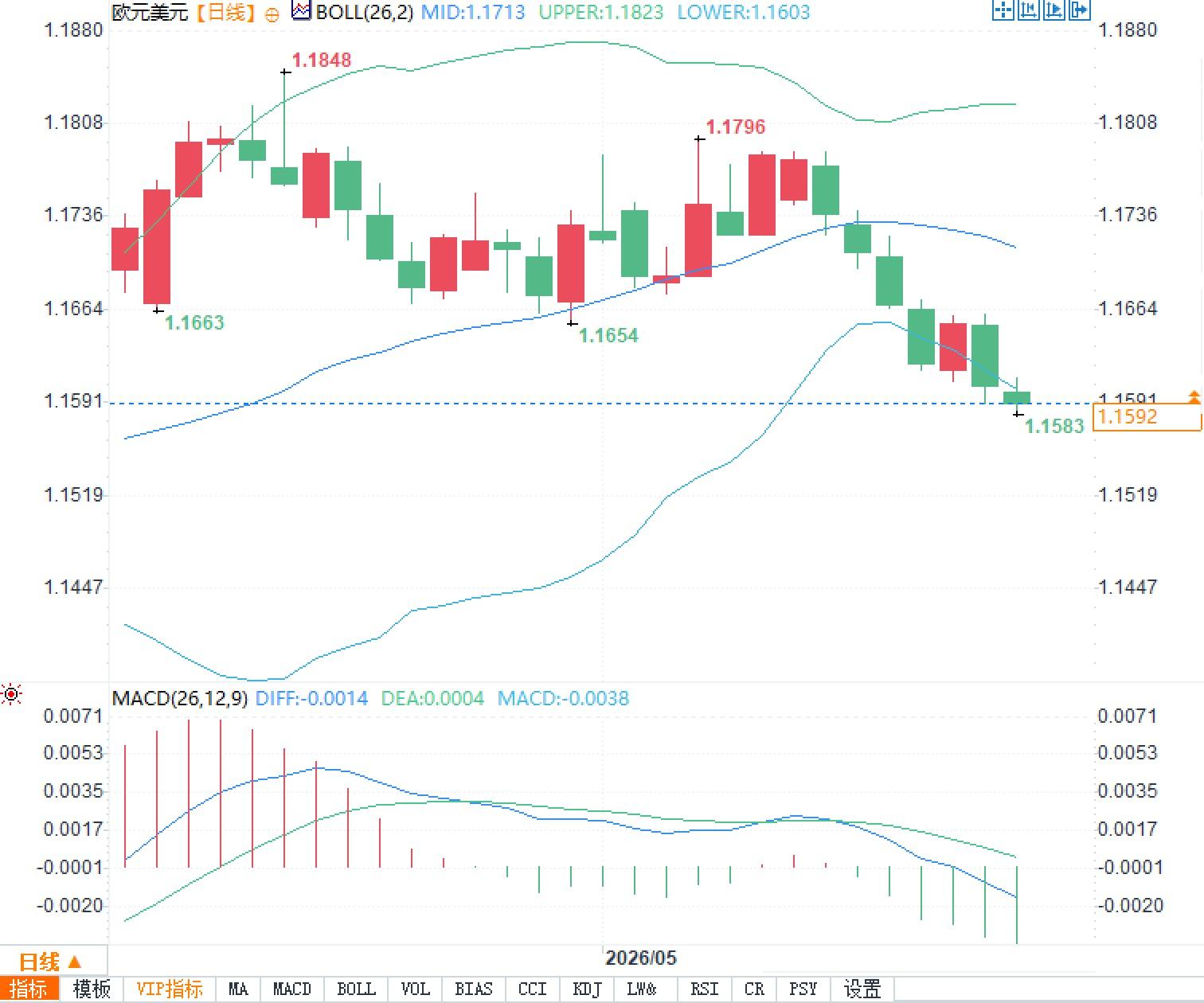
On Wednesday, May 20, the euro fell to around 1.1592 against the US dollar, hitting a daily low of 1.1583. The price broke below the lower Bollinger Band at 1.1603, with the middle Bollinger Band at 1.1713 and the upper Bollinger Band at 1.1823. The MACD indicator also weakened, indicating that the short-term pressure on the exchange rate was not solely triggered by technical factors, but rather was the result of pressure from expectations of US dollar interest rates, energy prices, and the inflation structure in the Eurozone.
The key factor behind the recent decline in the euro against the dollar is not the traditional, linear logic of risk aversion, but rather the repricing of US interest rate expectations. The ongoing Middle East conflict and the disruptions to energy transport caused by risks in the Strait of Hormuz have led the market to re-evaluate the secondary transmission of inflation through oil prices. Traders are currently more focused on the possibility that if energy prices remain high, the Federal Reserve's policy function may shift from "waiting for a rate cut window" to "retaining the option of rate hikes."
Recent market pricing indicates a significantly increased probability of a Federal Reserve rate hike this year, with some interest rate tools showing a probability of over 50% before the end of the year. This means that the strengthening of the US dollar is not entirely due to safe-haven buying, but rather a result of rising real interest rate expectations and long-term yields.
This pricing mechanism is even more damaging to the euro against the dollar. If the dollar's rise is driven solely by sudden safe-haven demand, the exchange rate often has room to recover once the situation eases. However, if the dollar's rise stems from upward revisions in interest rate expectations, then exchange rate pressure will continue to be transmitted through interest rate differentials, capital inflows, and term premiums. The current rise of the dollar index to a six-week high is a result of the combined effects of energy inflation, bond selling pressure, and changes in policy expectations.
Eurozone inflation data for April appears favorable for the euro. The latest official preliminary figures show that the Eurozone's annual inflation rate rose to 3.0% in April, up from 2.6% in March; energy prices rose 10.8% year-on-year, significantly higher than March's 5.1%; services inflation fell from 3.3% to 3.0%, while food, alcohol, and tobacco price inflation was around 2.4%. This data suggests that the main reason for the rebound in Eurozone inflation is energy costs, rather than broad-based demand expansion.
The problem is that the boost to the currency from energy-driven inflation is often unstable. If inflation stems from improved demand, the market tends to bet on economic resilience and monetary policy tightening, potentially providing trend support for the currency. However, if inflation arises from rising imported energy costs, it simultaneously erodes corporate profits, household purchasing power, and growth expectations. The euro currently faces this unfavorable combination: rising inflation increases hawkish pressure on the ECB, but growth has not improved accordingly.
The European Central Bank (ECB) kept its three key interest rates unchanged on April 30, emphasizing that both upside risks to inflation and downside risks to growth have intensified, and that its policy objective remains to ensure inflation returns to 2% in the medium term. The ECB's deposit facility rate is currently 2.00%. This means that while the ECB is unlikely to quickly shift to an easing stance, further tightening would also be constrained by economic pressures.
The market has already largely priced in a June rate hike by the European Central Bank (ECB), expecting a cumulative tightening of nearly 70 basis points this year. If this pricing holds true, it will be significantly more difficult for the euro to continue its upward movement solely based on interest rate expectations. The reason is straightforward: with the market already pricing in two to three rate hikes, the ECB would need to release stronger hawkish signals to continue driving the euro significantly higher.
However, the reality is that the Eurozone's inflation structure is not clean. Rising energy prices will force the ECB to remain vigilant, but core prices have not yet spiraled out of control, and service inflation has also slowed. If policymakers overemphasize interest rate hikes, it could amplify pressure on the real economy; if they emphasize a wait-and-see approach, it could weaken the support for euro interest rate differentials. Therefore, the ECB's policy statements are more likely to maintain a stance of "preserving room for maneuver" rather than readily committing to a path of continuous interest rate hikes.
Belgian central bank governor and ECB Governing Council member Winsch recently warned that the current situation may only be the beginning of an inflation problem, and that long-term geopolitical risks will increase the probability of costs being transmitted to inflation expectations and core prices. This statement explains why the ECB cannot ignore the energy shock, but it also reveals the euro's predicament: the higher the expectation of interest rate hikes, the more easily the market re-includes the growth discount.
From a daily chart perspective, the euro/dollar pair broke below the lower Bollinger Band, indicating that short-term volatility has deviated from its recent equilibrium range. The area around the middle Bollinger Band at 1.1713 can be considered a reference zone for the market to reassess its strength and weakness, while the area around 1.1600, which has now turned from support to resistance, will limit the pair's short-term upward momentum. In the MACD indicator, the DIFF is -0.0014, the DEA is 0.0004, and the histogram is -0.0038, showing that downward momentum is still expanding.
However, traders should pay more attention to the macroeconomic triggers behind the technical signals. If the situation in the Middle East eases and energy transportation risks decrease, a decline in oil prices may reduce the inflationary impact, and bets on a Fed rate hike may cool, thus weakening support for the dollar. Conversely, if energy prices remain high, the market will continue to price in "further acceleration of inflation" and "interest rates remaining high for a longer period," and the technical rebound of the euro against the dollar is likely to be suppressed again.
The main issue for the euro at present is not whether the European Central Bank (ECB) is hawkish, but whether its hawkishness exceeds market expectations. Similarly, the main issue for the dollar is not short-term safe-haven demand, but whether inflationary pressures are sufficient to alter the Federal Reserve's policy path. Combined, the short-term pricing of the euro against the dollar will revolve around three variables: whether energy prices continue to rise, whether interest rate futures further revise upwards on the probability of a Fed rate hike, and whether the ECB releases policy signals that exceed market expectations.
The core of the dollar's support is no longer just safe-haven demand, but rather the repricing of the yield curve.
The key factor behind the recent decline in the euro against the dollar is not the traditional, linear logic of risk aversion, but rather the repricing of US interest rate expectations. The ongoing Middle East conflict and the disruptions to energy transport caused by risks in the Strait of Hormuz have led the market to re-evaluate the secondary transmission of inflation through oil prices. Traders are currently more focused on the possibility that if energy prices remain high, the Federal Reserve's policy function may shift from "waiting for a rate cut window" to "retaining the option of rate hikes."
Recent market pricing indicates a significantly increased probability of a Federal Reserve rate hike this year, with some interest rate tools showing a probability of over 50% before the end of the year. This means that the strengthening of the US dollar is not entirely due to safe-haven buying, but rather a result of rising real interest rate expectations and long-term yields.
This pricing mechanism is even more damaging to the euro against the dollar. If the dollar's rise is driven solely by sudden safe-haven demand, the exchange rate often has room to recover once the situation eases. However, if the dollar's rise stems from upward revisions in interest rate expectations, then exchange rate pressure will continue to be transmitted through interest rate differentials, capital inflows, and term premiums. The current rise of the dollar index to a six-week high is a result of the combined effects of energy inflation, bond selling pressure, and changes in policy expectations.
Eurozone inflation rebounded, but the euro failed to gain sufficient support.
Eurozone inflation data for April appears favorable for the euro. The latest official preliminary figures show that the Eurozone's annual inflation rate rose to 3.0% in April, up from 2.6% in March; energy prices rose 10.8% year-on-year, significantly higher than March's 5.1%; services inflation fell from 3.3% to 3.0%, while food, alcohol, and tobacco price inflation was around 2.4%. This data suggests that the main reason for the rebound in Eurozone inflation is energy costs, rather than broad-based demand expansion.
The problem is that the boost to the currency from energy-driven inflation is often unstable. If inflation stems from improved demand, the market tends to bet on economic resilience and monetary policy tightening, potentially providing trend support for the currency. However, if inflation arises from rising imported energy costs, it simultaneously erodes corporate profits, household purchasing power, and growth expectations. The euro currently faces this unfavorable combination: rising inflation increases hawkish pressure on the ECB, but growth has not improved accordingly.
The European Central Bank (ECB) kept its three key interest rates unchanged on April 30, emphasizing that both upside risks to inflation and downside risks to growth have intensified, and that its policy objective remains to ensure inflation returns to 2% in the medium term. The ECB's deposit facility rate is currently 2.00%. This means that while the ECB is unlikely to quickly shift to an easing stance, further tightening would also be constrained by economic pressures.
The European Central Bank's hawkish stance is being prematurely priced in by the market.
The market has already largely priced in a June rate hike by the European Central Bank (ECB), expecting a cumulative tightening of nearly 70 basis points this year. If this pricing holds true, it will be significantly more difficult for the euro to continue its upward movement solely based on interest rate expectations. The reason is straightforward: with the market already pricing in two to three rate hikes, the ECB would need to release stronger hawkish signals to continue driving the euro significantly higher.
However, the reality is that the Eurozone's inflation structure is not clean. Rising energy prices will force the ECB to remain vigilant, but core prices have not yet spiraled out of control, and service inflation has also slowed. If policymakers overemphasize interest rate hikes, it could amplify pressure on the real economy; if they emphasize a wait-and-see approach, it could weaken the support for euro interest rate differentials. Therefore, the ECB's policy statements are more likely to maintain a stance of "preserving room for maneuver" rather than readily committing to a path of continuous interest rate hikes.
Belgian central bank governor and ECB Governing Council member Winsch recently warned that the current situation may only be the beginning of an inflation problem, and that long-term geopolitical risks will increase the probability of costs being transmitted to inflation expectations and core prices. This statement explains why the ECB cannot ignore the energy shock, but it also reveals the euro's predicament: the higher the expectation of interest rate hikes, the more easily the market re-includes the growth discount.
Technical analysis suggests the exchange rate has entered a phase of pressure release, but the direction will still be determined by energy and interest rates.
From a daily chart perspective, the euro/dollar pair broke below the lower Bollinger Band, indicating that short-term volatility has deviated from its recent equilibrium range. The area around the middle Bollinger Band at 1.1713 can be considered a reference zone for the market to reassess its strength and weakness, while the area around 1.1600, which has now turned from support to resistance, will limit the pair's short-term upward momentum. In the MACD indicator, the DIFF is -0.0014, the DEA is 0.0004, and the histogram is -0.0038, showing that downward momentum is still expanding.
However, traders should pay more attention to the macroeconomic triggers behind the technical signals. If the situation in the Middle East eases and energy transportation risks decrease, a decline in oil prices may reduce the inflationary impact, and bets on a Fed rate hike may cool, thus weakening support for the dollar. Conversely, if energy prices remain high, the market will continue to price in "further acceleration of inflation" and "interest rates remaining high for a longer period," and the technical rebound of the euro against the dollar is likely to be suppressed again.
The main issue for the euro at present is not whether the European Central Bank (ECB) is hawkish, but whether its hawkishness exceeds market expectations. Similarly, the main issue for the dollar is not short-term safe-haven demand, but whether inflationary pressures are sufficient to alter the Federal Reserve's policy path. Combined, the short-term pricing of the euro against the dollar will revolve around three variables: whether energy prices continue to rise, whether interest rate futures further revise upwards on the probability of a Fed rate hike, and whether the ECB releases policy signals that exceed market expectations.
- Risk Warning and Disclaimer
- The market involves risk, and trading may not be suitable for all investors. This article is for reference only and does not constitute personal investment advice, nor does it take into account certain users’ specific investment objectives, financial situation, or other needs. Any investment decisions made based on this information are at your own risk.