The Bank of England is caught in a dilemma: unable to raise interest rates, yet unwilling to cut them, the pound's premium is being relentlessly squeezed.
2026-05-20 17:59:15
On Wednesday, May 20th, the British pound traded around 1.3390 against the US dollar, with the price near the lower Bollinger Band, indicating a significant pullback from its early May highs. During the same period, the US dollar index hovered around 99.4, rising about 1% for the month, while long-term US Treasury yields remained high, with the 10-year and 30-year yields at 4.61% and 5.14% respectively. This put pressure on the pound against the dollar not only from UK data but also from the repricing of the US dollar.
The recent weakening of the pound against the dollar is superficially triggered by cooling UK employment and inflation data, but the underlying logic is a market recalibration of the Bank of England's policy path. The Bank of England's current interest rate is 3.75%, with the next rate decision scheduled for June 18th. The latest official statement still emphasizes that energy shocks could push up household fuel costs and potentially trigger a second round of wage and price reactions, but monetary policy itself cannot change global energy prices; it can only prevent high inflation from becoming entrenched.
This means that the pricing of the pound is entering a more complex phase. If we only look at the April CPI falling from 3.3% to 2.8%, the market could easily interpret this as a decrease in the necessity for the Bank of England to raise interest rates. However, when combined with rising PPI inputs, a jump in fuel prices, falling service inflation, and easing employment, the conclusion is not one of unilateral easing, but rather that the policy response function is becoming more dependent on subsequent data. For traders, the pound is currently not simply trading "lower-than-expected inflation," but rather a combination of "weaker growth, rising imported inflation, and limited policy space."
In April, the UK's CPI rose 2.8% year-on-year, down from 3.3% in March; the CPIH rose 3.0% year-on-year, down from 3.4% in March. Core CPI fell to 2.5% year-on-year from 3.1%, and services CPI fell to 3.2% year-on-year from 4.5%, which is a sign of easing endogenous inflationary pressures that the Bank of England is most concerned about.
However, this data cannot be simply interpreted as the risk of inflation being eliminated. Official data also shows that housing and household services are the main drags down inflation, with reductions in electricity and natural gas prices having a significant impact on the figures, while fuel prices within the transportation sector are still rising. In April, the average price of gasoline was 156.8 pence per liter, and the average price of diesel was 190.0 pence per liter, with overall motor vehicle fuel prices rising by 23.0% year-on-year, the largest annual increase since September 2022.
More importantly, upstream prices are at play. In April, UK producer input prices rose 7.7% year-on-year, higher than the revised 5.3% in March; producer prices rose 4.0% year-on-year, higher than the revised 3.0% in March. Among them, crude oil input prices rose 75.4% year-on-year, and coking coal and refined petroleum product prices rose 52.6% year-on-year. This indicates that the short-term decline in end-user CPI is not in sync with the cost pressures on enterprises.
This structure is most problematic for the pound. If the cooling of inflation stems from a one-off price adjustment or base effects, the Bank of England may not immediately turn dovish; however, if employment and consumption weaken simultaneously, the marginal benefit of raising interest rates will diminish. Therefore, the market is more inclined to compress the pound's interest rate premium than to allow for upward repricing of the pound.
Employment data is a more persistent variable in this round of pound sterling pullback. The preliminary figure for UK salaried employees in April was 30.2 million, a decrease of 100,000 month-on-month and 210,000 year-on-year. Officials also cautioned that the April data is preliminary and may be revised, but this does not change the overall trend of weakening employment growth momentum.
The UK unemployment rate was estimated at 5.0% from January to March, up 0.5 percentage points year-on-year; job vacancies fell to 705,000 from February to April, the lowest level since February to April 2021. During the same period, average wages excluding bonuses increased by 3.4% year-on-year, while wages including bonuses increased by 4.1%, and regular wages in the private sector increased by only 3.0%.
The impact of this data on the pound is not merely a matter of "weak economy." The real market implication is that easing wage stickiness weakens the Bank of England's justification for continuing to emphasize a second round of inflation. If service inflation has already fallen from 4.5% to 3.2%, and wage growth has further declined to an even lower range, the necessity to further suppress demand through interest rates decreases. At the same time, upstream energy and import price pressures limit the Bank of England's ability to signal easing measures prematurely. Caught in a policy dilemma, the monetary side typically sees an increase in risk premiums rather than valuation expansion.
From the daily chart, the latest price for GBP/USD is around 1.3390, having broken below the Bollinger Middle Band at 1.3511 and approaching the lower band at 1.3361. The exchange rate previously formed a high near 1.3657 before retreating, indicating that the upward momentum from early May has been broken. In terms of MACD, the DIFF is -0.0015, the DEA is 0.0011, and the histogram is -0.0052, suggesting that bearish momentum has not yet fully subsided.
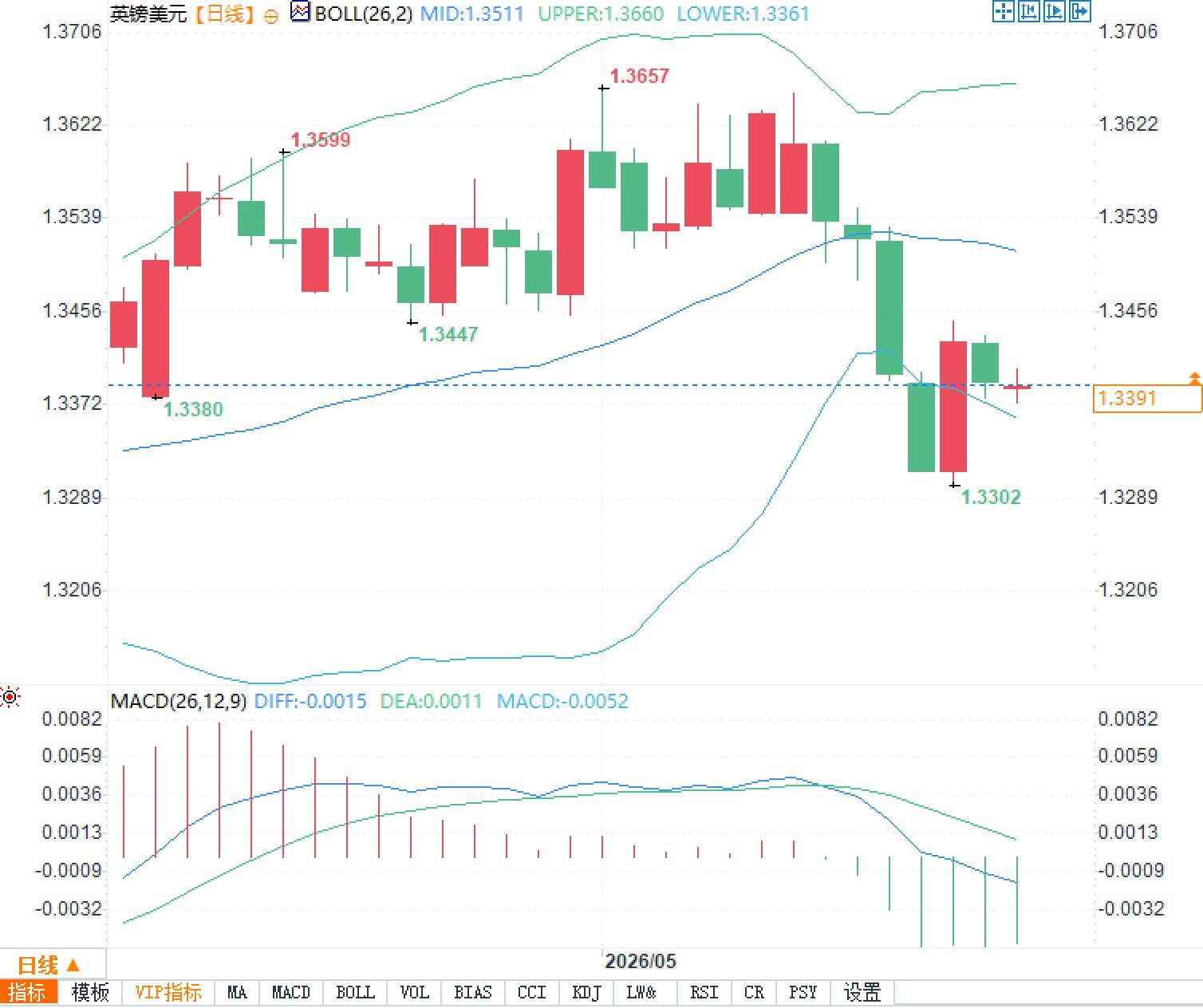
The key to this type of structure is not providing directional instructions, but rather identifying market conditions. The current price is around 1.3360 to 1.3400, which is the intersection of the lower Bollinger Band and the previous low consolidation zone. If the subsequent rebound fails to regain above 1.3510, the market is more likely to view the rebound as a correction rather than a trend reversal. If the price continues to fluctuate around 1.3300 to 1.3360, it indicates that the macro bearish logic is still being confirmed by the technicals.
The US dollar is also a factor that cannot be ignored. The US dollar index is hovering around 99.4, reflecting that safe-haven demand, long-term yields, and interest rate expectations continue to provide temporary support for the dollar. As for the pound against the dollar, UK data only determines the relative strength of the pound itself; it is the dollar yield that determines whether a decline in the exchange rate is amplified.
I. The core of the pressure on the pound lies not in a single data point, but in the shift in the macro pricing mix.
The recent weakening of the pound against the dollar is superficially triggered by cooling UK employment and inflation data, but the underlying logic is a market recalibration of the Bank of England's policy path. The Bank of England's current interest rate is 3.75%, with the next rate decision scheduled for June 18th. The latest official statement still emphasizes that energy shocks could push up household fuel costs and potentially trigger a second round of wage and price reactions, but monetary policy itself cannot change global energy prices; it can only prevent high inflation from becoming entrenched.
This means that the pricing of the pound is entering a more complex phase. If we only look at the April CPI falling from 3.3% to 2.8%, the market could easily interpret this as a decrease in the necessity for the Bank of England to raise interest rates. However, when combined with rising PPI inputs, a jump in fuel prices, falling service inflation, and easing employment, the conclusion is not one of unilateral easing, but rather that the policy response function is becoming more dependent on subsequent data. For traders, the pound is currently not simply trading "lower-than-expected inflation," but rather a combination of "weaker growth, rising imported inflation, and limited policy space."
II. Cooling inflation does not mean the disappearance of cost pressures.
In April, the UK's CPI rose 2.8% year-on-year, down from 3.3% in March; the CPIH rose 3.0% year-on-year, down from 3.4% in March. Core CPI fell to 2.5% year-on-year from 3.1%, and services CPI fell to 3.2% year-on-year from 4.5%, which is a sign of easing endogenous inflationary pressures that the Bank of England is most concerned about.
However, this data cannot be simply interpreted as the risk of inflation being eliminated. Official data also shows that housing and household services are the main drags down inflation, with reductions in electricity and natural gas prices having a significant impact on the figures, while fuel prices within the transportation sector are still rising. In April, the average price of gasoline was 156.8 pence per liter, and the average price of diesel was 190.0 pence per liter, with overall motor vehicle fuel prices rising by 23.0% year-on-year, the largest annual increase since September 2022.
More importantly, upstream prices are at play. In April, UK producer input prices rose 7.7% year-on-year, higher than the revised 5.3% in March; producer prices rose 4.0% year-on-year, higher than the revised 3.0% in March. Among them, crude oil input prices rose 75.4% year-on-year, and coking coal and refined petroleum product prices rose 52.6% year-on-year. This indicates that the short-term decline in end-user CPI is not in sync with the cost pressures on enterprises.
This structure is most problematic for the pound. If the cooling of inflation stems from a one-off price adjustment or base effects, the Bank of England may not immediately turn dovish; however, if employment and consumption weaken simultaneously, the marginal benefit of raising interest rates will diminish. Therefore, the market is more inclined to compress the pound's interest rate premium than to allow for upward repricing of the pound.
3. Easing in the labor market weakens the support for the pound's interest rate differential.
Employment data is a more persistent variable in this round of pound sterling pullback. The preliminary figure for UK salaried employees in April was 30.2 million, a decrease of 100,000 month-on-month and 210,000 year-on-year. Officials also cautioned that the April data is preliminary and may be revised, but this does not change the overall trend of weakening employment growth momentum.
The UK unemployment rate was estimated at 5.0% from January to March, up 0.5 percentage points year-on-year; job vacancies fell to 705,000 from February to April, the lowest level since February to April 2021. During the same period, average wages excluding bonuses increased by 3.4% year-on-year, while wages including bonuses increased by 4.1%, and regular wages in the private sector increased by only 3.0%.
The impact of this data on the pound is not merely a matter of "weak economy." The real market implication is that easing wage stickiness weakens the Bank of England's justification for continuing to emphasize a second round of inflation. If service inflation has already fallen from 4.5% to 3.2%, and wage growth has further declined to an even lower range, the necessity to further suppress demand through interest rates decreases. At the same time, upstream energy and import price pressures limit the Bank of England's ability to signal easing measures prematurely. Caught in a policy dilemma, the monetary side typically sees an increase in risk premiums rather than valuation expansion.
IV. The daily chart structure indicates that the British pound has entered a weak confirmation zone.
From the daily chart, the latest price for GBP/USD is around 1.3390, having broken below the Bollinger Middle Band at 1.3511 and approaching the lower band at 1.3361. The exchange rate previously formed a high near 1.3657 before retreating, indicating that the upward momentum from early May has been broken. In terms of MACD, the DIFF is -0.0015, the DEA is 0.0011, and the histogram is -0.0052, suggesting that bearish momentum has not yet fully subsided.
The key to this type of structure is not providing directional instructions, but rather identifying market conditions. The current price is around 1.3360 to 1.3400, which is the intersection of the lower Bollinger Band and the previous low consolidation zone. If the subsequent rebound fails to regain above 1.3510, the market is more likely to view the rebound as a correction rather than a trend reversal. If the price continues to fluctuate around 1.3300 to 1.3360, it indicates that the macro bearish logic is still being confirmed by the technicals.
The US dollar is also a factor that cannot be ignored. The US dollar index is hovering around 99.4, reflecting that safe-haven demand, long-term yields, and interest rate expectations continue to provide temporary support for the dollar. As for the pound against the dollar, UK data only determines the relative strength of the pound itself; it is the dollar yield that determines whether a decline in the exchange rate is amplified.
- Risk Warning and Disclaimer
- The market involves risk, and trading may not be suitable for all investors. This article is for reference only and does not constitute personal investment advice, nor does it take into account certain users’ specific investment objectives, financial situation, or other needs. Any investment decisions made based on this information are at your own risk.