Gold Trading Alert: A sudden turning point in the Iran peace talks caused oil prices to collapse by 6%, triggering a sharp V-shaped reversal in gold prices. Has the bull market restarted?
2026-05-21 07:39:04
On Wednesday (May 20), a dramatic reversal in asset prices, triggered by a sudden shift in geopolitical expectations, quietly unfolded. The oil market experienced a nearly 6% plunge, US Treasury yields retreated from multi-year highs, the dollar index weakened, and gold—a safe-haven asset that had been suffocating under the weight of rising yields in recent weeks—finally staged a resounding V-shaped reversal. Spot gold rose 1.38% in a single day to $4,543.53 per ounce, shaking off the shadow of its more than seven-week low of $4,453.60.
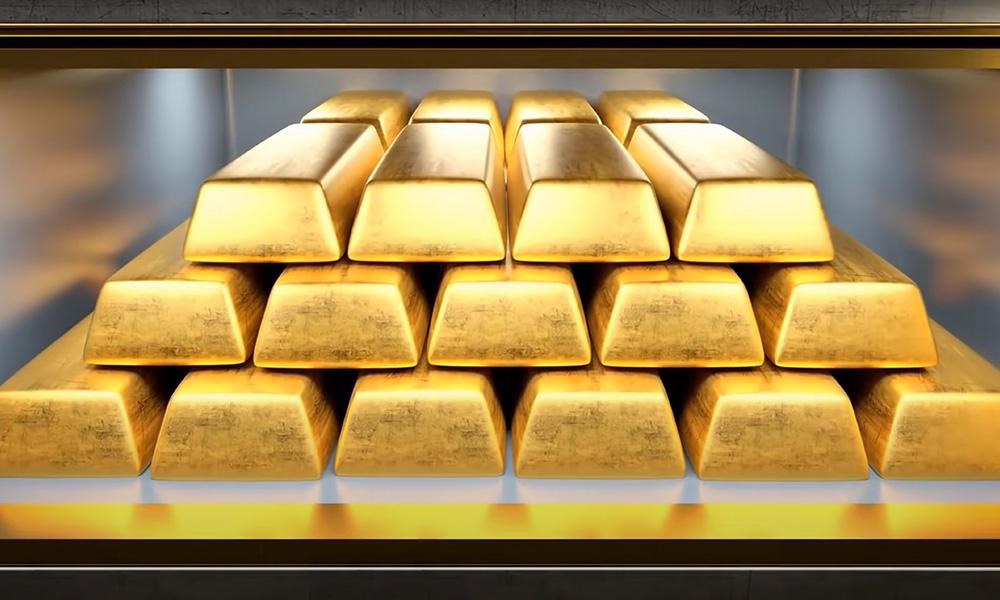
Gold prices experienced a dramatic move on Wednesday. Spot gold rose 1.38% to $4,543.53 an ounce, after earlier hitting a more than seven-week low of $4,453.60 an ounce. The immediate trigger for this reversal was not some mild economic data, but rather subtle geopolitical signals between Washington and Tehran.
US President Trump publicly stated that negotiations between the US and Iran have entered the "final stage." While warning of "very severe" retaliation if no agreement is reached, he also admitted that he is only "an hour away" from ordering the resumption of "Operation Epic Fury." This statement, intertwined with maximum pressure and a willingness to negotiate, was quickly interpreted by the market as a clear glimmer of hope for de-escalation. While Iran maintained a tough stance, accusing the US of preparing new attacks, it also signaled its willingness to cooperate with Oman and other countries to ensure the safety of shipping in the Strait of Hormuz.
More notably, two large Chinese oil tankers carrying approximately 4 million barrels of crude oil successfully passed through the Strait of Hormuz on Wednesday, after Iran had previously agreed to ease restrictions on Chinese vessels. While the number of ships passing through remains far below the pre-war level of approximately 140 per day, it has more than doubled compared to the previous week. These concrete, albeit small, developments have given capital markets a glimpse of the possibility that the conflict is subsiding.
Expectations of geopolitical easing first ignited the oil market. Brent crude futures plummeted 5.63% to $105.02 a barrel, while U.S. crude futures plunged 5.66% to $98.26 a barrel. Such a dramatic single-day drop in oil prices is rare in markets since the outbreak of war. This collapse in oil prices is precisely the key signal that gold bulls have been waiting for.
David Meger, Director of Precious Metals Trading at High Ridge Futures, pinpointed the underlying logic: "We've seen a slowdown in the continued rise in yields, which is why gold prices have rebounded from recent lows."
Previously, the benchmark 10-year US Treasury yield had just touched its highest level since January 2025 on Tuesday, while the 30-year yield hit a new high since the eve of the 2007 global financial crisis. Behind the soaring yields was deep market anxiety about persistent inflation triggered by a war with Iran. However, when oil prices plummeted due to peace expectations, the inflationary shadow hanging over the bond market instantly dissipated somewhat. On Wednesday, the 10-year US Treasury yield fell sharply by about 10 basis points to 4.567%, a significant pullback from a 16-month high. The decline in yields directly reduced the opportunity cost of holding non-yielding gold, paving the way for a rebound in gold prices.
Looking deeper, the plunge in oil prices has alleviated not only current inflation figures, but also extreme market expectations regarding the Federal Reserve's monetary policy path. Since the outbreak of the war, persistently high energy prices have begun to erode consumers' actual purchasing power, gradually reflected in core inflation data. If oil prices continue to fall, the urgency for the Fed to raise interest rates further will decrease accordingly. Indeed, according to CME's FedWatch tool, investors' expectations of a December rate hike by the Fed have fallen from 61% a day earlier to 53%. Although this probability is still not low, the marginal easing of expectations is enough to give gold, which had been severely suppressed, a breather.
On the same Wednesday, the Federal Reserve released the minutes of its April meeting. This document revealed a rather contradictory policy picture. On the one hand, most policymakers explicitly warned that the war with Iran could further push up inflation, and that if inflation persists above the 2% target, monetary policy may need to be tightened. This hawkish tone has been repeatedly digested by the market in recent weeks, becoming a core force driving up US Treasury yields and falling gold prices.
On the other hand, the market has also noted that policymakers are more focused on "warning" and "preparing" than on immediate action. Market pricing indicates that the probability of the Federal Reserve maintaining current interest rates at its next meeting in June remains as high as 89.6%. This means that the real interest rate environment will not change substantially in the short term due to the hawkish wording in the meeting minutes.
More importantly, Trump himself admitted in an interview with Fortune magazine on Monday that he might have to wait until the war with Iran ends before a rate cut becomes possible. This can be interpreted in reverse: as long as the conflict continues, a rate cut is a pipe dream, and the shadow of a rate hike will continue to loom over the market. Therefore, when the market begins to believe that the war is likely to end, not only will the probability of a rate hike decrease, but the space for future rate cuts may even reopen. This change in long-term interest rate expectations undoubtedly constitutes a strong upward pull for assets like gold, whose core pricing anchor is future real interest rates.
The rise in gold prices is not an isolated phenomenon; it coincides with a weakening of the US dollar index. On Wednesday, the dollar retreated from a six-week high, falling 0.2% to 99.13.
On the surface, the decline in the US dollar is closely related to the drop in yields—after all, there is a strong positive correlation between the dollar and US Treasury yields. But the deeper reason is that if the situation in the Middle East does indeed ease, then the capital that previously flowed into the dollar seeking safe haven will need to be reassessed and reallocated.
After all, as the war premium begins to subside, it's logical for funds to flow out of overweight dollar positions and into other assets or currencies. Furthermore, the USD/JPY pair has risen for seven consecutive trading days, and some short-term correction is possible.
When US Treasury yields fall and the dollar comes under pressure, gold, as an asset negatively correlated with the dollar, naturally receives a double boost—both from the decline in real interest rates and from the inverse effect of dollar pricing.
Despite Wednesday's sharp rebound in gold prices, not all institutions immediately turned optimistic. Citigroup explicitly stated its cautious stance on gold in the short term, providing a 0-3 month target price of $4,300 per ounce. This implies that, in Citigroup's view, even after Wednesday's rebound, gold prices still have room to fall in the coming months.
Citigroup's concerns are not unfounded: if the US and Iran do reach an agreement and the Strait of Hormuz gradually resumes normal navigation, oil prices may fall further to pre-war levels. At that time, inflation expectations may cool down more rapidly, and if nominal interest rates fall slower than inflation expectations, real interest rates may rise instead, which is not good for gold.
Furthermore, Citigroup warned that the oil market is underestimating the risk of continued supply disruptions, while Wood Mackenzie estimated that if the Strait of Hormuz remains largely blocked until the end of the year, oil prices could approach $200. If this extreme scenario materializes, gold's status as a safe-haven and inflation-hedging asset will be further strengthened.
Therefore, while the progress in peace negotiations is encouraging, there is still a long way to go before a final agreement is signed and all parties truly implement their commitments. Iran's demands include control of the Strait of Hormuz, war reparations, the lifting of all sanctions, the unfreezing of overseas assets, and the withdrawal of US troops from the entire region—these demanding conditions are vastly different from the Trump administration's bottom line. Trump can order the resumption of war within an hour, just as he can overturn the negotiating table at the last minute due to Iran's intransigence.
Wednesday's violent rally in gold from a low of $4,453 was essentially a short-covering and sentiment-correcting rally triggered by marginal changes in geopolitical expectations. The collapse in oil prices, the decline in US Treasury yields, and the weakening dollar combined to pull gold back from the brink of collapse. However, the sustainability of this rebound depends entirely on the actual progress of US-Iran negotiations in the coming days and weeks. If an agreement is ultimately reached and the Strait of Hormuz is truly reopened, gold may face dual pressures from rising real interest rates and waning safe-haven demand, making Citi's $4,300 target price not unattainable. Conversely, if negotiations break down again, or Iran proposes unacceptable conditions at the last minute, reigniting the conflict, oil prices will rebound rapidly, US Treasury yields will resume their upward trend, and gold may, after a brief respite, fall back into the torment of a high-interest-rate environment.
For gold investors, the current strategy is not simply to chase the highs or lows, but to closely monitor every oil tanker in the Persian Gulf, every statement from Tehran, and every assertion from Washington. Because in this market where a missile and an agreement can determine a price, gold's next move could be either a triumphant surge to new highs or a further decline below $4400.
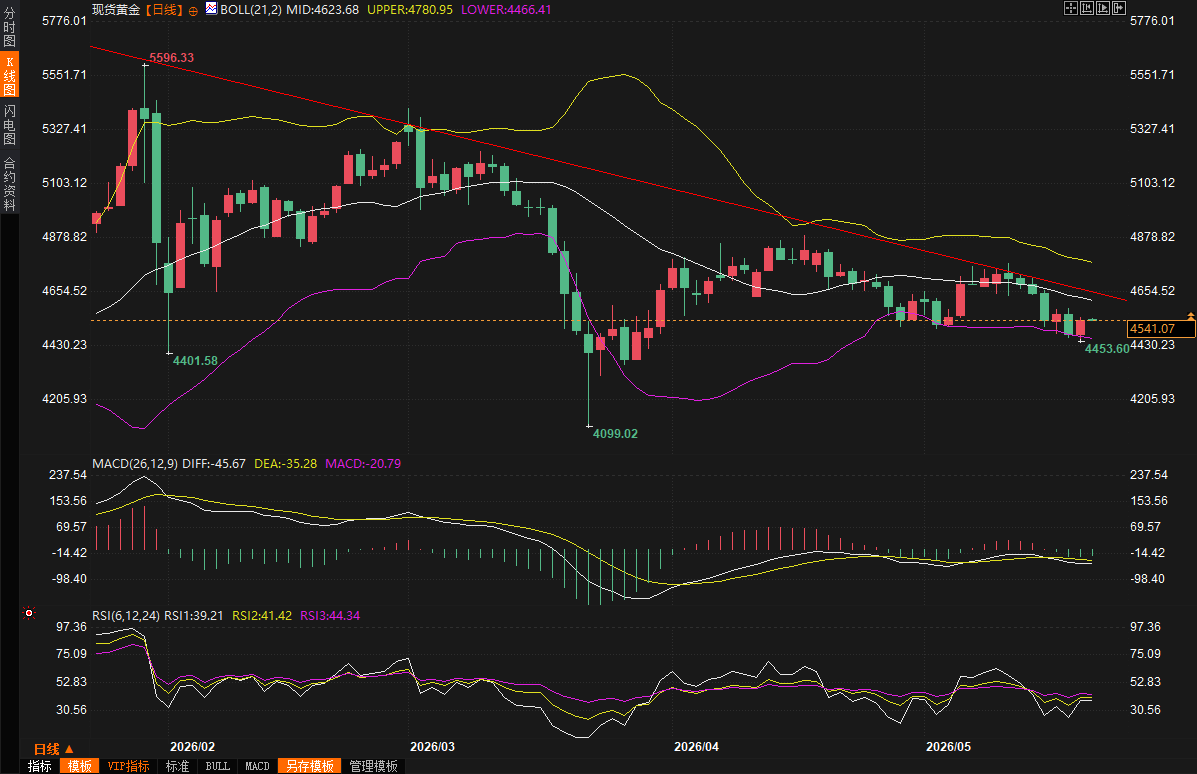
(Spot gold daily chart, source: FX678)
At 07:36 Beijing time, spot gold was trading at $4,541.82 per ounce.
I. The Geopolitical Balance Shifts: From "Epic Fury" to the Negotiation Table in the "Final Stage"
Gold prices experienced a dramatic move on Wednesday. Spot gold rose 1.38% to $4,543.53 an ounce, after earlier hitting a more than seven-week low of $4,453.60 an ounce. The immediate trigger for this reversal was not some mild economic data, but rather subtle geopolitical signals between Washington and Tehran.
US President Trump publicly stated that negotiations between the US and Iran have entered the "final stage." While warning of "very severe" retaliation if no agreement is reached, he also admitted that he is only "an hour away" from ordering the resumption of "Operation Epic Fury." This statement, intertwined with maximum pressure and a willingness to negotiate, was quickly interpreted by the market as a clear glimmer of hope for de-escalation. While Iran maintained a tough stance, accusing the US of preparing new attacks, it also signaled its willingness to cooperate with Oman and other countries to ensure the safety of shipping in the Strait of Hormuz.
More notably, two large Chinese oil tankers carrying approximately 4 million barrels of crude oil successfully passed through the Strait of Hormuz on Wednesday, after Iran had previously agreed to ease restrictions on Chinese vessels. While the number of ships passing through remains far below the pre-war level of approximately 140 per day, it has more than doubled compared to the previous week. These concrete, albeit small, developments have given capital markets a glimpse of the possibility that the conflict is subsiding.
II. The Chain Reaction of the Crude Oil Plunge: Cooling Inflation Expectations and Retreating US Treasury Yields
Expectations of geopolitical easing first ignited the oil market. Brent crude futures plummeted 5.63% to $105.02 a barrel, while U.S. crude futures plunged 5.66% to $98.26 a barrel. Such a dramatic single-day drop in oil prices is rare in markets since the outbreak of war. This collapse in oil prices is precisely the key signal that gold bulls have been waiting for.
David Meger, Director of Precious Metals Trading at High Ridge Futures, pinpointed the underlying logic: "We've seen a slowdown in the continued rise in yields, which is why gold prices have rebounded from recent lows."
Previously, the benchmark 10-year US Treasury yield had just touched its highest level since January 2025 on Tuesday, while the 30-year yield hit a new high since the eve of the 2007 global financial crisis. Behind the soaring yields was deep market anxiety about persistent inflation triggered by a war with Iran. However, when oil prices plummeted due to peace expectations, the inflationary shadow hanging over the bond market instantly dissipated somewhat. On Wednesday, the 10-year US Treasury yield fell sharply by about 10 basis points to 4.567%, a significant pullback from a 16-month high. The decline in yields directly reduced the opportunity cost of holding non-yielding gold, paving the way for a rebound in gold prices.
Looking deeper, the plunge in oil prices has alleviated not only current inflation figures, but also extreme market expectations regarding the Federal Reserve's monetary policy path. Since the outbreak of the war, persistently high energy prices have begun to erode consumers' actual purchasing power, gradually reflected in core inflation data. If oil prices continue to fall, the urgency for the Fed to raise interest rates further will decrease accordingly. Indeed, according to CME's FedWatch tool, investors' expectations of a December rate hike by the Fed have fallen from 61% a day earlier to 53%. Although this probability is still not low, the marginal easing of expectations is enough to give gold, which had been severely suppressed, a breather.
III. The Two Sides of the Federal Reserve Meeting Minutes: The Threat of Interest Rate Hikes and Policy Stalemate
On the same Wednesday, the Federal Reserve released the minutes of its April meeting. This document revealed a rather contradictory policy picture. On the one hand, most policymakers explicitly warned that the war with Iran could further push up inflation, and that if inflation persists above the 2% target, monetary policy may need to be tightened. This hawkish tone has been repeatedly digested by the market in recent weeks, becoming a core force driving up US Treasury yields and falling gold prices.
On the other hand, the market has also noted that policymakers are more focused on "warning" and "preparing" than on immediate action. Market pricing indicates that the probability of the Federal Reserve maintaining current interest rates at its next meeting in June remains as high as 89.6%. This means that the real interest rate environment will not change substantially in the short term due to the hawkish wording in the meeting minutes.
More importantly, Trump himself admitted in an interview with Fortune magazine on Monday that he might have to wait until the war with Iran ends before a rate cut becomes possible. This can be interpreted in reverse: as long as the conflict continues, a rate cut is a pipe dream, and the shadow of a rate hike will continue to loom over the market. Therefore, when the market begins to believe that the war is likely to end, not only will the probability of a rate hike decrease, but the space for future rate cuts may even reopen. This change in long-term interest rate expectations undoubtedly constitutes a strong upward pull for assets like gold, whose core pricing anchor is future real interest rates.
IV. The US dollar index fell slightly.
The rise in gold prices is not an isolated phenomenon; it coincides with a weakening of the US dollar index. On Wednesday, the dollar retreated from a six-week high, falling 0.2% to 99.13.
On the surface, the decline in the US dollar is closely related to the drop in yields—after all, there is a strong positive correlation between the dollar and US Treasury yields. But the deeper reason is that if the situation in the Middle East does indeed ease, then the capital that previously flowed into the dollar seeking safe haven will need to be reassessed and reallocated.
After all, as the war premium begins to subside, it's logical for funds to flow out of overweight dollar positions and into other assets or currencies. Furthermore, the USD/JPY pair has risen for seven consecutive trading days, and some short-term correction is possible.
When US Treasury yields fall and the dollar comes under pressure, gold, as an asset negatively correlated with the dollar, naturally receives a double boost—both from the decline in real interest rates and from the inverse effect of dollar pricing.
V. Citigroup's Caution and Market Optimism: A Divergent Outlook
Despite Wednesday's sharp rebound in gold prices, not all institutions immediately turned optimistic. Citigroup explicitly stated its cautious stance on gold in the short term, providing a 0-3 month target price of $4,300 per ounce. This implies that, in Citigroup's view, even after Wednesday's rebound, gold prices still have room to fall in the coming months.
Citigroup's concerns are not unfounded: if the US and Iran do reach an agreement and the Strait of Hormuz gradually resumes normal navigation, oil prices may fall further to pre-war levels. At that time, inflation expectations may cool down more rapidly, and if nominal interest rates fall slower than inflation expectations, real interest rates may rise instead, which is not good for gold.
Furthermore, Citigroup warned that the oil market is underestimating the risk of continued supply disruptions, while Wood Mackenzie estimated that if the Strait of Hormuz remains largely blocked until the end of the year, oil prices could approach $200. If this extreme scenario materializes, gold's status as a safe-haven and inflation-hedging asset will be further strengthened.
Therefore, while the progress in peace negotiations is encouraging, there is still a long way to go before a final agreement is signed and all parties truly implement their commitments. Iran's demands include control of the Strait of Hormuz, war reparations, the lifting of all sanctions, the unfreezing of overseas assets, and the withdrawal of US troops from the entire region—these demanding conditions are vastly different from the Trump administration's bottom line. Trump can order the resumption of war within an hour, just as he can overturn the negotiating table at the last minute due to Iran's intransigence.
Conclusion: The battle between bulls and bears in the gold market is still undecided.
Wednesday's violent rally in gold from a low of $4,453 was essentially a short-covering and sentiment-correcting rally triggered by marginal changes in geopolitical expectations. The collapse in oil prices, the decline in US Treasury yields, and the weakening dollar combined to pull gold back from the brink of collapse. However, the sustainability of this rebound depends entirely on the actual progress of US-Iran negotiations in the coming days and weeks. If an agreement is ultimately reached and the Strait of Hormuz is truly reopened, gold may face dual pressures from rising real interest rates and waning safe-haven demand, making Citi's $4,300 target price not unattainable. Conversely, if negotiations break down again, or Iran proposes unacceptable conditions at the last minute, reigniting the conflict, oil prices will rebound rapidly, US Treasury yields will resume their upward trend, and gold may, after a brief respite, fall back into the torment of a high-interest-rate environment.
For gold investors, the current strategy is not simply to chase the highs or lows, but to closely monitor every oil tanker in the Persian Gulf, every statement from Tehran, and every assertion from Washington. Because in this market where a missile and an agreement can determine a price, gold's next move could be either a triumphant surge to new highs or a further decline below $4400.
(Spot gold daily chart, source: FX678)
At 07:36 Beijing time, spot gold was trading at $4,541.82 per ounce.
- Risk Warning and Disclaimer
- The market involves risk, and trading may not be suitable for all investors. This article is for reference only and does not constitute personal investment advice, nor does it take into account certain users’ specific investment objectives, financial situation, or other needs. Any investment decisions made based on this information are at your own risk.