A weaker dollar and falling oil prices led to a slight rebound in gold prices.
2026-05-21 09:41:13
International gold prices remained range-bound during Thursday's Asian trading session, with XAU/USD trading around $4,560, as the market entered a cautious wait-and-see mode. Investors continued to focus on the stalled peace talks between the US and Iran, while closely watching the Federal Reserve's latest stance on the future path of interest rates. Against the backdrop of both geopolitical risks and high interest rate expectations, the gold market is currently experiencing a directional tug-of-war in the short term.

US President Trump stated on Wednesday that negotiations between the US and Iran had entered the "final stage," which the market initially interpreted as a possible close to an agreement, briefly boosting risk appetite. However, Trump also emphasized that if Iran does not accept the terms, the US will resume military action in the coming days. This contradictory statement caused a rapid fluctuation in market risk aversion, with investors reassessing the potential risks to global energy supplies from the escalating tensions in the Middle East.
The market's primary concern remains the Strait of Hormuz. This strait handles approximately 20% of global seaborne crude oil transport ; disruptions could further drive up international oil prices and exacerbate global inflationary pressures. Since gold is typically considered a key asset for hedging against geopolitical and inflationary risks, the uncertainty surrounding the Middle East continues to provide a floor for gold prices.
David Megel, head of metals trading at High Ridge Futures, said that if the conflict in the Middle East shows signs of easing, or if the Strait of Hormuz reopens to stable conditions, the market will expect global interest rates to gradually decline, which would be beneficial to the gold market in the long term. However, until the situation becomes clearer, safe-haven demand may continue to drive funds into the precious metals sector.
Meanwhile, the minutes of the Federal Open Market Committee (FOMC) meeting in April, released by the Federal Reserve, became another key driver for the market. The minutes showed that most Fed officials were concerned about inflation persisting above the 2% target and believed that if price pressures continued to rise, the Fed might need to reconsider its interest rate path. This statement significantly reinforced market expectations that "high interest rates will be maintained for longer."
The meeting minutes also pointed out that the Middle East conflict has led to rising energy prices, further exacerbating inflation risks within the United States. At its April policy meeting, the Federal Reserve decided to maintain the federal funds rate at 3.5%-3.75% , but officials were noticeably more cautious about future inflation trends. As a result, US Treasury yields remained high, and the US dollar index remained generally strong, putting some downward pressure on gold.
From a market sentiment perspective, gold is currently in a typical "two-factor driven" environment. On the one hand, geopolitical risks and safe-haven demand are supporting gold prices at high levels; on the other hand, the Federal Reserve's hawkish stance and rising US real yields are limiting further rapid increases in gold prices. Therefore, investors are awaiting more economic data and further clarity on the situation in the Middle East.
The market is now focusing on the preliminary reading of the US May Markit Purchasing Managers' Index (PMI) to be released Thursday evening. If the data shows continued resilience in US economic activity, the market may further reduce its bets on a Federal Reserve rate cut, thus pushing the dollar higher and suppressing gold's short-term performance. Conversely, if the PMI data shows a significant slowdown, it could reignite market expectations of a rate cut, thereby pushing gold to retest its recent highs.
From a technical perspective, gold's daily chart structure maintains a clear bullish trend. Gold prices have recently held above the $4,500 mark, indicating strong medium- to long-term buying power. Initial resistance is currently around $4,580 ; a break above this area could lead to a further test of the $4,600 level. Key support lies at $4,480 and $4,450; as long as prices remain above this range, the medium- to long-term uptrend remains intact.
The 4-hour chart shows that gold has recently entered a high-level consolidation phase. Short-term moving averages are gradually flattening, and the MACD indicator's momentum has slowed, indicating that the short-term bullish momentum has cooled. However, the RSI indicator remains above 50, showing that the overall market remains bullish. If the situation in the Middle East deteriorates further, gold may break out again; however, if US economic data is strong and the market continues to bet on the Federal Reserve maintaining high interest rates, gold prices may face pressure for a short-term technical correction.
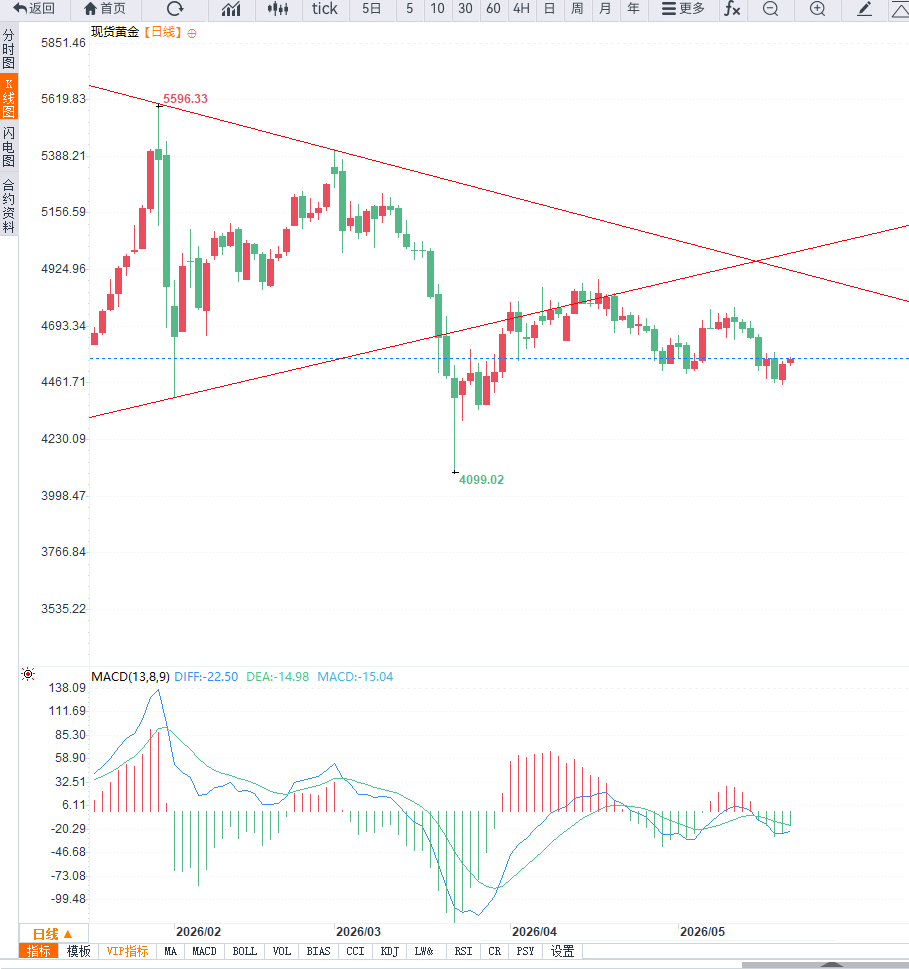
Overall, the core logic of the current gold market still revolves around "geopolitical risks" and "the Federal Reserve's policy path." Before global risk aversion subsides significantly, the support level for gold is expected to remain relatively solid. However, the high-interest-rate environment also means that a rapid, one-sided price surge is unlikely in the short term.
Editor's Summary : The gold market is currently in a sensitive phase at high levels, with a clear interplay between uncertainty in the Middle East and expectations of a hawkish Federal Reserve policy. The Strait of Hormuz risk continues to reinforce market concerns about energy supply and global inflation, providing long-term safe-haven support for gold. However, the Fed meeting minutes show that officials remain highly vigilant about inflation, and the high-interest-rate environment may persist for a longer period, thus limiting further upside potential for gold. Going forward, the market will need to focus on changes in US economic data, the evolution of the Middle East situation, and subsequent statements from Fed officials. If the US economy begins to slow while geopolitical risks remain high, gold is expected to retest historical highs; however, if the US economy continues to show resilience and the Fed maintains a hawkish stance, gold may enter a period of wide-range fluctuations at high levels.
US President Trump stated on Wednesday that negotiations between the US and Iran had entered the "final stage," which the market initially interpreted as a possible close to an agreement, briefly boosting risk appetite. However, Trump also emphasized that if Iran does not accept the terms, the US will resume military action in the coming days. This contradictory statement caused a rapid fluctuation in market risk aversion, with investors reassessing the potential risks to global energy supplies from the escalating tensions in the Middle East.
The market's primary concern remains the Strait of Hormuz. This strait handles approximately 20% of global seaborne crude oil transport ; disruptions could further drive up international oil prices and exacerbate global inflationary pressures. Since gold is typically considered a key asset for hedging against geopolitical and inflationary risks, the uncertainty surrounding the Middle East continues to provide a floor for gold prices.
David Megel, head of metals trading at High Ridge Futures, said that if the conflict in the Middle East shows signs of easing, or if the Strait of Hormuz reopens to stable conditions, the market will expect global interest rates to gradually decline, which would be beneficial to the gold market in the long term. However, until the situation becomes clearer, safe-haven demand may continue to drive funds into the precious metals sector.
Meanwhile, the minutes of the Federal Open Market Committee (FOMC) meeting in April, released by the Federal Reserve, became another key driver for the market. The minutes showed that most Fed officials were concerned about inflation persisting above the 2% target and believed that if price pressures continued to rise, the Fed might need to reconsider its interest rate path. This statement significantly reinforced market expectations that "high interest rates will be maintained for longer."
The meeting minutes also pointed out that the Middle East conflict has led to rising energy prices, further exacerbating inflation risks within the United States. At its April policy meeting, the Federal Reserve decided to maintain the federal funds rate at 3.5%-3.75% , but officials were noticeably more cautious about future inflation trends. As a result, US Treasury yields remained high, and the US dollar index remained generally strong, putting some downward pressure on gold.
From a market sentiment perspective, gold is currently in a typical "two-factor driven" environment. On the one hand, geopolitical risks and safe-haven demand are supporting gold prices at high levels; on the other hand, the Federal Reserve's hawkish stance and rising US real yields are limiting further rapid increases in gold prices. Therefore, investors are awaiting more economic data and further clarity on the situation in the Middle East.
The market is now focusing on the preliminary reading of the US May Markit Purchasing Managers' Index (PMI) to be released Thursday evening. If the data shows continued resilience in US economic activity, the market may further reduce its bets on a Federal Reserve rate cut, thus pushing the dollar higher and suppressing gold's short-term performance. Conversely, if the PMI data shows a significant slowdown, it could reignite market expectations of a rate cut, thereby pushing gold to retest its recent highs.
From a technical perspective, gold's daily chart structure maintains a clear bullish trend. Gold prices have recently held above the $4,500 mark, indicating strong medium- to long-term buying power. Initial resistance is currently around $4,580 ; a break above this area could lead to a further test of the $4,600 level. Key support lies at $4,480 and $4,450; as long as prices remain above this range, the medium- to long-term uptrend remains intact.
The 4-hour chart shows that gold has recently entered a high-level consolidation phase. Short-term moving averages are gradually flattening, and the MACD indicator's momentum has slowed, indicating that the short-term bullish momentum has cooled. However, the RSI indicator remains above 50, showing that the overall market remains bullish. If the situation in the Middle East deteriorates further, gold may break out again; however, if US economic data is strong and the market continues to bet on the Federal Reserve maintaining high interest rates, gold prices may face pressure for a short-term technical correction.
Overall, the core logic of the current gold market still revolves around "geopolitical risks" and "the Federal Reserve's policy path." Before global risk aversion subsides significantly, the support level for gold is expected to remain relatively solid. However, the high-interest-rate environment also means that a rapid, one-sided price surge is unlikely in the short term.
Editor's Summary : The gold market is currently in a sensitive phase at high levels, with a clear interplay between uncertainty in the Middle East and expectations of a hawkish Federal Reserve policy. The Strait of Hormuz risk continues to reinforce market concerns about energy supply and global inflation, providing long-term safe-haven support for gold. However, the Fed meeting minutes show that officials remain highly vigilant about inflation, and the high-interest-rate environment may persist for a longer period, thus limiting further upside potential for gold. Going forward, the market will need to focus on changes in US economic data, the evolution of the Middle East situation, and subsequent statements from Fed officials. If the US economy begins to slow while geopolitical risks remain high, gold is expected to retest historical highs; however, if the US economy continues to show resilience and the Fed maintains a hawkish stance, gold may enter a period of wide-range fluctuations at high levels.
- Risk Warning and Disclaimer
- The market involves risk, and trading may not be suitable for all investors. This article is for reference only and does not constitute personal investment advice, nor does it take into account certain users’ specific investment objectives, financial situation, or other needs. Any investment decisions made based on this information are at your own risk.