A rebound in US Treasury yields weakened the safe-haven appeal of silver, causing silver prices to fluctuate and decline.
2026-05-21 15:11:19
Spot silver (XAG/USD) fell significantly during Thursday's European trading session, dropping to around 75.20. Previously, silver prices had attempted to break through the 76.60 resistance level but failed to sustain the rebound, subsequently facing renewed selling pressure. The core factor driving this decline in silver prices was the renewed rise in US Treasury yields. The yield on the 10-year US Treasury note rose to around 4.6% on Thursday, a significant rebound from the previous trading day.
Although yields have fallen from the multi-year high of 4.69% reached on Tuesday, they remain at relatively high levels, continuing to exert downward pressure on the precious metals market. The high-interest-rate environment is diminishing the market appeal of non-interest-bearing assets such as silver . Since silver itself does not generate fixed income, investors typically prefer to allocate to higher-yielding dollar assets when US Treasury yields rise.
Previously, US President Trump stated that negotiations between the US and Iran had entered the "final stage," which temporarily eased market concerns about disruptions to Middle Eastern energy supplies. Driven by this news, international oil prices saw a significant correction on Wednesday, and US Treasury yields also briefly cooled.
However, market concerns about the situation in the Middle East have not completely disappeared. Shipping risks in the Strait of Hormuz remain, and the global energy supply outlook remains uncertain. As rising energy prices could push up US inflation, the Federal Reserve's future policy path has become more hawkish.
According to the CME FedWatch tool, the market currently expects a 51% probability of the Federal Reserve raising interest rates at least once this year. Prior to the outbreak of the Middle East wars, the market generally anticipated two rate cuts by the Fed this year. Market bets on "prolonged high interest rates" have clearly intensified , which is a key reason for the recent strength of the US dollar and US Treasury yields.
From a macroeconomic perspective, the silver market is currently facing "dual pressure": on the one hand, high US Treasury yields continue to suppress precious metals; on the other hand, the overall strength of the US dollar also weakens silver price performance. However, the silver market is not entirely without support. Given that global geopolitical risks have not yet been resolved, and considering silver's dual attributes of industrial use and safe-haven assets, some funds still maintain optimistic expectations for medium- to long-term demand for silver.
Especially given the growing demand from the new energy, photovoltaic, and electronics industries, long-term industrial demand for silver remains resilient. However, in terms of short-term fund flows, the market is currently paying significantly more attention to Federal Reserve policies and changes in US yields.
From a technical perspective, silver prices have entered a phase of consolidation. The daily chart shows that the price is currently trading below the 20-day exponential moving average (EMA) at 77.84, and has also broken below the upward trendline support of the previous ascending triangle pattern. The original trend support area has now become a new technical resistance level, located around 78.31. The break below the ascending triangle structure indicates that silver has entered a short-term correction phase (shown in bold) . Meanwhile, the RSI indicator is currently around 46, in the neutral to weak zone, indicating that the market still faces downward pressure, but has not yet entered an extremely oversold state.
From a resistance perspective, the first resistance level is located in the 77.84 area, where the 20-day EMA is situated. If the price can subsequently regain and stabilize above this level, it could alleviate short-term downward pressure. Stronger resistance lies near the May 15 high of 83.88. On the downside, the $70 psychological level is currently the most crucial support area. If silver prices continue to fail to return above the ascending triangle trendline, they may further test $70. Once below $70, the market may further test the March 26 low near 66.71.
From the 4-hour chart, silver prices remain bearish in the short term. The MACD indicator is below the zero line, indicating that bearish momentum still dominates; the RSI indicator continues to run below 50, suggesting cautious market sentiment. Furthermore, the short-term moving average system has formed a bearish alignment, indicating that the short-term trend remains downward. However, given the current high market volatility, if US Treasury yields fall again or the situation in the Middle East suddenly escalates, silver may experience another rapid rebound.
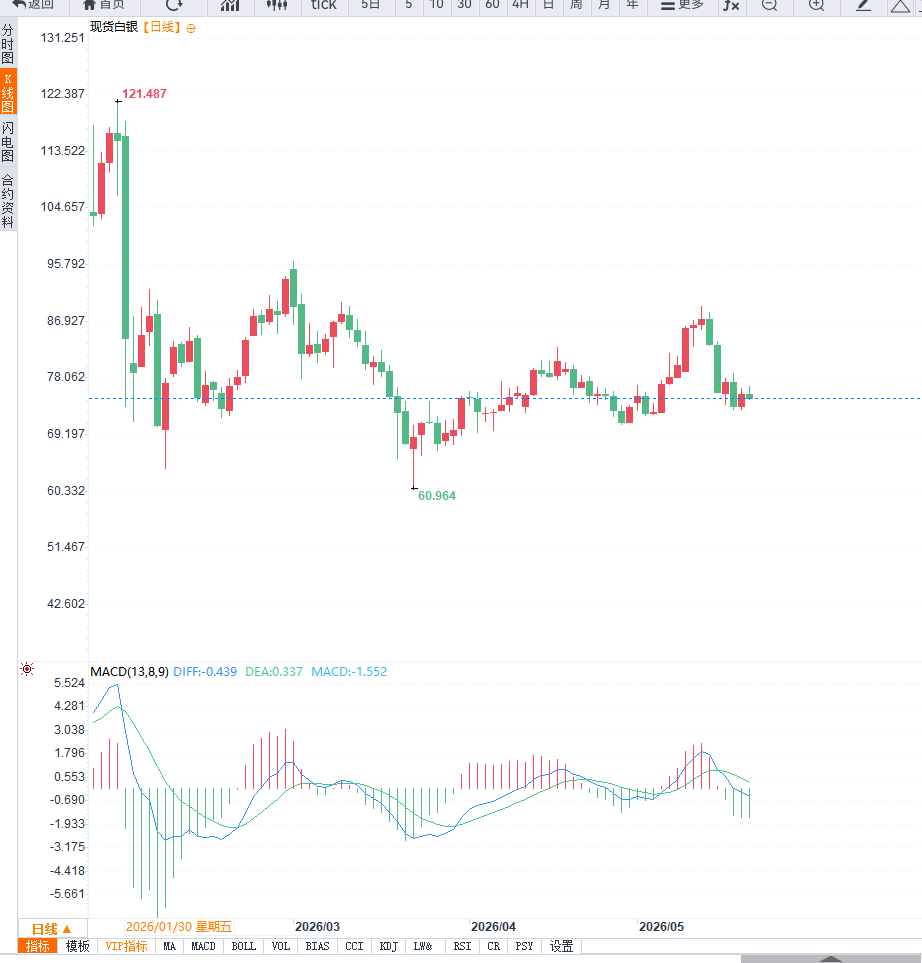
Editor's Summary : The silver market is currently under continued pressure from US Treasury yields and hawkish expectations from the Federal Reserve. As the market re-bets on a prolonged period of high US interest rates, the overall pressure on precious metals has increased significantly. From a technical perspective, after breaking below key trend support, silver prices have entered a short-term correction phase. The market will focus on whether the $78 area can be recovered and whether the key support level of $70 can hold. However, the situation in the Middle East, global energy risks, and industrial demand continue to provide medium- to long-term support for silver. Therefore, the current silver price movement is more like a high-level adjustment than a complete reversal of the long-term trend. Overall, future silver prices will remain highly dependent on the dollar's performance, changes in US Treasury yields, and shifts in global risk aversion.
Although yields have fallen from the multi-year high of 4.69% reached on Tuesday, they remain at relatively high levels, continuing to exert downward pressure on the precious metals market. The high-interest-rate environment is diminishing the market appeal of non-interest-bearing assets such as silver . Since silver itself does not generate fixed income, investors typically prefer to allocate to higher-yielding dollar assets when US Treasury yields rise.
Previously, US President Trump stated that negotiations between the US and Iran had entered the "final stage," which temporarily eased market concerns about disruptions to Middle Eastern energy supplies. Driven by this news, international oil prices saw a significant correction on Wednesday, and US Treasury yields also briefly cooled.
However, market concerns about the situation in the Middle East have not completely disappeared. Shipping risks in the Strait of Hormuz remain, and the global energy supply outlook remains uncertain. As rising energy prices could push up US inflation, the Federal Reserve's future policy path has become more hawkish.
According to the CME FedWatch tool, the market currently expects a 51% probability of the Federal Reserve raising interest rates at least once this year. Prior to the outbreak of the Middle East wars, the market generally anticipated two rate cuts by the Fed this year. Market bets on "prolonged high interest rates" have clearly intensified , which is a key reason for the recent strength of the US dollar and US Treasury yields.
From a macroeconomic perspective, the silver market is currently facing "dual pressure": on the one hand, high US Treasury yields continue to suppress precious metals; on the other hand, the overall strength of the US dollar also weakens silver price performance. However, the silver market is not entirely without support. Given that global geopolitical risks have not yet been resolved, and considering silver's dual attributes of industrial use and safe-haven assets, some funds still maintain optimistic expectations for medium- to long-term demand for silver.
Especially given the growing demand from the new energy, photovoltaic, and electronics industries, long-term industrial demand for silver remains resilient. However, in terms of short-term fund flows, the market is currently paying significantly more attention to Federal Reserve policies and changes in US yields.
From a technical perspective, silver prices have entered a phase of consolidation. The daily chart shows that the price is currently trading below the 20-day exponential moving average (EMA) at 77.84, and has also broken below the upward trendline support of the previous ascending triangle pattern. The original trend support area has now become a new technical resistance level, located around 78.31. The break below the ascending triangle structure indicates that silver has entered a short-term correction phase (shown in bold) . Meanwhile, the RSI indicator is currently around 46, in the neutral to weak zone, indicating that the market still faces downward pressure, but has not yet entered an extremely oversold state.
From a resistance perspective, the first resistance level is located in the 77.84 area, where the 20-day EMA is situated. If the price can subsequently regain and stabilize above this level, it could alleviate short-term downward pressure. Stronger resistance lies near the May 15 high of 83.88. On the downside, the $70 psychological level is currently the most crucial support area. If silver prices continue to fail to return above the ascending triangle trendline, they may further test $70. Once below $70, the market may further test the March 26 low near 66.71.
From the 4-hour chart, silver prices remain bearish in the short term. The MACD indicator is below the zero line, indicating that bearish momentum still dominates; the RSI indicator continues to run below 50, suggesting cautious market sentiment. Furthermore, the short-term moving average system has formed a bearish alignment, indicating that the short-term trend remains downward. However, given the current high market volatility, if US Treasury yields fall again or the situation in the Middle East suddenly escalates, silver may experience another rapid rebound.
Editor's Summary : The silver market is currently under continued pressure from US Treasury yields and hawkish expectations from the Federal Reserve. As the market re-bets on a prolonged period of high US interest rates, the overall pressure on precious metals has increased significantly. From a technical perspective, after breaking below key trend support, silver prices have entered a short-term correction phase. The market will focus on whether the $78 area can be recovered and whether the key support level of $70 can hold. However, the situation in the Middle East, global energy risks, and industrial demand continue to provide medium- to long-term support for silver. Therefore, the current silver price movement is more like a high-level adjustment than a complete reversal of the long-term trend. Overall, future silver prices will remain highly dependent on the dollar's performance, changes in US Treasury yields, and shifts in global risk aversion.
- Risk Warning and Disclaimer
- The market involves risk, and trading may not be suitable for all investors. This article is for reference only and does not constitute personal investment advice, nor does it take into account certain users’ specific investment objectives, financial situation, or other needs. Any investment decisions made based on this information are at your own risk.