Cooling UK inflation failed to halt the pound's rebound, with the pound nearing a one-week high against the yen, approaching the 214 level.
2026-05-21 16:41:50
The British pound (GBP/JPY) pair remained range-bound against the Japanese yen (JPY) during Thursday's European session, trading around 213.70, near its highs for the past week. Despite weak UK inflation data and lingering concerns about the UK job market and fiscal situation, the pound has maintained its overall strength. So far this week, GBP/JPY has risen by approximately 0.85% , indicating that market risk appetite remains significantly biased towards higher-yielding currencies.

Previously released UK Consumer Price Index (CPI) data showed a significant decline in UK inflation. The market had initially expected that the slowdown in inflation might reduce the need for the Bank of England (BoE) to maintain a hawkish stance, thus putting pressure on the pound. However, the pound did not fall significantly as a result, instead continuing to trade at high levels.
Market analysts believe that the current strength of the pound is partly due to investors' continued expectation that UK interest rates will remain high for an extended period. Although inflation has somewhat subsided, the overall price level in the UK remains above the Bank of England's target range, therefore market expectations for a rapid shift to easing policies by the Bank of England in the short term remain low.
Furthermore, improved global risk sentiment has driven continued capital flows into higher-yielding currency assets, thus supporting the pound against the yen. In contrast, while the yen received some support from economic data, its overall rebound remained limited.
Japan's latest trade balance data for April showed an unexpected trade surplus, with export growth significantly exceeding market expectations. This improved export performance indicates that external demand continues to provide some support to the economy . This data has boosted market confidence in Japan's economic recovery in the short term.
Meanwhile, Bank of Japan (BoJ) policy board member Junko Koeda stated that the BoJ should further raise interest rates as inflationary pressures continue to rise. This statement further reinforced market expectations that the BoJ will gradually exit its ultra-loose monetary policy in the future.
However, market buying of the yen has been relatively limited. The main reason is the persistent significant interest rate differential between Japan and the UK, while global funds currently tend to allocate more towards higher-yield assets. The UK-Japan interest rate differential remains a key driver of the GBP/JPY exchange rate remaining at high levels .
For a long time, Japan's ultra-low interest rate policy has made the yen one of the world's major funding currencies. Investors typically borrow low-interest-rate yen and then reinvest in assets with higher yields; this "carry trade" has consistently suppressed the yen's performance. Even though the Bank of Japan has begun to gradually signal policy normalization, the overall pace of interest rate hikes is still significantly slower than that of central banks in Europe and the United States. Therefore, the overall weakness of the yen has not completely changed.
From a global macroeconomic perspective, the current market focus remains on the global interest rate path, inflation changes, and risk appetite. While economic growth in the UK has slowed, the high-interest-rate environment continues to support the pound; Japan, on the other hand, is still in the process of slowly exiting its ultra-loose monetary policy.
From a technical perspective, the GBP/JPY daily chart maintains a clearly bullish structure. The exchange rate is currently trading steadily above major moving averages, indicating that the medium-term uptrend remains intact. Previous pullbacks followed by stabilization suggest that buying pressure remains strong. The RSI indicator is currently around 59, in bullish territory but not yet clearly overbought, indicating that the market still has room for further gains. The MACD indicator remains above the zero line; while bullish momentum is not extremely strong, it still maintains an overall advantage.
From a resistance perspective, 213.70 has become the first key resistance area in the short term. If this level is effectively broken, the next target may be around 214.40, the high point of May 11, which is also the top of the overall trading range in May. If 214.40 is broken further, the next target may be around 216.60, the high point of April 30.
On the downside, 212.65 forms the first support area, corresponding to Tuesday's low. A break below this level could lead to further testing of support around 211.25, with subsequent key support at the 210.40 area. Looking at the 4-hour chart, GBP/JPY remains in a short-term upward trend. The short-term moving average system maintains a bullish alignment, indicating a continued strong short-term trend. The MACD indicator remains slightly positive, suggesting that upward momentum has not yet fully ended.
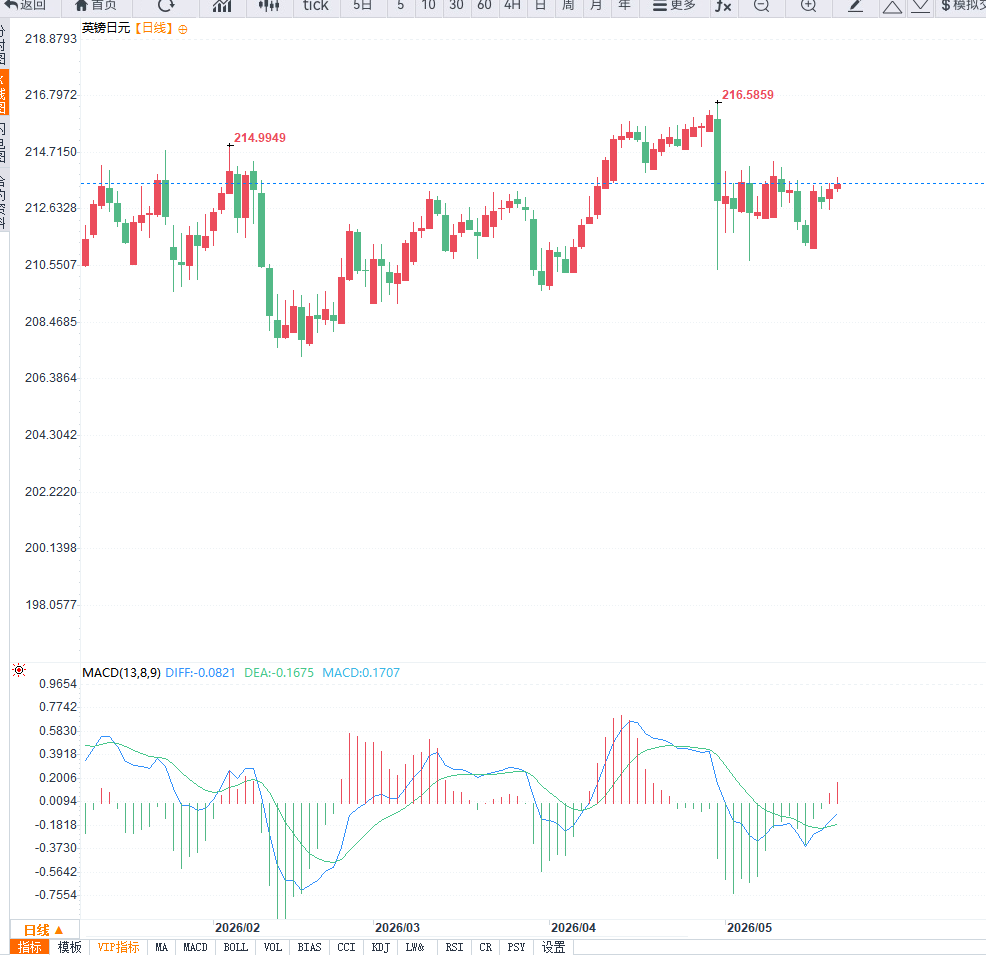
However, as the current exchange rate is near the top of its current trading range, short-term market volatility may intensify further. If the Bank of Japan signals a stronger policy normalization, or if global risk aversion suddenly escalates, the yen could rebound rapidly, triggering a technical correction in the GBP/JPY exchange rate.
Editor's Summary : The current GBP/JPY exchange rate remains driven by global interest rate differentials and risk appetite. Despite cooling UK economic data, market expectations that the Bank of England will maintain high interest rates continue to support the pound. Meanwhile, while Japanese economic data has improved and the Bank of Japan continues to send hawkish signals, the pace of policy normalization remains slow, resulting in continued weakness for the yen. In the short term, the 214.40 area will be a crucial technical level for GBP/JPY. A break above this level could open up further upside potential; however, if global risk sentiment weakens or expectations of Japanese policy change significantly increase, the exchange rate may face downward pressure. Overall, GBP/JPY currently maintains a relatively strong trend, but the risk of high-level volatility is gradually increasing.
Previously released UK Consumer Price Index (CPI) data showed a significant decline in UK inflation. The market had initially expected that the slowdown in inflation might reduce the need for the Bank of England (BoE) to maintain a hawkish stance, thus putting pressure on the pound. However, the pound did not fall significantly as a result, instead continuing to trade at high levels.
Market analysts believe that the current strength of the pound is partly due to investors' continued expectation that UK interest rates will remain high for an extended period. Although inflation has somewhat subsided, the overall price level in the UK remains above the Bank of England's target range, therefore market expectations for a rapid shift to easing policies by the Bank of England in the short term remain low.
Furthermore, improved global risk sentiment has driven continued capital flows into higher-yielding currency assets, thus supporting the pound against the yen. In contrast, while the yen received some support from economic data, its overall rebound remained limited.
Japan's latest trade balance data for April showed an unexpected trade surplus, with export growth significantly exceeding market expectations. This improved export performance indicates that external demand continues to provide some support to the economy . This data has boosted market confidence in Japan's economic recovery in the short term.
Meanwhile, Bank of Japan (BoJ) policy board member Junko Koeda stated that the BoJ should further raise interest rates as inflationary pressures continue to rise. This statement further reinforced market expectations that the BoJ will gradually exit its ultra-loose monetary policy in the future.
However, market buying of the yen has been relatively limited. The main reason is the persistent significant interest rate differential between Japan and the UK, while global funds currently tend to allocate more towards higher-yield assets. The UK-Japan interest rate differential remains a key driver of the GBP/JPY exchange rate remaining at high levels .
For a long time, Japan's ultra-low interest rate policy has made the yen one of the world's major funding currencies. Investors typically borrow low-interest-rate yen and then reinvest in assets with higher yields; this "carry trade" has consistently suppressed the yen's performance. Even though the Bank of Japan has begun to gradually signal policy normalization, the overall pace of interest rate hikes is still significantly slower than that of central banks in Europe and the United States. Therefore, the overall weakness of the yen has not completely changed.
From a global macroeconomic perspective, the current market focus remains on the global interest rate path, inflation changes, and risk appetite. While economic growth in the UK has slowed, the high-interest-rate environment continues to support the pound; Japan, on the other hand, is still in the process of slowly exiting its ultra-loose monetary policy.
From a technical perspective, the GBP/JPY daily chart maintains a clearly bullish structure. The exchange rate is currently trading steadily above major moving averages, indicating that the medium-term uptrend remains intact. Previous pullbacks followed by stabilization suggest that buying pressure remains strong. The RSI indicator is currently around 59, in bullish territory but not yet clearly overbought, indicating that the market still has room for further gains. The MACD indicator remains above the zero line; while bullish momentum is not extremely strong, it still maintains an overall advantage.
From a resistance perspective, 213.70 has become the first key resistance area in the short term. If this level is effectively broken, the next target may be around 214.40, the high point of May 11, which is also the top of the overall trading range in May. If 214.40 is broken further, the next target may be around 216.60, the high point of April 30.
On the downside, 212.65 forms the first support area, corresponding to Tuesday's low. A break below this level could lead to further testing of support around 211.25, with subsequent key support at the 210.40 area. Looking at the 4-hour chart, GBP/JPY remains in a short-term upward trend. The short-term moving average system maintains a bullish alignment, indicating a continued strong short-term trend. The MACD indicator remains slightly positive, suggesting that upward momentum has not yet fully ended.
However, as the current exchange rate is near the top of its current trading range, short-term market volatility may intensify further. If the Bank of Japan signals a stronger policy normalization, or if global risk aversion suddenly escalates, the yen could rebound rapidly, triggering a technical correction in the GBP/JPY exchange rate.
Editor's Summary : The current GBP/JPY exchange rate remains driven by global interest rate differentials and risk appetite. Despite cooling UK economic data, market expectations that the Bank of England will maintain high interest rates continue to support the pound. Meanwhile, while Japanese economic data has improved and the Bank of Japan continues to send hawkish signals, the pace of policy normalization remains slow, resulting in continued weakness for the yen. In the short term, the 214.40 area will be a crucial technical level for GBP/JPY. A break above this level could open up further upside potential; however, if global risk sentiment weakens or expectations of Japanese policy change significantly increase, the exchange rate may face downward pressure. Overall, GBP/JPY currently maintains a relatively strong trend, but the risk of high-level volatility is gradually increasing.
- Risk Warning and Disclaimer
- The market involves risk, and trading may not be suitable for all investors. This article is for reference only and does not constitute personal investment advice, nor does it take into account certain users’ specific investment objectives, financial situation, or other needs. Any investment decisions made based on this information are at your own risk.