Australia's unemployment rate rose to 4.49% and the PMI fell into contraction territory, suggesting the Reserve Bank of Australia's 4.35% interest rate may have peaked.
2026-05-21 16:57:47
The Australian economy has recently shown increasingly clear signs of cooling. Latest data shows that Australia's unemployment rate rose to 4.49% in April, the highest level since the end of 2021, further reinforcing market concerns about a slowdown in economic activity. At the same time, Australia's preliminary services PMI for May fell to 47.7 , officially entering contraction territory. This indicates that business activity and market demand are weakening significantly.
Standard Chartered strategist Nicholas Chia points out that current data on the Australian labor market, business activity, and wage growth all indicate that the tightening effects of the Reserve Bank of Australia's (RBA) previous aggressive interest rate hikes are gradually emerging.
Previously, the Reserve Bank of Australia maintained a high interest rate policy to control persistently high inflation. However, with interest rates remaining high for an extended period, corporate financing costs, household loan burdens, and consumer demand have all begun to be significantly affected.
The market is increasingly inclined to believe that the Reserve Bank of Australia's (RBA) cash rate of 4.35% has reached the peak of this cycle . Besides rising unemployment, slowing wage growth is also drawing market attention. Data shows that wage growth in Australia slowed to 3.3% year-on-year in the first quarter, largely in line with the RBA's previous forecast.
Slower wage growth suggests a decrease in labor market tightness, reducing the risk of a continued deterioration in wage-push inflation. However, Standard Chartered also cautions that it is too early to simply label the Australian job market as "collapsed."
Although the unemployment rate has risen significantly, seasonally adjusted hours worked still increased by 0.8% month-on-month in April, indicating that employment demand in some sectors remains resilient. Furthermore, Australia's overall job market has historically remained exceptionally strong, so a single month's data is insufficient to definitively confirm that the economy has entered a clear recession.
From a policy perspective, the situation facing the Reserve Bank of Australia (RBA) is changing. Previously, market concerns that high inflation might force the RBA to continue raising interest rates have shifted as economic activity gradually slows, with the policy focus moving towards avoiding a hard landing. Standard Chartered believes that the threshold for further RBA rate hikes has significantly increased before demand shows a clear renewed acceleration.
Meanwhile, the Australian government's latest fiscal budget also reflects a relatively restrained approach, refraining from excessively expansionary fiscal stimulus. This means that fiscal policy will not significantly boost demand and inflationary pressures in the short term, further reducing the need for the Reserve Bank of Australia (RBA) to continue raising interest rates. Discussions about future RBA rate cuts are gradually intensifying . Although Standard Chartered Bank has not included a rate cut as its benchmark expectation, it has pointed out that if economic activity deteriorates significantly in the future, the RBA may even consider withdrawing some of this year's tightening policies.
The global market environment also impacts Australia's economic prospects. Current global energy price volatility, tensions in the Middle East, and the high global interest rate environment are all putting pressure on Australian exports, consumption, and investment.
From the perspective of the currency market, the Australian dollar has been generally weak recently. As market bets on further interest rate hikes by the Reserve Bank of Australia have decreased, while the Federal Reserve has maintained a hawkish stance, the interest rate advantage between the Australian dollar and the US dollar is diminishing.
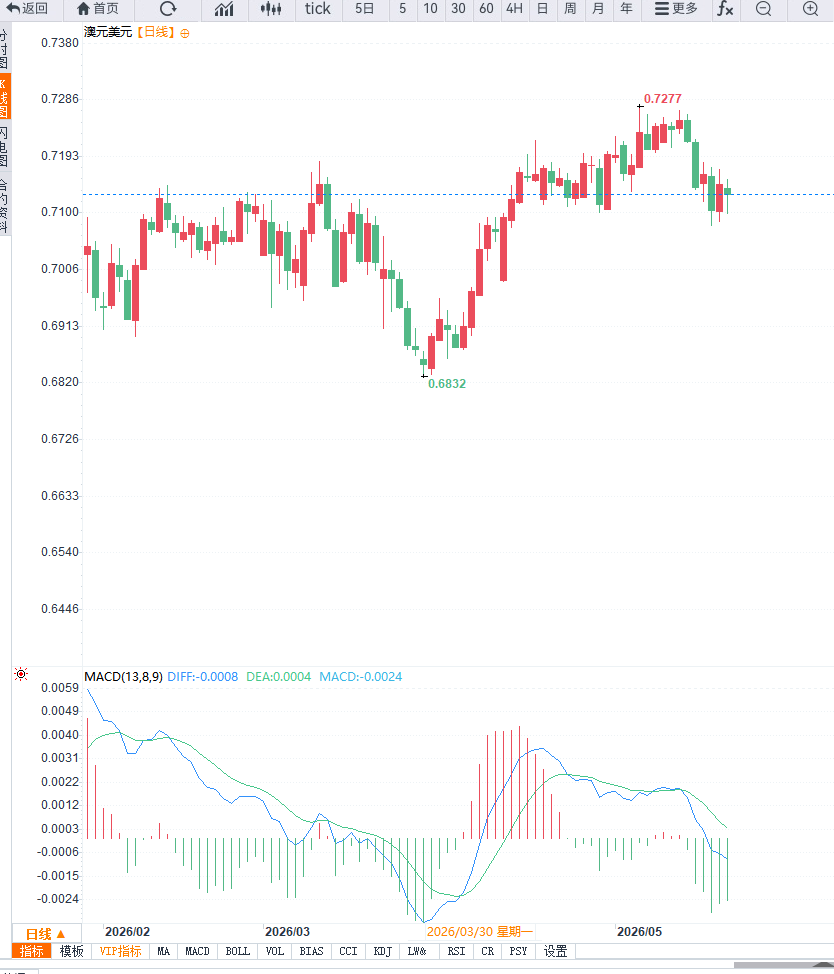
From a technical perspective, Australian dollar-related assets are currently exhibiting a generally weak and volatile structure. The daily chart for AUD/USD shows that the price has been consistently pressured below the 20-day moving average recently, and the medium-term trend is beginning to consolidate. The MACD indicator is gradually falling towards the zero line, indicating weakening upward momentum; the RSI indicator has fallen back to around 50, suggesting that market sentiment is becoming more cautious.
From a support and resistance perspective, the key resistance level for the Australian dollar against the US dollar is around 0.7200. If it fails to break through this level effectively, it may continue to fluctuate with a slightly bearish bias in the short term. Important support levels are located at 0.7100 and the 0.6950 area.
From the 4-hour chart, the Australian dollar remains weak and consolidating in the short term. Short-term moving averages are providing resistance, and the MACD indicator remains below the zero line, indicating that bears currently have the upper hand. However, if subsequent US economic data weakens, or the market resumes betting on a Fed rate cut, the Australian dollar may see a period of recovery.
Editor's Summary : The Australian economy is gradually showing the lagged pressures of high interest rates. Rising unemployment, a PMI falling into contraction territory, and slowing wage growth all indicate that economic activity is cooling. Against this backdrop, the Reserve Bank of Australia's (RBA) room for further interest rate hikes has significantly narrowed, and the market has begun to discuss the possibility of a future policy shift. However, as inflation has not yet fully returned to the target level, the RBA is likely to maintain a cautious stance in the short term. Future policy direction will heavily depend on changes in employment, inflation, and consumption data. Overall, the Australian economy is currently closer to a stage of "slower growth but not yet recession," and future market volatility may increase further.
Standard Chartered strategist Nicholas Chia points out that current data on the Australian labor market, business activity, and wage growth all indicate that the tightening effects of the Reserve Bank of Australia's (RBA) previous aggressive interest rate hikes are gradually emerging.
Previously, the Reserve Bank of Australia maintained a high interest rate policy to control persistently high inflation. However, with interest rates remaining high for an extended period, corporate financing costs, household loan burdens, and consumer demand have all begun to be significantly affected.
The market is increasingly inclined to believe that the Reserve Bank of Australia's (RBA) cash rate of 4.35% has reached the peak of this cycle . Besides rising unemployment, slowing wage growth is also drawing market attention. Data shows that wage growth in Australia slowed to 3.3% year-on-year in the first quarter, largely in line with the RBA's previous forecast.
Slower wage growth suggests a decrease in labor market tightness, reducing the risk of a continued deterioration in wage-push inflation. However, Standard Chartered also cautions that it is too early to simply label the Australian job market as "collapsed."
Although the unemployment rate has risen significantly, seasonally adjusted hours worked still increased by 0.8% month-on-month in April, indicating that employment demand in some sectors remains resilient. Furthermore, Australia's overall job market has historically remained exceptionally strong, so a single month's data is insufficient to definitively confirm that the economy has entered a clear recession.
From a policy perspective, the situation facing the Reserve Bank of Australia (RBA) is changing. Previously, market concerns that high inflation might force the RBA to continue raising interest rates have shifted as economic activity gradually slows, with the policy focus moving towards avoiding a hard landing. Standard Chartered believes that the threshold for further RBA rate hikes has significantly increased before demand shows a clear renewed acceleration.
Meanwhile, the Australian government's latest fiscal budget also reflects a relatively restrained approach, refraining from excessively expansionary fiscal stimulus. This means that fiscal policy will not significantly boost demand and inflationary pressures in the short term, further reducing the need for the Reserve Bank of Australia (RBA) to continue raising interest rates. Discussions about future RBA rate cuts are gradually intensifying . Although Standard Chartered Bank has not included a rate cut as its benchmark expectation, it has pointed out that if economic activity deteriorates significantly in the future, the RBA may even consider withdrawing some of this year's tightening policies.
The global market environment also impacts Australia's economic prospects. Current global energy price volatility, tensions in the Middle East, and the high global interest rate environment are all putting pressure on Australian exports, consumption, and investment.
From the perspective of the currency market, the Australian dollar has been generally weak recently. As market bets on further interest rate hikes by the Reserve Bank of Australia have decreased, while the Federal Reserve has maintained a hawkish stance, the interest rate advantage between the Australian dollar and the US dollar is diminishing.
From a technical perspective, Australian dollar-related assets are currently exhibiting a generally weak and volatile structure. The daily chart for AUD/USD shows that the price has been consistently pressured below the 20-day moving average recently, and the medium-term trend is beginning to consolidate. The MACD indicator is gradually falling towards the zero line, indicating weakening upward momentum; the RSI indicator has fallen back to around 50, suggesting that market sentiment is becoming more cautious.
From a support and resistance perspective, the key resistance level for the Australian dollar against the US dollar is around 0.7200. If it fails to break through this level effectively, it may continue to fluctuate with a slightly bearish bias in the short term. Important support levels are located at 0.7100 and the 0.6950 area.
From the 4-hour chart, the Australian dollar remains weak and consolidating in the short term. Short-term moving averages are providing resistance, and the MACD indicator remains below the zero line, indicating that bears currently have the upper hand. However, if subsequent US economic data weakens, or the market resumes betting on a Fed rate cut, the Australian dollar may see a period of recovery.
Editor's Summary : The Australian economy is gradually showing the lagged pressures of high interest rates. Rising unemployment, a PMI falling into contraction territory, and slowing wage growth all indicate that economic activity is cooling. Against this backdrop, the Reserve Bank of Australia's (RBA) room for further interest rate hikes has significantly narrowed, and the market has begun to discuss the possibility of a future policy shift. However, as inflation has not yet fully returned to the target level, the RBA is likely to maintain a cautious stance in the short term. Future policy direction will heavily depend on changes in employment, inflation, and consumption data. Overall, the Australian economy is currently closer to a stage of "slower growth but not yet recession," and future market volatility may increase further.
- Risk Warning and Disclaimer
- The market involves risk, and trading may not be suitable for all investors. This article is for reference only and does not constitute personal investment advice, nor does it take into account certain users’ specific investment objectives, financial situation, or other needs. Any investment decisions made based on this information are at your own risk.