Eurozone: Growth gone, inflation high, will interest rate hikes continue?
2026-05-21 17:40:33
During Thursday's (May 21) European trading session, the euro traded in a narrow range above 1.1600 against the US dollar, hovering around 1.1620.
A survey released earlier that day showed that eurozone economic activity contracted at its fastest pace in more than two and a half years in May, impacted by a surge in prices triggered by the conflict that dampened demand for services and pushed overall input price inflation to a three-and-a-half-year high. S&P Global's preliminary eurozone composite purchasing managers' index (PMI) fell to 47.5 in May from 48.8 in April, the lowest level since October 2023 and below the forecast of no change from April. This reading marks the second consecutive month of contraction in the eurozone private sector. A PMI below 50 indicates slowing economic activity.
Chris Williamson, chief business economist at S&P Global Market Intelligence, said, "The preliminary May PMI data shows that the Eurozone economy is suffering increasing damage from the US-Iran conflict. The survey data indicates that the Eurozone economy is expected to contract by 0.2% in the second quarter." Overall demand deteriorated sharply, with new private sector orders falling at their fastest pace in 18 months, and new export orders (including intra-Eurozone trade) experiencing their largest drop since January 2025. New business in the services sector declined sharply, while factory demand, which had recorded growth in April, also contracted again.
Williamson added, “The services sector was particularly hit by the conflict-induced surge in the cost of living, especially the dampening effect of rising energy prices on demand.” Services activity—a major driver of the eurozone economy and a key indicator of consumer demand—contracted at its fastest pace since February 2021, with the preliminary services PMI falling to 46.4 from 47.6 in April, while the market had expected a slight increase to 47.7.
Cost pressures have intensified sharply. The composite PMI showed input price inflation accelerating to a three-and-a-half-year high. Prices charged by businesses to customers also rose at their fastest pace in 38 months, although only slightly faster than the increase in April. S&P Global warned that these price indicators suggest inflation will approach 4% in the coming months. Official data showed that the eurozone's inflation rate remained at 3.0% in April, above the European Central Bank's target of 2.0%. The ECB kept interest rates unchanged at the end of last month but engaged in extensive debate on raising rates to combat soaring inflation, and publicly and privately hinted at possible action in June.
The labor market deteriorated further. Eurozone companies cut jobs for the fifth consecutive month at the fastest pace since November 2020—the largest drop since August 2013, excluding the pandemic period. Service sector companies cut jobs for the first time since the beginning of 2021, while manufacturing employment contracted again. Business confidence fell to a 32-month low, with pessimism in the service sector reaching its strongest level since September 2022.
In summary, the Eurozone's May PMI data paints a typical picture of stagflation: economic activity is contracting rapidly, demand is plummeting, and the labor market continues to deteriorate, while cost pressures and output prices are rising at an accelerating pace, with inflation well above the target level. This combination of "slowing growth and rising inflation" is precisely the "adverse scenario" frequently mentioned by ECB officials recently. S&P Global expects the Eurozone economy to contract by 0.2% in the second quarter, while price indicators point to inflation approaching 4% in the coming months. Against this backdrop, the probability of an ECB rate hike in June is rising, but whether a rate hike can curb inflation without further damaging economic growth remains a challenge for policymakers.
From the daily chart, the euro is currently trading around 1.1600 against the US dollar, in a weak consolidation phase at recent lows, with multiple technical indicators showing bearish signals.
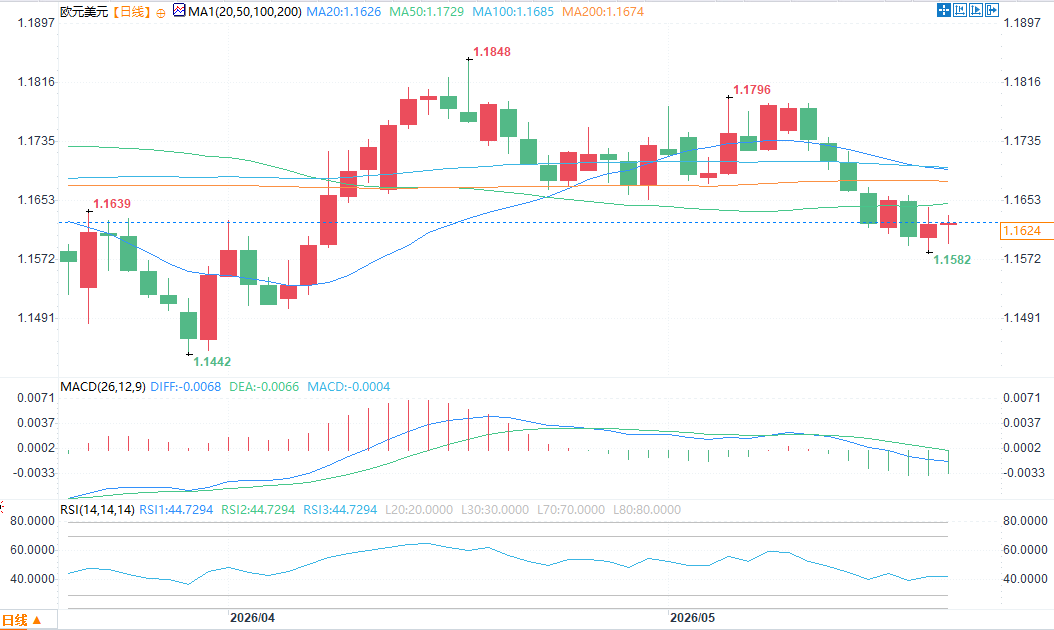
(Euro/USD daily chart, source: FX678)
Regarding the moving average system, all major moving averages are above the current price, forming a clear bearish alignment. The 20-day moving average (MA20) (1.1626) is the nearest resistance level, while the 50-day moving average (MA50) (1.1729), 100-day moving average (MA100) (1.1685), and 200-day moving average (MA200) are significantly higher than the current price. This alignment of "price below all moving averages" indicates that the Euro/USD pair is in a clear downtrend. It is worth noting that the exchange rate has repeatedly attempted to break through 1.1700 since late April without success, and has currently been trading below the MA20 for several consecutive trading days, indicating a relatively solid short-term bearish pattern.
A survey released earlier that day showed that eurozone economic activity contracted at its fastest pace in more than two and a half years in May, impacted by a surge in prices triggered by the conflict that dampened demand for services and pushed overall input price inflation to a three-and-a-half-year high. S&P Global's preliminary eurozone composite purchasing managers' index (PMI) fell to 47.5 in May from 48.8 in April, the lowest level since October 2023 and below the forecast of no change from April. This reading marks the second consecutive month of contraction in the eurozone private sector. A PMI below 50 indicates slowing economic activity.
Demand has deteriorated sharply, with the service sector being the hardest hit.
Chris Williamson, chief business economist at S&P Global Market Intelligence, said, "The preliminary May PMI data shows that the Eurozone economy is suffering increasing damage from the US-Iran conflict. The survey data indicates that the Eurozone economy is expected to contract by 0.2% in the second quarter." Overall demand deteriorated sharply, with new private sector orders falling at their fastest pace in 18 months, and new export orders (including intra-Eurozone trade) experiencing their largest drop since January 2025. New business in the services sector declined sharply, while factory demand, which had recorded growth in April, also contracted again.
Williamson added, “The services sector was particularly hit by the conflict-induced surge in the cost of living, especially the dampening effect of rising energy prices on demand.” Services activity—a major driver of the eurozone economy and a key indicator of consumer demand—contracted at its fastest pace since February 2021, with the preliminary services PMI falling to 46.4 from 47.6 in April, while the market had expected a slight increase to 47.7.
Cost pressures are intensifying, and the inflation rate is approaching 4%.
Cost pressures have intensified sharply. The composite PMI showed input price inflation accelerating to a three-and-a-half-year high. Prices charged by businesses to customers also rose at their fastest pace in 38 months, although only slightly faster than the increase in April. S&P Global warned that these price indicators suggest inflation will approach 4% in the coming months. Official data showed that the eurozone's inflation rate remained at 3.0% in April, above the European Central Bank's target of 2.0%. The ECB kept interest rates unchanged at the end of last month but engaged in extensive debate on raising rates to combat soaring inflation, and publicly and privately hinted at possible action in June.
The labor market deteriorated, and business confidence fell to a 32-month low.
The labor market deteriorated further. Eurozone companies cut jobs for the fifth consecutive month at the fastest pace since November 2020—the largest drop since August 2013, excluding the pandemic period. Service sector companies cut jobs for the first time since the beginning of 2021, while manufacturing employment contracted again. Business confidence fell to a 32-month low, with pessimism in the service sector reaching its strongest level since September 2022.
The Eurozone economy is mired in stagflation, increasing the probability of a June rate hike by the European Central Bank.
In summary, the Eurozone's May PMI data paints a typical picture of stagflation: economic activity is contracting rapidly, demand is plummeting, and the labor market continues to deteriorate, while cost pressures and output prices are rising at an accelerating pace, with inflation well above the target level. This combination of "slowing growth and rising inflation" is precisely the "adverse scenario" frequently mentioned by ECB officials recently. S&P Global expects the Eurozone economy to contract by 0.2% in the second quarter, while price indicators point to inflation approaching 4% in the coming months. Against this backdrop, the probability of an ECB rate hike in June is rising, but whether a rate hike can curb inflation without further damaging economic growth remains a challenge for policymakers.
Moving averages are converging, indicating a potential breakout in direction.
From the daily chart, the euro is currently trading around 1.1600 against the US dollar, in a weak consolidation phase at recent lows, with multiple technical indicators showing bearish signals.
(Euro/USD daily chart, source: FX678)
Regarding the moving average system, all major moving averages are above the current price, forming a clear bearish alignment. The 20-day moving average (MA20) (1.1626) is the nearest resistance level, while the 50-day moving average (MA50) (1.1729), 100-day moving average (MA100) (1.1685), and 200-day moving average (MA200) are significantly higher than the current price. This alignment of "price below all moving averages" indicates that the Euro/USD pair is in a clear downtrend. It is worth noting that the exchange rate has repeatedly attempted to break through 1.1700 since late April without success, and has currently been trading below the MA20 for several consecutive trading days, indicating a relatively solid short-term bearish pattern.
- Risk Warning and Disclaimer
- The market involves risk, and trading may not be suitable for all investors. This article is for reference only and does not constitute personal investment advice, nor does it take into account certain users’ specific investment objectives, financial situation, or other needs. Any investment decisions made based on this information are at your own risk.