Israel's war motives and the linkage between the US dollar and US Treasury bonds
2026-05-21 21:42:54
Signals from Israeli officials and media clearly indicate that even with the current fragile stalemate, the country is actively assessing the feasibility of resuming conflict with Iran. It is worth noting that the United States has gradually abandoned its deterrent stance of "resuming bombing if Iran does not sign a peace agreement," while according to market sources, the Israeli political core's inclination towards military action is becoming increasingly apparent.
The Israeli parliament today (May 20) passed a bill proposed by the ruling coalition to dissolve parliament, which could bring the general election to a close several weeks earlier. Israeli polls predict that Prime Minister Netanyahu's ruling coalition will lose the election.

This contradictory situation has recently become more apparent due to a leak: Israeli right-wing Channel 14 anchor Simon Riklin accidentally revealed what appeared to be classified plans for a second round of strikes against Tehran, including coordinates of uranium storage facilities that he claimed could be precisely targeted.
The statement was immediately met with fierce criticism from members of the Israeli parliament, forcing Riklin to urgently clarify that his statement was merely a hypothetical analysis.
Despite growing calls within Israel to resume hostilities, the reality is that without explicit authorization from the United States, Israel has virtually no capacity to conduct large-scale military operations independently, and such authorization is unlikely to materialize in the short term.
Sources revealed that Israeli Prime Minister Benjamin Netanyahu and US President Donald Trump spoke by phone late at night to discuss Washington's insistence on pushing for a ceasefire despite Israel's security concerns. The call reportedly left the Israeli leader "extremely anxious."
This week, Israeli media further revealed that Netanyahu has chaired the second meeting of the security cabinet, focusing on discussing specific plans for resuming military conflict with Iran.
However, even though the United States and Israel have used billions of dollars worth of high-tech weapons against Iran, the Tehran regime remains stable and shows no signs of wavering.
Iran's dual deterrence strategy of "attacking regional allies and blocking the Strait of Hormuz" has significantly reduced the United States' willingness to get involved in this high-cost, protracted war, and this situation is directly affecting the expected direction of the global energy and foreign exchange markets.
Israel's long-standing obsession with Iran forms the public opinion basis for its war impulses; this phenomenon is called "Iranophobia" by scholars.
For Netanyahu, the ceasefire agreement reached on April 8—in which Israel was almost entirely excluded from the negotiations—has triggered a serious political backlash. Analysts point out that it has also caused psychological fluctuations among the Israeli public, who have long been indoctrinated with the idea that "Iran is an existential threat."
Opposition leader Yair Lapid and former Prime Minister Naftali Bennett seized the opportunity to use the ceasefire as a political tool to attack Netanyahu. Lapid bluntly stated that the agreement was "the worst political disaster in Israeli history," a view that resonated strongly with the mainstream opinion of the Israeli public.
A poll conducted by the Israel Democracy Institute in early May showed that a majority of Israelis believe that ending the war prematurely would harm the country’s core security interests, while a similar proportion of respondents expect the conflict to break out again. This public opinion directly affects the market’s pricing logic for Middle East geopolitical risks.
Hagai Ram, a geopolitical expert at Ben-Gurion University, argues that the core demands of Israeli public and political elites, who have long viewed Iran as their primary geopolitical adversary, are actually quite vague.
"Politicians and the public have formed a fixed mindset that Iran is the ultimate enemy," Ram said, adding that his book, "Iranophobia," systematically examines Israel's long-standing strategic obsession with Iran.
He further pointed out that the Israeli people have developed a perception that "war is inevitable" through long-term exposure to the virus, which was particularly evident in the use of air-raid shelters during the Iranian missile attack—the Israeli people he encountered at the time showed an unusual calm in the face of the air attack threat.
“In their view, suspending normal social operations is a perfectly reasonable price to pay in order to stop Iran’s nuclear program, or as they put it, ‘to liberate the people in the region,’” Ram added.
For most Israelis, the core question remains: can Netanyahu, whom some call a "political magician," force Iran to submit through military means? This uncertainty continues to drive up the geopolitical risk premium in the Middle East.
Netanyahu's impulse to wage war stems from deeper domestic political pressures, making it akin to a "political séance."
The Israeli public is already accustomed to his unconventional political style: in 2022, despite being embroiled in multiple corruption allegations, Netanyahu still won the election.
He not only skillfully evaded security responsibility for the Hamas attack on southern Israel on October 7, 2023 (Hamas fired thousands of rockets into Israel and sent armed men to breach the Israeli border defenses, invading several Israeli border towns, causing numerous Israeli military and civilian casualties, and capturing an "unprecedented" number of soldiers and civilians), but was also accused of secretly pushing Trump to join the war against Iran—even though his official stance denied this claim, he still gained political prestige from it.
Former Israeli Ambassador and Consul General to New York, Aaron Pincas, stated that the October 2023 attacks and the US-led ceasefire agreement between Israel and Iran (in which Israel was not involved in the negotiations) are Netanyahu's most pressing political concerns, and these factors are becoming important incentives for him to push for the resumption of military operations.
Pincus analyzed, "I believe there are three related motivations behind Netanyahu's pursuit of restarting the war. First, he wants to completely sever ties with the security failures of the October 7 incident—he desperately needs a landmark strategic victory, and the Gaza or Lebanon battlefields can no longer satisfy this demand, making Iran the only target."
Secondly, the market generally believes that the war against Iraq has not yet achieved its strategic objectives, and both the general public and the media in Israel believe that the previous military operations have not yielded substantial results.
Third, opinion polls clearly show that he needs a victory in the Iraq War to boost his campaign and pave the way for the general election later this year.
However, Netanyahu's strategic foresight was clearly flawed: Iran's blockade of the Strait of Hormuz, which triggered turmoil in the global energy supply chain, and Tehran's cross-border strikes against neighboring countries, both exceeded his initial expectations.
Israel's tactical setbacks in the war against Iraq are expected to be a key focus of debate in the August elections, and this political variable continues to influence market pricing of Middle East geopolitical risks.
The current US-Iran rivalry has become deeply entangled in the blurred lines between geopolitical chaos and military competition.
Weeks after the ceasefire agreement was signed on April 8, Israeli Defense Minister Israel Katz publicly stated that Israel would immediately launch a "Stone Age" level devastating strike against Iran if authorized by the United States, highlighting Israel's tough stance on restarting the conflict.
Former Israeli government advisor Daniel Levy revealed that there is a clear strategic divide within Israel: some factions advocate for cutting losses and withdrawing from the conflict, while the political mainstream, led by Prime Minister Netanyahu, tends to escalate the stakes, utilizing US military assets deployed near Iran's coast in an attempt to fundamentally weaken Iran's geopolitical influence.
From the perspective of the linkage between geopolitics and financial markets, although there is a high level of political support in Israel for restarting the war against Iraq, Netanyahu's actions are still constrained by the framework of the US-Israel alliance.
Levy emphasized, "The US attitude is the ultimate switch in this conflict." As Trump clearly stated to Netanyahu after Tuesday night's call, "He will do exactly as I say," this statement further solidified market expectations of a US-led Middle East peace process, and its impact has been deeply transmitted to core financial market indicators.
The uncertainty surrounding the US-Iran conflict and the US's strategic dominance are directly influencing the volatility of oil prices, the US dollar index, and US Treasury yields.
Geopolitical tensions have fueled risk aversion, which has become a key factor supporting the strengthening of the US dollar index. Coupled with the relative resilience of US economic data and fluctuations in inflation expectations, the US dollar index has rebounded after being under pressure recently, prompting speculative traders to adjust their short positions to hedge against risks.
At the same time, the US Treasury market was also significantly impacted: the turmoil in the Middle East pushed up international oil prices, exacerbated inflation expectations, and weakened market bets on the Federal Reserve to cut interest rates, directly leading to a sharp rise of about 38 basis points in the 10-year US Treasury yield in March. Foreign investors reduced their holdings of US Treasuries to avoid duration risks, and foreign official and international accounts saw a cumulative decrease of nearly $82 billion in US Treasury custodian holdings at the Federal Reserve Bank of New York that month.
There were also some unexpected developments regarding US Treasury bonds. Gulf states, facing disruptions to oil and general trade, were forced to sell US Treasury bonds and buy dollars. Meanwhile, due to the sharp rise in global energy and raw material prices, countries like Japan, which rely heavily on imports, experienced severe imported inflation. This led to increased costs and higher prices for their domestic products, ultimately causing their currencies to depreciate both domestically and internationally. Consequently, some central banks intervened, continuing to sell US Treasury bonds.
At the same time, oil prices also rebounded rapidly.
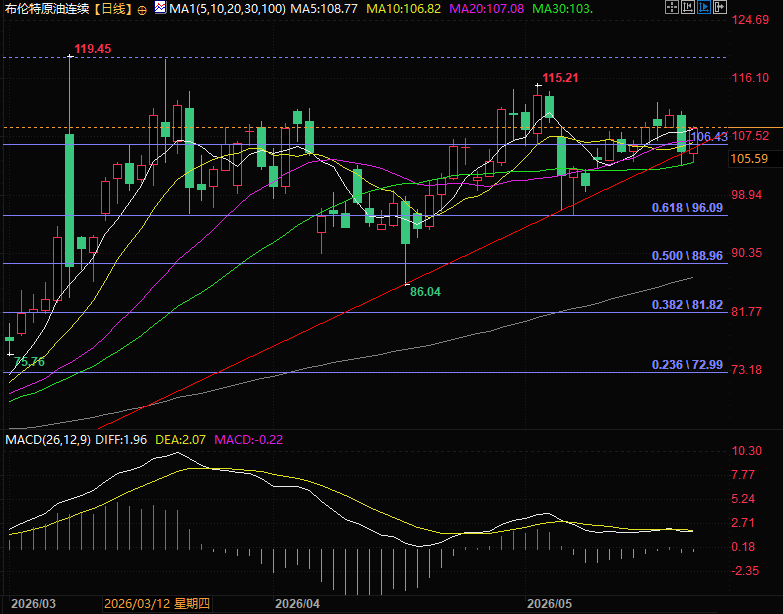
(Brent crude oil futures daily chart, source: FX678)
The Israeli parliament today (May 20) passed a bill proposed by the ruling coalition to dissolve parliament, which could bring the general election to a close several weeks earlier. Israeli polls predict that Prime Minister Netanyahu's ruling coalition will lose the election.
Leaks and the Realistic Constraints of Military Operations
This contradictory situation has recently become more apparent due to a leak: Israeli right-wing Channel 14 anchor Simon Riklin accidentally revealed what appeared to be classified plans for a second round of strikes against Tehran, including coordinates of uranium storage facilities that he claimed could be precisely targeted.
The statement was immediately met with fierce criticism from members of the Israeli parliament, forcing Riklin to urgently clarify that his statement was merely a hypothetical analysis.
Despite growing calls within Israel to resume hostilities, the reality is that without explicit authorization from the United States, Israel has virtually no capacity to conduct large-scale military operations independently, and such authorization is unlikely to materialize in the short term.
High-level US-Israel rivalry and Iran's deterrent response
Sources revealed that Israeli Prime Minister Benjamin Netanyahu and US President Donald Trump spoke by phone late at night to discuss Washington's insistence on pushing for a ceasefire despite Israel's security concerns. The call reportedly left the Israeli leader "extremely anxious."
This week, Israeli media further revealed that Netanyahu has chaired the second meeting of the security cabinet, focusing on discussing specific plans for resuming military conflict with Iran.
However, even though the United States and Israel have used billions of dollars worth of high-tech weapons against Iran, the Tehran regime remains stable and shows no signs of wavering.
Iran's dual deterrence strategy of "attacking regional allies and blocking the Strait of Hormuz" has significantly reduced the United States' willingness to get involved in this high-cost, protracted war, and this situation is directly affecting the expected direction of the global energy and foreign exchange markets.
The Cornerstone of Public Opinion: War Perceptions Fostered by "Iranophobia"
Israel's long-standing obsession with Iran forms the public opinion basis for its war impulses; this phenomenon is called "Iranophobia" by scholars.
For Netanyahu, the ceasefire agreement reached on April 8—in which Israel was almost entirely excluded from the negotiations—has triggered a serious political backlash. Analysts point out that it has also caused psychological fluctuations among the Israeli public, who have long been indoctrinated with the idea that "Iran is an existential threat."
Opposition leader Yair Lapid and former Prime Minister Naftali Bennett seized the opportunity to use the ceasefire as a political tool to attack Netanyahu. Lapid bluntly stated that the agreement was "the worst political disaster in Israeli history," a view that resonated strongly with the mainstream opinion of the Israeli public.
A poll conducted by the Israel Democracy Institute in early May showed that a majority of Israelis believe that ending the war prematurely would harm the country’s core security interests, while a similar proportion of respondents expect the conflict to break out again. This public opinion directly affects the market’s pricing logic for Middle East geopolitical risks.
Hagai Ram, a geopolitical expert at Ben-Gurion University, argues that the core demands of Israeli public and political elites, who have long viewed Iran as their primary geopolitical adversary, are actually quite vague.
The mindset of "enemy fixation" and the perception of the legitimacy of war
"Politicians and the public have formed a fixed mindset that Iran is the ultimate enemy," Ram said, adding that his book, "Iranophobia," systematically examines Israel's long-standing strategic obsession with Iran.
He further pointed out that the Israeli people have developed a perception that "war is inevitable" through long-term exposure to the virus, which was particularly evident in the use of air-raid shelters during the Iranian missile attack—the Israeli people he encountered at the time showed an unusual calm in the face of the air attack threat.
“In their view, suspending normal social operations is a perfectly reasonable price to pay in order to stop Iran’s nuclear program, or as they put it, ‘to liberate the people in the region,’” Ram added.
For most Israelis, the core question remains: can Netanyahu, whom some call a "political magician," force Iran to submit through military means? This uncertainty continues to drive up the geopolitical risk premium in the Middle East.
Political Necromancy: Netanyahu's Election Appeals and War Motives
Netanyahu's impulse to wage war stems from deeper domestic political pressures, making it akin to a "political séance."
The Israeli public is already accustomed to his unconventional political style: in 2022, despite being embroiled in multiple corruption allegations, Netanyahu still won the election.
He not only skillfully evaded security responsibility for the Hamas attack on southern Israel on October 7, 2023 (Hamas fired thousands of rockets into Israel and sent armed men to breach the Israeli border defenses, invading several Israeli border towns, causing numerous Israeli military and civilian casualties, and capturing an "unprecedented" number of soldiers and civilians), but was also accused of secretly pushing Trump to join the war against Iran—even though his official stance denied this claim, he still gained political prestige from it.
The three core political motivations for restarting the war
Former Israeli Ambassador and Consul General to New York, Aaron Pincas, stated that the October 2023 attacks and the US-led ceasefire agreement between Israel and Iran (in which Israel was not involved in the negotiations) are Netanyahu's most pressing political concerns, and these factors are becoming important incentives for him to push for the resumption of military operations.
Pincus analyzed, "I believe there are three related motivations behind Netanyahu's pursuit of restarting the war. First, he wants to completely sever ties with the security failures of the October 7 incident—he desperately needs a landmark strategic victory, and the Gaza or Lebanon battlefields can no longer satisfy this demand, making Iran the only target."
Secondly, the market generally believes that the war against Iraq has not yet achieved its strategic objectives, and both the general public and the media in Israel believe that the previous military operations have not yielded substantial results.
Third, opinion polls clearly show that he needs a victory in the Iraq War to boost his campaign and pave the way for the general election later this year.
Strategic miscalculations and political variables before the election
However, Netanyahu's strategic foresight was clearly flawed: Iran's blockade of the Strait of Hormuz, which triggered turmoil in the global energy supply chain, and Tehran's cross-border strikes against neighboring countries, both exceeded his initial expectations.
Israel's tactical setbacks in the war against Iraq are expected to be a key focus of debate in the August elections, and this political variable continues to influence market pricing of Middle East geopolitical risks.
Geopolitical Chaos: Israel's Strategic Differences and America's Ultimate Dominance
The current US-Iran rivalry has become deeply entangled in the blurred lines between geopolitical chaos and military competition.
Weeks after the ceasefire agreement was signed on April 8, Israeli Defense Minister Israel Katz publicly stated that Israel would immediately launch a "Stone Age" level devastating strike against Iran if authorized by the United States, highlighting Israel's tough stance on restarting the conflict.
Former Israeli government advisor Daniel Levy revealed that there is a clear strategic divide within Israel: some factions advocate for cutting losses and withdrawing from the conflict, while the political mainstream, led by Prime Minister Netanyahu, tends to escalate the stakes, utilizing US military assets deployed near Iran's coast in an attempt to fundamentally weaken Iran's geopolitical influence.
From the perspective of the linkage between geopolitics and financial markets, although there is a high level of political support in Israel for restarting the war against Iraq, Netanyahu's actions are still constrained by the framework of the US-Israel alliance.
Levy emphasized, "The US attitude is the ultimate switch in this conflict." As Trump clearly stated to Netanyahu after Tuesday night's call, "He will do exactly as I say," this statement further solidified market expectations of a US-led Middle East peace process, and its impact has been deeply transmitted to core financial market indicators.
Financial Linkage: The Profound Impact of the US-Iran Situation on Financial Markets
The uncertainty surrounding the US-Iran conflict and the US's strategic dominance are directly influencing the volatility of oil prices, the US dollar index, and US Treasury yields.
Geopolitical tensions have fueled risk aversion, which has become a key factor supporting the strengthening of the US dollar index. Coupled with the relative resilience of US economic data and fluctuations in inflation expectations, the US dollar index has rebounded after being under pressure recently, prompting speculative traders to adjust their short positions to hedge against risks.
At the same time, the US Treasury market was also significantly impacted: the turmoil in the Middle East pushed up international oil prices, exacerbated inflation expectations, and weakened market bets on the Federal Reserve to cut interest rates, directly leading to a sharp rise of about 38 basis points in the 10-year US Treasury yield in March. Foreign investors reduced their holdings of US Treasuries to avoid duration risks, and foreign official and international accounts saw a cumulative decrease of nearly $82 billion in US Treasury custodian holdings at the Federal Reserve Bank of New York that month.
There were also some unexpected developments regarding US Treasury bonds. Gulf states, facing disruptions to oil and general trade, were forced to sell US Treasury bonds and buy dollars. Meanwhile, due to the sharp rise in global energy and raw material prices, countries like Japan, which rely heavily on imports, experienced severe imported inflation. This led to increased costs and higher prices for their domestic products, ultimately causing their currencies to depreciate both domestically and internationally. Consequently, some central banks intervened, continuing to sell US Treasury bonds.
At the same time, oil prices also rebounded rapidly.
(Brent crude oil futures daily chart, source: FX678)
- Risk Warning and Disclaimer
- The market involves risk, and trading may not be suitable for all investors. This article is for reference only and does not constitute personal investment advice, nor does it take into account certain users’ specific investment objectives, financial situation, or other needs. Any investment decisions made based on this information are at your own risk.