The rising expectations of a hawkish Federal Reserve, coupled with falling oil prices, pressured the Canadian dollar, causing the USD/CAD exchange rate to rise for the fourth consecutive day.
2026-05-22 10:08:11
Friday's Asian session continued the pattern of a strong US dollar and weak commodity currencies, with the USD/CAD pair rising for the fourth consecutive trading day, reaching around 1.3790. The decline in international crude oil prices and rising expectations of a hawkish stance from the Federal Reserve were the core factors driving the continued rise of the USD/CAD pair.
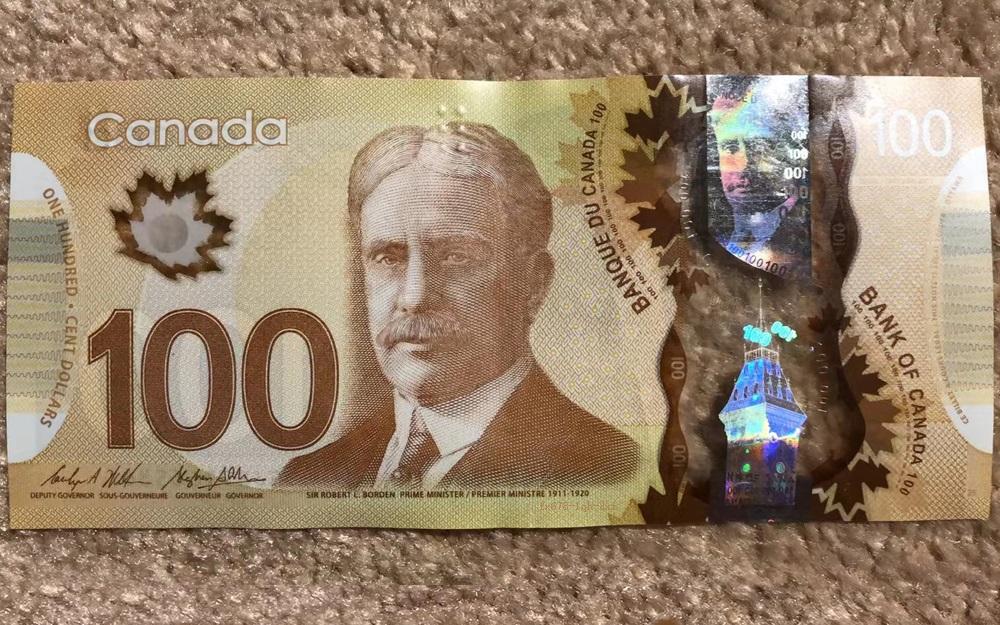
As one of the world's major crude oil exporters, Canada's economy is highly intertwined with the international energy market. Since Canada is the largest exporter of crude oil to the United States, international oil price movements often directly impact the Canadian dollar. The recent continuous decline in WTI crude oil prices has put significant pressure on the Canadian dollar.
In the international crude oil market, rising optimism regarding a potential agreement between the US and Iran has eased concerns about global supply shortages. US Secretary of State Marco Rubio stated that there are positive signs in negotiations between the US and Iran, and that Pakistan may also be involved in the coordination process. This has led the market to reassess supply risks in the Middle East.
While Iran emphasized that no formal agreement had been reached, it also acknowledged that differences were narrowing. However, control of the Strait of Hormuz and the issue of uranium enrichment remained key obstacles in the negotiations. The Strait of Hormuz handles approximately 20% of global seaborne crude oil transport , so any changes in the situation would have a significant impact on international energy prices.
Market participants believe that as market risk sentiment gradually cools, the risk premium for crude oil, previously driven by geopolitical risks, is declining. This has led to a continuous drop in WTI crude oil prices and weakened the support for the Canadian dollar as a commodity currency.
Meanwhile, the economic and policy environment in the United States continues to favor the dollar. The market is now repricing the risk that the Federal Reserve may continue to raise interest rates. Due to the situation in the Middle East keeping energy prices high, there is a risk of a resurgence in core inflationary pressures in the United States, and support within the Federal Reserve for maintaining high interest rates in the long term has clearly strengthened.
Federal Reserve officials have recently adopted a cautiously hawkish stance. While the market initially expected the Fed to gradually cut interest rates in the future, more and more officials are downplaying these expectations and emphasizing that further rate hikes are possible if inflation continues to exceed the target level.
Aside from policy factors, US economic data remains stable. Data released by the US Department of Labor shows that initial jobless claims fell by 3,000 to 209,000 in the second week of May, indicating that the US job market remains resilient. Although continuing jobless claims rose slightly, the overall labor market remains stable, further strengthening market confidence in a soft landing for the US economy.
A robust job market coupled with high inflation risks is reinforcing market expectations that the Federal Reserve will maintain high interest rates for an extended period . As a result, US Treasury yields have remained high recently, and the US dollar index has generally been strong.
In addition, the market is also paying close attention to the leadership changes at the Federal Reserve. US President Trump announced that he will formally appoint Kevin Warsh as the new Federal Reserve Chairman on Friday, succeeding Jerome Powell whose term is ending. The market generally believes that Kevin Warsh's overall policy stance leans hawkish, which further strengthens market expectations for future monetary policy tightening.
From a market sentiment perspective, funds are clearly flowing back into US dollar assets. Global economic uncertainty, the situation in the Middle East, and the advantage of high yields continue to enhance the attractiveness of the US dollar. In contrast, commodity currencies are generally under pressure, especially the Canadian dollar, which is highly correlated with oil prices, and has performed relatively weakly.
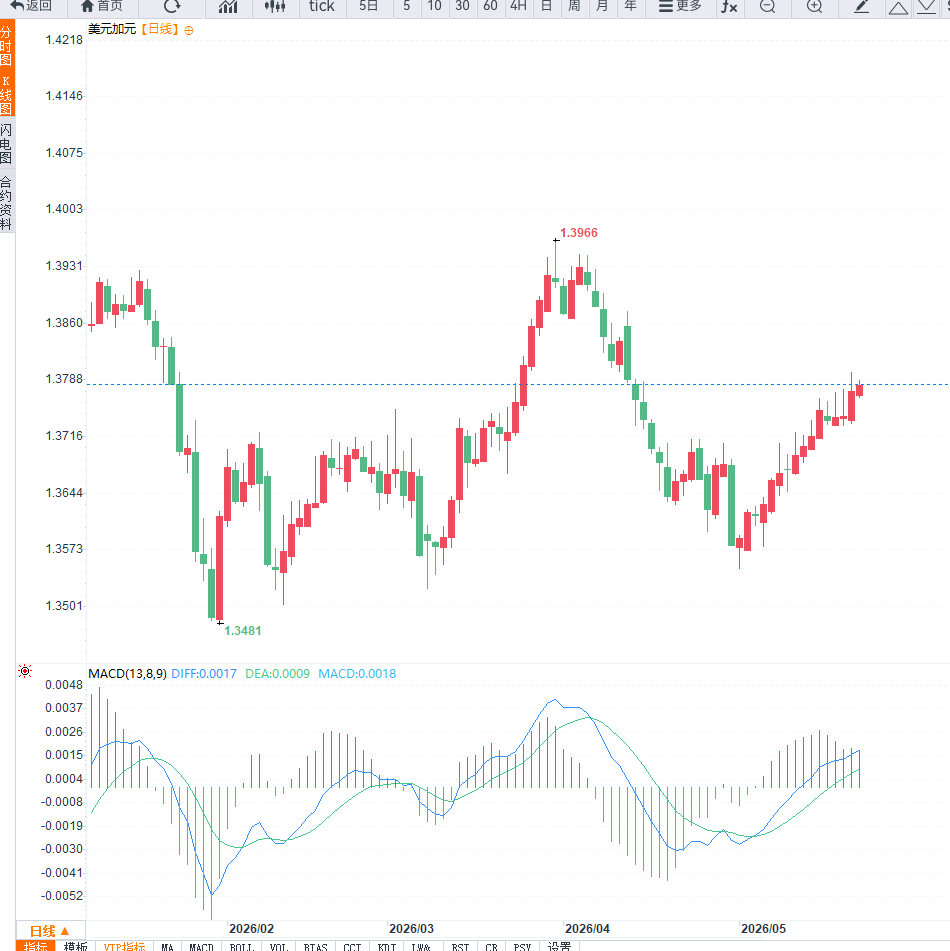
From a technical perspective, the USD/CAD pair has formed a clear rebound trend on the daily chart. The exchange rate has held above major moving averages for several consecutive trading days, indicating a gradually strengthening medium-term bullish structure. The daily MACD indicator has formed a golden cross again, with the red bars continuing to expand, while the RSI indicator has risen to near the overbought zone, suggesting increasing buying momentum. The initial resistance level is currently around 1.3820; a break above this area could lead to a further test of the 1.3900 psychological level. Key support levels are located at 1.3720 and 1.3650.
The 4-hour chart shows that the USD/CAD pair maintains a stable upward channel structure in the short term, with the moving average system showing a bullish alignment. Although the short-term RSI indicator is approaching overbought territory, suggesting a potential technical correction, as long as oil prices remain under pressure and the Federal Reserve maintains a hawkish stance, the USD/CAD pair is still biased towards an overall upward trend. If subsequent US economic data continues to be strong, further gains in the exchange rate cannot be ruled out.
Editor's Summary : The current rise in the USD/CAD exchange rate essentially reflects the combined effect of a strong US dollar and falling oil prices. On the one hand, renewed expectations of a Fed rate hike and resilient US economic data are driving the dollar higher overall. On the other hand, easing market supply concerns following US-Iran negotiations and a pullback in international oil prices have weakened support for the Canadian dollar. The market focus will remain on the Middle East situation, the Fed's policy direction, and changes in the international energy market. If international oil prices continue to fall while the US maintains a high-interest-rate environment, the USD/CAD exchange rate could see further upside potential. However, as the risks in the Strait of Hormuz have not been completely eliminated, the oil market could still experience significant volatility, meaning the future trajectory of the Canadian dollar remains highly uncertain.
As one of the world's major crude oil exporters, Canada's economy is highly intertwined with the international energy market. Since Canada is the largest exporter of crude oil to the United States, international oil price movements often directly impact the Canadian dollar. The recent continuous decline in WTI crude oil prices has put significant pressure on the Canadian dollar.
In the international crude oil market, rising optimism regarding a potential agreement between the US and Iran has eased concerns about global supply shortages. US Secretary of State Marco Rubio stated that there are positive signs in negotiations between the US and Iran, and that Pakistan may also be involved in the coordination process. This has led the market to reassess supply risks in the Middle East.
While Iran emphasized that no formal agreement had been reached, it also acknowledged that differences were narrowing. However, control of the Strait of Hormuz and the issue of uranium enrichment remained key obstacles in the negotiations. The Strait of Hormuz handles approximately 20% of global seaborne crude oil transport , so any changes in the situation would have a significant impact on international energy prices.
Market participants believe that as market risk sentiment gradually cools, the risk premium for crude oil, previously driven by geopolitical risks, is declining. This has led to a continuous drop in WTI crude oil prices and weakened the support for the Canadian dollar as a commodity currency.
Meanwhile, the economic and policy environment in the United States continues to favor the dollar. The market is now repricing the risk that the Federal Reserve may continue to raise interest rates. Due to the situation in the Middle East keeping energy prices high, there is a risk of a resurgence in core inflationary pressures in the United States, and support within the Federal Reserve for maintaining high interest rates in the long term has clearly strengthened.
Federal Reserve officials have recently adopted a cautiously hawkish stance. While the market initially expected the Fed to gradually cut interest rates in the future, more and more officials are downplaying these expectations and emphasizing that further rate hikes are possible if inflation continues to exceed the target level.
Aside from policy factors, US economic data remains stable. Data released by the US Department of Labor shows that initial jobless claims fell by 3,000 to 209,000 in the second week of May, indicating that the US job market remains resilient. Although continuing jobless claims rose slightly, the overall labor market remains stable, further strengthening market confidence in a soft landing for the US economy.
A robust job market coupled with high inflation risks is reinforcing market expectations that the Federal Reserve will maintain high interest rates for an extended period . As a result, US Treasury yields have remained high recently, and the US dollar index has generally been strong.
In addition, the market is also paying close attention to the leadership changes at the Federal Reserve. US President Trump announced that he will formally appoint Kevin Warsh as the new Federal Reserve Chairman on Friday, succeeding Jerome Powell whose term is ending. The market generally believes that Kevin Warsh's overall policy stance leans hawkish, which further strengthens market expectations for future monetary policy tightening.
From a market sentiment perspective, funds are clearly flowing back into US dollar assets. Global economic uncertainty, the situation in the Middle East, and the advantage of high yields continue to enhance the attractiveness of the US dollar. In contrast, commodity currencies are generally under pressure, especially the Canadian dollar, which is highly correlated with oil prices, and has performed relatively weakly.
From a technical perspective, the USD/CAD pair has formed a clear rebound trend on the daily chart. The exchange rate has held above major moving averages for several consecutive trading days, indicating a gradually strengthening medium-term bullish structure. The daily MACD indicator has formed a golden cross again, with the red bars continuing to expand, while the RSI indicator has risen to near the overbought zone, suggesting increasing buying momentum. The initial resistance level is currently around 1.3820; a break above this area could lead to a further test of the 1.3900 psychological level. Key support levels are located at 1.3720 and 1.3650.
The 4-hour chart shows that the USD/CAD pair maintains a stable upward channel structure in the short term, with the moving average system showing a bullish alignment. Although the short-term RSI indicator is approaching overbought territory, suggesting a potential technical correction, as long as oil prices remain under pressure and the Federal Reserve maintains a hawkish stance, the USD/CAD pair is still biased towards an overall upward trend. If subsequent US economic data continues to be strong, further gains in the exchange rate cannot be ruled out.
Editor's Summary : The current rise in the USD/CAD exchange rate essentially reflects the combined effect of a strong US dollar and falling oil prices. On the one hand, renewed expectations of a Fed rate hike and resilient US economic data are driving the dollar higher overall. On the other hand, easing market supply concerns following US-Iran negotiations and a pullback in international oil prices have weakened support for the Canadian dollar. The market focus will remain on the Middle East situation, the Fed's policy direction, and changes in the international energy market. If international oil prices continue to fall while the US maintains a high-interest-rate environment, the USD/CAD exchange rate could see further upside potential. However, as the risks in the Strait of Hormuz have not been completely eliminated, the oil market could still experience significant volatility, meaning the future trajectory of the Canadian dollar remains highly uncertain.
- Risk Warning and Disclaimer
- The market involves risk, and trading may not be suitable for all investors. This article is for reference only and does not constitute personal investment advice, nor does it take into account certain users’ specific investment objectives, financial situation, or other needs. Any investment decisions made based on this information are at your own risk.