Internal divisions within the Bank of England + Starmer's leadership crisis: a double whammy for the pound.
2026-05-22 12:26:29
On Friday (May 22) during the Asian session, the British pound traded within a narrow range against the US dollar, but is still on track for a modest weekly gain. The pair is currently trading around 1.3425, essentially unchanged for the day, and remains capped by the 100-day moving average.
Divergent signals from the Bank of England's policy outlook, political uncertainty in the UK, and geopolitical risks have collectively limited the scope for exchange rate volatility.
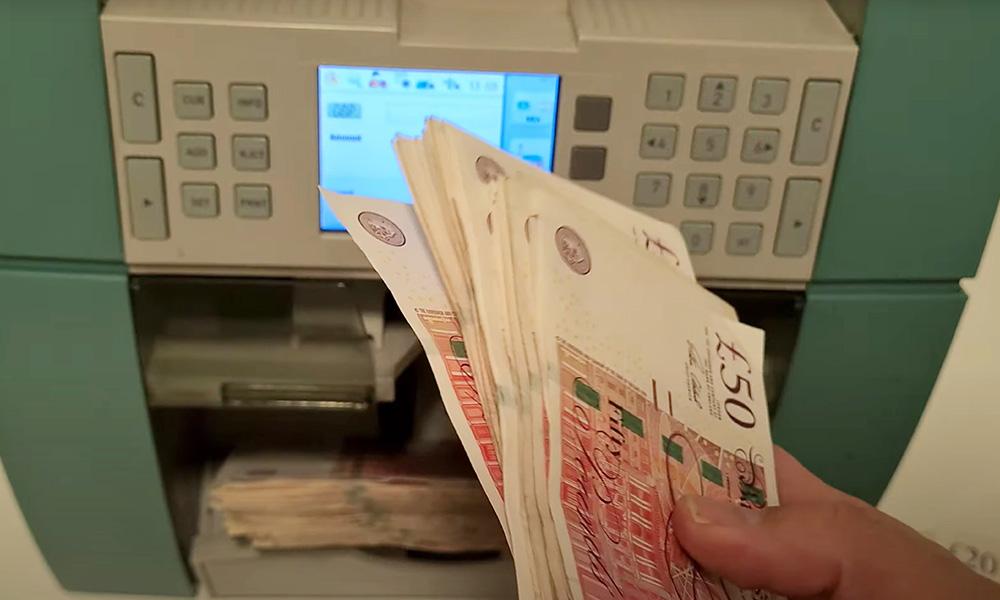
The pound has struggled to attract meaningful buying, primarily due to mixed signals regarding the Bank of England's policy outlook. Swati Dingra, a member of the External Monetary Policy Committee, stated that if "Scenario B" materializes—where rising energy prices produce only a mild second-round effect—the Bank of England may not need to raise interest rates.
In contrast, another outside member, Catherine Mann, warned that high inflation at the end of 2026 could be entrenched in the 2027 wage agreement. Meanwhile, Bank of England Governor Andrew Bailey said on Wednesday that the rise in market interest rates since the US-Iran conflict has given the central bank more time to assess the economic impact of the conflict. Nevertheless, the market is still pricing in the possibility of at least one more rate hike by the Bank of England in 2026.
Analysts point out that the Bank of England is currently in a "data-dependent" mode, and any discussion about raising interest rates will be a "high hurdle," requiring sustained evidence of inflation and wage growth data.
British Prime Minister Keir Starmer's leadership challenges have kept pound bulls cautious. In the May 7 local elections, the Labour Party suffered a historic defeat, losing over 1,400 seats, while the far-right Reform Party won over 1,400 seats.
Following the crushing election defeat, over 86 Labour MPs have publicly called for Starmer's resignation, exceeding the 81-person threshold required for the party's challenge process. Andy Burnham, the Mayor of Greater Manchester and considered the biggest potential challenger, has cleared the hurdle to returning to Parliament. Market forecasts indicate that Burnham's probability of becoming Prime Minister this year has risen to 42%, while Starmer's chances of remaining in power until the end of the year have fallen to 27%. This political uncertainty has directly dampened the pound's appeal.
Meanwhile, bullish sentiment towards the US dollar is putting upward pressure on the pound against the dollar. The minutes of the Fed's April meeting showed that most officials believed further tightening of policy "may become appropriate" if inflation persists above 2%. The market has priced in a Fed rate hike before the end of the year, rising to about 60%, and the dollar index is holding steady near a six-week high. Resilient US economic data (declining initial jobless claims and manufacturing activity rising to a four-year high) coupled with safe-haven demand from the Middle East are providing support for the dollar. The short-term outlook for the pound against the dollar is bearish; whether the 1.3400 level can hold depends on developments in the UK political situation and subsequent policy signals from the Fed.
Despite some positive news, investors remain skeptical of a US-Iran peace agreement, with significant differences persisting between the two sides over Iran's nuclear program and control of the Strait of Hormuz. Iran's Supreme Leader Ayatollah Khamenei has made it clear that uranium enrichment and Iran's control of strategic waterways remain the main sticking points in negotiations. This geopolitical risk, coupled with hawkish expectations from the Federal Reserve, has provided support for the US dollar.
The minutes of the Federal Reserve's April 28-29 meeting showed that most policymakers believed further tightening might be appropriate if inflation remained persistently above the 2% target. Traders reacted quickly, and the market is currently pricing in a roughly 60% probability of a Fed rate hike before the end of the year. This has helped the dollar maintain its recent gains, with the dollar index hovering near a six-week high. Pound bulls should remain vigilant.
In summary, the pound sterling is currently caught in a tug-of-war between multiple factors: internal disagreements within the Bank of England regarding the path of interest rate hikes are weighing on the pound's sentiment; while expectations of a Fed rate hike and geopolitical risks are providing support for the dollar.
The exchange rate is likely to fluctuate within the 1.3400-1.3450 range in the short term, and the direction of the breakout will depend on the evolution of the UK political situation, the progress of the US-Iran negotiations, and the subsequent policy signals from the Bank of England and the Bank of America.
From the daily chart, the British pound is currently trading around 1.3425 against the US dollar, in a weak consolidation phase at recent lows, with multiple technical indicators showing neutral to weak signals.
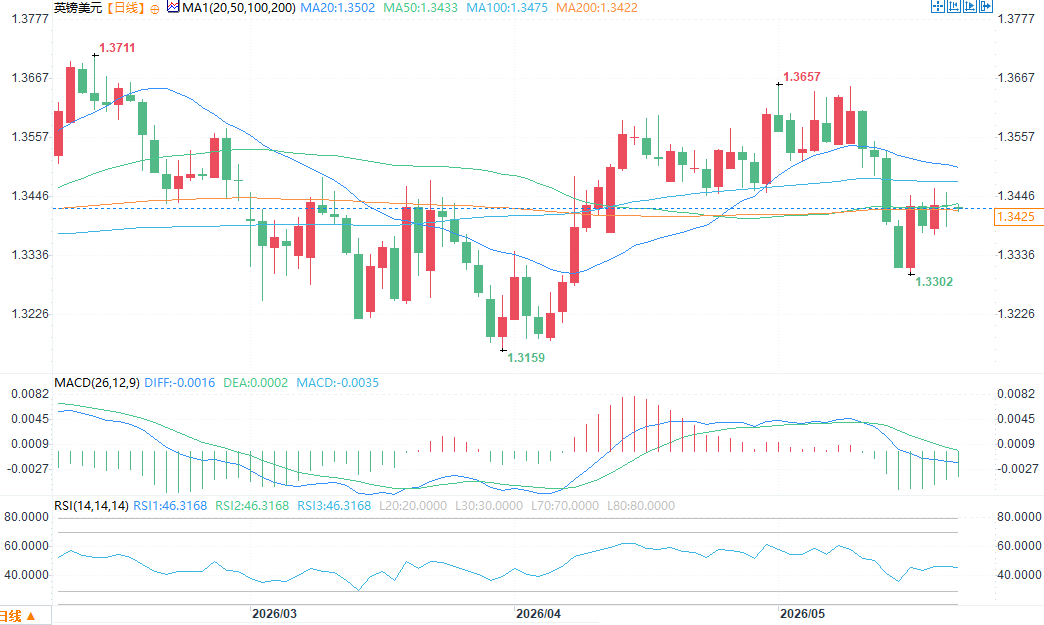
(GBP/USD daily chart, source: FX678)
Regarding the moving average system, the short-term moving average MA20 (1.3502) is above the current price, forming short-term resistance; MA50 (1.3433) is roughly the same as the current price, forming the focus of the short-term battle between bulls and bears; MA100 (1.3475) is also above the current price, forming additional resistance; while MA200 (1.3422) almost coincides with the current price, serving as an important support level in the near term. This arrangement of "price under pressure from multiple moving averages, but closely following MA200" indicates that GBP/USD is at a critical point of short-term correction—if it holds above MA200, it is expected to stabilize; if it falls below, it may weaken further.
At 12:26 Beijing time on May 22, the British pound was trading at 1.3428/29 against the US dollar.
Divergent signals from the Bank of England's policy outlook, political uncertainty in the UK, and geopolitical risks have collectively limited the scope for exchange rate volatility.
Internal divisions within the Bank of England: Whether or not to raise interest rates remains uncertain.
The pound has struggled to attract meaningful buying, primarily due to mixed signals regarding the Bank of England's policy outlook. Swati Dingra, a member of the External Monetary Policy Committee, stated that if "Scenario B" materializes—where rising energy prices produce only a mild second-round effect—the Bank of England may not need to raise interest rates.
In contrast, another outside member, Catherine Mann, warned that high inflation at the end of 2026 could be entrenched in the 2027 wage agreement. Meanwhile, Bank of England Governor Andrew Bailey said on Wednesday that the rise in market interest rates since the US-Iran conflict has given the central bank more time to assess the economic impact of the conflict. Nevertheless, the market is still pricing in the possibility of at least one more rate hike by the Bank of England in 2026.
Analysts point out that the Bank of England is currently in a "data-dependent" mode, and any discussion about raising interest rates will be a "high hurdle," requiring sustained evidence of inflation and wage growth data.
Political uncertainty weighs on the pound, while the dollar continues its strong performance.
British Prime Minister Keir Starmer's leadership challenges have kept pound bulls cautious. In the May 7 local elections, the Labour Party suffered a historic defeat, losing over 1,400 seats, while the far-right Reform Party won over 1,400 seats.
Following the crushing election defeat, over 86 Labour MPs have publicly called for Starmer's resignation, exceeding the 81-person threshold required for the party's challenge process. Andy Burnham, the Mayor of Greater Manchester and considered the biggest potential challenger, has cleared the hurdle to returning to Parliament. Market forecasts indicate that Burnham's probability of becoming Prime Minister this year has risen to 42%, while Starmer's chances of remaining in power until the end of the year have fallen to 27%. This political uncertainty has directly dampened the pound's appeal.
Meanwhile, bullish sentiment towards the US dollar is putting upward pressure on the pound against the dollar. The minutes of the Fed's April meeting showed that most officials believed further tightening of policy "may become appropriate" if inflation persists above 2%. The market has priced in a Fed rate hike before the end of the year, rising to about 60%, and the dollar index is holding steady near a six-week high. Resilient US economic data (declining initial jobless claims and manufacturing activity rising to a four-year high) coupled with safe-haven demand from the Middle East are providing support for the dollar. The short-term outlook for the pound against the dollar is bearish; whether the 1.3400 level can hold depends on developments in the UK political situation and subsequent policy signals from the Fed.
The stalemate in US-Iran nuclear talks and hawkish expectations from the Federal Reserve are supporting the US dollar.
Despite some positive news, investors remain skeptical of a US-Iran peace agreement, with significant differences persisting between the two sides over Iran's nuclear program and control of the Strait of Hormuz. Iran's Supreme Leader Ayatollah Khamenei has made it clear that uranium enrichment and Iran's control of strategic waterways remain the main sticking points in negotiations. This geopolitical risk, coupled with hawkish expectations from the Federal Reserve, has provided support for the US dollar.
The minutes of the Federal Reserve's April 28-29 meeting showed that most policymakers believed further tightening might be appropriate if inflation remained persistently above the 2% target. Traders reacted quickly, and the market is currently pricing in a roughly 60% probability of a Fed rate hike before the end of the year. This has helped the dollar maintain its recent gains, with the dollar index hovering near a six-week high. Pound bulls should remain vigilant.
Multiple factors combined suggest that the pound is likely to remain under pressure in the short term.
In summary, the pound sterling is currently caught in a tug-of-war between multiple factors: internal disagreements within the Bank of England regarding the path of interest rate hikes are weighing on the pound's sentiment; while expectations of a Fed rate hike and geopolitical risks are providing support for the dollar.
The exchange rate is likely to fluctuate within the 1.3400-1.3450 range in the short term, and the direction of the breakout will depend on the evolution of the UK political situation, the progress of the US-Iran negotiations, and the subsequent policy signals from the Bank of England and the Bank of America.
GBP/USD Daily Technical Analysis
From the daily chart, the British pound is currently trading around 1.3425 against the US dollar, in a weak consolidation phase at recent lows, with multiple technical indicators showing neutral to weak signals.
(GBP/USD daily chart, source: FX678)
Regarding the moving average system, the short-term moving average MA20 (1.3502) is above the current price, forming short-term resistance; MA50 (1.3433) is roughly the same as the current price, forming the focus of the short-term battle between bulls and bears; MA100 (1.3475) is also above the current price, forming additional resistance; while MA200 (1.3422) almost coincides with the current price, serving as an important support level in the near term. This arrangement of "price under pressure from multiple moving averages, but closely following MA200" indicates that GBP/USD is at a critical point of short-term correction—if it holds above MA200, it is expected to stabilize; if it falls below, it may weaken further.
At 12:26 Beijing time on May 22, the British pound was trading at 1.3428/29 against the US dollar.
- Risk Warning and Disclaimer
- The market involves risk, and trading may not be suitable for all investors. This article is for reference only and does not constitute personal investment advice, nor does it take into account certain users’ specific investment objectives, financial situation, or other needs. Any investment decisions made based on this information are at your own risk.