Crude Oil Analysis: Is the $110 high now history? Market signals suggest a potential period of narrow-range consolidation.
2026-05-22 21:33:36
On Friday, May 22, the crude oil market continued to be priced around the US-Iran negotiations, restrictions on passage through the Strait of Hormuz, and the rate of inventory depletion. Latest market data shows Brent crude fluctuating around $103 per barrel, while WTI crude is trading around $96 per barrel; fluctuating expectations for a breakthrough in the negotiations are putting downward pressure on crude oil prices. Meanwhile, Fatih Birol, head of the International Energy Agency, recently stated that commercial inventories are being depleted rapidly, and there is preparedness to further utilize reserves if necessary, but reserves are not unlimited.

Current oil prices are not solely driven by peak consumption season, but rather by supply chain risks. The Strait of Hormuz is a crucial node for global crude oil and refined product transportation; with passage restricted, the market needs to reassess effective supply, transportation cycles, and inventory safety margins. Recent US-Iran negotiations have released some signs of easing tensions, but key differences remain, including nuclear material stockpiles, passage arrangements through the strait, and related toll disputes. These issues are not variables that can be priced in with short-term verbal statements; therefore, oil prices exhibit typical news-driven, wide-ranging fluctuations.
From a trading structure perspective, crude oil bulls haven't completely exited, but the pricing method for risk premiums has changed. Previously, the market focused more on the supply disruption itself; now, it's more concerned about the duration of the disruption. If the recovery is only temporary and limited, the spot premium and the forward discount structure may remain strong; if the recovery is faster than expected, the geopolitical premium previously priced in will be compressed. This is why oil prices are highly sensitive to every piece of diplomatic news, but a single piece of news is unlikely to change the medium-term supply and demand constraints.
In this market rally, inventory variables have become significantly more important than traditional macroeconomic data. Recent calculations by market institutions show that global crude oil and refined product inventories are declining at an unusually rapid pace, with some estimates suggesting that inventory depletion reached around 8.7 million barrels per day in May. This reflects the combined effect of disrupted transportation and insufficient alternative routes squeezing available supply. Even if transportation routes gradually reopen, inventory rebuilding will take time, thus limiting the downside potential for oil prices.
The impact of low inventory levels extends beyond absolute prices, altering the term structure. Traders are currently focusing more on deliverable resources in near-month contracts rather than solely on forward demand expectations. If commercial inventories continue to decline, refinery procurement will rely more heavily on the spot market, making it easier to maintain spot premiums. While larger-scale releases of strategic reserves will temporarily alleviate near-term pressures, they cannot completely replace normal trade flows. Fatih Birol noted that reserve releases have already had a supplementary effect on the market, while emphasizing that reserves are not an unlimited resource. This means that policy buffers can reduce peak risks but cannot eliminate supply chain risk pricing.
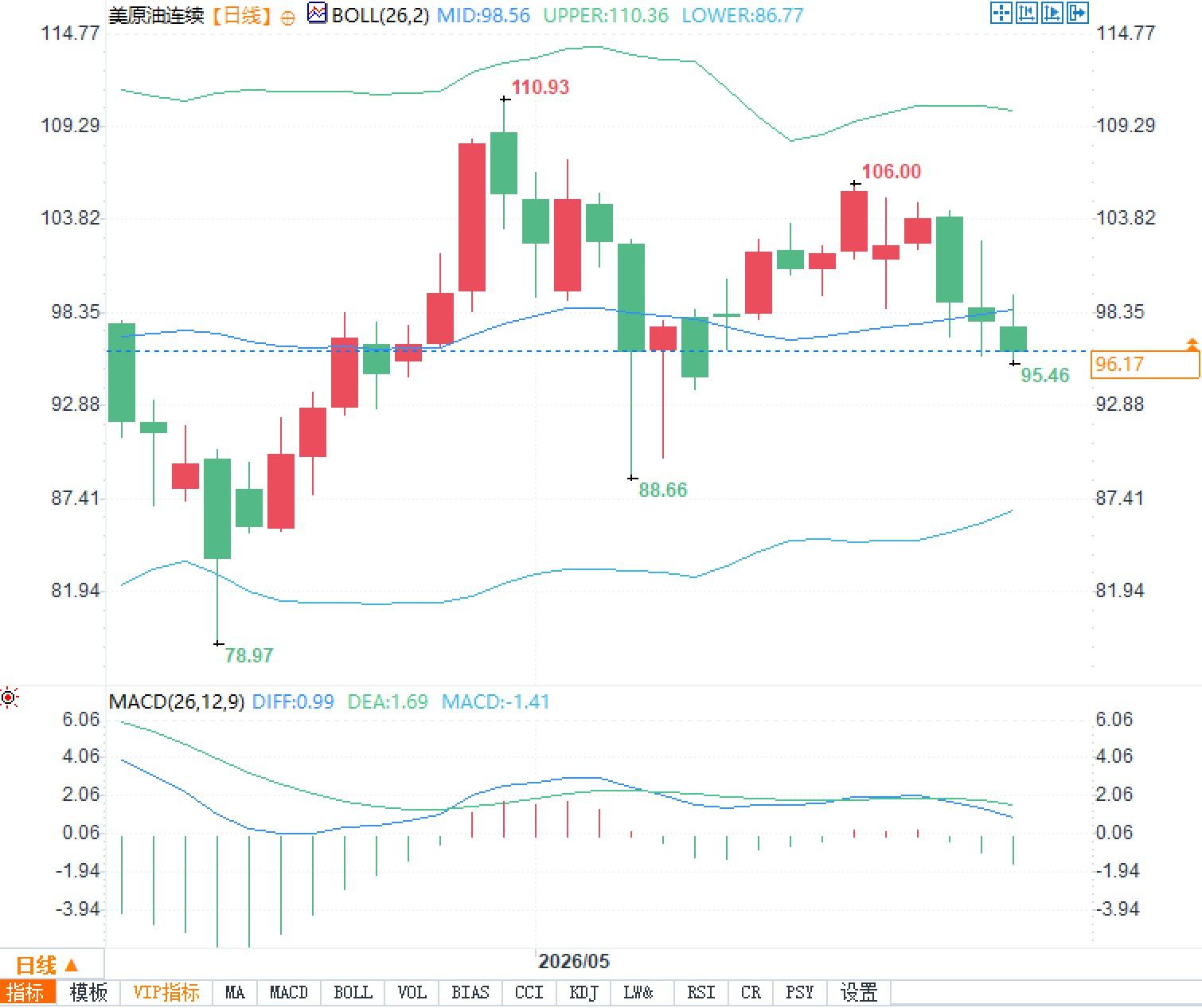
Looking at the daily chart for WTI crude oil, the current price is fluctuating around the middle Bollinger Band. The middle Bollinger Band is around $98.56, the upper band around $110.36, and the lower band around $86.77. The latest price is around $96, close to the lower edge of the daily consolidation range. The price previously rose to $110.93 before falling back, subsequently forming a secondary high near $106.00, indicating that selling pressure above has not been fully released. Recent lows are concentrated around $95.46. If this area continues to be tested repeatedly, the market will pay more attention to the potential for increased volatility if the middle Bollinger Band is breached.
From a MACD perspective, the fast and slow lines in the chart are still in positive territory, but the histogram is weakening, indicating that the previous upward momentum has cooled. More importantly, the upper Bollinger Band remains high, and the price has failed to follow suit, suggesting that the market is not in a one-sided trend but has entered a phase of "news shock, price regression, and central pricing." For traders, the most important thing to watch right now is not the daily price fluctuations, but whether the price can regain the $98 to $100 range and maintain stable trading volume. If there is insufficient support in this range, the market will continue to fluctuate between tight inventory levels and easing negotiations.
The first layer of negotiation involves diplomatic expectations. Pakistani Field Marshal Asim Munir's reported trip to Tehran is considered a key figure in the communication chain. Iran has stated that its latest proposal has partially narrowed the differences, but the top leadership's stance on the retention of nuclear materials and the dispute over Strait tolls leave the prospect of a breakthrough uncertain. For the oil market, the negotiations are not simply a matter of being bullish or bearish, but rather a variable affecting the risk premium discount rate.
The second layer of competition involves supply adjustments by oil producers. While some oil-producing countries have discussed increasing production, nominal output does not equate to deliverable supply given logistical constraints. If transportation bottlenecks persist, increased production may soothe long-term expectations but may not be effective for short-term spot prices. The third layer of competition concerns consumer affordability. High oil prices will gradually suppress some industrial and transportation demand, but this suppression has a lag. In the short term, refinery operating rates, shipping costs, and refined product crack spreads will continue to amplify crude oil price volatility.
Therefore, the current reasonable framework for oil prices is not simply judging "up or down," but rather assessing the combination of risk premium, inventory safety cushion, and the probability of channel recovery. As long as inventory depletion remains rapid and channel traffic has not returned to stable levels, oil prices are unlikely to fully return to a low-volatility state. If negotiations release substantial implementation details, the market will quickly compress some premiums, but the lag in inventory repair will limit the extent of the decline.
I. The core issue in oil prices has shifted from demand to channel risk.
Current oil prices are not solely driven by peak consumption season, but rather by supply chain risks. The Strait of Hormuz is a crucial node for global crude oil and refined product transportation; with passage restricted, the market needs to reassess effective supply, transportation cycles, and inventory safety margins. Recent US-Iran negotiations have released some signs of easing tensions, but key differences remain, including nuclear material stockpiles, passage arrangements through the strait, and related toll disputes. These issues are not variables that can be priced in with short-term verbal statements; therefore, oil prices exhibit typical news-driven, wide-ranging fluctuations.
From a trading structure perspective, crude oil bulls haven't completely exited, but the pricing method for risk premiums has changed. Previously, the market focused more on the supply disruption itself; now, it's more concerned about the duration of the disruption. If the recovery is only temporary and limited, the spot premium and the forward discount structure may remain strong; if the recovery is faster than expected, the geopolitical premium previously priced in will be compressed. This is why oil prices are highly sensitive to every piece of diplomatic news, but a single piece of news is unlikely to change the medium-term supply and demand constraints.
II. The rate of inventory depletion determines the downside potential of oil prices.
In this market rally, inventory variables have become significantly more important than traditional macroeconomic data. Recent calculations by market institutions show that global crude oil and refined product inventories are declining at an unusually rapid pace, with some estimates suggesting that inventory depletion reached around 8.7 million barrels per day in May. This reflects the combined effect of disrupted transportation and insufficient alternative routes squeezing available supply. Even if transportation routes gradually reopen, inventory rebuilding will take time, thus limiting the downside potential for oil prices.
The impact of low inventory levels extends beyond absolute prices, altering the term structure. Traders are currently focusing more on deliverable resources in near-month contracts rather than solely on forward demand expectations. If commercial inventories continue to decline, refinery procurement will rely more heavily on the spot market, making it easier to maintain spot premiums. While larger-scale releases of strategic reserves will temporarily alleviate near-term pressures, they cannot completely replace normal trade flows. Fatih Birol noted that reserve releases have already had a supplementary effect on the market, while emphasizing that reserves are not an unlimited resource. This means that policy buffers can reduce peak risks but cannot eliminate supply chain risk pricing.
III. Technical analysis indicates a struggle for control of the central area after high volatility.
Looking at the daily chart for WTI crude oil, the current price is fluctuating around the middle Bollinger Band. The middle Bollinger Band is around $98.56, the upper band around $110.36, and the lower band around $86.77. The latest price is around $96, close to the lower edge of the daily consolidation range. The price previously rose to $110.93 before falling back, subsequently forming a secondary high near $106.00, indicating that selling pressure above has not been fully released. Recent lows are concentrated around $95.46. If this area continues to be tested repeatedly, the market will pay more attention to the potential for increased volatility if the middle Bollinger Band is breached.
From a MACD perspective, the fast and slow lines in the chart are still in positive territory, but the histogram is weakening, indicating that the previous upward momentum has cooled. More importantly, the upper Bollinger Band remains high, and the price has failed to follow suit, suggesting that the market is not in a one-sided trend but has entered a phase of "news shock, price regression, and central pricing." For traders, the most important thing to watch right now is not the daily price fluctuations, but whether the price can regain the $98 to $100 range and maintain stable trading volume. If there is insufficient support in this range, the market will continue to fluctuate between tight inventory levels and easing negotiations.
IV. Fundamental pricing enters a triple game
The first layer of negotiation involves diplomatic expectations. Pakistani Field Marshal Asim Munir's reported trip to Tehran is considered a key figure in the communication chain. Iran has stated that its latest proposal has partially narrowed the differences, but the top leadership's stance on the retention of nuclear materials and the dispute over Strait tolls leave the prospect of a breakthrough uncertain. For the oil market, the negotiations are not simply a matter of being bullish or bearish, but rather a variable affecting the risk premium discount rate.
The second layer of competition involves supply adjustments by oil producers. While some oil-producing countries have discussed increasing production, nominal output does not equate to deliverable supply given logistical constraints. If transportation bottlenecks persist, increased production may soothe long-term expectations but may not be effective for short-term spot prices. The third layer of competition concerns consumer affordability. High oil prices will gradually suppress some industrial and transportation demand, but this suppression has a lag. In the short term, refinery operating rates, shipping costs, and refined product crack spreads will continue to amplify crude oil price volatility.
Therefore, the current reasonable framework for oil prices is not simply judging "up or down," but rather assessing the combination of risk premium, inventory safety cushion, and the probability of channel recovery. As long as inventory depletion remains rapid and channel traffic has not returned to stable levels, oil prices are unlikely to fully return to a low-volatility state. If negotiations release substantial implementation details, the market will quickly compress some premiums, but the lag in inventory repair will limit the extent of the decline.
- Risk Warning and Disclaimer
- The market involves risk, and trading may not be suitable for all investors. This article is for reference only and does not constitute personal investment advice, nor does it take into account certain users’ specific investment objectives, financial situation, or other needs. Any investment decisions made based on this information are at your own risk.