Kyiv experiences its "most terrifying night"! Russian bombardment spurs safe-haven demand; how far can the gold price rebound go?
2026-05-25 12:18:32
Last Sunday, Russia launched a nighttime airstrike lasting several hours on Kyiv and surrounding areas, firing hundreds of drones and missiles in one of the heaviest bombing raids on the city since the start of the war four years ago. The Russian military also fired a Hazel hypersonic missile near Kyiv, marking its third use of this type of missile in the conflict. According to Ukrainian officials, the attack killed four people, injured more than 80, and damaged dozens of residential buildings and several schools.

“This is a terrible night for Kyiv,” Kyiv Mayor Vitaly Klitschko said in a statement released at the scene of the attack. “Rescue workers are fighting fires and clearing rubble, and medical personnel are providing assistance to the wounded.” The Ukrainian Air Force stated that Russian forces launched a total of 90 missiles and 600 drones. Ukrainian President Zelenskyy stated, “This cannot go unpunished for Russia. Decisions need to be made—decisions from the United States, Europe, and other countries.” He also indicated that Russia targeted water supply facilities, intending to sabotage them before the increased demand in the summer.
The Hazel missile has a range of thousands of kilometers and is capable of carrying a nuclear warhead. The previous two strikes targeted major cities, while this attack targeted Beltzerkovi, a city of 200,000 people, located about 40 miles from the outskirts of Kyiv.
Russia stated that the use of Hazel, Iskander, Kinzhal, and Zircon missiles was in retaliation for Ukraine's strikes against Russian civilian targets. Ukraine maintains that it did not target civilians. The Russian Ministry of Defense stated that the strikes targeted Ukrainian military command facilities, including sites used by the army and military intelligence, air force bases, and defense industrial enterprises.
Just after 1 a.m., explosions were heard in Kyiv. Windows of the Ukrainian Ministry of Foreign Affairs building were shattered, and Kyiv's historic Independence Square suffered some damage.
Klitschko stated that at least two people were dead and 69 others injured in the capital. Many residents sought refuge in metro stations overnight. Natalia Zvalich, 62, said she rushed to a local metro station when the explosions began shaking the city. “It’s terrible, so terrifying,” she said. “We’ve been sitting here for over three hours, listening to the explosions above.” Attacks were also reported in other parts of Ukraine. Kyiv Regional Governor Mykola Kalashnikov stated that attacks in the Kyiv region resulted in two deaths and nine injuries. Ukrainian Prime Minister Yulia Sviridenko said that in the central Ukrainian city of Cherkasy, a drone crashed into an apartment building, injuring 11 people.
Last Sunday, as the sun rose over Kyiv, black smoke from several fires drifted across the skyline, and a pungent odor permeated parts of the city. Firefighters used hoses to extinguish flames in damaged buildings, and rescue workers evacuated the injured. Images showed the front facade of a five-story residential building had collapsed.
Officials reported that offices, shops, warehouses, and the entrance hall of a subway station were also damaged.
Zelensky warned on Saturday that Russia was preparing to launch an attack using Hazel missiles, based on intelligence from Ukraine, the United States, and Europe.
Russian President Vladimir Putin had previously stated that the missile travels at speeds exceeding Mach 10, making it impossible to intercept.
The sudden escalation of the Russia-Ukraine conflict provided additional safe-haven buying for gold. Spot gold rose about 1.25% in Asian trading on Monday (May 25), reaching a high of $4,579.79 per ounce during the session.
Analysts point out that Russia's use of its nuclear-capable Hazel missiles is interpreted as carrying the implication of "political intimidation and nuclear brinkmanship," which has amplified risk aversion in the market.
EU foreign policy chief Callas condemned the move as a "reckless nuclear brinkmanship," and French President Macron said the attack marked "a dead end in Russia's war of aggression."
In summary, Russia launched its largest airstrikes since the start of the war on Kyiv and surrounding areas last Sunday. The attacks severely damaged civilian infrastructure, including the Ministry of Foreign Affairs building, Independence Square, and numerous residential buildings, triggering increased risk aversion in the market. Spot gold rose more than 1% in Asian trading on Monday in response.
Analysts point out that Russia's military action has further strengthened the safe-haven demand for gold. Current geopolitical risks and progress in US-Iran negotiations are offsetting each other, providing short-term support for gold prices from multiple factors.
From the daily chart, spot gold is currently trading around $4,560, in a weak consolidation phase after a recent pullback from its highs, with multiple technical indicators showing bearish signals.
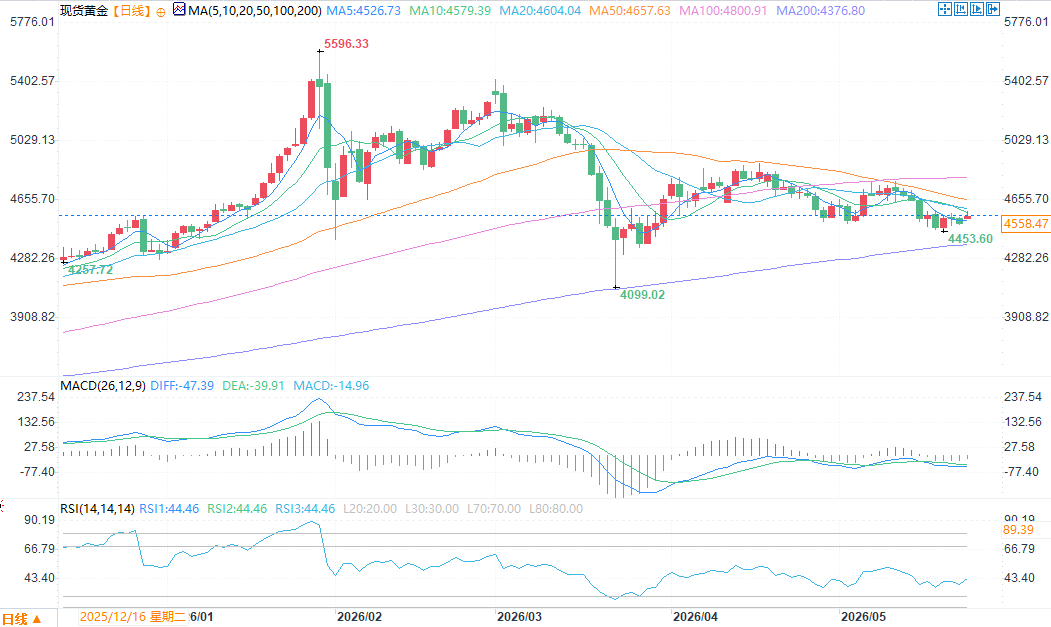
(Spot gold daily chart, source: FX678)
Regarding the moving average system, the short-term moving averages MA20 (4604.04) and MA50 (4657.63) are above the current price, forming resistance; MA100 (4800.91) is significantly higher than the current price, indicating substantial medium-term pressure; MA200 (4376.80) is below the current price, forming long-term support. This arrangement of "price under pressure from multiple short-term moving averages, but still above MA200" suggests that gold is in a short-term correction phase, but the long-term upward trend has not been completely broken.
At 12:18 Beijing time on May 25, spot gold was trading at $4,461.52 per ounce.
Scale of the attack and casualties
“This is a terrible night for Kyiv,” Kyiv Mayor Vitaly Klitschko said in a statement released at the scene of the attack. “Rescue workers are fighting fires and clearing rubble, and medical personnel are providing assistance to the wounded.” The Ukrainian Air Force stated that Russian forces launched a total of 90 missiles and 600 drones. Ukrainian President Zelenskyy stated, “This cannot go unpunished for Russia. Decisions need to be made—decisions from the United States, Europe, and other countries.” He also indicated that Russia targeted water supply facilities, intending to sabotage them before the increased demand in the summer.
The missile used by Russia: The nuclear-capable Hazel missile was deployed for the third time.
The Hazel missile has a range of thousands of kilometers and is capable of carrying a nuclear warhead. The previous two strikes targeted major cities, while this attack targeted Beltzerkovi, a city of 200,000 people, located about 40 miles from the outskirts of Kyiv.
Russia stated that the use of Hazel, Iskander, Kinzhal, and Zircon missiles was in retaliation for Ukraine's strikes against Russian civilian targets. Ukraine maintains that it did not target civilians. The Russian Ministry of Defense stated that the strikes targeted Ukrainian military command facilities, including sites used by the army and military intelligence, air force bases, and defense industrial enterprises.
Damage situation in Kyiv city
Just after 1 a.m., explosions were heard in Kyiv. Windows of the Ukrainian Ministry of Foreign Affairs building were shattered, and Kyiv's historic Independence Square suffered some damage.
Klitschko stated that at least two people were dead and 69 others injured in the capital. Many residents sought refuge in metro stations overnight. Natalia Zvalich, 62, said she rushed to a local metro station when the explosions began shaking the city. “It’s terrible, so terrifying,” she said. “We’ve been sitting here for over three hours, listening to the explosions above.” Attacks were also reported in other parts of Ukraine. Kyiv Regional Governor Mykola Kalashnikov stated that attacks in the Kyiv region resulted in two deaths and nine injuries. Ukrainian Prime Minister Yulia Sviridenko said that in the central Ukrainian city of Cherkasy, a drone crashed into an apartment building, injuring 11 people.
Sunday morning: Ruins and rescue
Last Sunday, as the sun rose over Kyiv, black smoke from several fires drifted across the skyline, and a pungent odor permeated parts of the city. Firefighters used hoses to extinguish flames in damaged buildings, and rescue workers evacuated the injured. Images showed the front facade of a five-story residential building had collapsed.
Officials reported that offices, shops, warehouses, and the entrance hall of a subway station were also damaged.
Zelensky warned on Saturday that Russia was preparing to launch an attack using Hazel missiles, based on intelligence from Ukraine, the United States, and Europe.
Russian President Vladimir Putin had previously stated that the missile travels at speeds exceeding Mach 10, making it impossible to intercept.
Impact on gold prices: Safe-haven demand receives support
The sudden escalation of the Russia-Ukraine conflict provided additional safe-haven buying for gold. Spot gold rose about 1.25% in Asian trading on Monday (May 25), reaching a high of $4,579.79 per ounce during the session.
Analysts point out that Russia's use of its nuclear-capable Hazel missiles is interpreted as carrying the implication of "political intimidation and nuclear brinkmanship," which has amplified risk aversion in the market.
EU foreign policy chief Callas condemned the move as a "reckless nuclear brinkmanship," and French President Macron said the attack marked "a dead end in Russia's war of aggression."
Kyiv suffers one of the heaviest airstrikes since the start of the war, as the Russia-Ukraine conflict continues to escalate.
In summary, Russia launched its largest airstrikes since the start of the war on Kyiv and surrounding areas last Sunday. The attacks severely damaged civilian infrastructure, including the Ministry of Foreign Affairs building, Independence Square, and numerous residential buildings, triggering increased risk aversion in the market. Spot gold rose more than 1% in Asian trading on Monday in response.
Analysts point out that Russia's military action has further strengthened the safe-haven demand for gold. Current geopolitical risks and progress in US-Iran negotiations are offsetting each other, providing short-term support for gold prices from multiple factors.
Spot Gold Daily Technical Analysis
From the daily chart, spot gold is currently trading around $4,560, in a weak consolidation phase after a recent pullback from its highs, with multiple technical indicators showing bearish signals.
(Spot gold daily chart, source: FX678)
Regarding the moving average system, the short-term moving averages MA20 (4604.04) and MA50 (4657.63) are above the current price, forming resistance; MA100 (4800.91) is significantly higher than the current price, indicating substantial medium-term pressure; MA200 (4376.80) is below the current price, forming long-term support. This arrangement of "price under pressure from multiple short-term moving averages, but still above MA200" suggests that gold is in a short-term correction phase, but the long-term upward trend has not been completely broken.
At 12:18 Beijing time on May 25, spot gold was trading at $4,461.52 per ounce.
- Risk Warning and Disclaimer
- The market involves risk, and trading may not be suitable for all investors. This article is for reference only and does not constitute personal investment advice, nor does it take into account certain users’ specific investment objectives, financial situation, or other needs. Any investment decisions made based on this information are at your own risk.