Expectations of a European Central Bank rate hike supported the euro's rise, while soaring Japanese inflation failed to reverse the yen's decline, pushing the euro above the 185 yen level.
2026-06-10 16:14:32
The euro/yen pair continued its recent upward trend during Wednesday's European trading session, closing higher for the third consecutive session, reaching around 185.30. The market's current focus is on the divergence in monetary policy paths between the European Central Bank and the Bank of Japan. Expectations of a continued hawkish stance from the European Central Bank and the overall weakness of the yen are jointly driving the euro/yen pair's strength.

Markets widely expect the European Central Bank (ECB) to raise its main interest rates by 25 basis points at its monetary policy meeting this week. ECB officials have previously signaled a hawkish stance, indicating that policymakers remain vigilant about persistent inflation risks. Higher interest rates in Europe have increased the attractiveness of euro-denominated assets and provided additional support for the euro among major currencies.
Martin Wahlberg, senior economist at Generali Investment Management, stated that the European Central Bank (ECB) is highly likely to raise interest rates by 25 basis points at its June meeting, an expectation consistent with recent hawkish policy signals from the central bank. In contrast, while Japan released strong inflation data, it failed to immediately trigger a significant rebound in the yen. Data showed that Japan's May producer price index (PPI) rose sharply to 6.3% year-on-year from a previously revised 5.3%, significantly higher than the market expectation of 5.5%, marking the fastest wholesale price growth in nearly three years. Rising energy costs and increased import prices are key factors driving up costs for Japanese companies.
The rapid rise in producer prices has further strengthened market expectations that the Bank of Japan (BOJ) will adopt a more hawkish stance. The BOJ faces the dual challenge of controlling inflation and stabilizing the exchange rate, as the previous continuous depreciation of the yen exacerbated import cost pressures on energy and raw materials. The market currently widely expects the BOJ to raise interest rates further at its policy meeting next week, while investors are also watching BOJ Governor Kazuo Ueda's speech to determine if a series of rate hikes are possible.
However, judging from the foreign exchange market performance, despite increased inflationary pressures in Japan, the interest rate differential between the euro and the yen remains high in the short term, as the European Central Bank also tends to continue tightening monetary policy. Furthermore, the market remains cautious about the extent of future interest rate hikes by the Bank of Japan, thus the yen has not fully benefited from the strong PPI data.
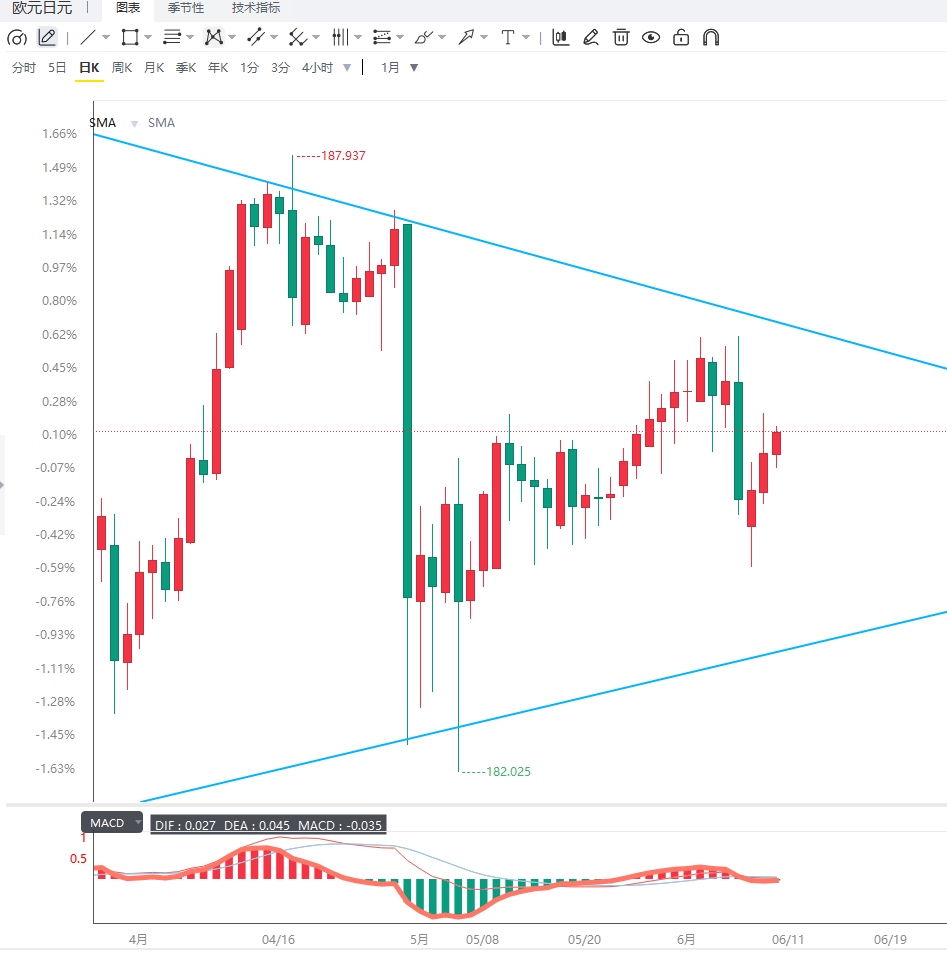
From a technical perspective, the EUR/JPY daily chart shows that the exchange rate has maintained an upward trend for several consecutive trading days and has successfully held above the 185.00 level, indicating that the bulls still control the market. If it further breaks through the resistance near 186.00, it could extend its gains towards the 187.50 or even 189.00 area. On the downside, 184.00 is the first important short-term support level; a break below this level could lead to a further pullback to the 182.80 to 183.00 area. Daily technical indicators remain in the strong zone, suggesting that there are no clear signs of a reversal in the upward trend.
From a 4-hour chart perspective, the EUR/JPY pair maintains a short-term upward trend with the moving average system continuing to diverge upwards, indicating that buyers still hold the upper hand. However, with the continuous rise in the exchange rate, some short-term technical indicators have entered overbought territory, and there is a certain risk of profit-taking in the market. If the Bank of Japan releases a more hawkish signal than the market expects, or if the yen receives support from safe-haven buying, the EUR/JPY pair may experience a period of correction; conversely, if the European Central Bank continues to emphasize its determination to control inflation, the exchange rate may still have the opportunity to maintain its high levels.
Editor's Summary : The recent rise in the euro/yen exchange rate has been primarily driven by expectations of a European Central Bank (ECB) rate hike and the continued weakness of the yen. Although Japan's May PPI rose sharply, strengthening market expectations for further rate hikes by the Bank of Japan (BOJ), the current interest rate differential still favors the euro, limiting the yen's rebound. In the short term, the ECB's interest rate decision, the BOJ's policy signals, and the performance around the 185 level will be key factors influencing the euro/yen's next move. If the ECB maintains a hawkish stance, and the BOJ's rate hikes fall short of market expectations, the euro/yen is likely to maintain a relatively strong trend.
Markets widely expect the European Central Bank (ECB) to raise its main interest rates by 25 basis points at its monetary policy meeting this week. ECB officials have previously signaled a hawkish stance, indicating that policymakers remain vigilant about persistent inflation risks. Higher interest rates in Europe have increased the attractiveness of euro-denominated assets and provided additional support for the euro among major currencies.
Martin Wahlberg, senior economist at Generali Investment Management, stated that the European Central Bank (ECB) is highly likely to raise interest rates by 25 basis points at its June meeting, an expectation consistent with recent hawkish policy signals from the central bank. In contrast, while Japan released strong inflation data, it failed to immediately trigger a significant rebound in the yen. Data showed that Japan's May producer price index (PPI) rose sharply to 6.3% year-on-year from a previously revised 5.3%, significantly higher than the market expectation of 5.5%, marking the fastest wholesale price growth in nearly three years. Rising energy costs and increased import prices are key factors driving up costs for Japanese companies.
The rapid rise in producer prices has further strengthened market expectations that the Bank of Japan (BOJ) will adopt a more hawkish stance. The BOJ faces the dual challenge of controlling inflation and stabilizing the exchange rate, as the previous continuous depreciation of the yen exacerbated import cost pressures on energy and raw materials. The market currently widely expects the BOJ to raise interest rates further at its policy meeting next week, while investors are also watching BOJ Governor Kazuo Ueda's speech to determine if a series of rate hikes are possible.
However, judging from the foreign exchange market performance, despite increased inflationary pressures in Japan, the interest rate differential between the euro and the yen remains high in the short term, as the European Central Bank also tends to continue tightening monetary policy. Furthermore, the market remains cautious about the extent of future interest rate hikes by the Bank of Japan, thus the yen has not fully benefited from the strong PPI data.
From a technical perspective, the EUR/JPY daily chart shows that the exchange rate has maintained an upward trend for several consecutive trading days and has successfully held above the 185.00 level, indicating that the bulls still control the market. If it further breaks through the resistance near 186.00, it could extend its gains towards the 187.50 or even 189.00 area. On the downside, 184.00 is the first important short-term support level; a break below this level could lead to a further pullback to the 182.80 to 183.00 area. Daily technical indicators remain in the strong zone, suggesting that there are no clear signs of a reversal in the upward trend.
From a 4-hour chart perspective, the EUR/JPY pair maintains a short-term upward trend with the moving average system continuing to diverge upwards, indicating that buyers still hold the upper hand. However, with the continuous rise in the exchange rate, some short-term technical indicators have entered overbought territory, and there is a certain risk of profit-taking in the market. If the Bank of Japan releases a more hawkish signal than the market expects, or if the yen receives support from safe-haven buying, the EUR/JPY pair may experience a period of correction; conversely, if the European Central Bank continues to emphasize its determination to control inflation, the exchange rate may still have the opportunity to maintain its high levels.
Editor's Summary : The recent rise in the euro/yen exchange rate has been primarily driven by expectations of a European Central Bank (ECB) rate hike and the continued weakness of the yen. Although Japan's May PPI rose sharply, strengthening market expectations for further rate hikes by the Bank of Japan (BOJ), the current interest rate differential still favors the euro, limiting the yen's rebound. In the short term, the ECB's interest rate decision, the BOJ's policy signals, and the performance around the 185 level will be key factors influencing the euro/yen's next move. If the ECB maintains a hawkish stance, and the BOJ's rate hikes fall short of market expectations, the euro/yen is likely to maintain a relatively strong trend.
- Risk Warning and Disclaimer
- The market involves risk, and trading may not be suitable for all investors. This article is for reference only and does not constitute personal investment advice, nor does it take into account certain users’ specific investment objectives, financial situation, or other needs. Any investment decisions made based on this information are at your own risk.