Three negative factors weigh on the Australian dollar: geopolitical risk aversion, cautious sentiment regarding CPI, and fading expectations of domestic interest rate hikes.
2026-06-10 16:21:45
On Wednesday (June 10), the Australian dollar remained range-bound against the US dollar during the European session, currently trading around 0.7015.
The exchange rate is currently being dragged down by two main factors: first, Trump's threat of retaliation against Iran has escalated geopolitical tensions, driving funds to safe-haven assets such as the US dollar; second, the market remains cautious ahead of Wednesday's US CPI data release.
Meanwhile, domestically in Australia, economists at the National Australia Bank (NAB) withdrew their expectations for an August rate hike, believing that the cash rate has peaked at 4.35%.

Tensions in the Middle East escalated sharply on June 9-10. On June 9, US President Trump instructed the US military to launch a "self-defense" strike against Iran in response to the earlier downing of a US Apache attack helicopter in the Strait of Hormuz. According to US officials, the US military launched strikes against multiple Iranian air defense and radar systems around the Strait of Hormuz. In response, the Iranian Islamic Revolutionary Guard Corps announced that it had launched missiles and drones at US targets in the region, and explosions were heard in several locations in Hormozgan province in southern Iran, including Sirik and Qeshm Island. Iranian Foreign Minister Araqchi warned that the Iranian armed forces would never ignore any attack or threat.
Oil prices subsequently rebounded, with WTI crude oil rising to around $88.50 per barrel. The US dollar index, however, maintained a high level of fluctuation. Escalating geopolitical risks caused funds to flow from risk-sensitive currencies such as the Australian dollar to the US dollar, directly contributing to the pressure on the Australian dollar.
Regarding US economic data, the National Federation of Independent Business (NFIB) reported that its Small Business Optimism Index further declined to 95.3 in May, falling below market expectations and significantly below the 52-year historical average of 98.0. This data indicates that while the overall US economy maintains a certain degree of resilience, the optimism of small businesses, which account for a significant share of the job market, regarding the economic outlook is continuing to decline. Small and medium-sized business owners generally report two pressures: first, continuously rising input costs, especially energy and raw material prices, are squeezing profit margins; second, tightening financing conditions and rising borrowing costs are forcing the postponement of expansion plans.
A noteworthy signal from the survey is that a staggering 34% of respondents plan to raise product prices within the next three months. This is a historically high percentage, indicating that small businesses are passing on upstream cost pressures to downstream consumers. If these price increases are widely implemented, it will further support inflation in the service sector, making it more difficult for overall inflation to fall. This is undoubtedly a warning sign for the Federal Reserve, which is closely monitoring inflation trends.
In the labor market, surveys show that small businesses have reduced their hiring plans, reflecting increased uncertainty about future demand and a more cautious approach to workforce expansion. However, the labor shortage problem has not eased, particularly in sectors like agriculture and wholesale trade, where businesses continue to struggle to find suitable employees. This structural contradiction of "declining hiring intentions but persistent labor shortages" indicates that the adjustment in the US labor market is not simply a matter of cooling demand, but rather a deeper issue of supply-demand mismatch. This also means that even with slower job growth, upward pressure on wages may persist, thus supporting inflation.
Market attention is focused on the U.S. May Consumer Price Index (CPI) data to be released Wednesday evening. This is not only the most important global economic indicator this week, but it will also reveal for the first time the actual impact of rising energy prices following the escalation of the U.S.-Iran conflict on inflation.
Since the downing of a US military helicopter in the Strait of Hormuz last week and the subsequent US retaliatory strikes against Iran, international crude oil prices have remained around $90 per barrel. Rising energy costs are gradually being passed on to end-consumer goods through channels such as gasoline, transportation, and electricity. Market participants hope to use this CPI data to assess the extent of this round of geopolitically driven inflationary pressures.
Amid an uncertain inflation outlook, a media survey of economists indicates that most respondents expect the Federal Reserve to keep interest rates unchanged for the remainder of the year.
Specifically, among the 102 economists surveyed, nearly 70% predict that the federal funds rate will remain in its current range of 3.50%-3.75% by the end of 2026. This assessment is based on a core assumption: while inflation may remain sticky, it will not be enough to force the Federal Reserve to restart interest rate hikes.
However, pricing in the interest rate futures market appears more cautious. The market has already priced in a rate hike of approximately 22 basis points by the end of the year, indicating that some traders have not completely ruled out the possibility of further tightening this year.
Meanwhile, some members of the Federal Open Market Committee (FOMC) have recently publicly stated that if inflation stalls or accelerates again, another interest rate hike may be necessary later this year. This divergence between economists' consensus and market pricing precisely reflects the high degree of uncertainty in the current macroeconomic environment.
If the CPI data exceeds expectations, market expectations for interest rate hikes will rise further, and the Federal Reserve's policy path will face reassessment.
Domestically in Australia, high inflation and persistently rising petrol prices are putting a double squeeze on household budgets, causing the consumer confidence index to decline again in June. Australian households are facing increasing pressure from the rising cost of living, particularly as rising fuel prices directly increase commuting and logistics costs, further weakening consumer spending. Retailers generally report that spending on non-essential items is slowing, with consumers more inclined to save and purchase necessities. If this cautious sentiment continues to spread, it could drag down consumer spending and economic growth in the coming months.
However, not all signs point to deterioration. According to survey data released by the National Australia Bank (NAB), Australian business conditions stabilized in May, indicating that businesses remain resilient. Despite a slight cooling in demand, activity in the service and resource-related sectors maintained some momentum, and employment conditions did not deteriorate sharply. This divergence between "household caution and business stability" complicates the overall outlook for the Australian economy.
Regarding monetary policy expectations, NAB Chief Economist Sally Olde offered a clear revision. She stated that the bank has adjusted its expectations for further tightening by the Reserve Bank of Australia (RBA). Olde noted, "We no longer expect the RBA to raise rates by 25 basis points in August, and we now believe the cash rate has peaked at its current level of 4.35%." This assessment is based on a comprehensive evaluation of recent weak consumption, marginal easing of inflationary pressures, and increased global economic uncertainty.
Looking back, the Reserve Bank of Australia (RBA) has raised interest rates three times this year in an attempt to curb stubborn inflation. However, as pressure on households becomes increasingly apparent, the marginal utility of further rate hikes is diminishing, while the risk of economic damage is rising. The RBA's recent shift in stance may indicate that more market participants will reassess the RBA's policy path. If future inflation data does not rise beyond expectations, the RBA may choose to hold rates steady, or even reserve policy space for potential downside risks to the economy. For the Australian dollar, the fading expectations of rate hikes mean the loss of a significant interest rate support, which could put continued pressure on the Australian dollar in the short term.
The Australian dollar is showing a pullback from its highs against the US dollar on the daily chart. The price has fallen rapidly from its recent high of 0.7277 and has now broken below the 20-day and 50-day moving averages, indicating a weak short-term trend. The moving average system suggests that after breaking below the 20-day moving average, the price is testing the previous support level of 0.7004. A decisive break below this level could open up further downside potential.
In the MACD indicator, the DIFF line is below the DEA line, and the histogram remains negative, indicating that bearish momentum is still being released. The RSI indicator has fallen back to around 36, approaching the oversold zone, suggesting a potential technical rebound in the short term, but no clear signs of stabilization have yet emerged.
In summary, the Australian dollar is currently in a short-term consolidation phase against the US dollar. The area around 0.7174 represents a previous support level and the 100-day moving average resistance; a rebound to this area may encounter resistance. Key support lies around 0.7000; a break below this level would target the previous low of 0.6832. Trading strategy should focus on a slightly bearish, range-bound approach, closely monitoring the effectiveness of support levels and the strength of any rebounds.
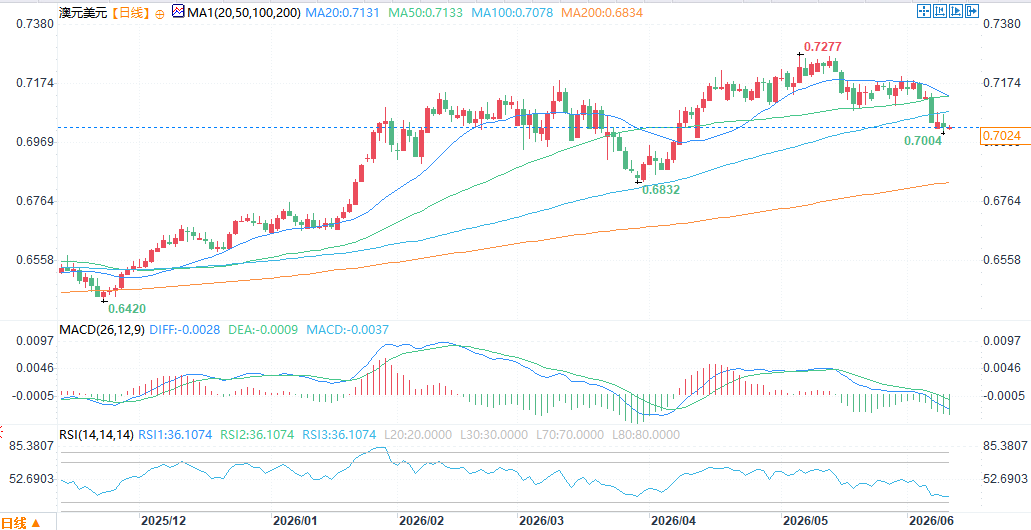
(AUD/USD daily chart, source: FX678)
At 16:21 Beijing time on June 10, the Australian dollar was trading at 0.7014/15 against the US dollar.
The exchange rate is currently being dragged down by two main factors: first, Trump's threat of retaliation against Iran has escalated geopolitical tensions, driving funds to safe-haven assets such as the US dollar; second, the market remains cautious ahead of Wednesday's US CPI data release.
Meanwhile, domestically in Australia, economists at the National Australia Bank (NAB) withdrew their expectations for an August rate hike, believing that the cash rate has peaked at 4.35%.
Geopolitics: Trump's threat to retaliate against Iran fuels risk aversion and weighs on the Australian dollar.
Tensions in the Middle East escalated sharply on June 9-10. On June 9, US President Trump instructed the US military to launch a "self-defense" strike against Iran in response to the earlier downing of a US Apache attack helicopter in the Strait of Hormuz. According to US officials, the US military launched strikes against multiple Iranian air defense and radar systems around the Strait of Hormuz. In response, the Iranian Islamic Revolutionary Guard Corps announced that it had launched missiles and drones at US targets in the region, and explosions were heard in several locations in Hormozgan province in southern Iran, including Sirik and Qeshm Island. Iranian Foreign Minister Araqchi warned that the Iranian armed forces would never ignore any attack or threat.
Oil prices subsequently rebounded, with WTI crude oil rising to around $88.50 per barrel. The US dollar index, however, maintained a high level of fluctuation. Escalating geopolitical risks caused funds to flow from risk-sensitive currencies such as the Australian dollar to the US dollar, directly contributing to the pressure on the Australian dollar.
US economic data: Small business confidence declines, inflation expectations remain.
Regarding US economic data, the National Federation of Independent Business (NFIB) reported that its Small Business Optimism Index further declined to 95.3 in May, falling below market expectations and significantly below the 52-year historical average of 98.0. This data indicates that while the overall US economy maintains a certain degree of resilience, the optimism of small businesses, which account for a significant share of the job market, regarding the economic outlook is continuing to decline. Small and medium-sized business owners generally report two pressures: first, continuously rising input costs, especially energy and raw material prices, are squeezing profit margins; second, tightening financing conditions and rising borrowing costs are forcing the postponement of expansion plans.
A noteworthy signal from the survey is that a staggering 34% of respondents plan to raise product prices within the next three months. This is a historically high percentage, indicating that small businesses are passing on upstream cost pressures to downstream consumers. If these price increases are widely implemented, it will further support inflation in the service sector, making it more difficult for overall inflation to fall. This is undoubtedly a warning sign for the Federal Reserve, which is closely monitoring inflation trends.
In the labor market, surveys show that small businesses have reduced their hiring plans, reflecting increased uncertainty about future demand and a more cautious approach to workforce expansion. However, the labor shortage problem has not eased, particularly in sectors like agriculture and wholesale trade, where businesses continue to struggle to find suitable employees. This structural contradiction of "declining hiring intentions but persistent labor shortages" indicates that the adjustment in the US labor market is not simply a matter of cooling demand, but rather a deeper issue of supply-demand mismatch. This also means that even with slower job growth, upward pressure on wages may persist, thus supporting inflation.
Market Focus: US CPI Data to be Released Soon
Market attention is focused on the U.S. May Consumer Price Index (CPI) data to be released Wednesday evening. This is not only the most important global economic indicator this week, but it will also reveal for the first time the actual impact of rising energy prices following the escalation of the U.S.-Iran conflict on inflation.
Since the downing of a US military helicopter in the Strait of Hormuz last week and the subsequent US retaliatory strikes against Iran, international crude oil prices have remained around $90 per barrel. Rising energy costs are gradually being passed on to end-consumer goods through channels such as gasoline, transportation, and electricity. Market participants hope to use this CPI data to assess the extent of this round of geopolitically driven inflationary pressures.
Amid an uncertain inflation outlook, a media survey of economists indicates that most respondents expect the Federal Reserve to keep interest rates unchanged for the remainder of the year.
Specifically, among the 102 economists surveyed, nearly 70% predict that the federal funds rate will remain in its current range of 3.50%-3.75% by the end of 2026. This assessment is based on a core assumption: while inflation may remain sticky, it will not be enough to force the Federal Reserve to restart interest rate hikes.
However, pricing in the interest rate futures market appears more cautious. The market has already priced in a rate hike of approximately 22 basis points by the end of the year, indicating that some traders have not completely ruled out the possibility of further tightening this year.
Meanwhile, some members of the Federal Open Market Committee (FOMC) have recently publicly stated that if inflation stalls or accelerates again, another interest rate hike may be necessary later this year. This divergence between economists' consensus and market pricing precisely reflects the high degree of uncertainty in the current macroeconomic environment.
If the CPI data exceeds expectations, market expectations for interest rate hikes will rise further, and the Federal Reserve's policy path will face reassessment.
Domestically in Australia: Consumer confidence declines, NAB withdraws expectations of interest rate hikes.
Domestically in Australia, high inflation and persistently rising petrol prices are putting a double squeeze on household budgets, causing the consumer confidence index to decline again in June. Australian households are facing increasing pressure from the rising cost of living, particularly as rising fuel prices directly increase commuting and logistics costs, further weakening consumer spending. Retailers generally report that spending on non-essential items is slowing, with consumers more inclined to save and purchase necessities. If this cautious sentiment continues to spread, it could drag down consumer spending and economic growth in the coming months.
However, not all signs point to deterioration. According to survey data released by the National Australia Bank (NAB), Australian business conditions stabilized in May, indicating that businesses remain resilient. Despite a slight cooling in demand, activity in the service and resource-related sectors maintained some momentum, and employment conditions did not deteriorate sharply. This divergence between "household caution and business stability" complicates the overall outlook for the Australian economy.
Regarding monetary policy expectations, NAB Chief Economist Sally Olde offered a clear revision. She stated that the bank has adjusted its expectations for further tightening by the Reserve Bank of Australia (RBA). Olde noted, "We no longer expect the RBA to raise rates by 25 basis points in August, and we now believe the cash rate has peaked at its current level of 4.35%." This assessment is based on a comprehensive evaluation of recent weak consumption, marginal easing of inflationary pressures, and increased global economic uncertainty.
Looking back, the Reserve Bank of Australia (RBA) has raised interest rates three times this year in an attempt to curb stubborn inflation. However, as pressure on households becomes increasingly apparent, the marginal utility of further rate hikes is diminishing, while the risk of economic damage is rising. The RBA's recent shift in stance may indicate that more market participants will reassess the RBA's policy path. If future inflation data does not rise beyond expectations, the RBA may choose to hold rates steady, or even reserve policy space for potential downside risks to the economy. For the Australian dollar, the fading expectations of rate hikes mean the loss of a significant interest rate support, which could put continued pressure on the Australian dollar in the short term.
Technical Analysis
The Australian dollar is showing a pullback from its highs against the US dollar on the daily chart. The price has fallen rapidly from its recent high of 0.7277 and has now broken below the 20-day and 50-day moving averages, indicating a weak short-term trend. The moving average system suggests that after breaking below the 20-day moving average, the price is testing the previous support level of 0.7004. A decisive break below this level could open up further downside potential.
In the MACD indicator, the DIFF line is below the DEA line, and the histogram remains negative, indicating that bearish momentum is still being released. The RSI indicator has fallen back to around 36, approaching the oversold zone, suggesting a potential technical rebound in the short term, but no clear signs of stabilization have yet emerged.
In summary, the Australian dollar is currently in a short-term consolidation phase against the US dollar. The area around 0.7174 represents a previous support level and the 100-day moving average resistance; a rebound to this area may encounter resistance. Key support lies around 0.7000; a break below this level would target the previous low of 0.6832. Trading strategy should focus on a slightly bearish, range-bound approach, closely monitoring the effectiveness of support levels and the strength of any rebounds.
(AUD/USD daily chart, source: FX678)
At 16:21 Beijing time on June 10, the Australian dollar was trading at 0.7014/15 against the US dollar.
- Risk Warning and Disclaimer
- The market involves risk, and trading may not be suitable for all investors. This article is for reference only and does not constitute personal investment advice, nor does it take into account certain users’ specific investment objectives, financial situation, or other needs. Any investment decisions made based on this information are at your own risk.