Dramatic Reversal! Silver rebounded by as much as 4%, but an even bigger bombshell looms at the Federal Reserve: the probability of an October rate hike surges to 55%.
2026-05-25 13:31:38
On Monday (May 25) during Asian trading hours, silver prices opened sharply higher after falling in the previous session, rebounding by more than 4% to $78.79 per ounce at one point. They have since retreated slightly, trading around $77.53 per ounce, a gain of nearly 3%. Growing optimism regarding a potential US-Iran deal eased market concerns about inflation and upcoming interest rate hikes, thus providing support for non-interest-bearing assets such as silver.
Reports indicate that the US and Iran are close to signing an agreement that includes a 60-day extension of the ceasefire. Under this agreement, the Strait of Hormuz would be reopened, Iran would agree to clear mines and allow free passage for ships, and in exchange, the US would lift its blockade of Iranian ports. This arrangement has been described by US officials as a "performance-for-exemption" deal, meaning the faster Iran acts, the faster the US will lift the blockade. The draft agreement also includes a commitment from Iran not to pursue nuclear weapons and negotiations on suspending its uranium enrichment program and transferring its highly enriched uranium stockpile.
However, the finalization of the agreement still faces multiple uncertainties. Iran denies making any commitments on the nuclear issue, emphasizing that the Straits will continue to be "managed" by Iran and will not be restored to the pre-war "free passage" status. The agreement has also faced criticism from Republican hawks in the United States, with Senator Graham calling it "nothing short of giving Hezbollah a shot in the arm." While Trump stated that the agreement was "basically agreed upon," he stressed that there was "no rush," and the blockade would remain in effect until "the agreement is verified and signed." The market still needs to wait for confirmation regarding whether the US military blockade will be lifted.
Reports indicate that the US government continues to obstruct certain provisions of the agreement to end the conflict, particularly those concerning the release of frozen Iranian assets. Iran emphasizes that some frozen assets must be unfrozen at the outset of the memorandum of understanding, ensuring Iran's full access to these assets; the mechanism for unfreezing other frozen assets must also be clearly defined during negotiations. If the US again obstructs the unfreezing, Iran will reconsider whether to proceed with the negotiations. Iran also stated that due to various reasons, including US obstruction of the unfreezing of Iranian assets, the content of the memorandum of understanding has not yet been finalized, thus raising the possibility of a failure to reach a consensus.
This stalemate further dampened immediate market expectations. US Secretary of State Marco Rubio stated that while the agreement with Iran had gained regional support, a comprehensive nuclear agreement could not be reached quickly or hastily. Rubio had previously emphasized during the NATO foreign ministers' meeting in Sweden that while negotiations had made "some progress," "we are not at that stage," and the core issue—Iran's nuclear ambitions—remained, stating that "Iran must never possess nuclear weapons." He clearly outlined the key US demands: the Strait of Hormuz must be unconditionally open, Iran must not charge passage fees, and Iran must hand over its stockpile of highly enriched uranium. Meanwhile, Iran emphasized that the memorandum of understanding did not address the nuclear issue at all, and that nuclear negotiations would be postponed until all fighting on all fronts ended and the US had fulfilled its commitments. The fundamental differences between the two sides on the negotiation framework and core issues have not been bridged, meaning that whether an agreement can ultimately be implemented remains highly uncertain.
Meanwhile, investors continued to assess the future outlook for Federal Reserve policy. Fed Governor Christopher Waller delivered his strongest hawkish signal to date in a speech on Friday. The long-time advocate of rate cuts, a staunch dove, explicitly stated his support for removing the phrase "accommodative bias" from the Fed's policy statement, indicating that the likelihood of future rate cuts is no higher than that of rate hikes. Waller bluntly stated that "inflation is not heading in the right direction," and that discussing near-term rate cuts is "simply unbelievable" given that inflation is persistently above target and the labor market is stabilizing. He emphasized that if inflation does not begin to slow soon, he can no longer rule out future rate hikes; and once inflation expectations begin to lose their anchor, he will "not hesitate to support rate hikes."
Waller's hawkish shift has rapidly prompted a repricing in the market. Interest rate futures markets indicate that the probability of a 25-basis-point rate hike at the Fed's October meeting has risen to approximately 55%, and the probability of a rate hike at the September meeting is also close to 50%, whereas traders previously widely expected the first rate hike to occur no earlier than December. This change, coinciding with the swearing-in of new Fed Chairman Kevin Warsh last Friday, adds another layer of complexity to the global economic landscape. Market observers point out that Warsh is likely to gain the support of several officials after taking office, pushing the policy statement towards a more "hawkish" stance at his first policy meeting on June 16-17. At the April meeting, three regional Fed presidents voted against retaining the "accommodative bias" wording, marking the largest number of dissenting votes since 1992. The focus of the Fed's monetary policy narrative is quietly shifting from "when will rate cuts come" to "is a rate hike necessary?"
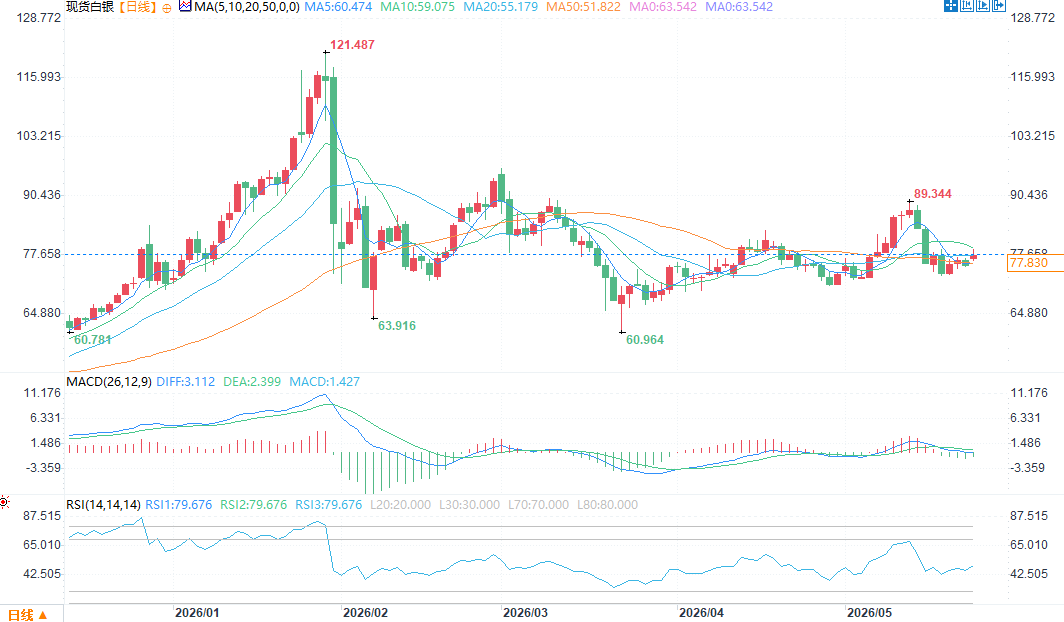
From the daily chart, spot silver is currently trading around $77.84, in a consolidation phase after the recent pullback, with multiple technical indicators showing neutral to weak signals.
(Spot silver daily chart, source: EasyForex)
Regarding the moving average system, the short-term moving average MA5 (75.87) is below the current price, forming short-term support; MA20 (77.5724) is roughly the same as the current price; MA50 (75.89) is below, forming medium-term support. MA100 (81.31) is significantly higher than the current price, indicating significant medium-term resistance; MA200 (65.94) is below, forming long-term support. The current price has risen above MA5 and MA50, but is still facing resistance near MA10 and MA20, indicating that silver is at a critical juncture for directional choice. Short-term rebound momentum exists, but the resistance above is significant.
In summary, silver is currently supported by positive progress in US-Iran negotiations, with expectations of easing geopolitical risks driving a price rebound. However, the unfreezing of Iranian assets remains an obstacle to negotiations, and hawkish voices within the Federal Reserve are growing, potentially putting pressure on non-interest-bearing assets. In the short term, silver price movements will depend on substantial progress in US-Iran negotiations, the navigation status of the Strait of Hormuz, and subsequent policy signals from the Federal Reserve.
At 13:30 Beijing time on May 25, spot silver was trading at $77.60 per ounce.
US-Iran negotiations: Agreement to extend 60-day ceasefire close to signing
Reports indicate that the US and Iran are close to signing an agreement that includes a 60-day extension of the ceasefire. Under this agreement, the Strait of Hormuz would be reopened, Iran would agree to clear mines and allow free passage for ships, and in exchange, the US would lift its blockade of Iranian ports. This arrangement has been described by US officials as a "performance-for-exemption" deal, meaning the faster Iran acts, the faster the US will lift the blockade. The draft agreement also includes a commitment from Iran not to pursue nuclear weapons and negotiations on suspending its uranium enrichment program and transferring its highly enriched uranium stockpile.
However, the finalization of the agreement still faces multiple uncertainties. Iran denies making any commitments on the nuclear issue, emphasizing that the Straits will continue to be "managed" by Iran and will not be restored to the pre-war "free passage" status. The agreement has also faced criticism from Republican hawks in the United States, with Senator Graham calling it "nothing short of giving Hezbollah a shot in the arm." While Trump stated that the agreement was "basically agreed upon," he stressed that there was "no rush," and the blockade would remain in effect until "the agreement is verified and signed." The market still needs to wait for confirmation regarding whether the US military blockade will be lifted.
Negotiation obstacles remain: The issue of unfreezing Iranian assets remains unresolved.
Reports indicate that the US government continues to obstruct certain provisions of the agreement to end the conflict, particularly those concerning the release of frozen Iranian assets. Iran emphasizes that some frozen assets must be unfrozen at the outset of the memorandum of understanding, ensuring Iran's full access to these assets; the mechanism for unfreezing other frozen assets must also be clearly defined during negotiations. If the US again obstructs the unfreezing, Iran will reconsider whether to proceed with the negotiations. Iran also stated that due to various reasons, including US obstruction of the unfreezing of Iranian assets, the content of the memorandum of understanding has not yet been finalized, thus raising the possibility of a failure to reach a consensus.
This stalemate further dampened immediate market expectations. US Secretary of State Marco Rubio stated that while the agreement with Iran had gained regional support, a comprehensive nuclear agreement could not be reached quickly or hastily. Rubio had previously emphasized during the NATO foreign ministers' meeting in Sweden that while negotiations had made "some progress," "we are not at that stage," and the core issue—Iran's nuclear ambitions—remained, stating that "Iran must never possess nuclear weapons." He clearly outlined the key US demands: the Strait of Hormuz must be unconditionally open, Iran must not charge passage fees, and Iran must hand over its stockpile of highly enriched uranium. Meanwhile, Iran emphasized that the memorandum of understanding did not address the nuclear issue at all, and that nuclear negotiations would be postponed until all fighting on all fronts ended and the US had fulfilled its commitments. The fundamental differences between the two sides on the negotiation framework and core issues have not been bridged, meaning that whether an agreement can ultimately be implemented remains highly uncertain.
Fed Policy Outlook: Waller Hints at Need to Remove "Dovish Bias"
Meanwhile, investors continued to assess the future outlook for Federal Reserve policy. Fed Governor Christopher Waller delivered his strongest hawkish signal to date in a speech on Friday. The long-time advocate of rate cuts, a staunch dove, explicitly stated his support for removing the phrase "accommodative bias" from the Fed's policy statement, indicating that the likelihood of future rate cuts is no higher than that of rate hikes. Waller bluntly stated that "inflation is not heading in the right direction," and that discussing near-term rate cuts is "simply unbelievable" given that inflation is persistently above target and the labor market is stabilizing. He emphasized that if inflation does not begin to slow soon, he can no longer rule out future rate hikes; and once inflation expectations begin to lose their anchor, he will "not hesitate to support rate hikes."
Waller's hawkish shift has rapidly prompted a repricing in the market. Interest rate futures markets indicate that the probability of a 25-basis-point rate hike at the Fed's October meeting has risen to approximately 55%, and the probability of a rate hike at the September meeting is also close to 50%, whereas traders previously widely expected the first rate hike to occur no earlier than December. This change, coinciding with the swearing-in of new Fed Chairman Kevin Warsh last Friday, adds another layer of complexity to the global economic landscape. Market observers point out that Warsh is likely to gain the support of several officials after taking office, pushing the policy statement towards a more "hawkish" stance at his first policy meeting on June 16-17. At the April meeting, three regional Fed presidents voted against retaining the "accommodative bias" wording, marking the largest number of dissenting votes since 1992. The focus of the Fed's monetary policy narrative is quietly shifting from "when will rate cuts come" to "is a rate hike necessary?"
Spot silver daily chart technical analysis
From the daily chart, spot silver is currently trading around $77.84, in a consolidation phase after the recent pullback, with multiple technical indicators showing neutral to weak signals.
(Spot silver daily chart, source: EasyForex)
Regarding the moving average system, the short-term moving average MA5 (75.87) is below the current price, forming short-term support; MA20 (77.5724) is roughly the same as the current price; MA50 (75.89) is below, forming medium-term support. MA100 (81.31) is significantly higher than the current price, indicating significant medium-term resistance; MA200 (65.94) is below, forming long-term support. The current price has risen above MA5 and MA50, but is still facing resistance near MA10 and MA20, indicating that silver is at a critical juncture for directional choice. Short-term rebound momentum exists, but the resistance above is significant.
Geopolitical optimism supports silver prices, but the Federal Reserve's policy shift poses potential pressure.
In summary, silver is currently supported by positive progress in US-Iran negotiations, with expectations of easing geopolitical risks driving a price rebound. However, the unfreezing of Iranian assets remains an obstacle to negotiations, and hawkish voices within the Federal Reserve are growing, potentially putting pressure on non-interest-bearing assets. In the short term, silver price movements will depend on substantial progress in US-Iran negotiations, the navigation status of the Strait of Hormuz, and subsequent policy signals from the Federal Reserve.
At 13:30 Beijing time on May 25, spot silver was trading at $77.60 per ounce.
- Risk Warning and Disclaimer
- The market involves risk, and trading may not be suitable for all investors. This article is for reference only and does not constitute personal investment advice, nor does it take into account certain users’ specific investment objectives, financial situation, or other needs. Any investment decisions made based on this information are at your own risk.