1.1640 level tug-of-war: the "surface" and "substance" of US-Iran negotiations, the divergence of US and European central bank policies, how far can the euro rebound go?
2026-05-25 14:55:41
On Monday (May 25) during Asian trading hours, the euro opened higher against the US dollar and continued to rise, currently holding steady around 1.1640, up about 0.34%. As market expectations for a near-agreement between the US and Iran solidified, improved risk sentiment weakened the safe-haven demand for the dollar, causing the dollar index to fall slightly and currently holding steady near a low of 99.00.

Expectations for a US-Iran deal have escalated further after US President Trump tweeted over the weekend that an agreement with Iran was "fundamentally agreed upon," including the reopening of the Strait of Hormuz. Trump added, "The final aspects and details of the agreement are currently under discussion and will be released soon." This boosted investor confidence that the two sides would reach an agreement soon. According to media reports, the core elements of the draft agreement include a 60-day ceasefire extension, Iran clearing mines from the Strait, the lifting of US sanctions on Iranian ports, and partial sanctions waivers. A US official described this arrangement as "performance for waivers," stating that the economic easing would follow Iran's actual actions, rather than being granted in advance. The draft also includes an Iranian commitment not to pursue nuclear weapons and negotiations on suspending its uranium enrichment program and transferring its highly enriched uranium stockpile.
However, in a subsequent post, Trump stated that he was "in no hurry to reach an agreement" because "time is on America's side." He also emphasized that the US blockade of the Strait of Hormuz "will remain fully effective and continue to be enforced" until an agreement is reached, confirmed, and signed. White House officials later stated that the US and Iran were "still a few days away" from signing an agreement, which still required the approval of Iran's Supreme Leader Khamenei. Iran's Fars News Agency questioned Trump's statement, calling the claim that the Strait of Hormuz would be "open" "incomplete," and emphasizing that even if an agreement was reached, the strait would continue to be "managed" by Iran, rather than returning to its pre-war "free passage" status. The fundamental differences between the two sides on the nuclear issue have not been bridged—the US insists that Iran must first relinquish its stockpile of highly enriched uranium, while Iran has clearly stated that the current memorandum of understanding "does not involve the nuclear issue at all." This back-and-forth between "optimistic statements" and "substantive stalemate" keeps the uncertainty in the global energy market high.
The escalating expectations of a US-Iran agreement have had an immediate impact on the energy market. Currently, both WTI crude oil futures and Brent crude oil futures prices have fallen by more than 5%, with WTI crude oil futures trading at $91.50 per barrel and Brent crude oil futures at $98.40 per barrel.
The direct consequence of the oil price crash is a cooling of market expectations for further tightening of monetary policy by the Federal Reserve—the decline in energy prices has eased short-term inflationary pressures, thereby reducing the urgency of raising interest rates.
According to the CME FedWatch tool, the market's expectation of at least one Fed rate hike this year has fallen from 67% last Friday to around 57%. Meanwhile, the probability of the Fed keeping rates unchanged until June remains as high as 97.3%. However, significant disagreements persist in the market regarding the future policy path. Recent bond market pricing has reversed – with Kevin Warsh taking over as Fed chairman, investors are more inclined to believe the Fed will prioritize maintaining its reputation as an inflation fighter rather than responding to government expectations of rate cuts.
It's worth noting a significant discrepancy between White House chief economic advisor Hassett's and market assessments. Hassett stated that a US-Iran agreement and a sharp drop in energy prices would create "significant room" for the Federal Reserve to lower interest rates. He predicted that the US might even experience negative inflation after energy prices decline. However, most institutions remain cautious about the potential for further declines in oil prices.
Analysts point out that even if an agreement is successfully reached, oil prices may remain above $90 per barrel until the end of the year, and inflationary pressures will persist throughout the second half of the year. The head of the UAE's national oil company further warned that even if the conflict ends now, oil shipments through the Strait of Hormuz will not fully recover until the first or second quarter of 2027. This means that the supply-side constraints are unlikely to ease significantly in the short term.
In the Eurozone, comments from several European Central Bank officials have pointed to rising inflationary pressures, raising market expectations for future interest rate hikes.
European Central Bank policymaker and Belgian central bank governor Pierre Winsch said last week that the central bank needs to take action at some point because "we are at the beginning of an inflation problem."
This statement echoes the tough stance of Bundesbank President Nagel, who bluntly stated that "we are no longer in the baseline scenario predicted by the Eurosystem, but are moving towards an adverse scenario."
Nagel warned that supply shocks often take up to 18 months to fully transmit to all commodity categories, meaning the Eurozone will continue to face considerable inflationary pressures. ECB Executive Board member Schnabel also pointed out that, given the "fresh memory" of inflation, the transmission of energy prices to core inflation in this round may be faster than in 2021-2022. Meanwhile, the ECB's "baseline scenario" released in March (assuming the war ends in April and the energy shock is moderate) has essentially become invalid, replaced by an "adverse scenario" of economic slowdown and soaring inflation.
Latest data shows that the Eurozone's preliminary composite PMI unexpectedly fell to 47.5 in May, marking the second consecutive month in contraction territory; however, input price inflation accelerated to a three-and-a-half-year high during the same period, and business charges also rose at their fastest pace in 38 months. This stagflation combination of "economic contraction and soaring inflation" is reshaping market expectations.
According to reports, a consensus has largely formed within the European Central Bank: unless inflation data shows a dramatic decline, a June rate hike is almost a certainty. Economists are currently betting on two to three rate hikes in 2026, possibly in June, September, or even by the end of the year.
Greek central bank governor Sturnarara stated frankly that "maintaining the credibility of the European Central Bank is a strong argument for raising interest rates next month"—if the central bank does not take action in the face of persistent inflation, consumers will sooner or later question whether its promise to "be prepared to deal with it" is just empty talk.
In summary, the euro is currently supported by optimism surrounding a US-Iran deal, with improved risk appetite driving the dollar lower. However, Trump's subsequent statement that he is "in no hurry to reach an agreement" indicates that the deal remains uncertain. Meanwhile, falling oil prices have dampened expectations of a Fed rate hike, while hawkish comments from European Central Bank officials have provided additional support for the euro.
In the short term, the euro's exchange rate against the US dollar will depend on the substantive progress of the US-Iran negotiations and changes in market expectations regarding the policies of the two central banks.
From the daily chart, the euro is currently trading around 1.1640 against the US dollar, in a consolidation phase after rebounding from recent lows, with multiple technical indicators showing neutral to weak signals.
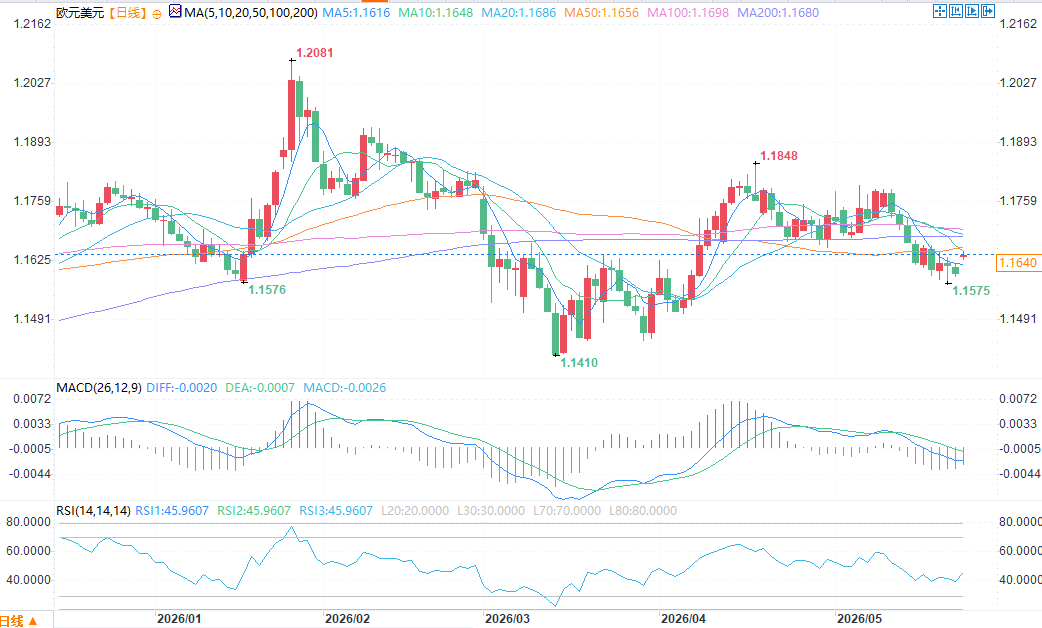
(Euro/USD daily chart, source: FX678)
In terms of moving averages, the current price is above the short-term moving average MA5 (1.1616), while MA10 (1.1647) is slightly higher. MA20 (1.1686), MA50 (1.1656), MA100 (1.1698), and MA200 (1.1680) are all above the current price, forming short-term resistance. This arrangement of "price below all major moving averages" indicates that the Euro/USD pair is under significant short-term pressure and is in a weak consolidation pattern. It is worth noting that since the price fell from above 1.1800 in early May, it has failed to effectively recover the MA20, indicating insufficient upward momentum.
At 14:54 Beijing time on May 25, the euro was trading at 1.1643/44 against the US dollar.
US-Iran negotiations: Trump says a deal is "basically agreed" but "not in a hurry to finalize"
Expectations for a US-Iran deal have escalated further after US President Trump tweeted over the weekend that an agreement with Iran was "fundamentally agreed upon," including the reopening of the Strait of Hormuz. Trump added, "The final aspects and details of the agreement are currently under discussion and will be released soon." This boosted investor confidence that the two sides would reach an agreement soon. According to media reports, the core elements of the draft agreement include a 60-day ceasefire extension, Iran clearing mines from the Strait, the lifting of US sanctions on Iranian ports, and partial sanctions waivers. A US official described this arrangement as "performance for waivers," stating that the economic easing would follow Iran's actual actions, rather than being granted in advance. The draft also includes an Iranian commitment not to pursue nuclear weapons and negotiations on suspending its uranium enrichment program and transferring its highly enriched uranium stockpile.
However, in a subsequent post, Trump stated that he was "in no hurry to reach an agreement" because "time is on America's side." He also emphasized that the US blockade of the Strait of Hormuz "will remain fully effective and continue to be enforced" until an agreement is reached, confirmed, and signed. White House officials later stated that the US and Iran were "still a few days away" from signing an agreement, which still required the approval of Iran's Supreme Leader Khamenei. Iran's Fars News Agency questioned Trump's statement, calling the claim that the Strait of Hormuz would be "open" "incomplete," and emphasizing that even if an agreement was reached, the strait would continue to be "managed" by Iran, rather than returning to its pre-war "free passage" status. The fundamental differences between the two sides on the nuclear issue have not been bridged—the US insists that Iran must first relinquish its stockpile of highly enriched uranium, while Iran has clearly stated that the current memorandum of understanding "does not involve the nuclear issue at all." This back-and-forth between "optimistic statements" and "substantive stalemate" keeps the uncertainty in the global energy market high.
Falling oil prices weaken expectations of a Fed rate hike
The escalating expectations of a US-Iran agreement have had an immediate impact on the energy market. Currently, both WTI crude oil futures and Brent crude oil futures prices have fallen by more than 5%, with WTI crude oil futures trading at $91.50 per barrel and Brent crude oil futures at $98.40 per barrel.
The direct consequence of the oil price crash is a cooling of market expectations for further tightening of monetary policy by the Federal Reserve—the decline in energy prices has eased short-term inflationary pressures, thereby reducing the urgency of raising interest rates.
According to the CME FedWatch tool, the market's expectation of at least one Fed rate hike this year has fallen from 67% last Friday to around 57%. Meanwhile, the probability of the Fed keeping rates unchanged until June remains as high as 97.3%. However, significant disagreements persist in the market regarding the future policy path. Recent bond market pricing has reversed – with Kevin Warsh taking over as Fed chairman, investors are more inclined to believe the Fed will prioritize maintaining its reputation as an inflation fighter rather than responding to government expectations of rate cuts.
It's worth noting a significant discrepancy between White House chief economic advisor Hassett's and market assessments. Hassett stated that a US-Iran agreement and a sharp drop in energy prices would create "significant room" for the Federal Reserve to lower interest rates. He predicted that the US might even experience negative inflation after energy prices decline. However, most institutions remain cautious about the potential for further declines in oil prices.
Analysts point out that even if an agreement is successfully reached, oil prices may remain above $90 per barrel until the end of the year, and inflationary pressures will persist throughout the second half of the year. The head of the UAE's national oil company further warned that even if the conflict ends now, oil shipments through the Strait of Hormuz will not fully recover until the first or second quarter of 2027. This means that the supply-side constraints are unlikely to ease significantly in the short term.
Eurozone: ECB officials hint at rising inflationary pressures.
In the Eurozone, comments from several European Central Bank officials have pointed to rising inflationary pressures, raising market expectations for future interest rate hikes.
European Central Bank policymaker and Belgian central bank governor Pierre Winsch said last week that the central bank needs to take action at some point because "we are at the beginning of an inflation problem."
This statement echoes the tough stance of Bundesbank President Nagel, who bluntly stated that "we are no longer in the baseline scenario predicted by the Eurosystem, but are moving towards an adverse scenario."
Nagel warned that supply shocks often take up to 18 months to fully transmit to all commodity categories, meaning the Eurozone will continue to face considerable inflationary pressures. ECB Executive Board member Schnabel also pointed out that, given the "fresh memory" of inflation, the transmission of energy prices to core inflation in this round may be faster than in 2021-2022. Meanwhile, the ECB's "baseline scenario" released in March (assuming the war ends in April and the energy shock is moderate) has essentially become invalid, replaced by an "adverse scenario" of economic slowdown and soaring inflation.
Latest data shows that the Eurozone's preliminary composite PMI unexpectedly fell to 47.5 in May, marking the second consecutive month in contraction territory; however, input price inflation accelerated to a three-and-a-half-year high during the same period, and business charges also rose at their fastest pace in 38 months. This stagflation combination of "economic contraction and soaring inflation" is reshaping market expectations.
According to reports, a consensus has largely formed within the European Central Bank: unless inflation data shows a dramatic decline, a June rate hike is almost a certainty. Economists are currently betting on two to three rate hikes in 2026, possibly in June, September, or even by the end of the year.
Greek central bank governor Sturnarara stated frankly that "maintaining the credibility of the European Central Bank is a strong argument for raising interest rates next month"—if the central bank does not take action in the face of persistent inflation, consumers will sooner or later question whether its promise to "be prepared to deal with it" is just empty talk.
The euro received short-term support, but uncertainty surrounding the US-Iran agreement remains.
In summary, the euro is currently supported by optimism surrounding a US-Iran deal, with improved risk appetite driving the dollar lower. However, Trump's subsequent statement that he is "in no hurry to reach an agreement" indicates that the deal remains uncertain. Meanwhile, falling oil prices have dampened expectations of a Fed rate hike, while hawkish comments from European Central Bank officials have provided additional support for the euro.
In the short term, the euro's exchange rate against the US dollar will depend on the substantive progress of the US-Iran negotiations and changes in market expectations regarding the policies of the two central banks.
EUR/USD Daily Technical Analysis
From the daily chart, the euro is currently trading around 1.1640 against the US dollar, in a consolidation phase after rebounding from recent lows, with multiple technical indicators showing neutral to weak signals.
(Euro/USD daily chart, source: FX678)
In terms of moving averages, the current price is above the short-term moving average MA5 (1.1616), while MA10 (1.1647) is slightly higher. MA20 (1.1686), MA50 (1.1656), MA100 (1.1698), and MA200 (1.1680) are all above the current price, forming short-term resistance. This arrangement of "price below all major moving averages" indicates that the Euro/USD pair is under significant short-term pressure and is in a weak consolidation pattern. It is worth noting that since the price fell from above 1.1800 in early May, it has failed to effectively recover the MA20, indicating insufficient upward momentum.
At 14:54 Beijing time on May 25, the euro was trading at 1.1643/44 against the US dollar.
- Risk Warning and Disclaimer
- The market involves risk, and trading may not be suitable for all investors. This article is for reference only and does not constitute personal investment advice, nor does it take into account certain users’ specific investment objectives, financial situation, or other needs. Any investment decisions made based on this information are at your own risk.