The plunge in oil prices, coupled with expectations that the Reserve Bank of India would stabilize the currency market, caused the US dollar to fall to a two-week low against the Indian rupee.
2026-05-25 14:34:28
The US dollar continued to weaken against the Indian rupee in Asian trading on Monday, falling to around 95.20, a near two-week low. The rupee had risen for the fourth consecutive trading day, driven by a combination of factors including a sharp drop in international oil prices, a weaker US dollar index, and signals from the Reserve Bank of India to stabilize the exchange rate.
Market risk sentiment has improved significantly, with expectations that the US and Iran are close to reaching an agreement continuing to rise, rapidly easing tensions in the global energy market. Meanwhile, the Reserve Bank of India's positive statements regarding stabilizing the foreign exchange market have also noticeably boosted market confidence in the Indian rupee.
Reserve Bank of India (RBI) Governor Sanjay Malhotra said in an interview on Monday that the RBI is prepared to deal with excessive one-sided volatility in the Indian rupee, emphasizing that the central bank has ample tools to maintain stability in the foreign exchange market. Malhotra pointed out that India currently has nearly $700 billion in foreign exchange reserves, sufficient to cope with abnormal speculative fluctuations.
Following the Reserve Bank of India's (RBI) signal of stabilizing the exchange rate, market confidence in the Indian rupee improved significantly in the short term. Previously, the rupee had been relatively weak among major Asian currencies over the past year due to factors such as rising international oil prices, global trade concerns, and increased gold imports. Malhotra also stated that the rupee is expected to appreciate again as the situation in the Middle East gradually stabilizes. This statement further strengthened market expectations that the RBI may continue to intervene in the foreign exchange market.
Meanwhile, a sharp drop in international oil prices on Monday also contributed significantly to the rise of the Indian rupee. WTI crude oil prices plunged nearly 6% at one point during the session, falling to around $90, the lowest level in the past two weeks.
US President Trump stated over the weekend that a deal between the US and Iran "has been largely reached," including key provisions such as the reopening of the Strait of Hormuz. Markets believe that if normal shipping resumes through the Strait of Hormuz, global energy supply risks will significantly decrease, thereby pushing international oil prices further down.
However, Trump later stated that the US was "not in a hurry to reach an agreement" and that negotiations were progressing in an "orderly and constructive" manner. This implies that while overall market sentiment is optimistic, some uncertainty remains regarding the situation in the Middle East. As one of the world's major crude oil importers, India is extremely sensitive to changes in international oil prices. When international oil prices fall, India's energy import costs will decrease significantly, thereby improving its trade balance and inflation prospects, and benefiting the Indian rupee.
Furthermore, the recent overall decline in the US dollar index has further pushed down the dollar against the Indian rupee. Currently, the US dollar index (DXY) has fallen to around 99.00, and market bets on further interest rate hikes by the Federal Reserve have clearly decreased. Previously, due to rising international oil prices and tensions in the Middle East, the market was concerned that US inflation might rebound, thus prompting the Federal Reserve to maintain a hawkish policy. However, with the rapid decline in oil prices, market expectations for further interest rate hikes by the Federal Reserve have cooled significantly.
According to the CME Group's FedWatch tool, the market's expectation of at least one more Fed rate hike this year has fallen to about 57%, significantly lower than last Friday's 67%. The declining expectation of a Fed rate hike weakens the dollar's yield advantage, thus putting temporary pressure on the dollar.
However, the Indian stock market still faces some pressure from capital outflows. Data shows that overseas institutional investors have been net sellers of Indian stocks for four consecutive trading days, with a cumulative reduction of approximately 1.0386 trillion rupees. Market concerns that high energy prices could impact the profit prospects of Indian companies have led some international funds to remain cautious. Furthermore, the risk of a global economic slowdown may continue to affect India's exports and investment environment, meaning that the future trend of the Indian rupee may still be influenced by external fluctuations.
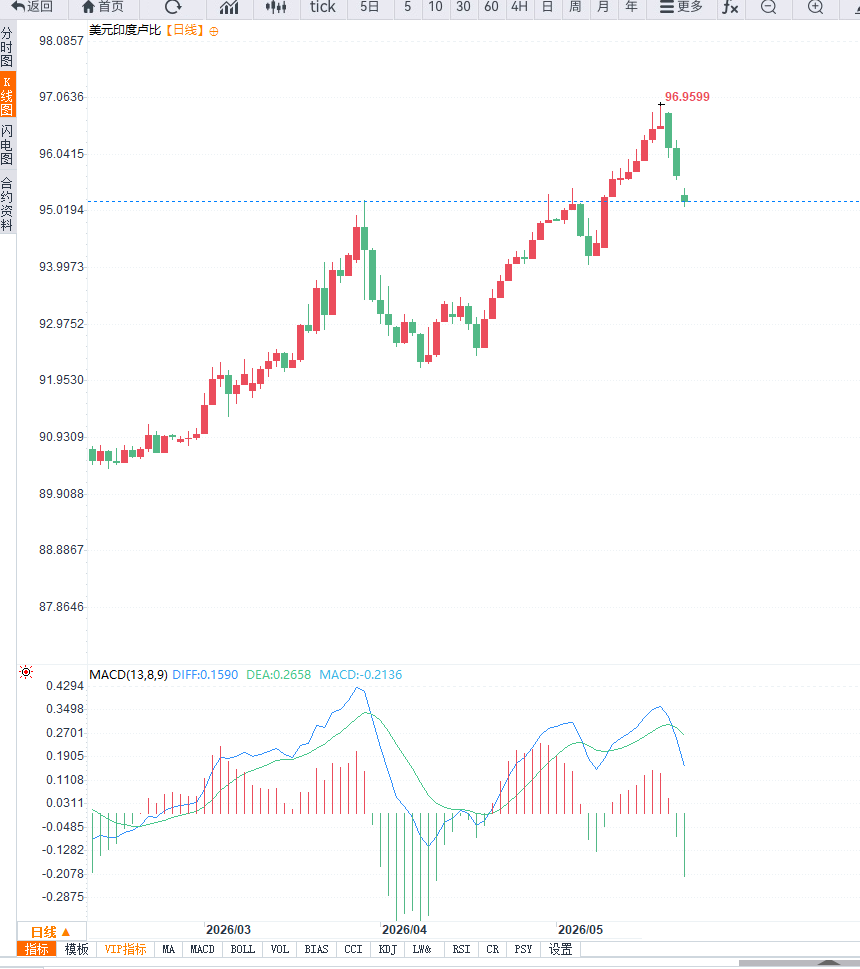
From a technical perspective, the USD/INR daily chart shows a clear pullback. After a significant rise, the exchange rate is currently retracing towards the 20-day exponential moving average around 95.37, indicating a short-term mean-correction in the market. Key support on the daily chart lies at the 95.00 level; a break below this level could lead to a further decline towards the 94.00 area. On the upside, the 96.37 area remains a major resistance zone; a successful retest of this level could see USD/INR retest the 97.00 level.
From a daily chart perspective, the RSI indicator is currently hovering around 53, indicating a slightly bearish overall market momentum. Although the USD/INR pair has seen a short-term correction, the price remains above some short-term trend support areas, suggesting that bearish momentum has not yet fully taken over. However, if tensions in the Middle East escalate again, leading to a rebound in international oil prices, and the Federal Reserve reaffirms its hawkish stance, the USD/INR pair could regain support.
Overall, the current USD/INR exchange rate is primarily influenced by three factors: declining international oil prices, expectations of the Reserve Bank of India stabilizing the foreign exchange market, and a weakening US dollar index. Short-term market sentiment is clearly biased towards the Indian rupee, but future trends will depend on the situation in the Middle East, Federal Reserve policy, and changes in international capital flows.
Editor's Summary : The USD/INR exchange rate is currently in a tug-of-war between the positive impact of falling oil prices on India and global risk uncertainty. The sharp drop in international oil prices has significantly eased India's energy import pressure, while the Reserve Bank of India's (RBI) stable exchange rate stance has boosted market confidence in the rupee. However, continued capital outflows from the Indian stock market and the risk of a global economic slowdown may still put some pressure on the rupee. Furthermore, the Federal Reserve's policy path and changes in the Middle East situation will continue to influence the dollar's trajectory and global risk sentiment. Going forward, the market needs to focus on the progress of the US-Iran agreement, changes in international oil prices, expectations regarding Federal Reserve policy, and the RBI's intervention in the foreign exchange market, as these factors will continue to dominate the future direction of the USD/INR exchange rate.
Market risk sentiment has improved significantly, with expectations that the US and Iran are close to reaching an agreement continuing to rise, rapidly easing tensions in the global energy market. Meanwhile, the Reserve Bank of India's positive statements regarding stabilizing the foreign exchange market have also noticeably boosted market confidence in the Indian rupee.
Reserve Bank of India (RBI) Governor Sanjay Malhotra said in an interview on Monday that the RBI is prepared to deal with excessive one-sided volatility in the Indian rupee, emphasizing that the central bank has ample tools to maintain stability in the foreign exchange market. Malhotra pointed out that India currently has nearly $700 billion in foreign exchange reserves, sufficient to cope with abnormal speculative fluctuations.
Following the Reserve Bank of India's (RBI) signal of stabilizing the exchange rate, market confidence in the Indian rupee improved significantly in the short term. Previously, the rupee had been relatively weak among major Asian currencies over the past year due to factors such as rising international oil prices, global trade concerns, and increased gold imports. Malhotra also stated that the rupee is expected to appreciate again as the situation in the Middle East gradually stabilizes. This statement further strengthened market expectations that the RBI may continue to intervene in the foreign exchange market.
Meanwhile, a sharp drop in international oil prices on Monday also contributed significantly to the rise of the Indian rupee. WTI crude oil prices plunged nearly 6% at one point during the session, falling to around $90, the lowest level in the past two weeks.
US President Trump stated over the weekend that a deal between the US and Iran "has been largely reached," including key provisions such as the reopening of the Strait of Hormuz. Markets believe that if normal shipping resumes through the Strait of Hormuz, global energy supply risks will significantly decrease, thereby pushing international oil prices further down.
However, Trump later stated that the US was "not in a hurry to reach an agreement" and that negotiations were progressing in an "orderly and constructive" manner. This implies that while overall market sentiment is optimistic, some uncertainty remains regarding the situation in the Middle East. As one of the world's major crude oil importers, India is extremely sensitive to changes in international oil prices. When international oil prices fall, India's energy import costs will decrease significantly, thereby improving its trade balance and inflation prospects, and benefiting the Indian rupee.
Furthermore, the recent overall decline in the US dollar index has further pushed down the dollar against the Indian rupee. Currently, the US dollar index (DXY) has fallen to around 99.00, and market bets on further interest rate hikes by the Federal Reserve have clearly decreased. Previously, due to rising international oil prices and tensions in the Middle East, the market was concerned that US inflation might rebound, thus prompting the Federal Reserve to maintain a hawkish policy. However, with the rapid decline in oil prices, market expectations for further interest rate hikes by the Federal Reserve have cooled significantly.
According to the CME Group's FedWatch tool, the market's expectation of at least one more Fed rate hike this year has fallen to about 57%, significantly lower than last Friday's 67%. The declining expectation of a Fed rate hike weakens the dollar's yield advantage, thus putting temporary pressure on the dollar.
However, the Indian stock market still faces some pressure from capital outflows. Data shows that overseas institutional investors have been net sellers of Indian stocks for four consecutive trading days, with a cumulative reduction of approximately 1.0386 trillion rupees. Market concerns that high energy prices could impact the profit prospects of Indian companies have led some international funds to remain cautious. Furthermore, the risk of a global economic slowdown may continue to affect India's exports and investment environment, meaning that the future trend of the Indian rupee may still be influenced by external fluctuations.
From a technical perspective, the USD/INR daily chart shows a clear pullback. After a significant rise, the exchange rate is currently retracing towards the 20-day exponential moving average around 95.37, indicating a short-term mean-correction in the market. Key support on the daily chart lies at the 95.00 level; a break below this level could lead to a further decline towards the 94.00 area. On the upside, the 96.37 area remains a major resistance zone; a successful retest of this level could see USD/INR retest the 97.00 level.
From a daily chart perspective, the RSI indicator is currently hovering around 53, indicating a slightly bearish overall market momentum. Although the USD/INR pair has seen a short-term correction, the price remains above some short-term trend support areas, suggesting that bearish momentum has not yet fully taken over. However, if tensions in the Middle East escalate again, leading to a rebound in international oil prices, and the Federal Reserve reaffirms its hawkish stance, the USD/INR pair could regain support.
Overall, the current USD/INR exchange rate is primarily influenced by three factors: declining international oil prices, expectations of the Reserve Bank of India stabilizing the foreign exchange market, and a weakening US dollar index. Short-term market sentiment is clearly biased towards the Indian rupee, but future trends will depend on the situation in the Middle East, Federal Reserve policy, and changes in international capital flows.
Editor's Summary : The USD/INR exchange rate is currently in a tug-of-war between the positive impact of falling oil prices on India and global risk uncertainty. The sharp drop in international oil prices has significantly eased India's energy import pressure, while the Reserve Bank of India's (RBI) stable exchange rate stance has boosted market confidence in the rupee. However, continued capital outflows from the Indian stock market and the risk of a global economic slowdown may still put some pressure on the rupee. Furthermore, the Federal Reserve's policy path and changes in the Middle East situation will continue to influence the dollar's trajectory and global risk sentiment. Going forward, the market needs to focus on the progress of the US-Iran agreement, changes in international oil prices, expectations regarding Federal Reserve policy, and the RBI's intervention in the foreign exchange market, as these factors will continue to dominate the future direction of the USD/INR exchange rate.
- Risk Warning and Disclaimer
- The market involves risk, and trading may not be suitable for all investors. This article is for reference only and does not constitute personal investment advice, nor does it take into account certain users’ specific investment objectives, financial situation, or other needs. Any investment decisions made based on this information are at your own risk.