Expectations of easing geopolitical tensions are putting downward pressure on the dollar; be wary of a sharp pullback.
2026-05-25 15:31:24
The US dollar has continued its overall volatile trend recently, with rising US Treasury yields and high energy prices being key factors supporting the dollar. Meanwhile, growing concerns about renewed US inflation have further strengthened market expectations that the Federal Reserve will maintain its high-interest-rate policy.
According to Lloyd Chen, an analyst at MUFG, the recent continuous rise in the yield on 2-year U.S. Treasury bonds indicates that the market has fully priced in at least one interest rate hike by the Federal Reserve before January 2027. As short-term yields rise, the attractiveness of dollar assets increases further, thus driving the dollar to maintain its overall strength.
Current energy prices in the United States remain high. Data shows that the average gasoline price in the US is still above $5 per gallon, which continues to reinforce market concerns about a resurgence of inflationary pressures in the US. Meanwhile, the University of Michigan's May consumer survey shows that long-term inflation expectations in the US have risen to 3.9% from 3.5% in April. This continued rise in long-term inflation expectations indicates market concerns that future price pressures in the US may worsen further.
Furthermore, the US consumer confidence index has fallen to near historical lows, indicating that high inflation and high interest rates are beginning to significantly impact consumer confidence. Against this backdrop, market attention continues to rise regarding the Federal Reserve's future policy path. Investors are currently focusing on the future policy stance of the new Federal Reserve Chairman, Kevin Warsh. The market is assessing how he will formulate monetary policy in a complex environment of rising inflation risks, declining consumer confidence, and high US government debt.
The market has gradually formed a trading logic that "the Federal Reserve will maintain high interest rates for a longer period." The continued rise in US Treasury yields has further enhanced the return advantage of dollar assets, thereby attracting global capital inflows into the dollar market. However, there are still significant potential risks behind the current strength of the dollar, with the biggest variable stemming from changes in the situation in the Middle East.
US President Trump recently stated that an agreement between the US and Iran has been "fundamentally reached." Meanwhile, Gulf states, including the UAE, Saudi Arabia, and Qatar, continue to push for a diplomatic solution and warn against further escalation. The market believes that if the US and Iran ultimately reach an agreement and normal shipping resumes in the Strait of Hormuz, global energy supply risks will significantly decrease. This could not only push international oil prices down but also weaken the current key support for the US dollar.
Previously, due to tensions in the Middle East, safe-haven funds continued to flow into dollar assets, while high oil prices also fueled market concerns about US inflation. However, if geopolitical risks significantly ease, the demand for the dollar as a safe haven could decline rapidly. While current long positions in the dollar have increased somewhat, they have not yet reached extreme levels. Therefore, if geopolitical risks ease quickly, the dollar may face significant downward pressure.
Meanwhile, fluctuations in international oil prices will also be a crucial variable in the future trajectory of the US dollar. If the Strait of Hormuz reopens and global energy transportation returns to normal, international oil prices may fall further. A decline in oil prices will directly reduce market concerns about continued deterioration in US inflation and weaken market bets on further interest rate hikes by the Federal Reserve. This means that the current logic supporting the US dollar—"high oil prices + high yields"—may be challenged.
However, in the short term, the US economy as a whole still demonstrates strong resilience. The US job market remains robust, and US Treasury yields remain high, which also means that the US dollar still has a certain fundamental advantage in the short term.
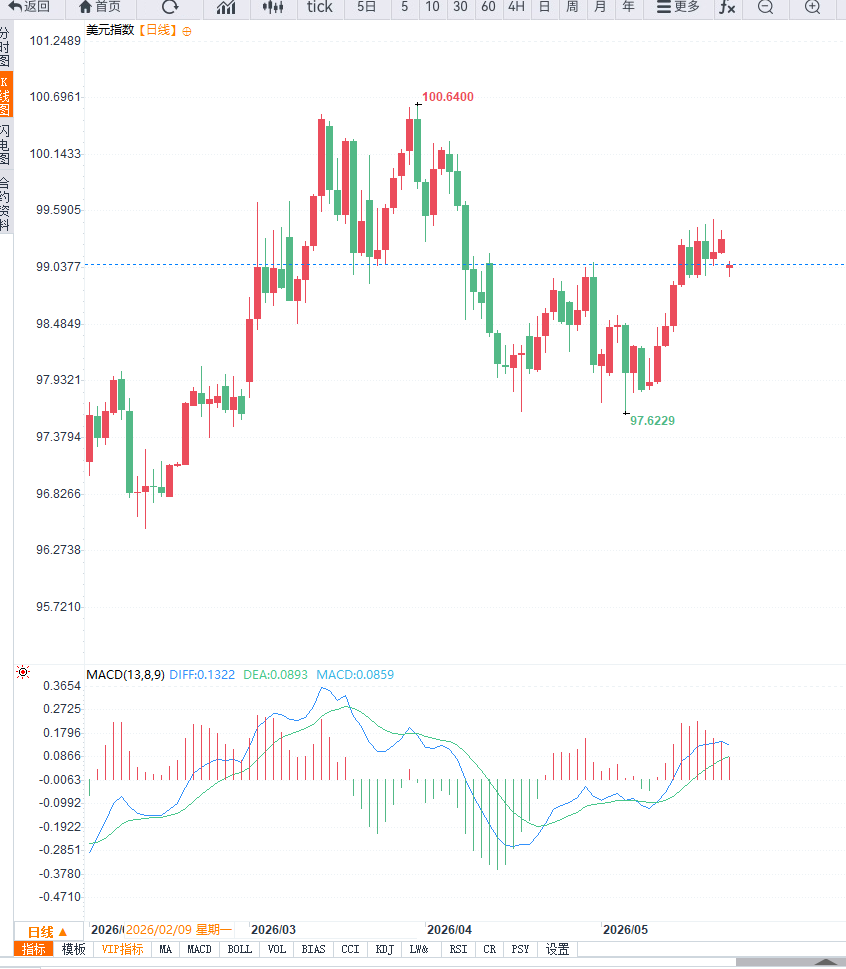
From a technical perspective, the US dollar index daily chart maintains a generally bullish, high-level consolidation structure. Currently, the dollar index is trading around 99.00, and the overall market remains bullish. Key resistance levels to watch on the daily chart are the 99.80-100.20 area. A break above 100 could lead to a test of the 101 level. On the downside, the 98.50 area has formed a significant short-term support zone. A break below this level could see the dollar index fall further to the 97.80 area. Looking at the daily indicators, the MACD remains above the zero line, indicating a continued bullish medium-term trend. The RSI indicator is in a neutral-to-strong zone, reflecting that the dollar still has some upward momentum, but short-term signs of high-level consolidation are emerging.
Meanwhile, if a substantial breakthrough is achieved in the US-Iran agreement, and international oil prices fall further, the US dollar index may experience a more significant technical correction. Overall, the current dollar trend is primarily driven by three factors: US Treasury yields, high oil prices, and geopolitical risks. Although the dollar remains strong in the short term, market concerns about potential future corrections are clearly intensifying.
Editor's Summary : The US dollar is currently in a critical phase of balancing between "high interest rate support" and "de-escalating geopolitical risks." The continued rise in US Treasury yields and increasing inflation expectations have provided strong support for the dollar. However, the growing expectation of a US-Iran peace agreement also means that the safe-haven demand for the dollar may decline significantly in the future. If international oil prices fall rapidly and the market reassesses the Federal Reserve's policy path, the dollar may face pressure for a period of adjustment. Going forward, the market will need to focus on the final progress of the US-Iran agreement, the policy stance of the new Federal Reserve Chairman, US inflation data, and changes in international oil prices, as these factors will continue to determine the dollar's medium- to long-term direction.
According to Lloyd Chen, an analyst at MUFG, the recent continuous rise in the yield on 2-year U.S. Treasury bonds indicates that the market has fully priced in at least one interest rate hike by the Federal Reserve before January 2027. As short-term yields rise, the attractiveness of dollar assets increases further, thus driving the dollar to maintain its overall strength.
Current energy prices in the United States remain high. Data shows that the average gasoline price in the US is still above $5 per gallon, which continues to reinforce market concerns about a resurgence of inflationary pressures in the US. Meanwhile, the University of Michigan's May consumer survey shows that long-term inflation expectations in the US have risen to 3.9% from 3.5% in April. This continued rise in long-term inflation expectations indicates market concerns that future price pressures in the US may worsen further.
Furthermore, the US consumer confidence index has fallen to near historical lows, indicating that high inflation and high interest rates are beginning to significantly impact consumer confidence. Against this backdrop, market attention continues to rise regarding the Federal Reserve's future policy path. Investors are currently focusing on the future policy stance of the new Federal Reserve Chairman, Kevin Warsh. The market is assessing how he will formulate monetary policy in a complex environment of rising inflation risks, declining consumer confidence, and high US government debt.
The market has gradually formed a trading logic that "the Federal Reserve will maintain high interest rates for a longer period." The continued rise in US Treasury yields has further enhanced the return advantage of dollar assets, thereby attracting global capital inflows into the dollar market. However, there are still significant potential risks behind the current strength of the dollar, with the biggest variable stemming from changes in the situation in the Middle East.
US President Trump recently stated that an agreement between the US and Iran has been "fundamentally reached." Meanwhile, Gulf states, including the UAE, Saudi Arabia, and Qatar, continue to push for a diplomatic solution and warn against further escalation. The market believes that if the US and Iran ultimately reach an agreement and normal shipping resumes in the Strait of Hormuz, global energy supply risks will significantly decrease. This could not only push international oil prices down but also weaken the current key support for the US dollar.
Previously, due to tensions in the Middle East, safe-haven funds continued to flow into dollar assets, while high oil prices also fueled market concerns about US inflation. However, if geopolitical risks significantly ease, the demand for the dollar as a safe haven could decline rapidly. While current long positions in the dollar have increased somewhat, they have not yet reached extreme levels. Therefore, if geopolitical risks ease quickly, the dollar may face significant downward pressure.
Meanwhile, fluctuations in international oil prices will also be a crucial variable in the future trajectory of the US dollar. If the Strait of Hormuz reopens and global energy transportation returns to normal, international oil prices may fall further. A decline in oil prices will directly reduce market concerns about continued deterioration in US inflation and weaken market bets on further interest rate hikes by the Federal Reserve. This means that the current logic supporting the US dollar—"high oil prices + high yields"—may be challenged.
However, in the short term, the US economy as a whole still demonstrates strong resilience. The US job market remains robust, and US Treasury yields remain high, which also means that the US dollar still has a certain fundamental advantage in the short term.
From a technical perspective, the US dollar index daily chart maintains a generally bullish, high-level consolidation structure. Currently, the dollar index is trading around 99.00, and the overall market remains bullish. Key resistance levels to watch on the daily chart are the 99.80-100.20 area. A break above 100 could lead to a test of the 101 level. On the downside, the 98.50 area has formed a significant short-term support zone. A break below this level could see the dollar index fall further to the 97.80 area. Looking at the daily indicators, the MACD remains above the zero line, indicating a continued bullish medium-term trend. The RSI indicator is in a neutral-to-strong zone, reflecting that the dollar still has some upward momentum, but short-term signs of high-level consolidation are emerging.
Meanwhile, if a substantial breakthrough is achieved in the US-Iran agreement, and international oil prices fall further, the US dollar index may experience a more significant technical correction. Overall, the current dollar trend is primarily driven by three factors: US Treasury yields, high oil prices, and geopolitical risks. Although the dollar remains strong in the short term, market concerns about potential future corrections are clearly intensifying.
Editor's Summary : The US dollar is currently in a critical phase of balancing between "high interest rate support" and "de-escalating geopolitical risks." The continued rise in US Treasury yields and increasing inflation expectations have provided strong support for the dollar. However, the growing expectation of a US-Iran peace agreement also means that the safe-haven demand for the dollar may decline significantly in the future. If international oil prices fall rapidly and the market reassesses the Federal Reserve's policy path, the dollar may face pressure for a period of adjustment. Going forward, the market will need to focus on the final progress of the US-Iran agreement, the policy stance of the new Federal Reserve Chairman, US inflation data, and changes in international oil prices, as these factors will continue to determine the dollar's medium- to long-term direction.
- Risk Warning and Disclaimer
- The market involves risk, and trading may not be suitable for all investors. This article is for reference only and does not constitute personal investment advice, nor does it take into account certain users’ specific investment objectives, financial situation, or other needs. Any investment decisions made based on this information are at your own risk.