Trump reiterates his red line on the Iran nuclear deal; what will happen to oil prices after they fall below the 50-day moving average?
2026-05-25 20:03:25
On Monday (May 25), US President Trump issued a strong statement on social media, clearly stating that any nuclear agreement with Iran must be "a great and meaningful agreement," otherwise "there is no agreement." He firmly emphasized that the United States will never sign any agreement that could pave the way for Iran to acquire nuclear weapons. This latest statement once again draws a clear red line for the ongoing US-Iran negotiations and has also drawn widespread international attention to the prospects of the negotiations.
Nuclear negotiations between Iran and the United States have been ongoing for several rounds, remaining in a delicate stalemate where a breakthrough is difficult to achieve. Neither side is willing to make crucial concessions on core issues, particularly regarding the disposal of Iran's highly enriched uranium stockpile, verification mechanisms, and the handling of facility residues—these have become the biggest points of contention. On the one hand, Iran insists on maintaining its sovereign rights to its nuclear program and its peaceful use of energy; on the other hand, the United States and its allies demand strict, transparent, and verifiable international supervision to completely eliminate the risk of nuclear proliferation. Trump's remarks can be interpreted as either an optimistic expectation that negotiations will ultimately reach a comprehensive, high-quality, and long-term agreement, or as a reflection of the limited substantive progress made, indicating a significant gap between the two sides' positions.
Despite significant differences, neither side currently possesses a strong incentive to escalate the conflict into a full-blown direct military confrontation. The US strategic community and policymakers generally recognize that Iran, as a formidable adversary in the Middle East with powerful asymmetric warfare capabilities, a missile network, and a network of regional proxies, poses a significant threat; any large-scale conflict could incur unbearable costs, including drastic fluctuations in oil prices, disruptions to global energy supply chains, spillover geopolitical risks, and potential human and economic losses. Iran, too, faces severe economic pressures and domestic challenges and is unwilling to bear the consequences of a full-scale war. Therefore, under the current circumstances, a "struggle without breaking" approach and continued diplomatic maneuvering remain the prevailing expectation on both sides. Recent reports indicate that the two sides have made marginal progress on some framework issues, such as arrangements related to the Strait of Hormuz, but the core nuclear issue still requires further consultation.
Technical Analysis: Directional Choice After Breaking Below the 50-Day Moving Average
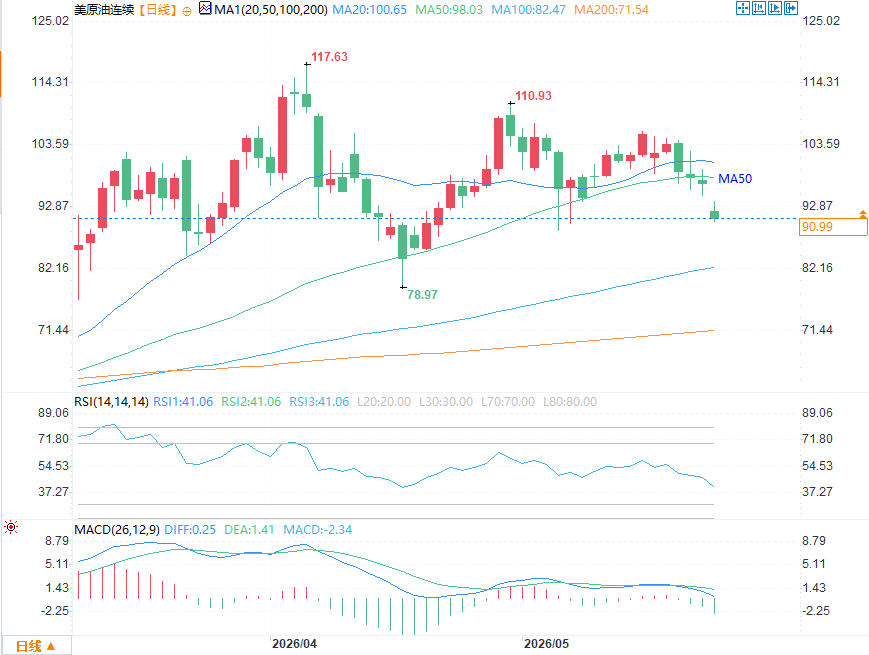
(WTI crude oil daily chart source: FX678)
Amidst ongoing US-Iran negotiations, the international crude oil market has become a crucial indicator for investors and global economic observers. Recently, oil prices have fallen below the 50-day moving average (MA50), forming a significant price gap—a technical pattern that warrants close market attention.
The 50-day moving average (MA50) is a key technical indicator reflecting medium-term trends. It not only represents the average holding cost over the past 50 trading days but also often acts as dynamic support or resistance. Given the ongoing geopolitical uncertainties, a drop in oil prices below the MA50 could indicate two main scenarios: a downward trend breakout or a directional choice. After a prolonged period of consolidation within a triangle pattern, oil prices may break downwards. This move could reflect a cautious assessment of the prospects for US-Iran negotiations, as well as a comprehensive judgment of relatively ample global oil supply and slowing demand growth.
If oil prices can effectively stabilize below the 50-day moving average (MA50), they may further test the next support level in the short term, and volatility will remain at a high level.
Many technical analysts believe that the current gap has a high probability of being filled. If there are positive signs of easing tensions in US-Iran negotiations, OPEC+ oil-producing countries show flexibility in increasing production, or other positive macroeconomic factors take effect, oil prices are expected to rebound and retest the MA50, forming a corrective rally after a "false breakout." Several institutions, such as CICC and JPMorgan Chase, have pointed out in recent reports that, given the ongoing geopolitical risks, the performance of the MA50 will directly determine the medium-term trading range of oil prices and the direction of market sentiment.
The current oil price environment is also influenced by a wider range of factors, including the pace of global economic recovery, the exchange rate of the US dollar, and the policy dynamics of major oil-producing countries. Investors are paying close attention to the progress of US-Iran diplomatic relations while simultaneously tracking the weekly US crude oil inventory report, EIA data, and the latest statements from Middle Eastern oil-producing countries. In the short term, oil prices are likely to remain highly volatile, and traders need to implement strict risk management by combining fundamental and technical analysis to avoid one-sided bets.
Overall, Trump's latest remarks have injected new certainty into the fragile US-Iran negotiations, while technical signals in oil prices have provided a real-time "thermometer" for global markets. Within a rational framework where neither side intends to escalate into extreme confrontation, the intensive diplomatic interactions in the coming weeks and months are still expected to bring significant changes.
Nuclear negotiations between Iran and the United States have been ongoing for several rounds, remaining in a delicate stalemate where a breakthrough is difficult to achieve. Neither side is willing to make crucial concessions on core issues, particularly regarding the disposal of Iran's highly enriched uranium stockpile, verification mechanisms, and the handling of facility residues—these have become the biggest points of contention. On the one hand, Iran insists on maintaining its sovereign rights to its nuclear program and its peaceful use of energy; on the other hand, the United States and its allies demand strict, transparent, and verifiable international supervision to completely eliminate the risk of nuclear proliferation. Trump's remarks can be interpreted as either an optimistic expectation that negotiations will ultimately reach a comprehensive, high-quality, and long-term agreement, or as a reflection of the limited substantive progress made, indicating a significant gap between the two sides' positions.
Despite significant differences, neither side currently possesses a strong incentive to escalate the conflict into a full-blown direct military confrontation. The US strategic community and policymakers generally recognize that Iran, as a formidable adversary in the Middle East with powerful asymmetric warfare capabilities, a missile network, and a network of regional proxies, poses a significant threat; any large-scale conflict could incur unbearable costs, including drastic fluctuations in oil prices, disruptions to global energy supply chains, spillover geopolitical risks, and potential human and economic losses. Iran, too, faces severe economic pressures and domestic challenges and is unwilling to bear the consequences of a full-scale war. Therefore, under the current circumstances, a "struggle without breaking" approach and continued diplomatic maneuvering remain the prevailing expectation on both sides. Recent reports indicate that the two sides have made marginal progress on some framework issues, such as arrangements related to the Strait of Hormuz, but the core nuclear issue still requires further consultation.
Technical Analysis: Directional Choice After Breaking Below the 50-Day Moving Average
(WTI crude oil daily chart source: FX678)
Amidst ongoing US-Iran negotiations, the international crude oil market has become a crucial indicator for investors and global economic observers. Recently, oil prices have fallen below the 50-day moving average (MA50), forming a significant price gap—a technical pattern that warrants close market attention.
The 50-day moving average (MA50) is a key technical indicator reflecting medium-term trends. It not only represents the average holding cost over the past 50 trading days but also often acts as dynamic support or resistance. Given the ongoing geopolitical uncertainties, a drop in oil prices below the MA50 could indicate two main scenarios: a downward trend breakout or a directional choice. After a prolonged period of consolidation within a triangle pattern, oil prices may break downwards. This move could reflect a cautious assessment of the prospects for US-Iran negotiations, as well as a comprehensive judgment of relatively ample global oil supply and slowing demand growth.
If oil prices can effectively stabilize below the 50-day moving average (MA50), they may further test the next support level in the short term, and volatility will remain at a high level.
Many technical analysts believe that the current gap has a high probability of being filled. If there are positive signs of easing tensions in US-Iran negotiations, OPEC+ oil-producing countries show flexibility in increasing production, or other positive macroeconomic factors take effect, oil prices are expected to rebound and retest the MA50, forming a corrective rally after a "false breakout." Several institutions, such as CICC and JPMorgan Chase, have pointed out in recent reports that, given the ongoing geopolitical risks, the performance of the MA50 will directly determine the medium-term trading range of oil prices and the direction of market sentiment.
The current oil price environment is also influenced by a wider range of factors, including the pace of global economic recovery, the exchange rate of the US dollar, and the policy dynamics of major oil-producing countries. Investors are paying close attention to the progress of US-Iran diplomatic relations while simultaneously tracking the weekly US crude oil inventory report, EIA data, and the latest statements from Middle Eastern oil-producing countries. In the short term, oil prices are likely to remain highly volatile, and traders need to implement strict risk management by combining fundamental and technical analysis to avoid one-sided bets.
Overall, Trump's latest remarks have injected new certainty into the fragile US-Iran negotiations, while technical signals in oil prices have provided a real-time "thermometer" for global markets. Within a rational framework where neither side intends to escalate into extreme confrontation, the intensive diplomatic interactions in the coming weeks and months are still expected to bring significant changes.
- Risk Warning and Disclaimer
- The market involves risk, and trading may not be suitable for all investors. This article is for reference only and does not constitute personal investment advice, nor does it take into account certain users’ specific investment objectives, financial situation, or other needs. Any investment decisions made based on this information are at your own risk.