Japanese bond yields have quietly fallen back to 2.7%, so why hasn't the yen rebounded yet?
2026-05-25 20:00:29
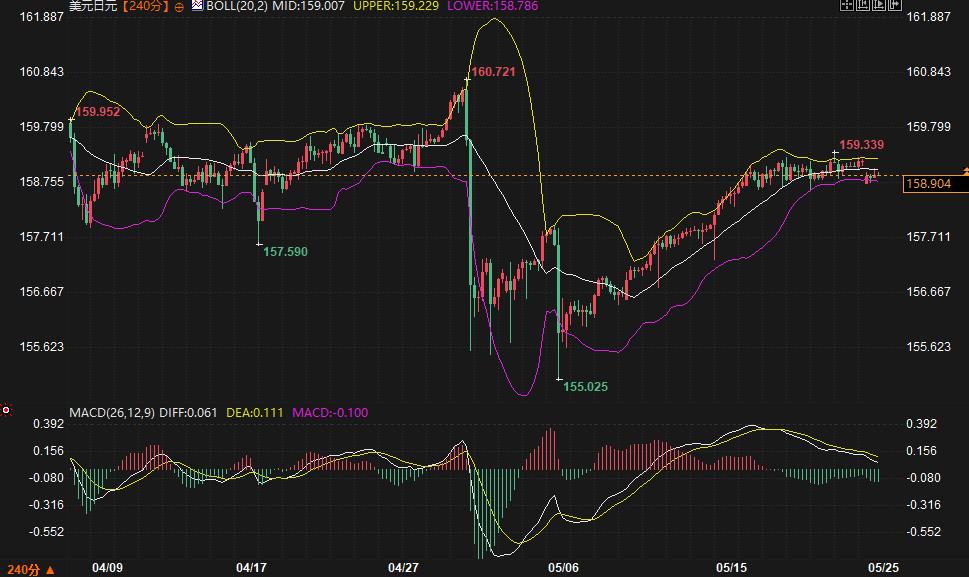
On Monday (May 25), the USD/JPY 4-hour chart showed the latest price around 158.904, a slight intraday decline of 0.16%, hovering near the lower edge of the recent high-level consolidation. In early May, the price touched a high of 160.721 before quickly falling to a low of 155.025, followed by a period of consolidation and rebound, with a recent high of 159.339. Today, market focus is on the impact of Japan's additional budget measures on the government bond market, and the transmission of potential currency intervention to the yen exchange rate.

The Japanese government announced an additional budget of approximately 3 trillion yen (about US$19 billion) to subsidize fuel costs and alleviate pressure on the cost of living, while pledging that overall bond issuance will not increase and will be offset by new tax revenue and surplus funds. This statement aims to ease market concerns about fiscal expansion, but the actual impact of its implementation on long-term interest rates remains to be seen.
Japan's additional budget measures directly impact the supply and demand dynamics of government bonds. Prime Minister Sanae Takaichi stated that the additional spending will be covered by deficit-financed bonds, but the overall bond issuance will remain unchanged. She anticipates that additional tax revenue, non-tax revenue, and savings will offset approximately 3 trillion yen of the originally planned issuance demand. The prevailing market view is that this commitment indicates the authorities are considering the concerns of the bond market, but fiscal risks remain, including potential adjustments to the food consumption tax and rising debt servicing costs.
The yield on the benchmark 10-year Japanese government bond fell to around 2.70% in early trading today, retreating from its previous high, and remained within a narrow range throughout the session. Higher long-term yields have pushed up debt interest payments, and debt servicing costs in the fiscal year 2026 general accounting budget have already increased more than expected. If yields remain high, it will further exacerbate fiscal pressure and impact yen funding costs.
Japanese bond yields are closely correlated with the USD/JPY exchange rate. A high-yield environment typically supports a return of yen to Japan, but expectations of fiscal expansion could weaken this support. Recent fluctuations in energy prices related to the Middle East situation and import cost pressures also constitute additional variables for the yen. Authorities have previously taken action when the USD/JPY exchange rate approached or broke through the psychological level of 160, and the market continues to monitor potential intervention thresholds.
Technical Analysis: On the 4-hour chart, the Bollinger Bands (20,2) have an upper band at 159.229, a middle band at 159.007, and a lower band at 158.786. The price briefly broke below the middle band and is currently trading between the middle and lower bands. The Bollinger Bands are narrowing and flattening, indicating a decrease in short-term volatility and a potential directional decision point. The upper and middle bands form short-term resistance, while the lower band provides initial support.
The MACD indicator shows that the DIFF line has crossed below the DEA line, forming a death cross, and the MACD histogram continues to expand, indicating that short-term bearish momentum is dominant. However, the DIFF line is still above the zero line, suggesting that the medium- to long-term rebound structure has not yet been fully reversed. In terms of candlestick patterns, after rebounding to 159.339, several doji and small bearish candlesticks appeared, indicating significant resistance at high levels and a potential short-term pullback.
Support and resistance range prediction:
- Reference Contracts: Primarily USD/JPY continuous contracts, combined with a 4-hour timeframe.
- Range Logic: Currently consolidating at high levels after a rebound, with the Bollinger Band middle line around 159.0 acting as a key watershed. Initial support is at 158.786 (lower Bollinger Band). A decisive break below this level could lead to further testing of the 158.0-158.3 area, which corresponds to the 38.2% retracement level of the previous rebound. Resistance is at 159.229 (upper Bollinger Band) and the recent high of 159.339. A return and hold above 159.0 could lead to a retest of the previous high resistance.
- Key points to watch during the session: Observe whether the 10-year Treasury yield remains below 2.70%. A rebound in the yield would provide additional support for the yen. Also, monitor the correlation between the US dollar index and US Treasury yields; a decline in US Treasury yields could alleviate downward pressure on the yen. Any breakout above the 158.70 area needs to be validated by trading volume and fundamental news.
Overall, fundamentals are being transmitted to the exchange rate through the Japanese government bond yield curve, while technical factors provide short-term trading range boundaries. Combined, these factors suggest that the market is currently in a cautious equilibrium, and its direction will depend on the details of fiscal policy implementation and changes in the external interest rate environment.
In the short term, the USD/JPY pair is expected to maintain a high-level consolidation pattern, with attention focused on the core range of 158.0-159.3. If Japanese government bond yields stabilize and decline, and there are no clear signals of new fiscal expansion, the yen may find some support. Conversely, if yields rise again or expectations of intervention cool, the exchange rate may face upward pressure. In the medium term, it remains necessary to monitor the coordination between Japanese monetary and fiscal policies, as well as the impact of changes in global risk appetite on the yen's safe-haven status. All analysis is based on currently available information and charts and is for reference only, not constituting any trading advice.
Will additional budget measures significantly push up Japanese bond yields, thus benefiting the yen?
The additional budget, financed through adjustments to existing issuance plans, has temporarily eased market concerns about new supply, pushing the 10-year yield down to around 2.70% today. However, if subsequent debt servicing costs increase more than expected due to higher yields, concerns about fiscal sustainability could again weigh on the yen. The market needs to observe the actual implementation of the issuance.
What does the narrowing and flattening of the Bollinger Bands indicate about the short-term trend of the USD/JPY exchange rate?
The narrowing of the Bollinger Bands indicates decreasing volatility, and the price being between the middle and lower bands suggests a short-term consolidation phase. A break above the upper band at 159.229 may restart a rebound, while a break below the lower band at 158.786 would open up further downside potential. A comprehensive assessment of momentum changes requires consideration of the MACD death cross signal.
What would be the effect of potential exchange rate intervention at the current price level?
Historical data shows that authorities tend to take action when the USD/JPY exchange rate approaches or exceeds 160. Currently, the area around 158.90 is in a sensitive zone for intervention expectations; any clear intervention signal could trigger rapid short-term fluctuations, but sustainability still depends on supporting fundamentals.
Does a MACD death cross mean the end of the rebound trend?
The 4-hour MACD death cross indicates strengthening short-term bearish momentum and weakening rebound momentum, but the indicator is still above the zero line, suggesting that the medium-to-long-term structure has not completely reversed. A trend reversal can only be determined by waiting for the price to decisively break below key support or for a second confirmation from the indicator.
With Japanese bond yields moving in tandem with the USD/JPY exchange rate, which variables should investors focus on monitoring?
The key monitoring areas include changes in 10-year and ultra-long-term JGB yields, the US-Japan 10-year yield spread, and statements from Japanese authorities regarding bond issuance and fiscal sustainability. These variables collectively influence yen funding costs and exchange rate expectations.
The Japanese government announced an additional budget of approximately 3 trillion yen (about US$19 billion) to subsidize fuel costs and alleviate pressure on the cost of living, while pledging that overall bond issuance will not increase and will be offset by new tax revenue and surplus funds. This statement aims to ease market concerns about fiscal expansion, but the actual impact of its implementation on long-term interest rates remains to be seen.
Analysis combining fundamental and technical factors
Japan's additional budget measures directly impact the supply and demand dynamics of government bonds. Prime Minister Sanae Takaichi stated that the additional spending will be covered by deficit-financed bonds, but the overall bond issuance will remain unchanged. She anticipates that additional tax revenue, non-tax revenue, and savings will offset approximately 3 trillion yen of the originally planned issuance demand. The prevailing market view is that this commitment indicates the authorities are considering the concerns of the bond market, but fiscal risks remain, including potential adjustments to the food consumption tax and rising debt servicing costs.
The yield on the benchmark 10-year Japanese government bond fell to around 2.70% in early trading today, retreating from its previous high, and remained within a narrow range throughout the session. Higher long-term yields have pushed up debt interest payments, and debt servicing costs in the fiscal year 2026 general accounting budget have already increased more than expected. If yields remain high, it will further exacerbate fiscal pressure and impact yen funding costs.
Japanese bond yields are closely correlated with the USD/JPY exchange rate. A high-yield environment typically supports a return of yen to Japan, but expectations of fiscal expansion could weaken this support. Recent fluctuations in energy prices related to the Middle East situation and import cost pressures also constitute additional variables for the yen. Authorities have previously taken action when the USD/JPY exchange rate approached or broke through the psychological level of 160, and the market continues to monitor potential intervention thresholds.
Technical Analysis: On the 4-hour chart, the Bollinger Bands (20,2) have an upper band at 159.229, a middle band at 159.007, and a lower band at 158.786. The price briefly broke below the middle band and is currently trading between the middle and lower bands. The Bollinger Bands are narrowing and flattening, indicating a decrease in short-term volatility and a potential directional decision point. The upper and middle bands form short-term resistance, while the lower band provides initial support.
The MACD indicator shows that the DIFF line has crossed below the DEA line, forming a death cross, and the MACD histogram continues to expand, indicating that short-term bearish momentum is dominant. However, the DIFF line is still above the zero line, suggesting that the medium- to long-term rebound structure has not yet been fully reversed. In terms of candlestick patterns, after rebounding to 159.339, several doji and small bearish candlesticks appeared, indicating significant resistance at high levels and a potential short-term pullback.
Support and resistance range prediction:
- Reference Contracts: Primarily USD/JPY continuous contracts, combined with a 4-hour timeframe.
- Range Logic: Currently consolidating at high levels after a rebound, with the Bollinger Band middle line around 159.0 acting as a key watershed. Initial support is at 158.786 (lower Bollinger Band). A decisive break below this level could lead to further testing of the 158.0-158.3 area, which corresponds to the 38.2% retracement level of the previous rebound. Resistance is at 159.229 (upper Bollinger Band) and the recent high of 159.339. A return and hold above 159.0 could lead to a retest of the previous high resistance.
- Key points to watch during the session: Observe whether the 10-year Treasury yield remains below 2.70%. A rebound in the yield would provide additional support for the yen. Also, monitor the correlation between the US dollar index and US Treasury yields; a decline in US Treasury yields could alleviate downward pressure on the yen. Any breakout above the 158.70 area needs to be validated by trading volume and fundamental news.
Overall, fundamentals are being transmitted to the exchange rate through the Japanese government bond yield curve, while technical factors provide short-term trading range boundaries. Combined, these factors suggest that the market is currently in a cautious equilibrium, and its direction will depend on the details of fiscal policy implementation and changes in the external interest rate environment.
Future Trend Outlook
In the short term, the USD/JPY pair is expected to maintain a high-level consolidation pattern, with attention focused on the core range of 158.0-159.3. If Japanese government bond yields stabilize and decline, and there are no clear signals of new fiscal expansion, the yen may find some support. Conversely, if yields rise again or expectations of intervention cool, the exchange rate may face upward pressure. In the medium term, it remains necessary to monitor the coordination between Japanese monetary and fiscal policies, as well as the impact of changes in global risk appetite on the yen's safe-haven status. All analysis is based on currently available information and charts and is for reference only, not constituting any trading advice.
Frequently Asked Questions
Will additional budget measures significantly push up Japanese bond yields, thus benefiting the yen?
The additional budget, financed through adjustments to existing issuance plans, has temporarily eased market concerns about new supply, pushing the 10-year yield down to around 2.70% today. However, if subsequent debt servicing costs increase more than expected due to higher yields, concerns about fiscal sustainability could again weigh on the yen. The market needs to observe the actual implementation of the issuance.
What does the narrowing and flattening of the Bollinger Bands indicate about the short-term trend of the USD/JPY exchange rate?
The narrowing of the Bollinger Bands indicates decreasing volatility, and the price being between the middle and lower bands suggests a short-term consolidation phase. A break above the upper band at 159.229 may restart a rebound, while a break below the lower band at 158.786 would open up further downside potential. A comprehensive assessment of momentum changes requires consideration of the MACD death cross signal.
What would be the effect of potential exchange rate intervention at the current price level?
Historical data shows that authorities tend to take action when the USD/JPY exchange rate approaches or exceeds 160. Currently, the area around 158.90 is in a sensitive zone for intervention expectations; any clear intervention signal could trigger rapid short-term fluctuations, but sustainability still depends on supporting fundamentals.
Does a MACD death cross mean the end of the rebound trend?
The 4-hour MACD death cross indicates strengthening short-term bearish momentum and weakening rebound momentum, but the indicator is still above the zero line, suggesting that the medium-to-long-term structure has not completely reversed. A trend reversal can only be determined by waiting for the price to decisively break below key support or for a second confirmation from the indicator.
With Japanese bond yields moving in tandem with the USD/JPY exchange rate, which variables should investors focus on monitoring?
The key monitoring areas include changes in 10-year and ultra-long-term JGB yields, the US-Japan 10-year yield spread, and statements from Japanese authorities regarding bond issuance and fiscal sustainability. These variables collectively influence yen funding costs and exchange rate expectations.
- Risk Warning and Disclaimer
- The market involves risk, and trading may not be suitable for all investors. This article is for reference only and does not constitute personal investment advice, nor does it take into account certain users’ specific investment objectives, financial situation, or other needs. Any investment decisions made based on this information are at your own risk.