Risk premiums have been given back significantly! Oil prices have fallen below $100, but is the worst really over?
2026-05-25 21:26:29
On Monday, May 25th, the core variable in the crude oil market shifted from a supply gap to a reduction in geopolitical risk premiums. Brent crude oil fell to around $97 per barrel at one point during the session, a daily drop of nearly 6%, while West Texas Intermediate crude oil also fell back to around $91 per barrel. This sharp price drop does not necessarily mean that supply and demand pressures have disappeared, but rather that the market is beginning to reassess the probability of the Strait of Hormuz potentially reopening and Iran and the US continuing contact on a framework for ending the conflict. Market reports indicate that senior Iranian negotiators and the Foreign Minister traveled to Doha to discuss potential arrangements, with topics including the Strait of Hormuz, highly enriched uranium, and the release of frozen funds.

This round of oil price declines is more like a compression of previous high-risk pricing rather than a sudden easing of fundamentals. After Brent crude fell below $100 per barrel, the market first priced in the tail premium resulting from the long-term blockage in the Straits. The problem is that the potential framework is still far from a final agreement, and maritime security, nuclear-related issues, funding arrangements, and the actual implementation sequence could all affect the pace of resumption of shipping. In other words, the decline in oil prices from their highs is a reaction to a decrease in the probability of a worst-case scenario, not a confirmation of a full supply recovery.
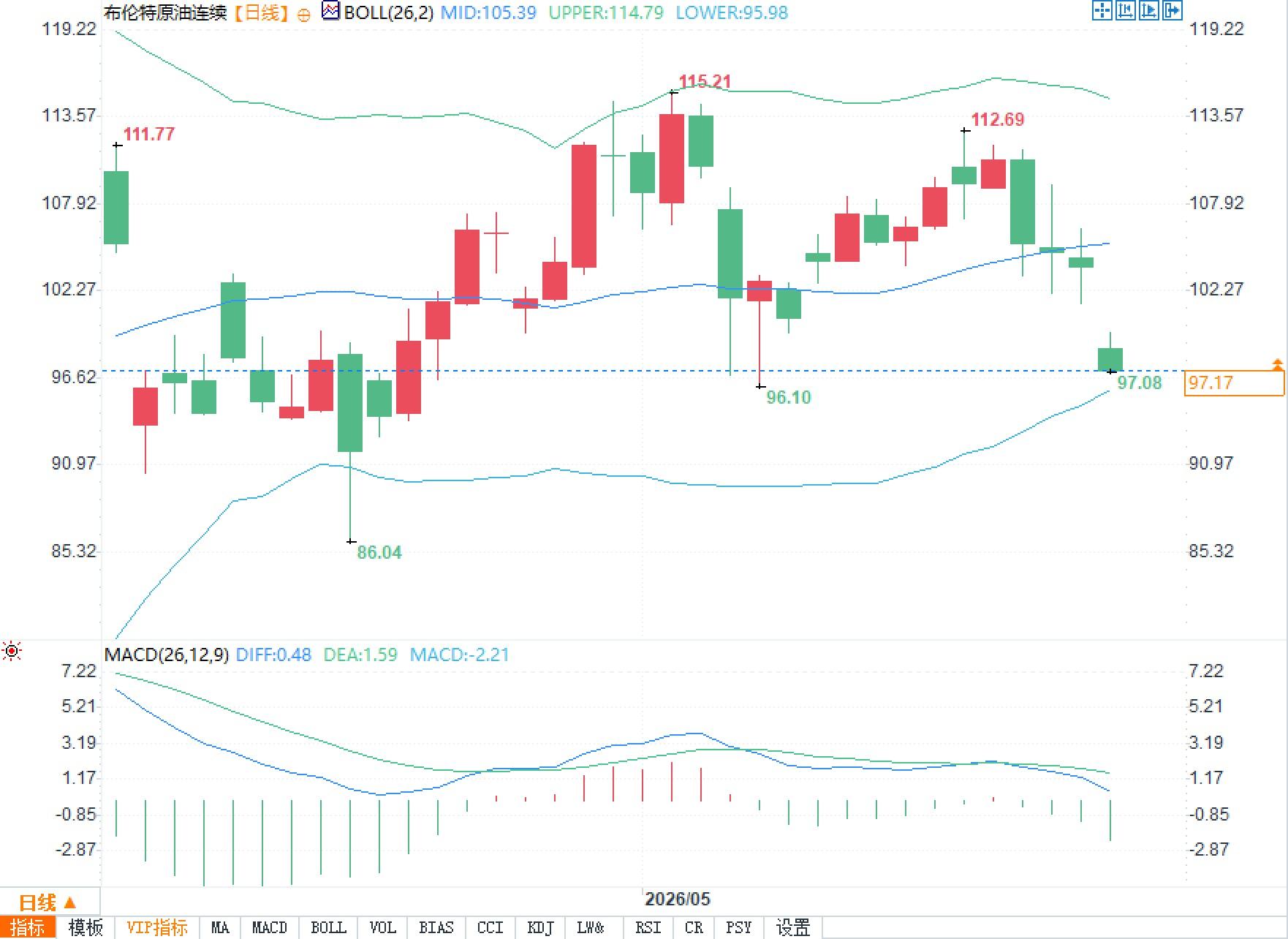
From the daily chart, Brent crude oil prices have approached the lower Bollinger Band at $95.98 per barrel, the middle band at $105.39 per barrel, and the upper band at $114.79 per barrel. The MACD remains in a weak zone. The technical indicators reflect the release of momentum following news-driven price movements; however, the true determinants of future valuation levels will be spot market flows, inventory depletion, and the verification of cross-strait trading.
The Strait of Hormuz is not an ordinary shipping route. In 2025, approximately 20 million barrels of crude oil and refined petroleum products will be transported through this strait daily, accounting for about 25% of seaborne oil trade. Alternative pipeline capacity is estimated at only 3.5 million to 5.5 million barrels per day, meaning that even if partial bypasses are feasible, they cannot fully replace the strait's function. As long as traffic remains unstable, spot premiums, freight rates, insurance costs, and refinery procurement cycles will continue to carry risk discounts.
The recent resumption of passage for some oil tankers and LNG carriers through the strait has provided a cooling signal to the market, but traders are more focused on continuity than the number of vessels passing through each day. If subsequent passage transitions from a tentative resumption to a regular occurrence, the risk premium for near-term contracts will continue to be compressed. If negotiations stall on key terms, the market will re-induce "transportation uncertainty" into near-month contracts and refined product crack spreads.
High oil prices have spurred a rebound in upstream activity in North America. Baker Hughes data shows that as of the week ending May 22, the number of active oil rigs rose to 425, an increase of 10 from the previous week, a rare weekly increase recently. Well completion activity is also picking up, with the number of fracturing rigs increasing to 189 during the same period, a weekly increase of 5. The increase in rigs and well completions indicates that producers are responding to prices, but there is still a time lag between drilling and achieving stable production.
Inventory levels, however, indicate that the spot market is not loose. In the week ending May 15, total U.S. crude oil inventories fell sharply by 17.8 million barrels, with commercial inventories decreasing by 7.86 million barrels and strategic inventories decreasing by approximately 9.9 million barrels. Crude oil exports briefly approached 5.6 million barrels per day, reflecting that demand for alternative supplies is still absorbing inventory, rather than being entirely covered by new production.
Previously, high oil prices fueled energy inflation expectations and influenced the pricing of the Federal Reserve's policy path. The rapid decline in oil prices weakens the logic that "high energy prices suppress expectations of easing," but this does not automatically relieve interest rate pressures. Central banks are more concerned with whether the decline in oil prices can be sustained in fuel, freight, food, and business costs, rather than the magnitude of the single-day drop itself.
Therefore, the key to crude oil prices right now is not whether it's $97 or $100, but whether the market confirms three things: the continued recovery of Straits trade, a slowdown in inventory declines, and that increased upstream production can fill the supply gap. Without any one of these three, Brent crude will find it difficult to fully return to its pre-conflict low volatility range. The price fluctuations in this phase are essentially a tug-of-war between a reassessment of risk premiums and the reality of tight spot supply.
Question 1: Does the drop in oil prices below $100 per barrel mean the end of the supply crisis?
A: That's not the correct interpretation. The current decline mainly stems from expectations that the Strait of Hormuz may reopen to traffic, representing a risk premium correction. As long as safe passage, agreement implementation, and inventory replenishment remain unconfirmed, supply risks will continue to be embedded in the price spreads between near and far months and freight rates.
Question 2: Will the increase in North American drilling rigs quickly depress oil prices?
A: The increase in drilling rigs indicates that the production side is responding to high prices, but the increased output requires drilling, completion, pipeline transportation, and sales cycles. Short-term spot tightness is more determined by inventory and transportation, while drilling rig data has a greater impact on medium-term supply expectations.
Question 3: What is the most important point to watch for in the future oil price?
A: The key factors to watch are the number of consecutive days of passage through the strait, changes in commercial inventory, export strength, and the implementation of negotiated terms. If shipping resumes and the decline in inventory narrows, the risk premium will continue to decrease. If negotiations are protracted or passage is interrupted, oil prices may be repriced for tail risks.
The retracement of risk premiums does not mean that supply risks have been eliminated.
This round of oil price declines is more like a compression of previous high-risk pricing rather than a sudden easing of fundamentals. After Brent crude fell below $100 per barrel, the market first priced in the tail premium resulting from the long-term blockage in the Straits. The problem is that the potential framework is still far from a final agreement, and maritime security, nuclear-related issues, funding arrangements, and the actual implementation sequence could all affect the pace of resumption of shipping. In other words, the decline in oil prices from their highs is a reaction to a decrease in the probability of a worst-case scenario, not a confirmation of a full supply recovery.
From the daily chart, Brent crude oil prices have approached the lower Bollinger Band at $95.98 per barrel, the middle band at $105.39 per barrel, and the upper band at $114.79 per barrel. The MACD remains in a weak zone. The technical indicators reflect the release of momentum following news-driven price movements; however, the true determinants of future valuation levels will be spot market flows, inventory depletion, and the verification of cross-strait trading.
The Strait of Hormuz remains the anchor for oil price pricing.
The Strait of Hormuz is not an ordinary shipping route. In 2025, approximately 20 million barrels of crude oil and refined petroleum products will be transported through this strait daily, accounting for about 25% of seaborne oil trade. Alternative pipeline capacity is estimated at only 3.5 million to 5.5 million barrels per day, meaning that even if partial bypasses are feasible, they cannot fully replace the strait's function. As long as traffic remains unstable, spot premiums, freight rates, insurance costs, and refinery procurement cycles will continue to carry risk discounts.
The recent resumption of passage for some oil tankers and LNG carriers through the strait has provided a cooling signal to the market, but traders are more focused on continuity than the number of vessels passing through each day. If subsequent passage transitions from a tentative resumption to a regular occurrence, the risk premium for near-term contracts will continue to be compressed. If negotiations stall on key terms, the market will re-induce "transportation uncertainty" into near-month contracts and refined product crack spreads.
There are signals of supply response in North America, but not an immediate increase.
High oil prices have spurred a rebound in upstream activity in North America. Baker Hughes data shows that as of the week ending May 22, the number of active oil rigs rose to 425, an increase of 10 from the previous week, a rare weekly increase recently. Well completion activity is also picking up, with the number of fracturing rigs increasing to 189 during the same period, a weekly increase of 5. The increase in rigs and well completions indicates that producers are responding to prices, but there is still a time lag between drilling and achieving stable production.
Inventory levels, however, indicate that the spot market is not loose. In the week ending May 15, total U.S. crude oil inventories fell sharply by 17.8 million barrels, with commercial inventories decreasing by 7.86 million barrels and strategic inventories decreasing by approximately 9.9 million barrels. Crude oil exports briefly approached 5.6 million barrels per day, reflecting that demand for alternative supplies is still absorbing inventory, rather than being entirely covered by new production.
At the macro level, oil prices affect the yield curve rather than a single commodity.
Previously, high oil prices fueled energy inflation expectations and influenced the pricing of the Federal Reserve's policy path. The rapid decline in oil prices weakens the logic that "high energy prices suppress expectations of easing," but this does not automatically relieve interest rate pressures. Central banks are more concerned with whether the decline in oil prices can be sustained in fuel, freight, food, and business costs, rather than the magnitude of the single-day drop itself.
Therefore, the key to crude oil prices right now is not whether it's $97 or $100, but whether the market confirms three things: the continued recovery of Straits trade, a slowdown in inventory declines, and that increased upstream production can fill the supply gap. Without any one of these three, Brent crude will find it difficult to fully return to its pre-conflict low volatility range. The price fluctuations in this phase are essentially a tug-of-war between a reassessment of risk premiums and the reality of tight spot supply.
Frequently Asked Questions
Question 1: Does the drop in oil prices below $100 per barrel mean the end of the supply crisis?
A: That's not the correct interpretation. The current decline mainly stems from expectations that the Strait of Hormuz may reopen to traffic, representing a risk premium correction. As long as safe passage, agreement implementation, and inventory replenishment remain unconfirmed, supply risks will continue to be embedded in the price spreads between near and far months and freight rates.
Question 2: Will the increase in North American drilling rigs quickly depress oil prices?
A: The increase in drilling rigs indicates that the production side is responding to high prices, but the increased output requires drilling, completion, pipeline transportation, and sales cycles. Short-term spot tightness is more determined by inventory and transportation, while drilling rig data has a greater impact on medium-term supply expectations.
Question 3: What is the most important point to watch for in the future oil price?
A: The key factors to watch are the number of consecutive days of passage through the strait, changes in commercial inventory, export strength, and the implementation of negotiated terms. If shipping resumes and the decline in inventory narrows, the risk premium will continue to decrease. If negotiations are protracted or passage is interrupted, oil prices may be repriced for tail risks.
- Risk Warning and Disclaimer
- The market involves risk, and trading may not be suitable for all investors. This article is for reference only and does not constitute personal investment advice, nor does it take into account certain users’ specific investment objectives, financial situation, or other needs. Any investment decisions made based on this information are at your own risk.