Preliminary details of the US-Iran peace talks revealed, weakening the US dollar index.
2026-05-25 21:35:21
On Monday (May 25), during the Asian and European sessions, the US dollar index opened lower and then fell, dropping as much as 0.38% to a one-week low, directly pricing in the progress of US-Iran negotiations.
Trump revealed on social media that he has pushed the UAE, Qatar, Pakistan, Egypt, Jordan and other countries to sign the agreement, and plans to subsequently admit Iran into this "Agreement on Normalization of Relations between Israel and Arab Countries" in order to break the deadlock in negotiations and reshape the geopolitical landscape of the Middle East.
Since the weekend, the signals from the US have been contradictory but generally conciliatory: Trump first claimed that the war-ending agreement was "largely negotiated," confirmed on Saturday that the memorandum was "basically agreed," but on Sunday he emphasized that the blockade of Iranian ports would be "fully effective" until the agreement is formally signed.
With the preliminary agreement between the US and Iran on the Strait of Hormuz emerging, the two sides have reached a memorandum of understanding agreeing to extend the current ceasefire for 60 days. During this period, the Strait of Hormuz will be unblocked, and Iran will be free to sell oil (i.e., the maritime blockade will be lifted). At the same time, negotiations will begin on measures to limit Iran's nuclear program.
A senior White House official made it clear that the U.S. has not committed to immediately unfreezing Iranian assets or lifting sanctions, which is the core premise for Iran's insistence on keeping the agreement intact. The main differences between the two sides currently lie in the handling of about 400 kilograms of enriched uranium: the U.S. demands a 20-year suspension of uranium enrichment activities, while Iran advocates for a shorter period and insists that uranium enrichment must be carried out within its own territory and subject to regional rather than international supervision.
The draft agreement clearly defines two core points: first, to end the war between Israel and Hezbollah; and second, to commit to not interfering in the internal affairs of regional countries (directly referring to Iran's support for proxies such as the Houthis in Yemen, Hamas in Gaza, and Shiite militias in Iraq).
The US and Iran still have differences on this issue: the US insists that Israel can deal with threats in Lebanon on its own, while Iran explicitly opposes this, and a compromise was finally reached that "guarantees Israel's right to self-defense and allows action only against immediate threats".
The Strait of Hormuz resumes navigation, and sanctions and blockades are lifted simultaneously.
The proposed terms stipulate that the Strait will be "gradually opened in sync" with the lifting of the blockade on Iranian ports implemented by the United States on April 17. The blockade had previously caused Iran's oil exports to stagnate and its foreign exchange earnings to dry up, and its long-term sluggish economy was in dire need of cash flow.
The US plans to allow Iran to resume crude oil exports through "sanctions waivers," while details such as the complete lifting of sanctions and the unfreezing of hundreds of billions of dollars in frozen overseas funds will be further negotiated during the "60-day negotiation window," which has become an important economic incentive for Iran to compromise.
Iran's denuclearization is a prerequisite for lifting sanctions.
The Iranian nuclear issue is the root of geopolitical tensions, and the US and Israel have planned military strikes to destroy Iran's stockpile of highly enriched uranium.
According to the draft agreement, Iran must give up all of its stockpile of 60% enriched uranium (data from the International Atomic Energy Agency shows that Iran currently holds 440.9 kilograms of this level of uranium, just one step away from the 90% weapons-grade standard).
The specific disposal plan will be finalized within 60 days: some of the uranium will be diluted and processed, and the remainder will be transferred to Russia (Russia has clearly stated its willingness to accept it).
The US has made it clear that "denuclearization is the only prerequisite for lifting sanctions," and if Iran fails to comply, all economic waivers will be revoked.
Iran maintains that its nuclear program is for peaceful purposes, and President Pezzichyan publicly pledged on Sunday that he would "never seek nuclear weapons." Trump also drew a "nuclear ban red line," and the two sides reached a preliminary consensus on the nuclear issue.
Although the core framework has been reached, several sensitive issues remain unaddressed, posing potential uncertainties:
The future scale of Iran's uranium enrichment capacity remains unclear; the only agreement is to abandon its existing stockpile of highly enriched uranium.
Iran’s missile program, which Israel has strongly opposed, was not mentioned; Israel has repeatedly demanded that the program be destroyed.
The US-Israel demand for regime change in Iran, which was advocated at the beginning of the war, was completely shelved, and no discussion was made with the Tehran leadership.
Iran's core demands have been dashed: the withdrawal of US troops from the Middle East and war reparations were not included in the negotiations.
Trump's positive statements reinforced market expectations of a de-escalation in the Middle East, and the geopolitical risk premium continued to recede.
Brent crude oil fell 5.8% on Monday and continues its downward trend, reflecting investors' optimism about the reopening of the Strait of Hormuz and the recovery of crude oil supply.
This change directly impacted the foreign exchange market, putting downward pressure on the US dollar index: on the one hand, geopolitical tensions in the Middle East are an important safe-haven factor supporting the US dollar, and as the situation eases, funds flow out of the US dollar and into risk assets, weakening the dollar's attractiveness.
On the other hand, the sharp drop in oil prices eased global inflationary pressures, cooled market expectations for the Federal Reserve to maintain aggressive interest rate hikes, and weakened the support for the dollar interest rate differential.
However, the downside potential for the dollar in the short term may be limited: US inflation data remains stubborn, Federal Reserve officials maintain a hawkish stance, and monetary policy expectations continue to provide bottom support for the dollar.
The future trend of the US dollar will depend heavily on the pace of the implementation of the US-Iran agreement. If the remaining issues are resolved smoothly within the 60-day negotiation period, the logic of geopolitical easing will continue to suppress the US dollar; if the negotiations encounter new changes, safe-haven demand may be restarted, driving a rebound in the US dollar.
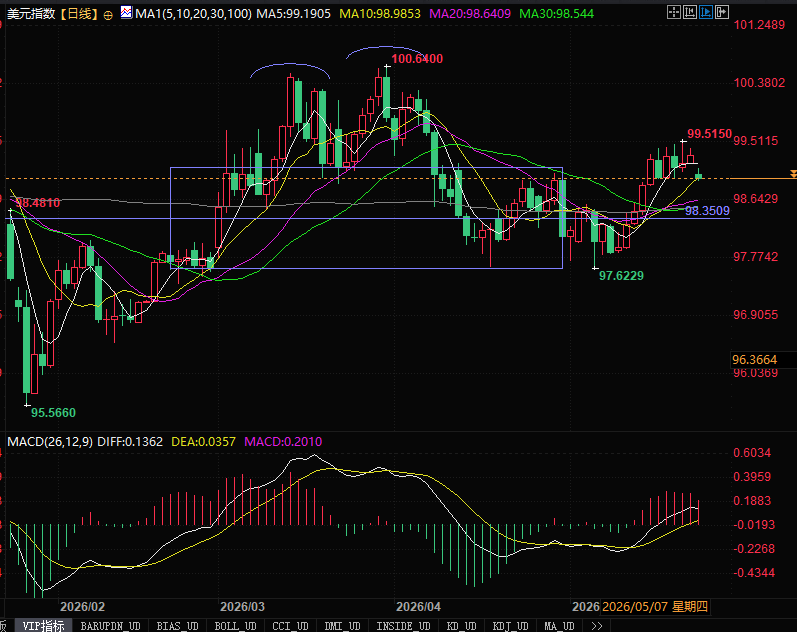
(US Dollar Index Daily Chart, Source: EasyForex)
At 21:33 Beijing time, the US dollar index is currently at 98.97.
Trump revealed on social media that he has pushed the UAE, Qatar, Pakistan, Egypt, Jordan and other countries to sign the agreement, and plans to subsequently admit Iran into this "Agreement on Normalization of Relations between Israel and Arab Countries" in order to break the deadlock in negotiations and reshape the geopolitical landscape of the Middle East.
Since the weekend, the signals from the US have been contradictory but generally conciliatory: Trump first claimed that the war-ending agreement was "largely negotiated," confirmed on Saturday that the memorandum was "basically agreed," but on Sunday he emphasized that the blockade of Iranian ports would be "fully effective" until the agreement is formally signed.
With the preliminary agreement between the US and Iran on the Strait of Hormuz emerging, the two sides have reached a memorandum of understanding agreeing to extend the current ceasefire for 60 days. During this period, the Strait of Hormuz will be unblocked, and Iran will be free to sell oil (i.e., the maritime blockade will be lifted). At the same time, negotiations will begin on measures to limit Iran's nuclear program.
A senior White House official made it clear that the U.S. has not committed to immediately unfreezing Iranian assets or lifting sanctions, which is the core premise for Iran's insistence on keeping the agreement intact. The main differences between the two sides currently lie in the handling of about 400 kilograms of enriched uranium: the U.S. demands a 20-year suspension of uranium enrichment activities, while Iran advocates for a shorter period and insists that uranium enrichment must be carried out within its own territory and subject to regional rather than international supervision.
The core framework of the agreement consists of three key points: the end of the war, resumption of flights, and denuclearization.
The draft agreement clearly defines two core points: first, to end the war between Israel and Hezbollah; and second, to commit to not interfering in the internal affairs of regional countries (directly referring to Iran's support for proxies such as the Houthis in Yemen, Hamas in Gaza, and Shiite militias in Iraq).
The US and Iran still have differences on this issue: the US insists that Israel can deal with threats in Lebanon on its own, while Iran explicitly opposes this, and a compromise was finally reached that "guarantees Israel's right to self-defense and allows action only against immediate threats".
The Strait of Hormuz resumes navigation, and sanctions and blockades are lifted simultaneously.
The proposed terms stipulate that the Strait will be "gradually opened in sync" with the lifting of the blockade on Iranian ports implemented by the United States on April 17. The blockade had previously caused Iran's oil exports to stagnate and its foreign exchange earnings to dry up, and its long-term sluggish economy was in dire need of cash flow.
The US plans to allow Iran to resume crude oil exports through "sanctions waivers," while details such as the complete lifting of sanctions and the unfreezing of hundreds of billions of dollars in frozen overseas funds will be further negotiated during the "60-day negotiation window," which has become an important economic incentive for Iran to compromise.
Iran's denuclearization is a prerequisite for lifting sanctions.
The Iranian nuclear issue is the root of geopolitical tensions, and the US and Israel have planned military strikes to destroy Iran's stockpile of highly enriched uranium.
According to the draft agreement, Iran must give up all of its stockpile of 60% enriched uranium (data from the International Atomic Energy Agency shows that Iran currently holds 440.9 kilograms of this level of uranium, just one step away from the 90% weapons-grade standard).
The specific disposal plan will be finalized within 60 days: some of the uranium will be diluted and processed, and the remainder will be transferred to Russia (Russia has clearly stated its willingness to accept it).
The US has made it clear that "denuclearization is the only prerequisite for lifting sanctions," and if Iran fails to comply, all economic waivers will be revoked.
Iran maintains that its nuclear program is for peaceful purposes, and President Pezzichyan publicly pledged on Sunday that he would "never seek nuclear weapons." Trump also drew a "nuclear ban red line," and the two sides reached a preliminary consensus on the nuclear issue.
The agreement leaves room for interpretation: These key issues remain unresolved.
Although the core framework has been reached, several sensitive issues remain unaddressed, posing potential uncertainties:
The future scale of Iran's uranium enrichment capacity remains unclear; the only agreement is to abandon its existing stockpile of highly enriched uranium.
Iran’s missile program, which Israel has strongly opposed, was not mentioned; Israel has repeatedly demanded that the program be destroyed.
The US-Israel demand for regime change in Iran, which was advocated at the beginning of the war, was completely shelved, and no discussion was made with the Tehran leadership.
Iran's core demands have been dashed: the withdrawal of US troops from the Middle East and war reparations were not included in the negotiations.
Market ripple effects: Oil prices fell, and the US dollar index came under pressure.
Trump's positive statements reinforced market expectations of a de-escalation in the Middle East, and the geopolitical risk premium continued to recede.
Brent crude oil fell 5.8% on Monday and continues its downward trend, reflecting investors' optimism about the reopening of the Strait of Hormuz and the recovery of crude oil supply.
This change directly impacted the foreign exchange market, putting downward pressure on the US dollar index: on the one hand, geopolitical tensions in the Middle East are an important safe-haven factor supporting the US dollar, and as the situation eases, funds flow out of the US dollar and into risk assets, weakening the dollar's attractiveness.
On the other hand, the sharp drop in oil prices eased global inflationary pressures, cooled market expectations for the Federal Reserve to maintain aggressive interest rate hikes, and weakened the support for the dollar interest rate differential.
However, the downside potential for the dollar in the short term may be limited: US inflation data remains stubborn, Federal Reserve officials maintain a hawkish stance, and monetary policy expectations continue to provide bottom support for the dollar.
The future trend of the US dollar will depend heavily on the pace of the implementation of the US-Iran agreement. If the remaining issues are resolved smoothly within the 60-day negotiation period, the logic of geopolitical easing will continue to suppress the US dollar; if the negotiations encounter new changes, safe-haven demand may be restarted, driving a rebound in the US dollar.
(US Dollar Index Daily Chart, Source: EasyForex)
At 21:33 Beijing time, the US dollar index is currently at 98.97.
- Risk Warning and Disclaimer
- The market involves risk, and trading may not be suitable for all investors. This article is for reference only and does not constitute personal investment advice, nor does it take into account certain users’ specific investment objectives, financial situation, or other needs. Any investment decisions made based on this information are at your own risk.